
“Hey David, if I’m trying to eat clean on the run, I just grab the fresh options at GYG. That’s safe, right?”
A friend asked me this recently. It’s a fair question. As far as fast food goes, Guzman y Gomez (GYG) is actually one of the better operators out there. They have built an empire on the promise of fresh, real food, free from artificial flavours and preservatives.
If you are trying to make smart dietary choices, you probably walk up to a counter like that with a rough plan, avoid the obvious junk like sugary sauces, go for decent protein, and stick to whole foods.
But if your goal is avoiding the metabolic rust caused by seed oils, you have to be much more surgical than that.
To find out exactly how to navigate their menu, I wrote some code to scrape and analyze the fat profiles across all 298 items on the GYG menu. I didn’t want to just expose the bad stuff. I wanted to find out if they have options which you can get away with for a meal on the run.
I ran the menu through a strict biochemical filter:
The Purge: Ruthlessly eliminate anything containing Canola Oil, Soybean Oil, or standard Sunflower Oil.
The Exceptions: Give a pass to High Oleic Sunflower Oil (HOSO) (which has a stable monounsaturated profile that mimics olive oil) and Coconut Oil. I also told the script to tentatively allow generic “Vegetable Oil”—but with a major catch.
Generic “vegetable oil” is a notorious industry loophole. It could mean literally anything. To figure out what they are actually pumping into the fryer, you have to look at the nutritional maths. If the overall saturated fat percentage of the food is high, that vague “vegetable oil” is almost certainly palm oil. The fast-food industry usually hides behind the generic label because they don’t want to own up to using non-sustainably sourced palm. From a purely metabolic and biochemical standpoint, palm oil is stable and perfectly fine (much like coconut oil), even if you have concerns about its environmental sustainability.
The 40% Rule: To ensure that generic “vegetable oil” wasn’t just a cheap seed oil blend in disguise, I told set a filter that the total fat profile of the food must be above 40% saturated fat. That suggests the vague label is actually hiding stable palm or coconut fat. If the percentage drops below that, we know the “vegetable oil” is just oxidized seed oil sludge, and it goes in the bin.
Here is what the code revealed, and exactly how you should order.
First, let’s look at what failed.
The most dangerous items on a fast-food menu aren’t usually the obvious junk. The most dangerous items are the ones masquerading as health food.
I programmed the code to hunt for the items where the fat profile was driven purely by cheap, highly volatile polyunsaturated fats (PUFAs) like Canola and Soybean Oil, meaning no stable olive, coconut, or palm oil to soften the blow.
The results were surprising. The worst offenders were the items a health-conscious consumer is most likely to order.
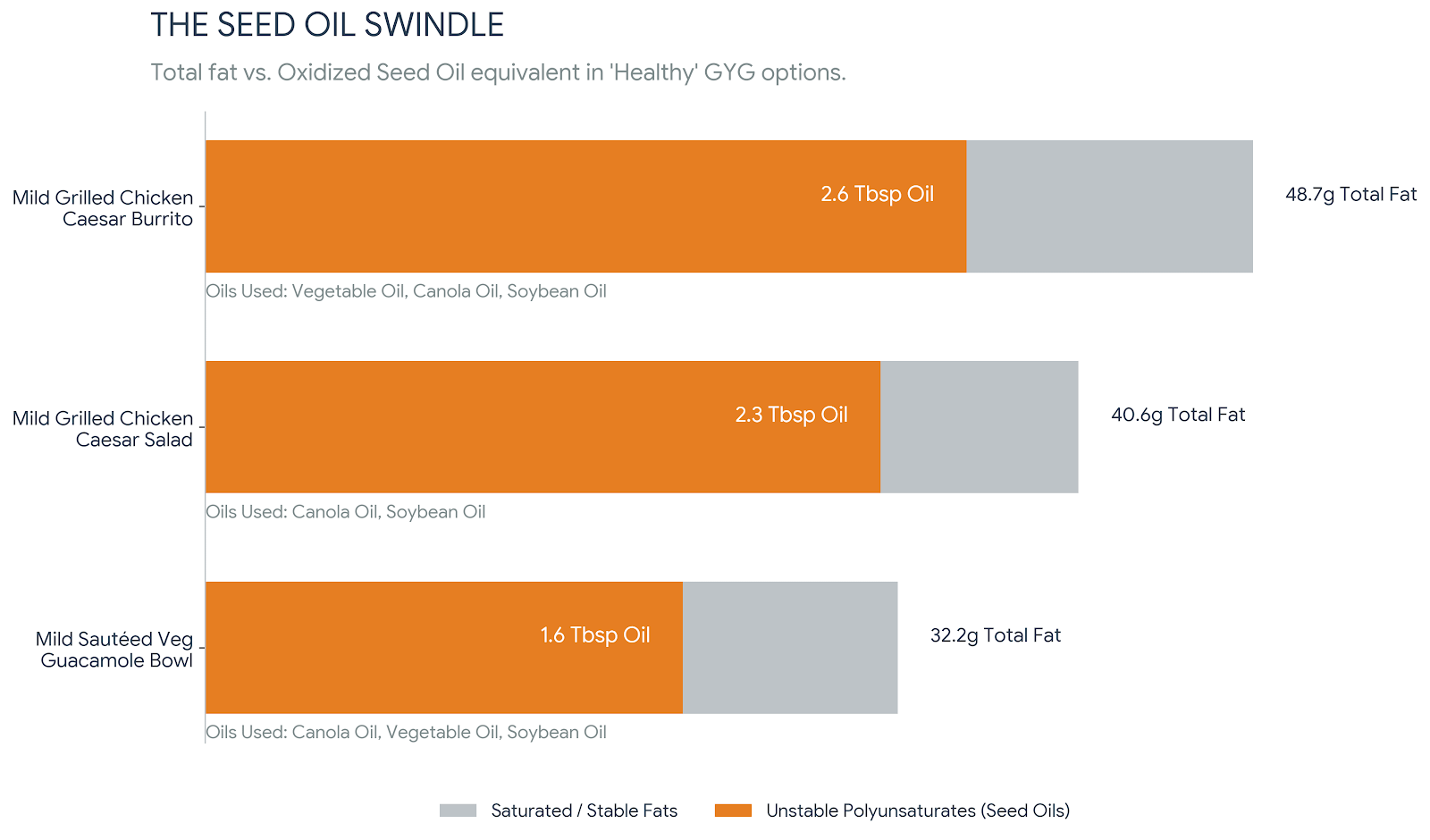
Take the Mild Grilled Chicken Caesar Burrito. You might think lean chicken and salad in a wrap is a smart, clean choice. But the code flagged it as carrying 35.4 grams of unstable unsaturated fat.
The ingredients list claims this comes from a blend of ‘Vegetable Oil’, Canola Oil, and Soybean Oil. But the filter caught the lie. The total fat profile of the burrito is only 27% saturated. That is far too low for the “vegetable oil” to be stable palm or coconut. That low percentage strongly suggests the blend is dominated by seed oils.
That 35.4 grams equates to over 38 mL of oil.
That is 2.6 full tablespoons of seed oil in a single burrito.
Think a salad is safer? The Mild Grilled Chicken Caesar Salad hides 2.3 tablespoons of Canola and Soybean oil. Even the Mild Sautéed Veg & Guacamole Bowl, which sounds like a plant-based health dream, is contaminated with 1.6 tablespoons of the stuff.
The Condiment Trap & Side Dish trap
But the most concentrated dose of industrial sludge isn’t in the main meals, it’s in the dipping sauces. Take the Herb Mayo (VG). It carries a vegan health halo, but the script revealed it is little more than a chemical oil slick. A single tiny serving contains 31.6 grams of fat, but the saturated fat sits at a miserable 7%. The oil? Pure Canola oil, lightly flavoured with coriander. You are dunking your food into 2.1 tablespoons of pure seed oil.
The Chipotle Mayo isn't much better. Despite sounding like a traditional, spice-forward Mexican condiment, its fat profile is identical: an abysmal 7% saturated fat. The ingredient list confirms it is quite literally just plain Canola Oil mixed with flavouring, delivering another 1.4 tablespoons of pure polyunsaturated sludge straight into your bloodstream.
And if you thought about adding a side of fries? The data immediately exposes the deep-fryer.
The ingredients list for a Large Fries claims a blend of Canola, High Oleic Sunflower, and generic “Vegetable Oil.” But the maths caught them again. The total fat profile is an abysmal 8% saturated. That tells us the “vegetable oil” in the vat isn’t stable palm or coconut—it’s just more cheap, unstable seed oil. A single order of Large Fries delivers 1.8 tablespoons of oxidized PUFAs, and if you grab the Family Fries, you are walking out with over 4 full tablespoons of the stuff.
The Final Boss: The Nachos
If you think skipping the burrito and ordering a “fun, shareable” tray of Nachos is a better move, the data proves it is actually the worst decision you can make at the counter.
When I ran the numbers, the Nachos proved to be the single largest seed oil payload on the entire GYG menu. The maths exposes why: you are stacking the traps on top of each other.
I had the code isolate just the plain Corn Chips. On their own, a single serve contains 28.4 grams of fat. But the saturated fat sits at a miserable 9%. The ingredients confirm they are deep-fried in a vat of Canola Oil. Because it fails the 40% rule so catastrophically, we know that base of chips is delivering 1.9 tablespoons of seed oil before the kitchen even adds a topping.
Then, the assembly line strikes. They take those deep-fried chips and smother them in the main meal fillings, which we already know are heavily contaminated with Soybean and Canola oil.
The result is a biochemical disaster. If you order the Mild Ground Beef Nachos, the unsaturated fat count rockets to 50.3 grams (3.6 tablespoons of seed oil). If you order the Mild Pulled Shiitake Mushroom Nachos, it hits 54.7 grams.
That equates to roughly 4 full tablespoons of inflammatory seed oil in a single meal. You are effectively eating a cardboard tray of sponges soaked in industrial lubricant.
Because pure polyunsaturated oils lack structural stability, they oxidize rapidly in the warm, oxygen-rich environment of your body. They act like cellular rust, driving systemic inflammation and frying the delicate wiring in your brain.
If you are trying to protect your metabolic engine, you cannot order a standard burrito, bowl, or salad.
But here is the good news. GYG does offer clean options, provided you know where to look. When the code filtered out the bad oils and applied the 40% saturated fat rule, exactly 34 items survived out of a menu of almost 300.
If you are on the run and need a clean hit of fuel, here is what you could order:
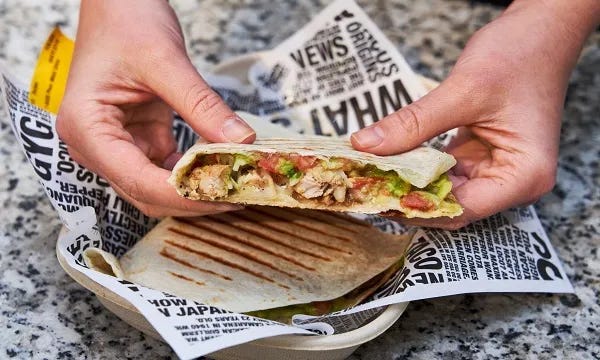
1. The Quesadillas This is your best play for a main meal, and the data reveals exactly why. If you order a standard Burrito or a Bowl, you are getting a scoop of Brown Rice (cooked in Canola Oil) and a scoop of Black Beans (cooked in Soybean Oil). The cheap carbohydrate fillers are the carriers for the industrial sludge.
But a Quesadilla (Mild Cheese, Pulled Pork, or Ground Beef) skips the rice and beans entirely. It is just meat, cheese, and a tortilla. It bypasses the Canola/Soybean trap completely. Because their saturated fat profile ranges from 51% to 61%, we know the remaining generic oil used is dominantly stable palm or coconut.
2. Soft Flour Tacos If you want meat and carbs without the industrial sludge, the Soft Flour Tacos (specifically Ground Beef or Pulled Pork) survived the filter, clocking in well over the 50% saturated fat mark. A word of warning on the tacos: You must stick to the soft flour tortillas. The script flagged every single Hard Taco on the menu as contaminated. To get that crunch, the kitchen deep-fries the hard corn shells in a heavy bath of Canola Oil.
3. The Breakfast Hack GYG’s breakfast menu is surprisingly clean if you navigate it correctly. The Brekkie Quesadillas and Brekkie Tacos (like the Bacon or Free Range Chicken Chorizo) passed the test. They are cooked using a blend of Vegetable Oil and real Butter, and sit comfortably above a 43% saturated fat profile.
4. The Dairy & Extras If you want to build a high-fat, low-carb meal from the extras menu, you are in safe territory. Mother Nature’s fats are untouched here.
Sour Cream (68% saturated fat) and Queso dip (67% saturated fat) are clean.
Naked Meats: If you order standalone sides of Mild Ground Beef off the extras list, it arrives completely clean, high in traditional animal fat (49% saturated), and completely free of the burrito-line seed oils.
You don’t have to write off fast food entirely, but you do have to stop ordering blindly. GYG is actually a great option if you follow these four strict metabolic rules:
1. The Main Meal Pivot (Skip the Rice and Beans) Do not order the Burrito or the Bowl. The assembly line for these items is heavily reliant on Canola and Soybean oil hidden inside the brown rice and black beans. Instead, pivot to the Quesadillas or Soft Flour Tacos (specifically Ground Beef or Pulled Pork). These bypass the cheap carbohydrate fillers completely and use dominantly stable fats.
2. Beware the Deep Fryer (Skip the Fries and Nachos) Never order the fries, and treat the nachos like radioactive waste. The data proves that the hard corn chips and potato fries act as literal sponges, soaking up the Canola and Sunflower oil from the deep fryer. If it crunches, or if it comes out of a frying vat, it is a chemical trap. Walk away.
3. Dodge the Sauce Never touch the mayo or the creamy dipping sauces. Do not fall for the “Vegan” or “Traditional” marketing halos. They are nothing more than Canola oil carrying up to 2 tablespoons of pure polyunsaturated sludge in a single tiny tub. Stick to the fresh salsas or real sour cream.
4. The 40% Rule When you are looking at a menu in the wild, check the nutritional breakdown. If a meal or side dish is high in total fat, but less than 40% of that fat is saturated, the kitchen is flooding it with seed oils. Use the maths to catch the lie.
In the next issue of The Seed Oil Sleuth, I’m taking the investigation into the supermarket aisles: the $4 bottle of oil hiding in your pantry, and the simple 5-second test to spot deceptive labels.
Comments
Nothing yet. Say the first thing.
Sign in to join the conversation.