
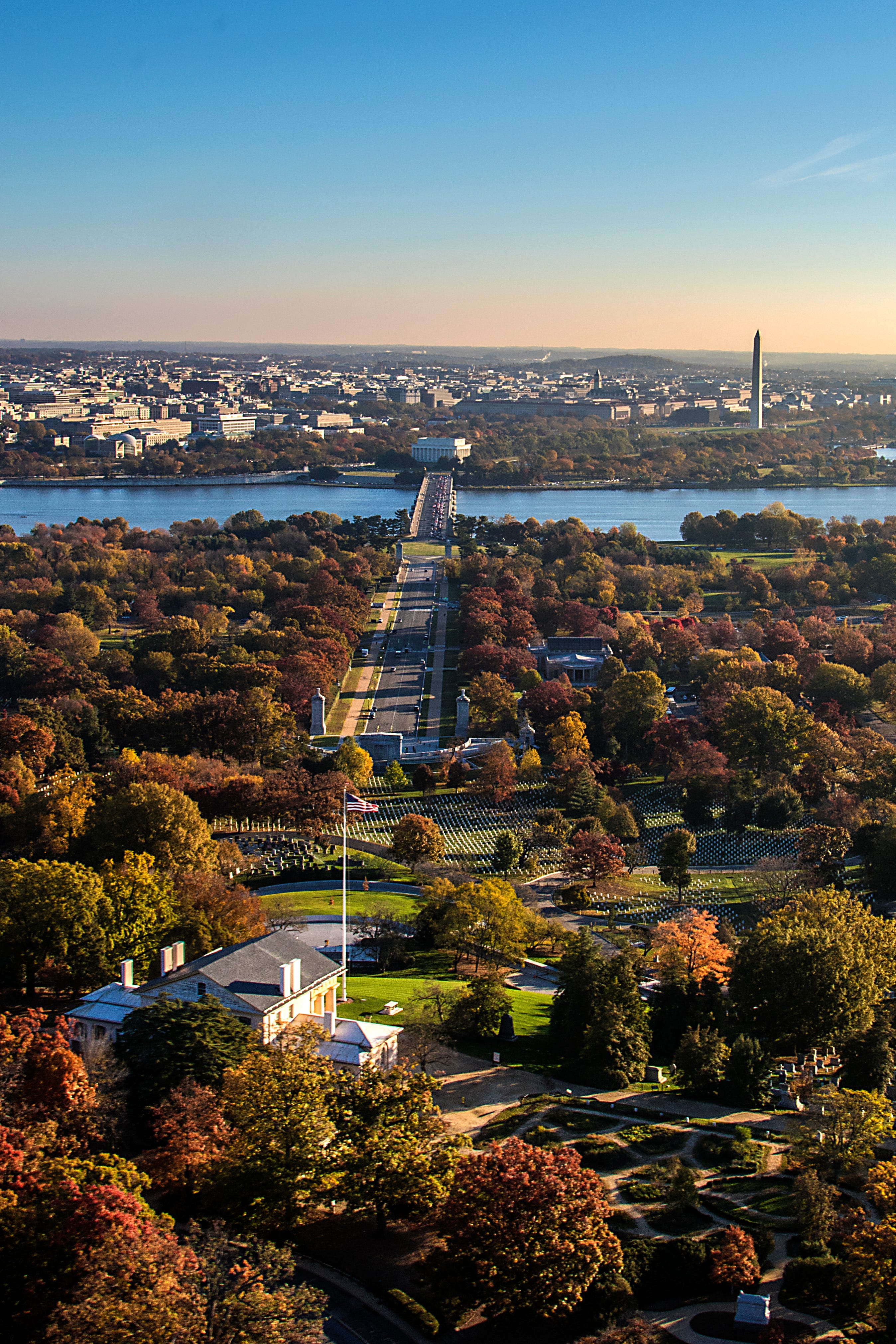
I’m a history obsessive who has logged far too many air miles. I’ve seen places steeped in history. I’ve seen beautiful places. I’ve seen places that are both. And at the top of that last category’s short list I would place Arlington National Cemetery — one view in particular.
On a high bluff, you stand in front of Arlington mansion, once owned by Robert E. Lee. All the land around you was Lee’s, land worked by slaves, until the Civil War.
In the terrible slaughter that followed, the dead soon exceeded the capacity of existing cemeteries so new graves were dug on Lee’s former estate. At first, it was informal, more necessity than symbol. But some saw the symbolism and, to ensure Lee never got his property back, they mad Arlington a national cemetery well before the war was won. Today, standing on that bluff, you look down on a gentle downward slope and see the plain grave of John F. Kennedy, adorned only with an eternal flame and magnolia trees. Beyond sprawl acres of graves with identical headstones. Each is the last resting place of veterans. The headstones are placed in files and ranks with perfect precision, like soldiers on a parade ground. Further out, a wide, straight boulevard leads to the Potomac River. On the far bank, in Washington D.C., lies the Lincoln Memorial, and a little to the south-east, the Washington Monument.
The view would be impressive even if you knew nothing of the history it embodies. But with that knowledge, it is awesome, in the original sense of the word. It is great and terrible, inspiring and humbling.
It is a sublime vista.
And Donald Trump wants to put the equivalent of a gilded Las Vegas monstrosity smack in the middle of it.
News reports about Trump’s ridiculous plan to build a 250-foot triumphal arch mostly sound bemused. It would be like the Arc de Triomphe in Paris, they say, but so much bigger. With lots more gold.
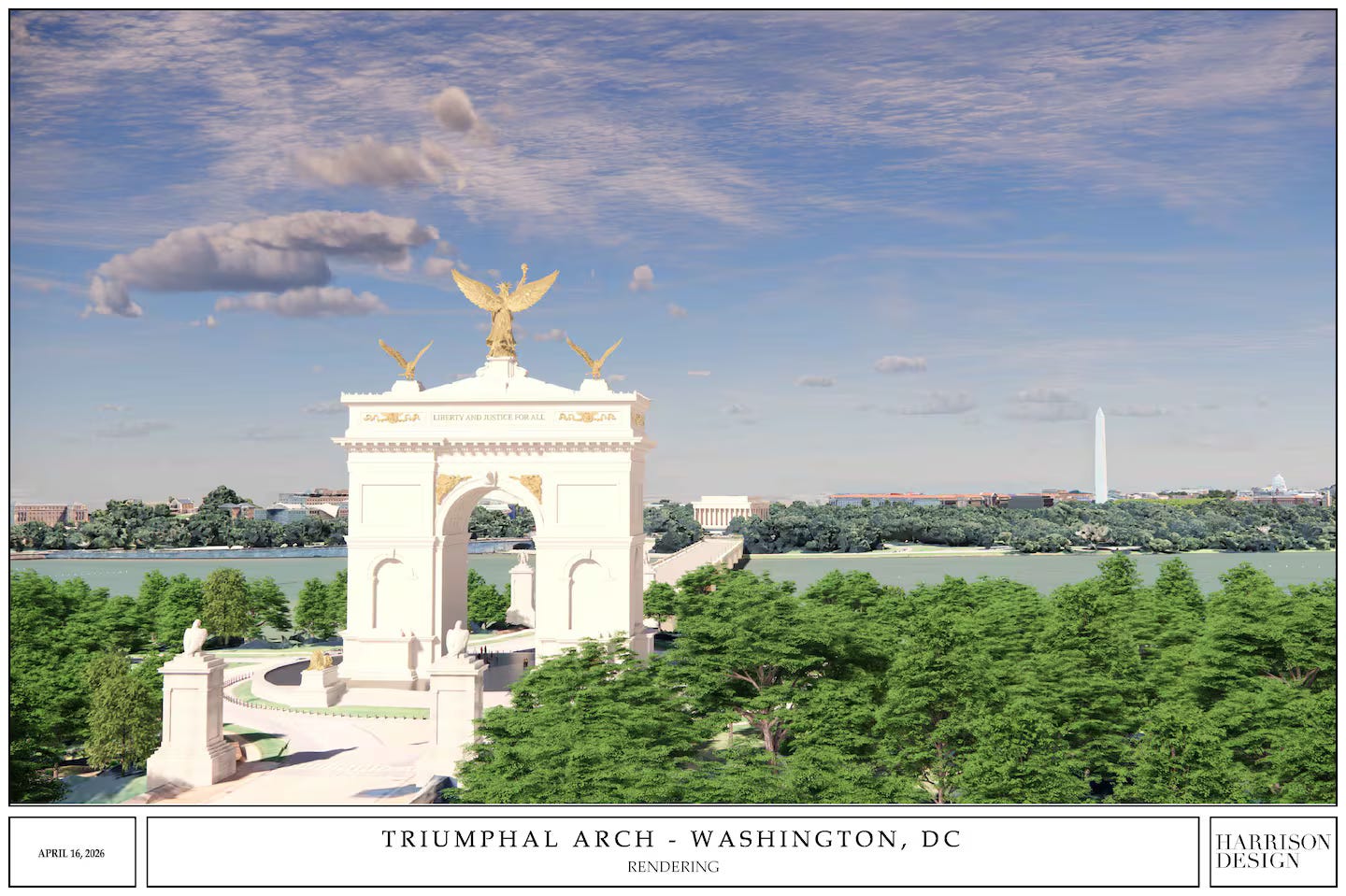
Why? What’s it for? The Arc de Triomphe was erected to commemorate the victories and sacrifices of France in the Napoleonic wars. What would Trump’s Brobdingnagian lump of masonry honour? No one knows.
When a reporter asked Trump who or what the arch would be “for,” he pointed to himself and said, “me.” It seems Trump wants to erect this towering pile of pointlessness for the same reason he has slapped gold curlicues all over the Oval Office: He likes bling. And he can.
But this isn’t merely another Trump folly.
Look at the picture of Arlington above. Trump’s arch would be built half-way between the Lincoln Memorial and Arlington mansion, on the Virginia side of the Potomac. That’s exactly in the middle of that view. Trump’s immense arch would utterly dominate the vista and all the history and lives and meaning bound up in that space.
It would be nothing less than desecration.
But remember, there’s a lot of history packed into that view — and remarkably, this isn’t the first time that vista has been threatened by a truly atrocious plan.
A different sort of desecration came dangerously close to happening in 1940.
In 1940, the United States was still at peace but the Second World War was raging in Europe and Asia. Isolationists — mostly Republicans — blocked Franklin Roosevelt from entering the war on the side of the Allies but when Hitler’s spring offensive overran Western Europe, leaving only Britain unconquered, the need to at least prepare for war was obvious to all but the most blinkered isolationists.
Roosevelt declared a national emergency and ordered a massive re-armament program that would see the tiny peacetime US military become one of the biggest in the world.
To do that, the military needed a headquarters that would bring together the fractious commands of the Army and Navy. It would also have to be big enough to manage the largest organization in the United States. And given that the crisis was well underway, it had to be built at lightning speed.
The job was given to Army General Brehon Somerville, an engineer who had recently completed what became LaGuardia airport. Somerville was a human bulldozer. Order him to build something and he would smash through anything to get it done. He was a man made for the moment.
The required floorspace of the new headquarters was huge and with steel needed for ships and tanks the building could not be tall. It had to sprawl outward. That ruled out building in Washington D.C., so Somerville’s staff look for a site across the river in Virginia.
They soon found a small airfield by the river but discovered it was a floodplain. Scratch that. Where else? They found some empty land bounded by five roads. If the building were to fill the whole space between the five roads, it would be big enough.
That’s it, Somerville declared. Get moving.
Plans were drawn up and Somerville rushed to get approval from Congress and the President’s Cabinet. It’s the only site that will do, Somerville declared forcefully. We need to get shovels in the ground now.
Everyone signed off. The project was up and running.
Only when all this was announced publicly did anyone pay attention to where, exactly, this new building was to be built.
See the photo of Arlington above? See all those somber headstones? That was the site.
Somerville was going to build a giant, four-storey office building, with acres of parking lots, right there. Remarkably, the plan was even worse than that sounds: The five roads that would define the footprint of the building were all different lengths, so the building would take the shape of an immense, misshapen pentagon. It would be staggeringly ugly. And visitors to Arlington National Cemetery would forever look down on its misshapen roof.
But this was a national emergency, remember. Sacrifices had to be made. And General Somerville was not the sort of man who spent a lot of time musing about beauty and historical remembrance. When officials who did think about that sort of thing objected to what they saw as desecration, Somerville pushed them aside like a bulldozer dealing with gravel.
When those same officials asked if Somerville had looked for other sites, the general dismissed them again. This was the best site, he said. The only site. Get out of the way.
When the officials found another site only a little further south — a site that offered more land so the misshapen pentagon shape could be replaced with a symmetrical pentagon, making the building less ugly and more efficient — Somerville told them to go to hell and threatened to bite the head off anyone who brought up the subject. Shovels were going in the ground, God damn it.
By coincidence, one of the officials turned out to be the uncle of a certain Franklin D. Roosevelt. That official had a word with his nephew. And Roosevelt had a word with the general.
And General Somerville? He ignored the Commander-in-Chief. Shovels were going in the ground, God damn it.
Roosevelt had to give Somerville a direct and very explicit order — twice — to get him to finally move the site.
That’s why the Pentagon is where it is today. And why it is a pentagon — a symmetrical pentagon. And why the sublime vista of Arlington is still there. For now.
Now, place these two stories side by side and what do you see?
In 1940, the emergency was all too real. The US military had to expand rapidly. It had to have a massive new headquarters. General Somerville’s plan was a response to an urgent need at a time when the highest principles of the nation were at stake. True, Somerville was pig-headed. But he was a human bulldozer, after all. That’s why they gave him the job.
What about Trump’s arch? There’s no emergency driving the plan. There isn’t even a purpose, such as historical commemoration. It would be an ersatz triumphal arch, a fake, a gaudy knock-off, like the casinos in Las Vegas that mimic Venetian canals or Roman palaces. The sole driving force of the project is the sick psychology of one man devoid of principle or accomplishment, a man who desires nothing so much as beating his chest and listening to others praise him as the greatest of all time.
The contrast between these two threatened desecrations is uncomfortably telling of what the United States was, and has become.
In 1940, the United States was a nation that had suffered terribly for the previous decade and would sacrifice much more to secure victory in the war. The United States would use that victory to establish an international order that reflected American ideals of liberal democracy, liberty, and capitalism. And the order it established would produce decades of unprecedented peace and prosperity.
Today, the United States is vastly wealthier than it was then, but it is divided, cynical, and decadent. Its president is corrupt. He believes in nothing and desires only enrichment and praise. He is demolishing the international order created by the generation that fought the Second World War. He supports the enemies of liberal democracy and liberty. He is turning capitalism into cronyism.
His legacy, if he is not stopped, will be war and decline. And an arch that will forever stain what should be sacred.
Comments
Nothing yet. Say the first thing.
Sign in to join the conversation.