
I recently visited Portsmouth, England, with Son #2. Lovers of rum and Patrick O’Brian novels will know Portsmouth is the home of the Royal Navy, but it is also home to excellent museums and an array of gobsmacking historical exhibits.
A Cold War submarine. A small warship that survived the First World War Battle of Gallipoli. The remains of the Mary Rose, Henry VIII’s favourite warship, sunk in battle in 1545. And most famously, HMS Victory, Admiral Nelson’s flagship.
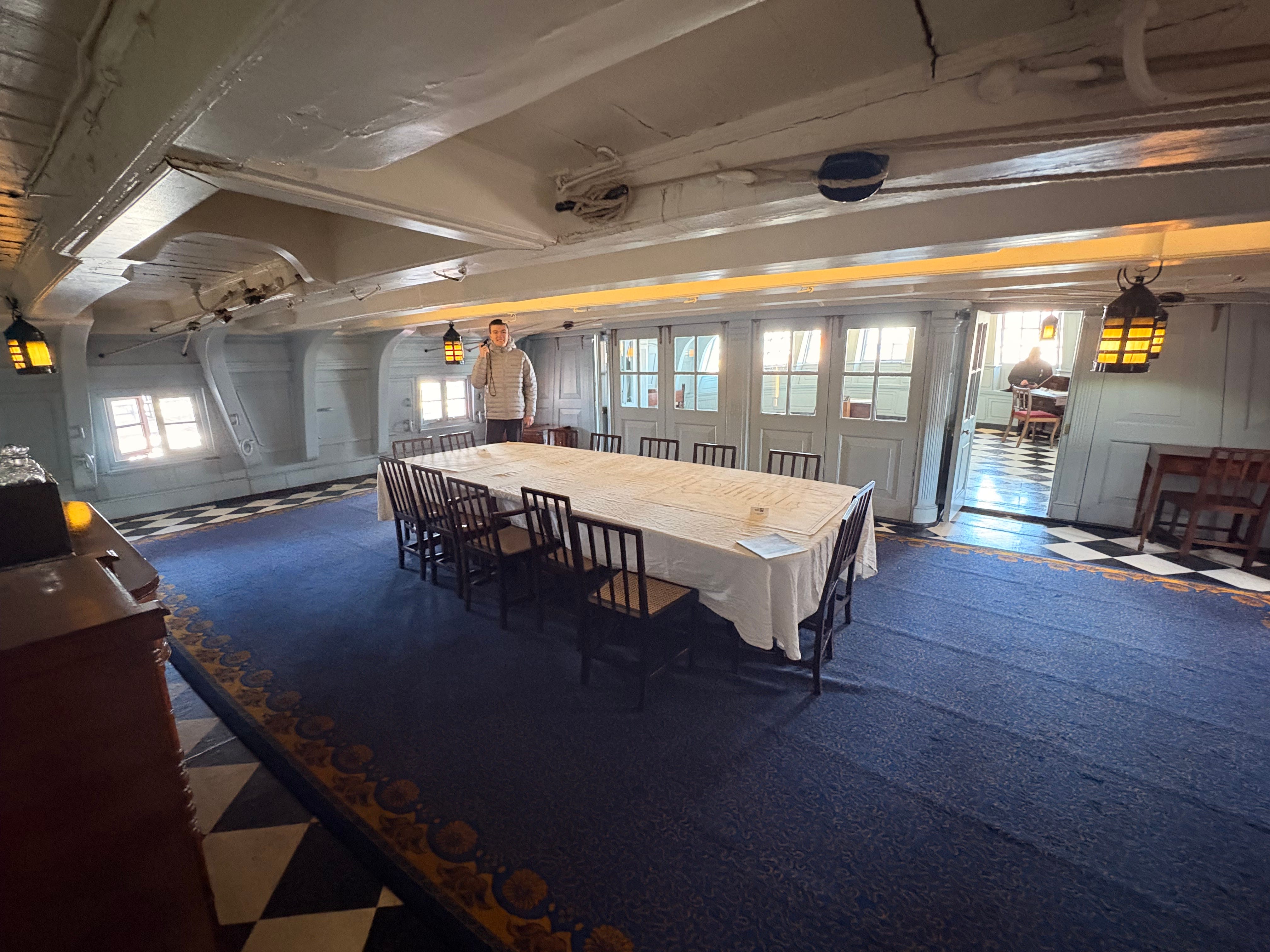
It’s hard not to feel a thrill standing by the table where Nelson plotted with his captains the night before the Battle of Trafalgar; or looking down at the very spot where Nelson was shot by a French sniper; or where he died (“kiss me, Hardy”) belowdecks.
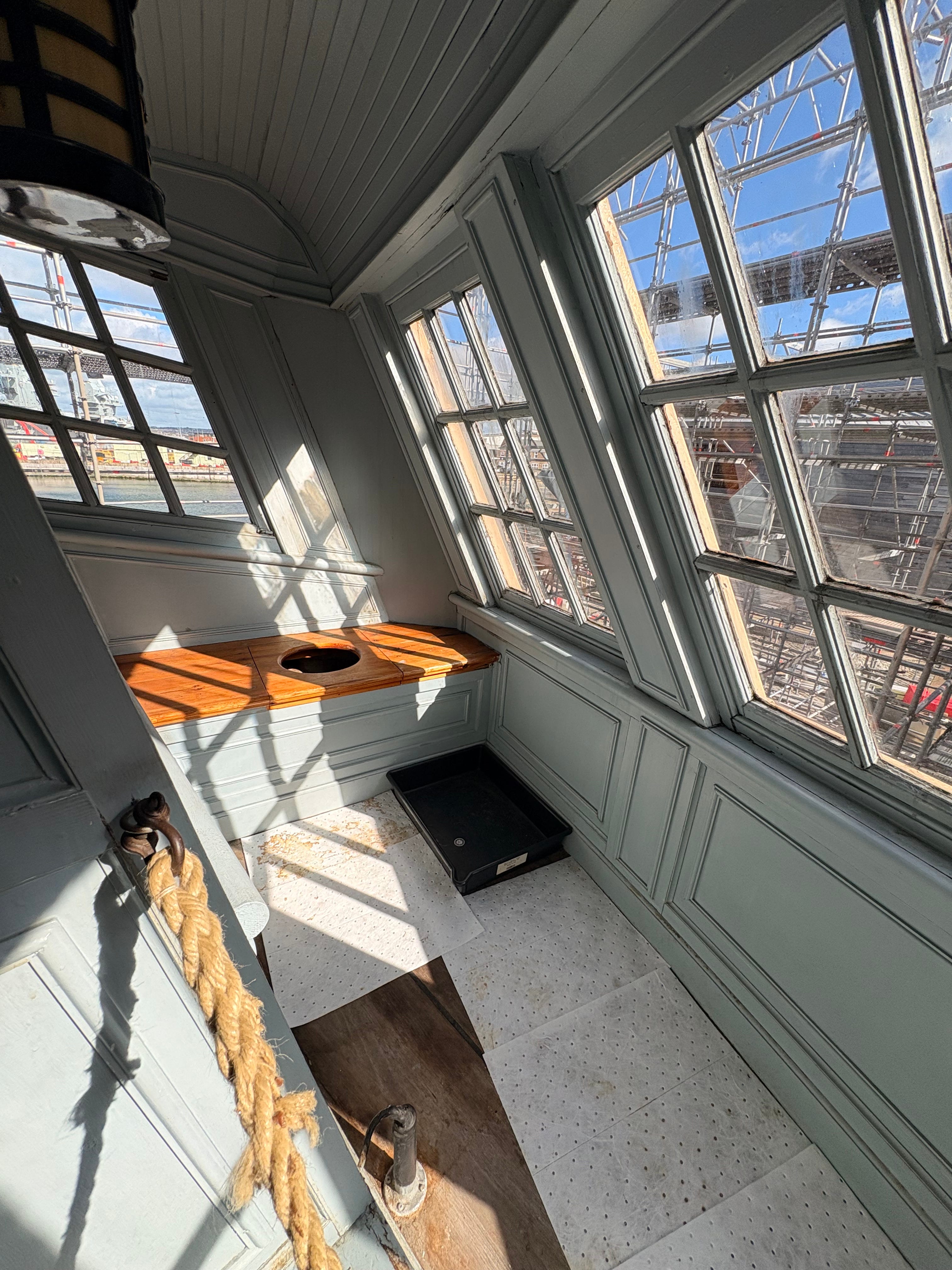
It’s even hard not to feel a little thrill looking at Nelson’s head — in the naval sense — which is a closet overhanging the sea next to Nelson’s quarters.
“Nelson shit here,” you marvel. “Right here.”
Or maybe that’s just me.
But this post isn’t about my vacation photos. (Promise.)
It is, rather, about another marvel that I wasn’t familiar with before visiting Portsmouth — and what it tells us about technological change and the accelerating pace of life.
We know all about the mad rush of technological progress. We’re at the cutting edge, after all. Change is happening in a blur, coming faster than ever before. It feels impossible to keep up. And sometimes — let’s be honest — you think it would be nice to live in a simpler time when change happened, perhaps, but at a gentler pace.
The mid-1800s would do, don’t you think?
Now, here is that marvel I promised.
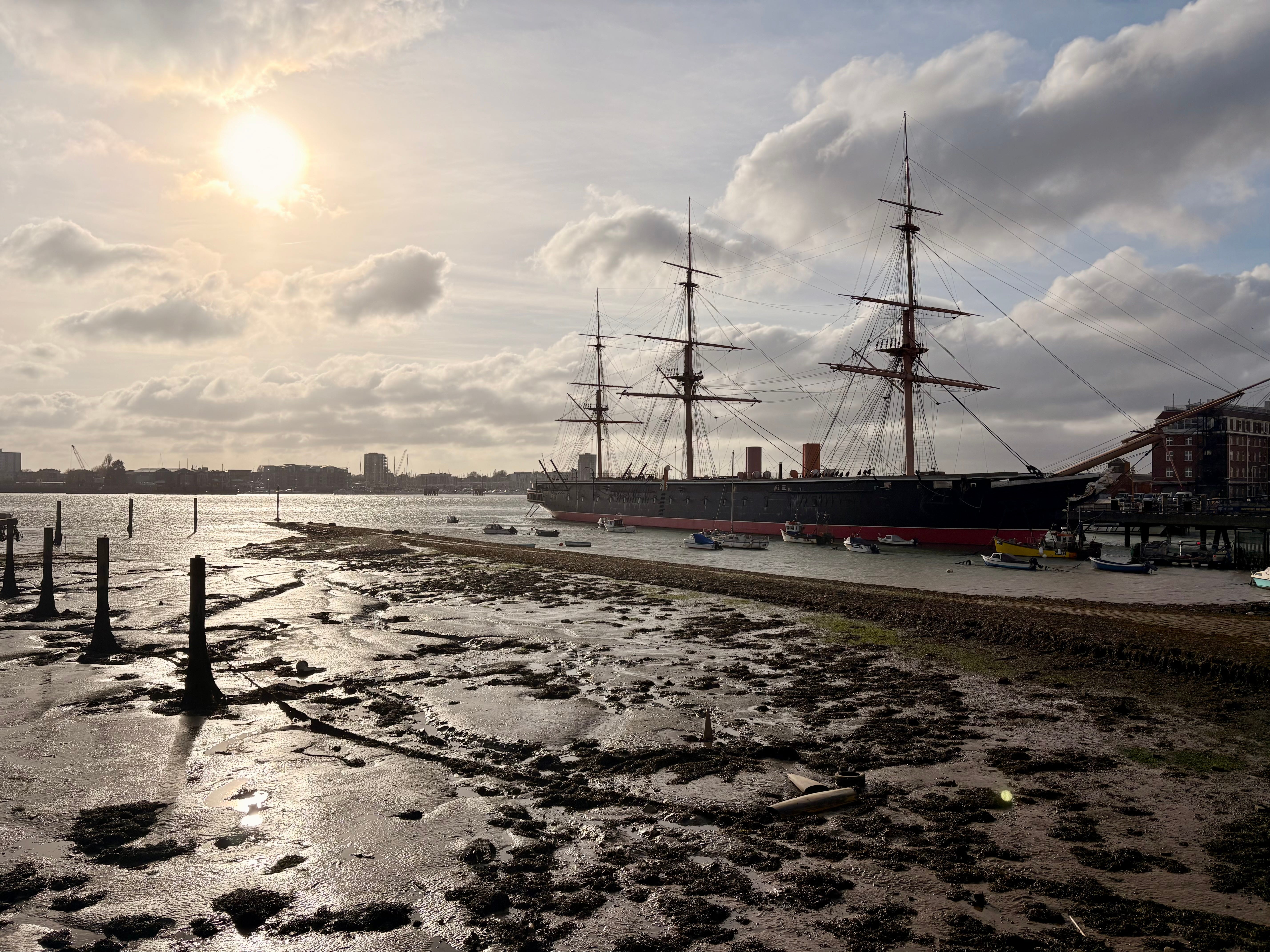
It looks like a classic tall ship from the age of masts and billowing sails. You can almost hear the creak of the wood as the ship is rocked gently by the Atlantic waves. Makes you want to hum Heart of Oak, the march of the Royal Navy.
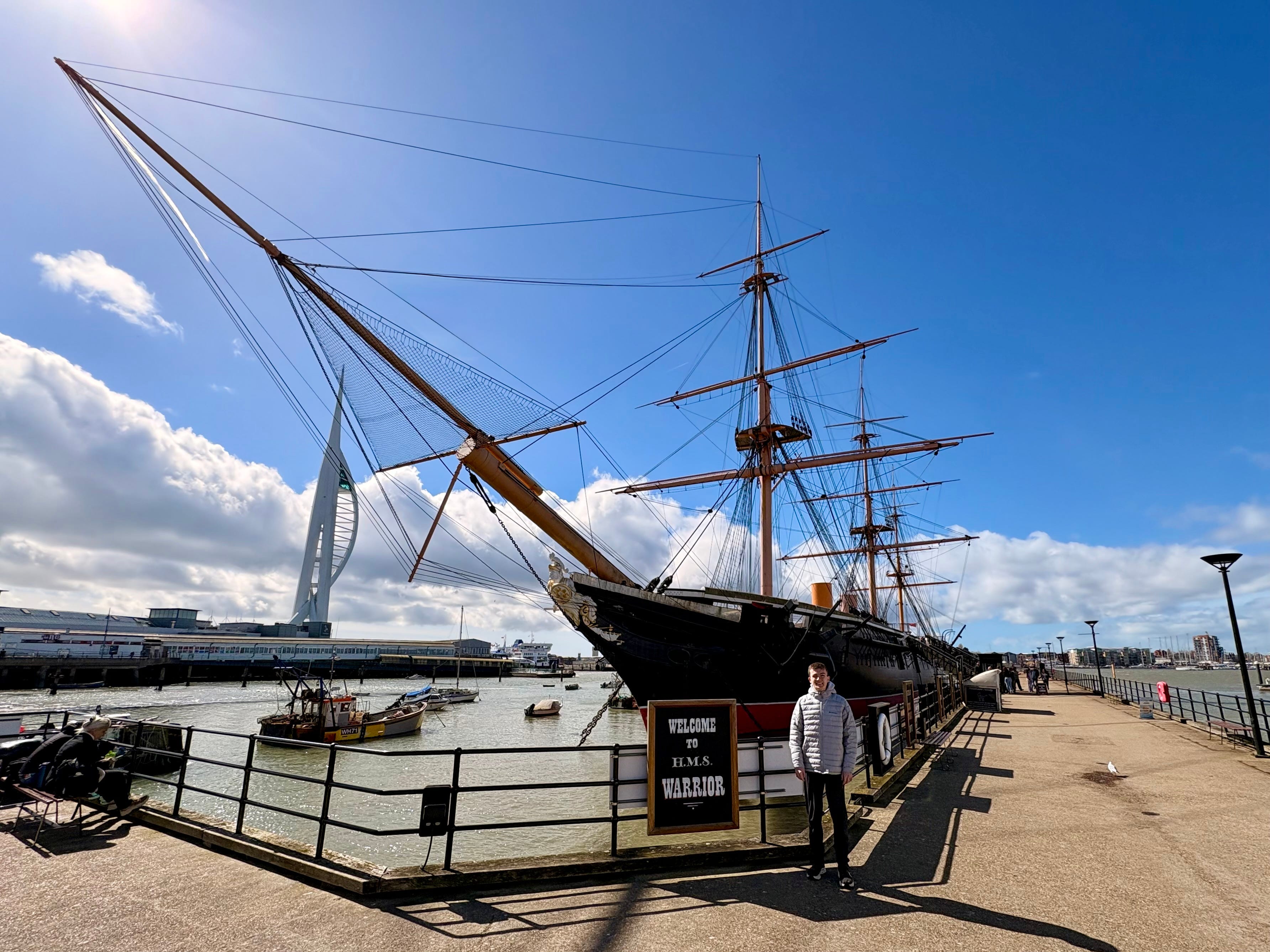
That ship is HMS Warrior.
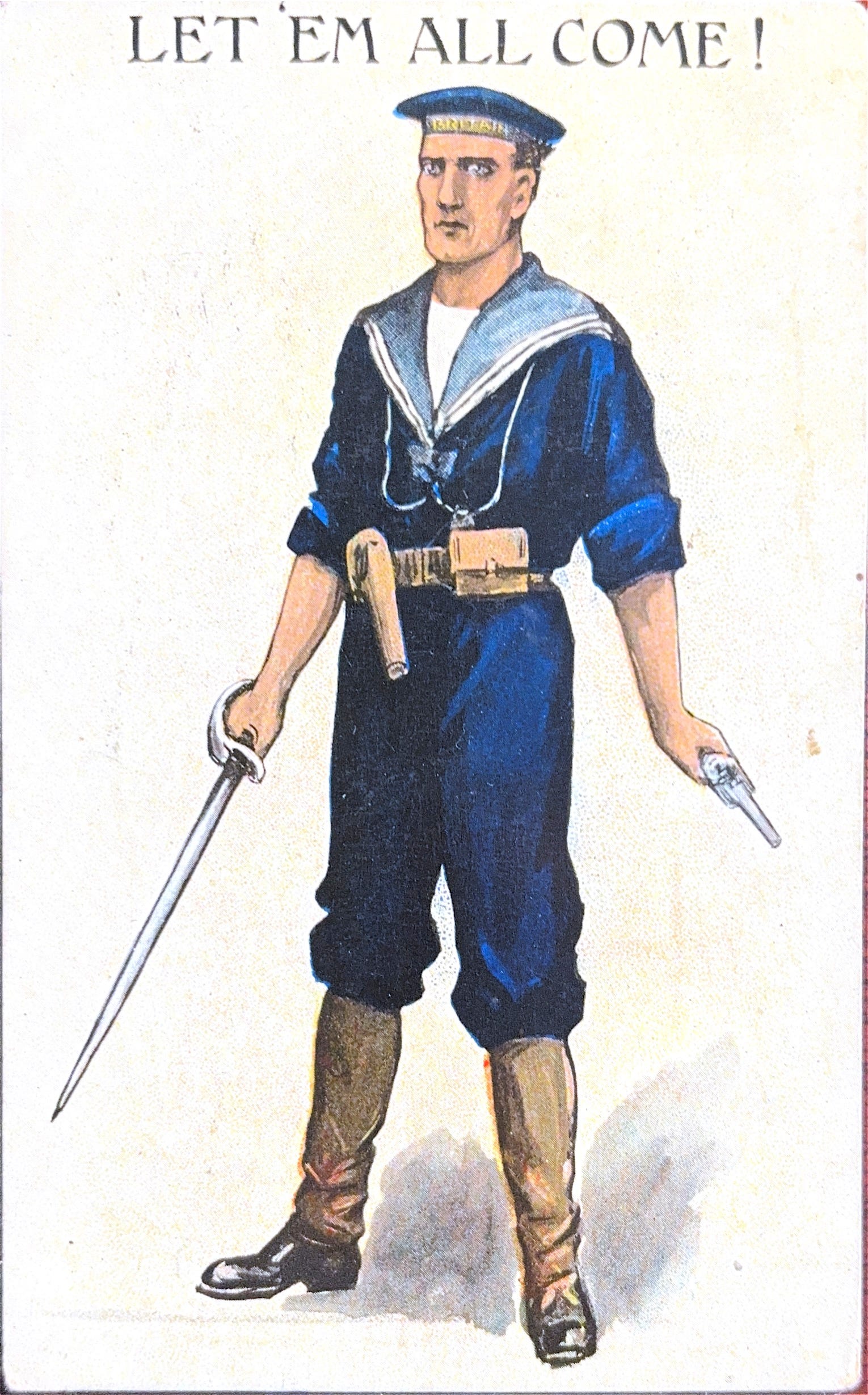
Approach her after visiting Victory and what immediately strikes you is that the scale has changed. Everything about Warrior is bigger, from her length, to the spaciousness below decks, to the girth of her cannons. But scale aside? Warrior looks to be very much from Victory’s era. There are even cutlasses and pistols stored alongside the cannons so crews may leap into action should the ship be boarded.
It’s all very 18th century. Nelson would approve.
But give Warrior’s hull a rap. That’s not oak. It’s iron. And it’s only the first of many surprises she contains.
When HMS Warrior was launched in 1860, her outward form was familiar. But she was, in fact, nothing less than a floating technological revolution.
After the Napoleonic wars, the Industrial Revolution went to sea.
The first boat with an iron hull was a canal barge launched in 1809. The first iron-hulled steamship at sea was the Aaron Manby, launched in 1822. The Aaron Manby’s engines turned paddle wheels attached to the hull but in 1839 the Archimedes went to sea with a screw propellor.
All these developments involved civilian shipping. In naval warfare, the big revolution came in the 1820s with the development of explosive shells.
By the 1850s, navies pondered how to put all these changes together. In 1859, France — seeking to challenge British dominance of the seas — launched Gloire. She was steam-powered and propelled with a screw. And she was ironclad. But not iron. Gloire had iron plates mounted on a traditional wooden hull.
In 1860, HMS Warrior was launched and she was the full package: Not a wooden hull with plates but an entirely iron hull with additional armour for battle. Her cannons were rifled, breech-loading guns firing explosive shells with exceptional range and accuracy. Her powerful steam engine turned a screw propellor. Outwardly, scale aside, her form appeared little changed from ships-of-the-line of the past century, yet Warrior was the incarnation of all the enormous technological advances of the previous forty years. And she instantly made everything that came before her obsolete.
Under steam power alone, Warrior could make 14.4 knots (27.7 kph). That beat all other warships in the world. But under steam and sail, Warrior was an incredible 17.2 knots (31.9 kph). Nothing could get close to her.
And if an enemy ship had managed to get in range? It wouldn’t matter. In trials, an array of powerful naval guns was tested against Warrior’s armour. Nothing could penetrate. She was effectively invulnerable. It was often said Warrior was “a fleet of one,” capable of taking on the entire French navy by herself.
For a nation and empire whose lifeblood was control of the seas, the new ship was a godsend. Warrior was the nation’s pride, celebrated in the press, cheered by crowds when she sailed by.
And yet — quite unlike HMS Victory — if you’ve never visited Portsmouth, you’ve probably never heard of HMS Warrior.
That’s because Warrior — again, quite unlike Victory — never fired a shot in anger. And she never went to war because her entire service as a warship lasted only ten years.
By 1870, HMS Warrior, the world’s most advanced warship in 1860, was obsolete.
She was put into reserve. By 1883, she was no longer fit to go to sea, and for decades was used as a floating classroom, a workshop, “and even a pontoon for fuelling ships.”
Warrior’s success was the cause of her rapid obsolescence: In a mere decade, everything that made Warrior special became standard in advanced navies. And the technologies continued to evolve with head-spinning speed. In the 1870s, the first steel ships were launched. Steam engines became far more powerful, reliable, and efficient, so sails were removed. Far more powerful guns were placed within rotating iron turrets on deck. The shape that warships had taken for centuries, the shape Warrior preserved, was gone. What we would now recognize as a modern warship had taken form.
And it all happened in a matter of years. By the 1870s, warships and navies would have been unrecognizable to Nelson.
The pace of change was so furious that naval officers struggled to comprehend and make coordinated use of all the new technology. The great historian Elting Morison wrote a famous paper describing how the US Navy struggled for decades — largely unsuccessfully — to fuse the new technologies with old organizations and create a coherent, capable fighting force. That work took until the turn of the century.
Today, in this time of supposedly unprecedented technological change, designing and deploying even one important new naval weapon within a decade would be a major challenge. To revolutionize warfare at the pace of the Warrior era is unthinkable.
The simple truth is that we are not being subjected to an unprecedented pace of technological change. Important bursts of change with the potential to create further, sweeping changes are indeed underway — but bursts of revolutionary change have happened many times over the past couple of centuries. And to those who lived in such times, they were as dizzying as anything we are experiencing.
There really is nothing new under the sun.
Comments
Nothing yet. Say the first thing.
Sign in to join the conversation.