
Quick bit of housekeeping before we get into it: there are now 1,600 of you getting this thing in your inbox every week. When I started sending it, I figured a couple hundred people might care about what’s happening in DFW running. Turns out this community is bigger and hungrier than I ever gave it credit for. Thank you.
Now — this week’s episode.
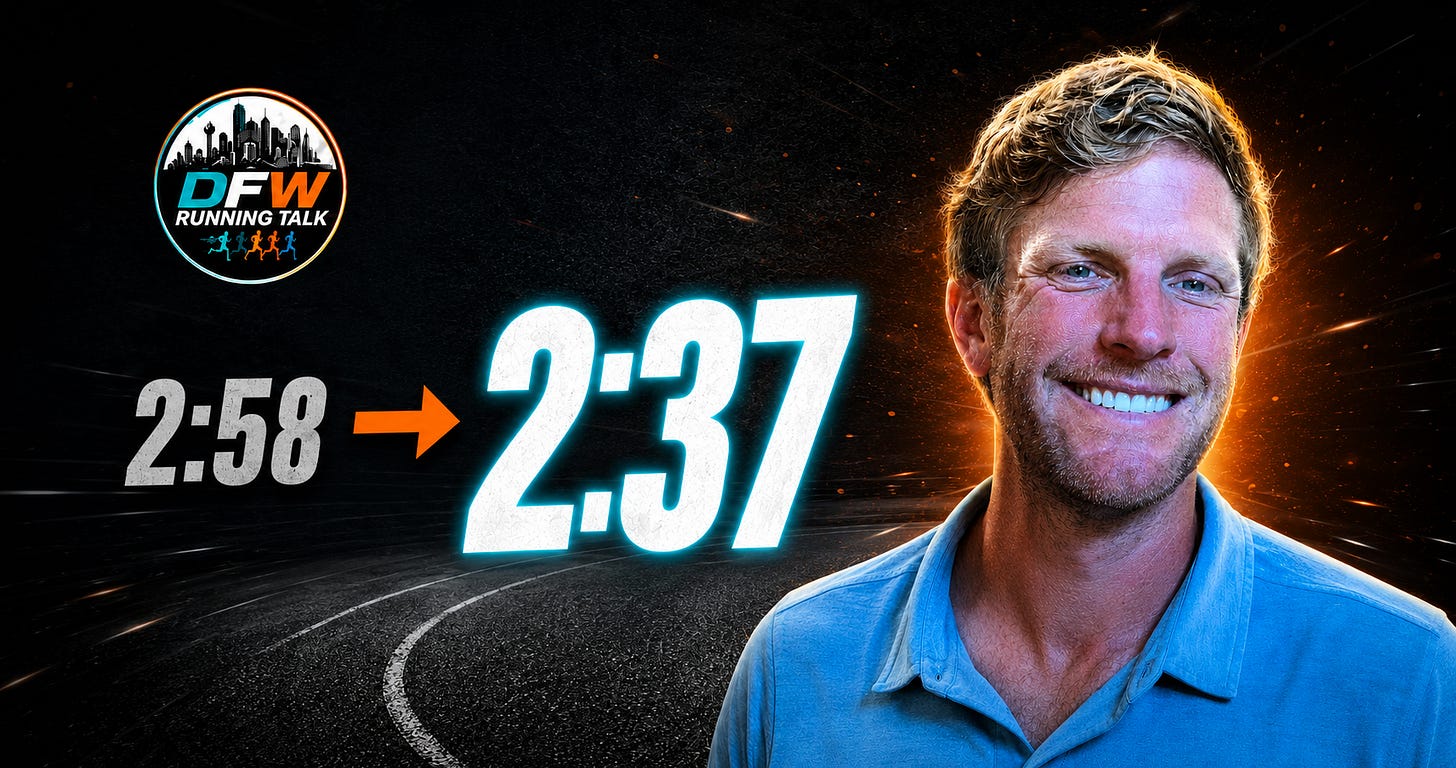
Most of the people I put on this show are fast in a way that feels far away. Jeff Pels is fast too — 2:37 at CIM this past December — but his story is the one I think most of you will actually see yourselves in.
Because Jeff spent about a decade running 2:58, 2:59, 2:58.
He wasn’t some guy who picked up running at 35. He ran the 800 and 1500 at TCU. He’d been racing since fifth grade, when he ran laps around his elementary school during PE and collected 20 tally marks on his hand while everyone else walked. He had the engine. He passed his last CPA exam in December 2012, decided it was time to get back into running, signed up for Cowtown in March with about ten weeks of training, and ran 3:28. Second marathon, actually trained, 2:58. Boston. Chicago. New York.
And then… 2:58. 2:59. 2:57. Year after year after year.
Here’s the part I want you to sit with. When I asked what finally changed, there was no revelation. No new coach, no lactate testing, no supershoe epiphany.
“There’s no secret sauce to long-distance running. It’s just more miles.”
During the plateau years he was running 55–60 miles a week with one or two twenty-milers. For CIM he built a base in the seventies, spent time in the eighties, and peaked at 90. That’s it. That’s the whole trick.
Houston 2024: 2:43. CIM 2025: 2:37. A 21-minute PR at 37 years old, from a guy who’d been running for over half his life and had every reason to believe he’d already found his ceiling.
1. He doesn’t have a coach. He has a group. Jeff jokes that he “mooches” workouts off Dustin Darakhshan and whoever else on the Sloths posts something good on Strava. Tuesday mornings at JJ Pierce with ten or twelve people, long runs out of Mimosa Park. That’s the whole system. It works because he shows up.
2. He got there because his wife made a daycare friend. Their son and Dustin’s son were at the same daycare in Richardson. She found out Dustin was a runner, found out he was doing Chicago, and basically volunteered her husband. Every single one of these stories starts with somebody’s chance encounter.
3. He talked himself off the fast pace at the start line — and it saved his race. Eric, Aaron and Jennifer were going out at 2:35. Jeff had planned to be with them. Standing there before the corral, he told them he was going for 2:37–2:38 instead, because he knew his history of falling apart at 20. He ran the first 5K ten to fifteen seconds slower than goal pace and settled in. They gave him grief. He still thinks he made the right call. (He also spent miles 16–22 running with the women’s OTQ pack, terrified of clipping somebody and ruining their day.)
4. The 24-hour rule. Borrowed from Steve Magness: after any race, good or bad, you get 24 hours to celebrate or mourn. Then it’s over and you move on. Boston 2025 didn’t go his way — 2:57, bad nutrition, the hills. Eight months later he ran 2:37.
“It’s not linear growth with running. It’s more like a spiral. Sometimes you go backwards and sometimes you make small increments, but you keep showing up and it’s an upward trajectory nevertheless.”
If you’re in year three of the same finish time, that’s your permission slip. The work is compounding even when the results aren’t showing yet.
🎧 [Listen to the full episode →]
Also in there: why he thinks the 1500 is the best race in track, what happened when his TCU recruiting coach announced on day one that he was leaving for NAU, why he now plans a vacation around every out-of-state marathon (Napa after CIM, Oktoberfest after Berlin next fall), and his fall schedule — Irving Oktoberfest, Turkey Trot, Dallas Half in December, Houston in January.
One question for you this week: are you stuck at a time you can’t seem to break? Hit reply and tell me what it is and how long you’ve been there. I read every one of these, and I’m thinking about doing a whole episode on the plateau.
Coming up next week: David Slear.
If you got something out of this, forward it to the person you run with on Saturday mornings. That’s how this list has grown to 1,600, and it’s the only growth strategy I’ve got.
See y’all out there, Chris
🎧 Apple · Spotify · YouTube · 🌐 dfwrunningtalk.com
Comments
Nothing yet. Say the first thing.
Sign in to join the conversation.