
Get Scipio’s latest book, The Empire of Lies: the American Empire unmasked.
Buy Anatomy of a Revolution today!
Information is a weapon. Arm your family and friends.
Hit the Tip Jar and help spread the message!
This post contains affiliate links, which means I may receive a commission or affiliate fee for purchases made through these links.
Meet Scipio & get practical tools for wellness and preparedness at the Sovereign Health Summit — save 5% with promo code SCIPIO.

Unlock the mysteries of Biblical cosmology and enrich your faith with some of the top rated Christian reads at BooksOnline.club.
Expand your horizons @ BooksOnline.club!
Click the image below and be sure to use promo code SCIPIO for 10% off your order at HeavensHarvest.com: your one stop shop for emergency food, heirloom seeds and survival supplies.

Related Entries
That the received books constituting the LXX canon were more expansive than the Rabbinic canon, now erroneously referred to as the Hebrew Bible, is not particularly controversial.
This point is admitted even by Protestant scholars: Edmon L. Gallagher notes that, for Christians, the LXX tradition was never restricted merely to the Greek Pentateuch (emphasis mine):
The translation for Christians encompasses the entire Old Testament, or, at least, more than the Greek Pentateuch. Justin [Martyr], for instance, refers to the Septuagint translation of Isaiah (Dial. 70–73). This view of the Septuagint becomes immediately universal for Christians. Irenaeus, later in the second century, relates the translation story, affirming the inspiration of the translators (in line with Philo) but also describing the translation of Isaiah as a part of the Septuagint (Haer. 3.21.1–3)
— Translation of The Seventy (Section I.3)
This is precisely why the term LXX is being used in this series in its broader Patristic sense. As I laid out in the opening chapter, the Old Testament (OT) received and used by the early Church was not identical in scope to the later Rabbinic canon, nor was it governed by the Masoretic textual tradition. It was the Greek OT, the LXX, which passed into the hands of the Church and became the Scriptures that they used. What is decidedly more controversial is whether Western Christians are willing to let that fact govern their understanding of the OT and the Canon as a whole.
If one begins with the later Rabbinic canon as their starting point, then the Church’s broader OT looks like an addition. But if one begins with the actual scriptural world of the first century, that perception is reversed: the broader Christian OT reflects an earlier and wider Jewish inheritance, while the Rabbinic canon represents a later narrowing. McDonald states the matter succinctly (emphasis mine):
Christian Scriptures were larger because the Jews at an earlier time included more writings than they did later under the influence of rabbinic Judaism. When the Christians left Jerusalem in 62–66 C.E. following the death of James the brother of Jesus, they moved to Pella on the east side of the Jordan river and the influence of Judaism upon the Christians, and especially in their understanding of the scope of their Scriptures, significantly diminished. When the last Christians were finally and completely excluded from the synagogue in 132–135 C.E. because they did not support the Bar Kokhba rebellion, there was no more Jewish influence on the scope of the Christian OT Scriptures.
— The Biblical Canon (Part 2, Ch. 4.IV)
After the Bar Kokhba revolt, Christians were finally and decisively severed from the synagogue system. That the synagogues of the Roman Empire were once fertile ground for evangelization, particularly using the LXX, can be seen throughout the Acts of the Apostles, as the well respected Evangelical scholar F.F. Bruce notes (emphasis mine):
As soon as the gospel was carried into the Greek-speaking world, the Septuagint came into its own as the sacred text to which the preachers appealed. It was used in the Greek-speaking synagogues throughout the Roman Empire. When Paul at Thessalonica visited the synagogue on three successive sabbaths and ‘argued with them from the scriptures, explaining and proving that it was necessary for the Christ to suffer and to rise from the dead’ (Acts 17:2f.), it was on the Septuagint that he based his arguments. We see him doing this earlier in greater detail in the synagogue of Pisidian Antioch.
— The Canon of Scripture (Ch. 3)
From that point forward, the Church’s OT and the Rabbinic OT departed from one another — as evidenced by Josephus’s usage of Deuterocanonical material and Talmudic references to Sirach as Scripture. The burden of proof, therefore, falls upon those who would have Christians receive their OT canon from the very Rabbinic tradition which rejected Christ.
Anglican scholar J.N.D. Kelly summarizes the result with equal clarity (emphasis mine):
It should be observed that the Old Testament thus admitted as authoritative in the Church was somewhat bulkier and more comprehensive than the twenty-two, or twenty-four, books of the Hebrew Bible of Palestinian Judaism. (These conventional totals were arrived at by reckoning 1 and 2 Samuel and 1 and 2 Kings as two books, the twelve minor prophets as one book, Ezra-Nehemiah and 1-2 Chronicles as one book each, and, in the case of the former, by attaching Ruth and Lamentations to Judges and Jeremiah respectively.) It always included, though with varying degrees of recognition, the so-called Apocrypha, or deuterocanonical books. The reason for this is that the Old Testament which passed in the first instance into the hands of Christians was not the original Hebrew version, but the Greek translation known as the Septuagint.
— Early Christian Doctrines (2nd Ed., Pg.53)
Kelly’s assertion that the LXX was not itself a witness to an ancient Hebrew textual tradition will be disputed in the chapters ahead; nevertheless, his broader point stands.
Not only was the Christian OT always more robust, but the Deuterocanonical texts were always viewed, albeit to varying degrees, as authoritative.
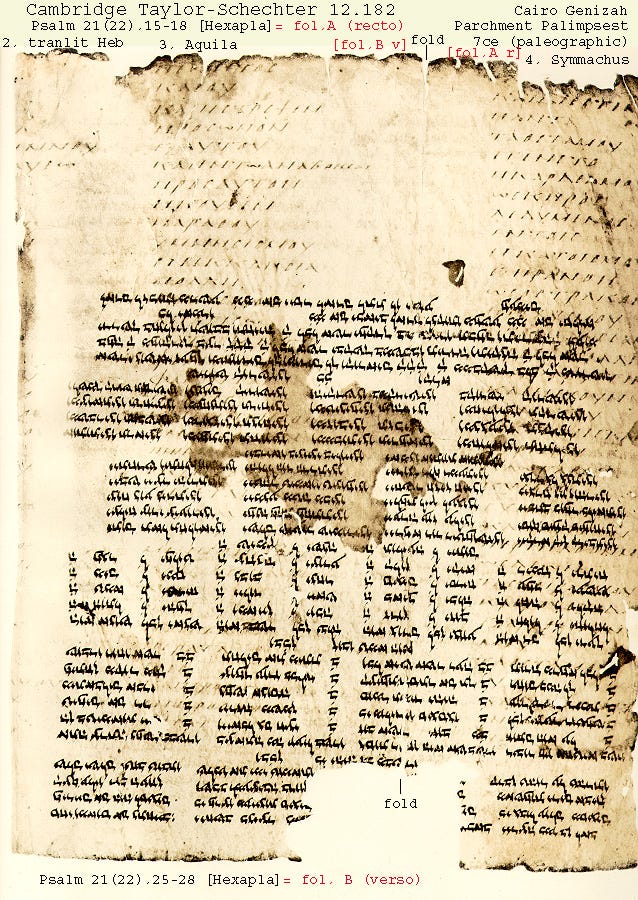
— A 7th c. fragment of Origen’s Hexapla (c. 240 AD), an interlinear translation compiling six different Greek and Hebrew textual traditions.
Since the Deuterocanonical writings belonged to the broader scriptural inheritance of the early Church, it should not surprise us to find the New Testament (NT) littered with allusions and references to them.
This is not to say that every allusion to a text within the NT immediately settles the question of that writing’s canonical status or importance. St. Paul cites pagan poets — obviously they are not canonical — and St. Jude can cite Enoch without requiring us to affirm 1st Enoch. My point is more modest, and therefore more difficult to evade: Christ and His Apostles were plainly familiar with the wider Jewish literary and theological world preserved in the LXX tradition. We turn once again to McDonald, who summarizes the matter well for us: “Origen, for example, believed that Jesus used and recognized the Wisdom of Solomon (Luke 11:49; Matt 23:35). Scholars have long acknowledged the significant parallels in word and thought with Paul’s arguments in Rom 1:18–3:20 and the Wisdom of Solomon. Stuhlmacher also draws attention to the close parallels between the series of proverbs in Jesus’ teachings in Matt 11:25–30 (see also Luke 10:21–22) to those found in Sirach (24:19; 51:1, 23, 26).” (McDonald, The Biblical Canon)
Jesus also makes several pointed allusions to 1st Maccabees during His Olivet Discourse. Though Christ refers to St. Daniel’s “abomination of desolation,” the image is filled out by the Maccabees: Antiochus’ men “set up the abomination of desolation upon the altar” in 1st Maccabees 1:54, and the faithful later flee to the mountains in 2:28. That is why St. Luke renders what St. Matthew & St. Mark call the “abomination of desolation” in their Gospel accounts as “Jerusalem surrounded by armies”: he is explaining the same sign for readers who may not understand the Maccabean shorthand. Even Jesus’ warning to pray that the Apostles’ flight from Jerusalem not be on the Sabbath recalls 1st Maccabees 2:29–41, where fugitive Judeans refuse to break the Sabbath and were slaughtered for it. So while Jesus most directly invokes St. Daniel, He clearly expects the Apostles to recognize these allusions to the Maccabean revolt.
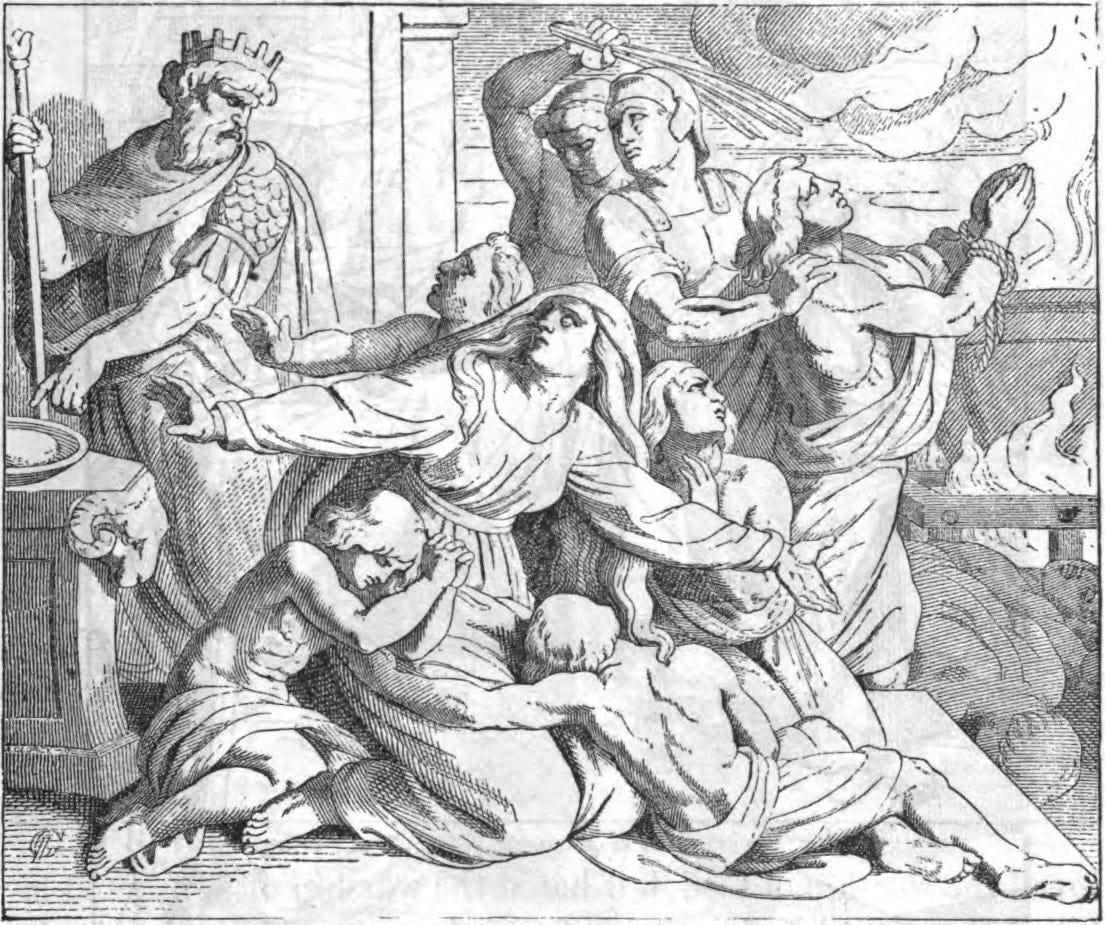
— The Seven Maccabean Martyrs and their mother are put to death by Antiochus Epiphanes (ill. 1873).
Indeed, the NT does not read as though its authors are ignorant of it. Quite the opposite:
Stuhlmacher, however, lists many parallels and allusions to this literature in the NT writings, for example:
Mark 10:19 appears to make use of Sir 4:1 alongside the canonical Exod 20:12–16 and Deut 5:16–20.
Second Timothy 2:19–20 appears to cite Sir 17:26 alongside the canonical Num 16:5.
It is likely that Paul uses Wis 14:22–31 in Rom 1:24–32 and Wis 2:23–24 in Rom 5:12–21.
In 1 Cor 2:9, Paul appears to cite as Scripture (“it is written”) either the Ascension of Isaiah 11:34 or a lost Elijah Apocalypse derived from Isa 64:3.
Jude 14 expressly mentions Enoch who “prophesied” and refers explicitly to 1 En. 1:9.
The author of 2 Pet 2:4 and 3:6 shows knowledge or awareness of 1 Enoch.
The author of Heb 1:3 makes clear reference to the Wis 7:25–26.
James 4:5 appears to cite an unknown Scripture.
The pseudepigraphal writings Life of Adam and Eve and Apocalypse of Moses have several parallels in the writings of the NT.
— The Biblical Canon (Part 2, Ch. 8.II)
The Wisdom of Solomon is one of the clearest demonstrations of this fact, and I would encourage the reader to examine the opening chapters of each book for themselves to put any doubt firmly to rest. St. Paul is plainly drawing from the same argument, in places with such close overlap that the dependency is difficult to deny without special pleading. Wisdom argues that all men know God from the beauty and order of creation, yet nevertheless they turned from the Creator to idolatry, which in turn became the beginning of moral corruption, and that sexual disorder and social collapse follow false worship. Romans 1-2 follows the same pattern.
The same problem appears for advocates of the Rabbinic canon when we turn from the NT to the Church’s continued use of the Deuterocanonical writings. Canon 2 of the Council of Trullo, later affirmed at the seventh ecumenical synod, Nicea II, endorsed the 85 Apostolic Canons as “handed down to us in the name of the holy and glorious Apostles.” Canon 85 lays out the Old and New Testament books considered to be “sacred” (emphasis mine):
Let the following books be counted venerable and sacred by all of you, both clergy and laity. Of the Old Testament, five books of Moses, Genesis, Exodus, Leviticus, Numbers, Deuteronomy; of Joshua the Son of Nun, one; of the Judges, one; of Ruth, one; of the Kings, four; of the Chronicles of the book of the days, two; of Ezra, two; of Esther, one; [some texts read of Judith, one;] of the Maccabees, three; of Job, one; of the Psalter, one; of Solomon, three, viz.: Proverbs, Ecclesiastes, and the Song of Songs; of the Prophets, twelve; of Isaiah, one; of Jeremiah, one; of Ezekiel, one; of Daniel, one. But besides these you are recommended to teach your young persons the Wisdom of the very learned Sirach. Our own books, that is, those of the New Testament, are: the four Gospels of Matthew, Mark, Luke, and John; fourteen Epistles of Paul; two Epistles of Peter; three of John; one of James, and one of Jude. Two Epistles of Clemens, and the Constitutions of me Clemens, addressed to you Bishops, in eight books, which are not to be published to all on account of the mystical things in them. And the Acts of us the Apostles.
— Canon 85, The Apostolic Canons
It should be noted, then, that the earliest canonical laws of the Church represent numerous Deuterocanonical texts as sacred, venerable, and suitable for instruction. Though not exhaustive, it is this basic OT — with minor variations and later clarifications — which appears in the ancient Church before the Great Schism. Afterwards, both the Latin Council of Trent and the Eastern Synod of Jerusalem would reaffirm the canonical status of the so-called Apocrypha.
Whatever complexities arise from this list — and there are certainly complexities — it will not do to answer that this canon list is not identical to Trent or Jerusalem. The Gospels hold a preeminence above the Apostolic epistles, yet no one imagines that this makes St. Paul’s writings any less canonical per se than St. Matthew’s. Likewise, the fact that Wisdom or Sirach may be distinguished in certain early canonical lists does not mean they were banished from the scriptural life of the Church. Such an objection misses the point, as the early Church’s canon was primarily liturgical, catechetical, and hierarchical. This is, in fact, what the word Deuterocanon means: a second canon — secondary in rank and preeminence, not secondary in truth, authority, or ecclesial use.
Even in the early Reformation period, when the Western consensus on the Canon had just begun to fracture, the liturgical usage of these books had not completely vanished. Bruce notes “In an appendix to [William Tyndale’s] 1534 revision of the New Testament he translated those Old Testament passages which were prescribed to be read in church as Epistles on certain days… e.g. Sir. 15:1–6 for St John the Evangelist’s Day (December 27), Wisdom 5:1–5 for St Philip and St James’ Day (May 1).” (Bruce, The Canon of Scripture)
But we need not turn to the Medieval era, as St. Athanasius makes this distinction even plainer, and for that very reason he is one of the most abused witnesses in the entire canon dispute. Gallagher writes (emphasis mine):
Athanasius himself cites the Wisdom of Solomon three times under the label γραφή (graphē, “writing” or “scripture”), though in his canon list, this book appears among the anaginoskomena (books for reading but not in the canon) intended for catechumens. He also freely cites other writings in his anaginoskomena, including Sirach and the Shepherd of Hermas.
— Edmon L. Gallagher, Translation of The Seventy (Section II.4)
Gallagher is right to note the distinction, but draws the wrong conclusion. If St. Athanasius cites Wisdom as graphē, then Wisdom is functioning for him as Scripture. If he places it among the anaginoskomena, that still means it is a book appointed for reading in the Church, especially for novices being brought into the faith. Thus, when Gallagher says Wisdom appears among books “for reading but not in the canon,” he begs the question as that is precisely what is in dispute.
If by canon one means St. Athanasius’s primary tier of Scripture, then the statement is true enough, but that is clearly not the sense in which Gallagher understands it. If by canon we mean what this series has meant from the beginning — writings received, read, taught, preserved, and treated as binding within the life of the Church — then clearly Wisdom falls under that category. St. Athanasius’s canonical list must be interpreted in light of his praxis: if a book is cited as Scripture and read to those entering the Church, then it is functioning canonically in the very sense established at the outset of this series. Consequently, whatever distinction blessed St. Athanasius is making, it is a distinction of rank and use — not a later Reformation distinction between “inspired” Scripture and “uninspired” religious literature.
These facts do not support the later Protestant demotion of Wisdom or Sirach — they flatly contradict it.
The debate between the MT & the LXX is both a question of manuscripts and a question of interpretive authority.
Ancient or proto-Hebrew was written as a consonantal text lacking any vowels, meaning that to read or translate it necessitated an oral tradition: the vowels had to be supplied by the reader according to the tradition he had inherited. To use a crude English analogy, if English were written this way, the consonants SLP might be read as sleep, slip, or slap, depending upon which vowels were supplied. Quite obviously, the addition of vowels can radically alter a word’s meaning. Therefore, when one appeals to the MT as the Hebrew, he is — at minimum — actually appealing to the Masoretic interpretive tradition placed upon it.
By the time the Masoretic tradition comes down to us in its mature form, the synagogue had already rejected Christ, rejected the Church’s use of the LXX, rejected the broader canon, and produced rival Greek translations to blunt the force of Christian prooftexts. To pretend, after all of this, that the MT may simply be received as a neutral preservation of “the Hebrew Bible” strikes this author as dangerously naïve.
I do not make this charge lightly, for it is a grave thing to suggest that those to whom the oracles of God were entrusted would later alter or excise portions of the very Scriptures placed into their care. Truly, it is hideous to imagine. But if the rulers of Israel could disfigure the living Icon of God, the Eternal Son who stood before them in flesh, is it truly unthinkable that their spiritual and physical heirs would disfigure the written witnesses which also testified of Him?
I, for one, do not find such a thing difficult to believe, and neither did the early Church.
We turn once again to St. Justin Martyr, who stands amongst the earliest witnesses to this controversy (emphasis mine):
… from the sayings of Jeremiah they have cut out the following: ‘I [was] like a lamb that is brought to the slaughter: they devised a device against me, saying, Come, let us lay on wood on His bread, and let us blot Him out from the land of the living; and His name shall no more be remembered.’ (Jeremiah 11:19). And since this passage from the sayings of Jeremiah is still written in some copies [of the Scriptures] in the synagogues of the Jews (for it is only a short time since they were cut out), and since from these words it is demonstrated that the Jews deliberated about the Christ Himself, to crucify and put Him to death, He Himself is both declared to be led as a sheep to the slaughter, as was predicted by Isaiah, and is here represented as a harmless lamb; but being in a difficulty about them, they give themselves over to blasphemy.
— St. Justin Martyr, Dialogue with Trypho (Ch. 72)
Here we have concrete testimony to the earliest stages of this editing process, an ongoing and living textual struggle within the synagogue. Jeremiah’s lamb, like Isaiah’s sheep, had become a weapon in the Church’s proclamation of the Passion.
St. Irenaeus of Lyon, writing around 180 AD, echoes similar charges as those made in Dialogue with Trypho. Like St. Justin, St. Irenaeus focuses on Isaiah 7 (emphasis mine):
God, then, was made man, and the Lord did Himself save us, giving us the token of the Virgin. But not as some allege, among those now presuming to expound the Scripture, [thus:] Behold, a young woman shall conceive, and bring forth a son, (Isaiah 7:14) as Theodotion the Ephesian has interpreted, and Aquila of Pontus, both Jewish proselytes. The Ebionites, following these, assert that He was begotten by Joseph; thus destroying, as far as in them lies, such a marvellous dispensation of God, and setting aside the testimony of the prophets which proceeded from God. For truly this prediction was uttered before the removal of the people to Babylon; that is, anterior to the supremacy acquired by the Medes and Persians. But it was interpreted into Greek by the Jews themselves, much before the period of our Lord’s advent, that there might remain no suspicion that perchance the Jews, complying with our humour, did put this interpretation upon these words. They indeed, had they been cognizant of our future existence, and that we should use these proofs from the Scriptures, would themselves never have hesitated to burn their own Scriptures, which do declare that all other nations partake of [eternal] life, and show that they who boast themselves as being the house of Jacob and the people of Israel, are disinherited from the grace of God.
— St. Irenaeus of Lyon, Against Heresies (Book III, Ch. 21)
Given the conduct of the rabbis in the late second century, it is hard not to share such pessimistic sentiments. Contrasting a pre-Christian Jewish witness with post-Christian Jewish revisions, St. Irenaeus notes how the older LXX translation affirmed what the Church said. Tertullian, writing around the same time period, preserves the same sentiment. Though he would later depart into the Montanist heresy, his testimony here remains valuable because it shows how widespread this accusation had become by 200 AD. In On the Apparel of Women, he notes that the Jews rejected Enoch (which he considers to be Scripture in a loose sense) “for that [very] reason, just like all the other [portions] nearly which tell of Christ.”
Origen, writing in the early third century, sharpens the accusation in his Letter to Africanus. Africanus had objected to the story of Susanna because it was absent from the proto-Masoretic version of Daniel. Though later condemned for his heretical theology, Origen’s reply, while lengthy, is crucial to reproduce here (emphasis mine):
Why then is the History not in their Daniel, if, as you say, their wise men hand down by tradition such stories? The answer is, that they hid from the knowledge of the people as many of the passages which contained any scandal against the elders, rulers, and judges, as they could, some of which have been preserved in uncanonical writings (Apocrypha). As an example, take the story told about Esaias; and guaranteed by the Epistle to the Hebrews, which is found in none of their public books. For the author of the Epistle to the Hebrews, in speaking of the prophets, and what they suffered, says, They were stoned, they were sawn asunder, they were slain with the sword. To whom, I ask, does the sawn asunder refer (for by an old idiom, not peculiar to Hebrew, but found also in Greek, this is said in the plural, although it refers to but one person)? Now we know very well that tradition says that Esaias the prophet was sawn asunder; and this is found in some apocryphal work, which probably the Jews have purposely tampered with …
In the blood of what prophets, can any one tell me? For where do we find anything like this written of Esaias, or Jeremias, or any of the twelve, or Daniel? Then about Zacharias the son of Barachias, who was slain between the temple and the altar, we learn from Jesus only, not knowing it otherwise from any Scripture. Wherefore I think no other supposition is possible, than that they who had the reputation of wisdom, and the rulers and elders, took away from the people every passage which might bring them into discredit among the people. We need not wonder, then, if this history of the evil device of the licentious elders against Susanna is true, but was concealed and removed from the Scriptures by men themselves not very far removed from the counsel of these elders.
— Origen, Letter to Africanus (§9-10)
The author of Hebrews knows of a prophet sawn asunder; Christ speaks of Zechariah slain between the temple and altar; yet these stories are plainly not found in the Rabbinic canon. The story of Susanna is emblematic of this as it records a scathing indictment of wicked elders and the corruption of authority. The very class condemned by such stories had motive to suppress them, and that is precisely what Origen argues.
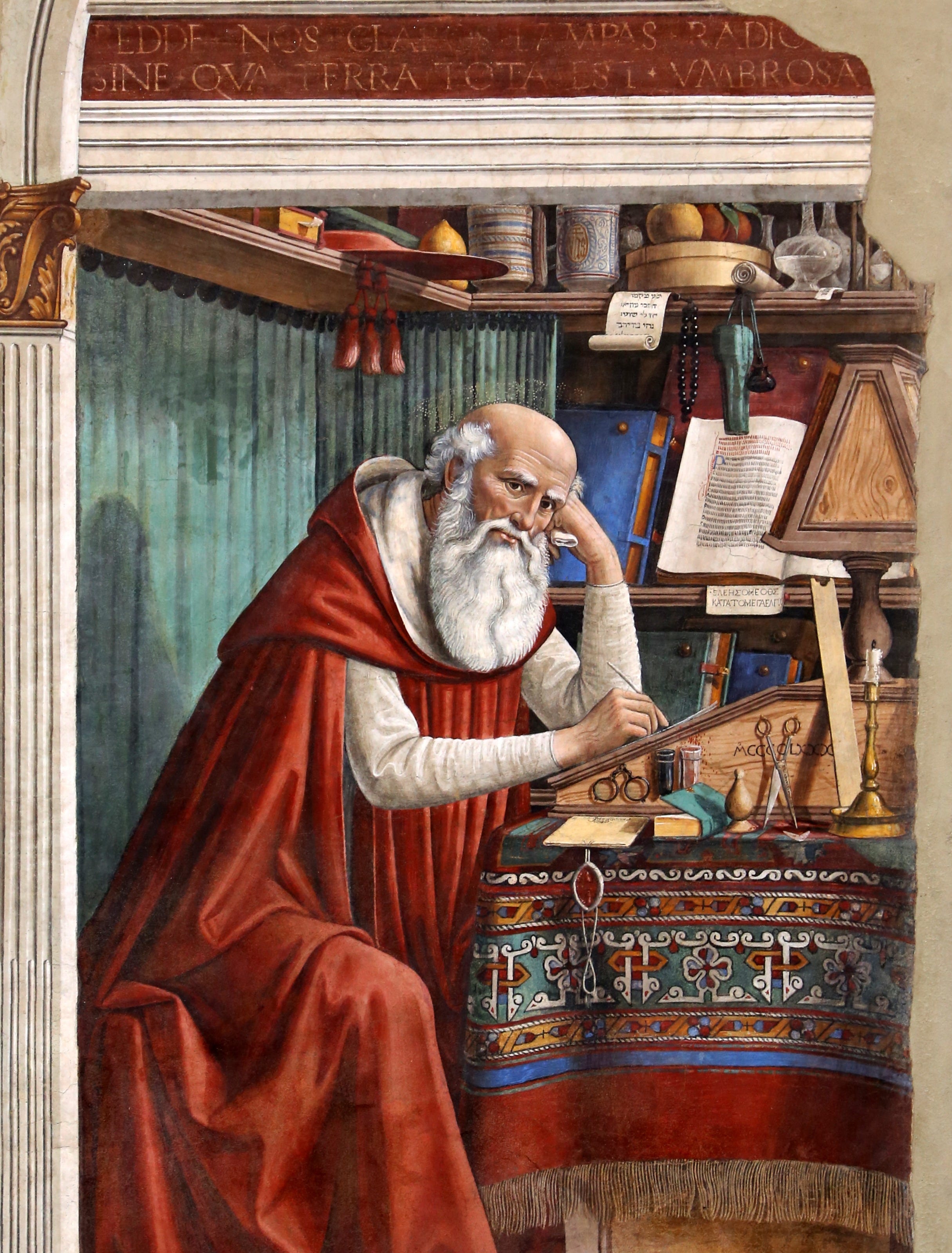
— St. Jerome of Stridon in his study, ill. by Domenico Ghirlandaio.
St. Jerome is, perhaps, the most inconvenient witness of all. Writing in the late fourth and early fifth century, St. Jerome is the Father most associated with the Western turn toward the Hebrew text. If any Father could be expected to defend the Hebrew tradition against the LXX, it would be him. Yet, in his commentary on Galatians, when he compares St. Paul’s OT citation, the LXX, the Jewish manuscripts, and the Samaritan text, he reaches precisely the same conclusions as his forebears. In analyzing Galatians 3:10, St. Jerome notes (emphasis mine):
Whenever the apostles quote from the Old Testament, it is my custom to revert to the sources of these quotations and to scrutinize the quotations in their original context. I have found that this verse from Deuteronomy is rendered by the translators of the Septuagint as, “Cursed is everyone who does not continue in all of the words of this law and do them; and all the people will say, ‘Let it be done!”’ … From the above we infer that the Apostle, here as on other occasions, has captured the sense of a passage rather than its mere words. We do not know for certain whether the Seventy added “everyone” and “in all” or whether these words had been present in the original Hebrew text but later excised by the Jews. I am inclined to believe that the Apostle, a man of Hebrew learning and exceptionally well-versed in the Law, would never have added these words, as if they were necessary to prove that all who rely on keeping the Law are under a curse, unless they were in the Hebrew manuscripts. This led me to read through the Hebrew manuscripts of the Samaritans. I found the word chol, which means “everyone” or “in all” and agrees with the Septuagint translators. The Jews expunged these words to avoid looking as if they were under a curse for failing to comply with everything that is written. Their efforts, however, were in vain, for the ancient literature of another nation testifies that these words had originally been present.
— St. Jerome of Stridon, Commentary on Galatians (Book II)
St. Jerome: the great Western Hebraist, the man who did more than almost anyone else to turn the Latin West toward the Hebrew textual tradition. And yet here, when the evidence is placed before him, he follows the Apostolic witness. When these witnesses divide, Jerome does not enthrone the Rabbinic text.
Nor is the idea of scribal alteration merely a Christian accusation. The Jewish Encyclopedia itself admits that “Tannaitic sources mention several passages of Scripture in which the conclusion is inevitable that the ancient reading must have differed from that of the present text. … R. Simon b. Pazzi, an amora of the third century, calls these readings “emendations of the Scribes” … assuming that the Scribes actually made the changes. This view was adopted by the later Midrash and by the majority of Masorites.” Truly, given the mountain of Apostolic, Patristic, Septuagintal, and even Rabbinic evidence arrayed here, lazy appeals to the MT as “the Hebrew” can, and should, be firmly put to rest.
Chapter III will therefore leave the realm of history and place the textual witnesses side by side. If the Fathers are correct, as we argue, then the divergences between the LXX and MT should appear most sharply where the stakes are highest: in the Messianic prophecies, in the chronology of redemptive history, and the Gospel texts upon which the Apostles built their proclamation of the crucified and risen Christ.
That is precisely what we find.
Continued in Part III…
— Erasing the Messiah II, digital art, 2026.
Get Scipio’s latest book, The Empire of Lies: the American Empire unmasked.
Buy Anatomy of a Revolution today!
Information is a weapon. Arm your family and friends.
Hit the Tip Jar and help spread the message!
This post contains affiliate links, which means I may receive a commission or affiliate fee for purchases made through these links.
Meet Scipio & get practical tools for wellness and preparedness at the Sovereign Health Summit — save 5% with promo code SCIPIO.
Unlock the mysteries of Biblical cosmology and enrich your faith with some of the top rated Christian reads at BooksOnline.club.
Expand your horizons @ BooksOnline.club!
Click the image below and be sure to use promo code SCIPIO for 10% off your order at HeavensHarvest.com: your one stop shop for emergency food, heirloom seeds and survival supplies.
Further Research
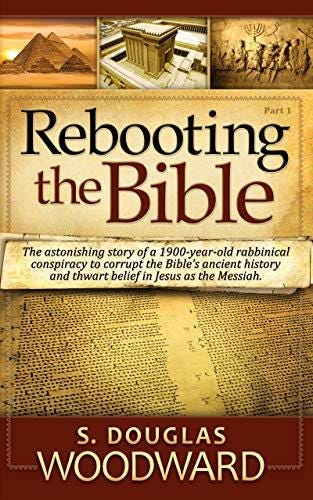
Rebooting the Bible: Exposing the Second Century Conspiracy to Corrupt the Scripture and Alter Biblical Chronology (Part 1) by S. Douglas Woodward
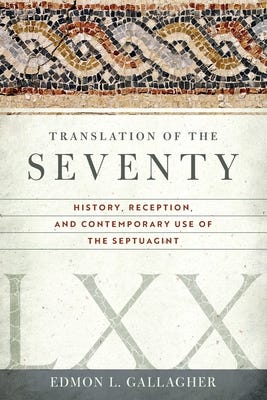
Translation of the Seventy: History, Reception, and Contemporary Uses of the Septuagint by Edmon L. Gallagher
The Septuagint: What It Is and Why It Matters by Gregory R. Lanier & William A. Ross
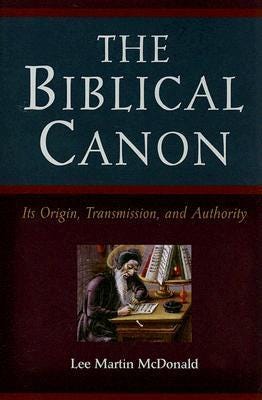
The Biblical Canon: Its Origin, Transmission, And Authority (3rd Edition) by Lee Martin McDonald
The Formation of the Biblical Canon, Volume I: The Old Testament: Its Authority and Canonicity by Lee Martin McDonald
Comments
Nothing yet. Say the first thing.
Sign in to join the conversation.