
When people tell me their agent system is inconsistent, they usually show me prompts.
They rewrite instructions, add constraints, add examples, tweak tone, tighten tool descriptions, and run the same workflow again. Sometimes output improves for a day. Then drift comes back.
The reason is simple: they are trying to solve a memory problem with instruction tuning.
If your system cannot remember the right thing at the right layer, no prompt can save it for long. The model will still produce fluent outputs. The system will still fail.
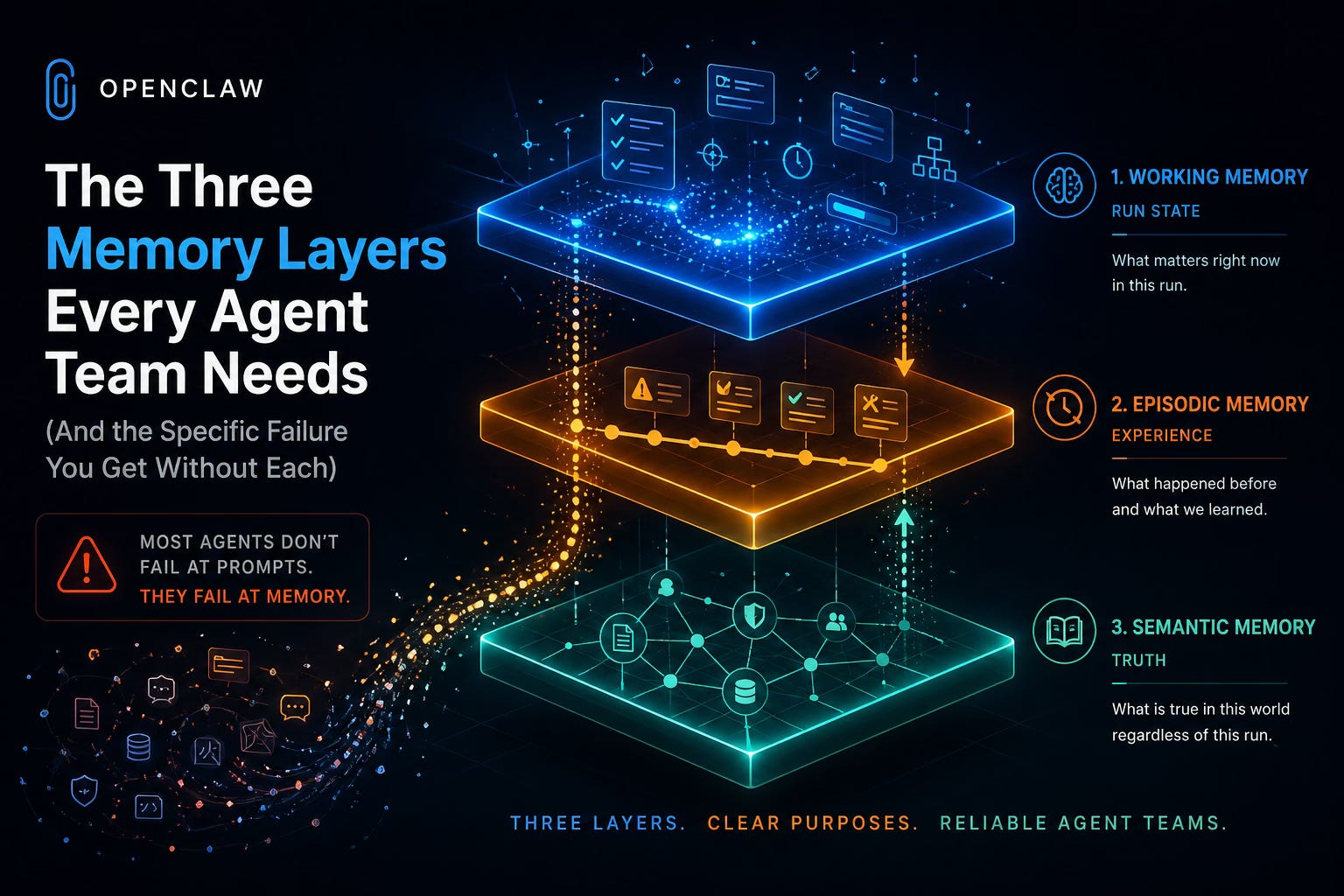
Most teams need at least three distinct memory layers:
Working memory — what matters right now in this run.
Episodic memory — what happened in prior runs and why.
Semantic memory — stable truths about your domain, policies, entities, and constraints.
Put all three into one blob and you get random behavior. Skip one entirely and you get a predictable failure mode. Treat memory as a first-class architecture decision, and your reliability curve changes.
This post is a map of those three layers: what each is for, what fails when it is missing, and how to wire each one without building a research project.
Before details, use this:
Working answers: What is this run trying to do right now?
Episodic answers: What happened last time and what should we avoid repeating?
Semantic answers: What is true in this world regardless of this run?
If a piece of information does not have a clear answer to one of those questions, it usually does not belong in memory at all.
A prompt-only setup often starts strong in demos because the constraints are all visible and fresh. In production, two things happen:
The system sees more variation than the prompt anticipated.
The prompt becomes a dumping ground for data that should live elsewhere.
Now your “memory” is half instructions, half stale context, half policy notes, and half old incidents. Yes, that is four halves. That is what it feels like to debug.
The downstream pattern is familiar:
Agent repeats solved mistakes because it cannot recall prior outcomes.
Agent ignores stable business rules because they are buried in run-local context.
Agent overfits to the current run and loses long-horizon priorities.
You do not fix that with a better adjective in line 87 of your system prompt.
You fix it by separating memory responsibilities.
Comments
Nothing yet. Say the first thing.
Sign in to join the conversation.