
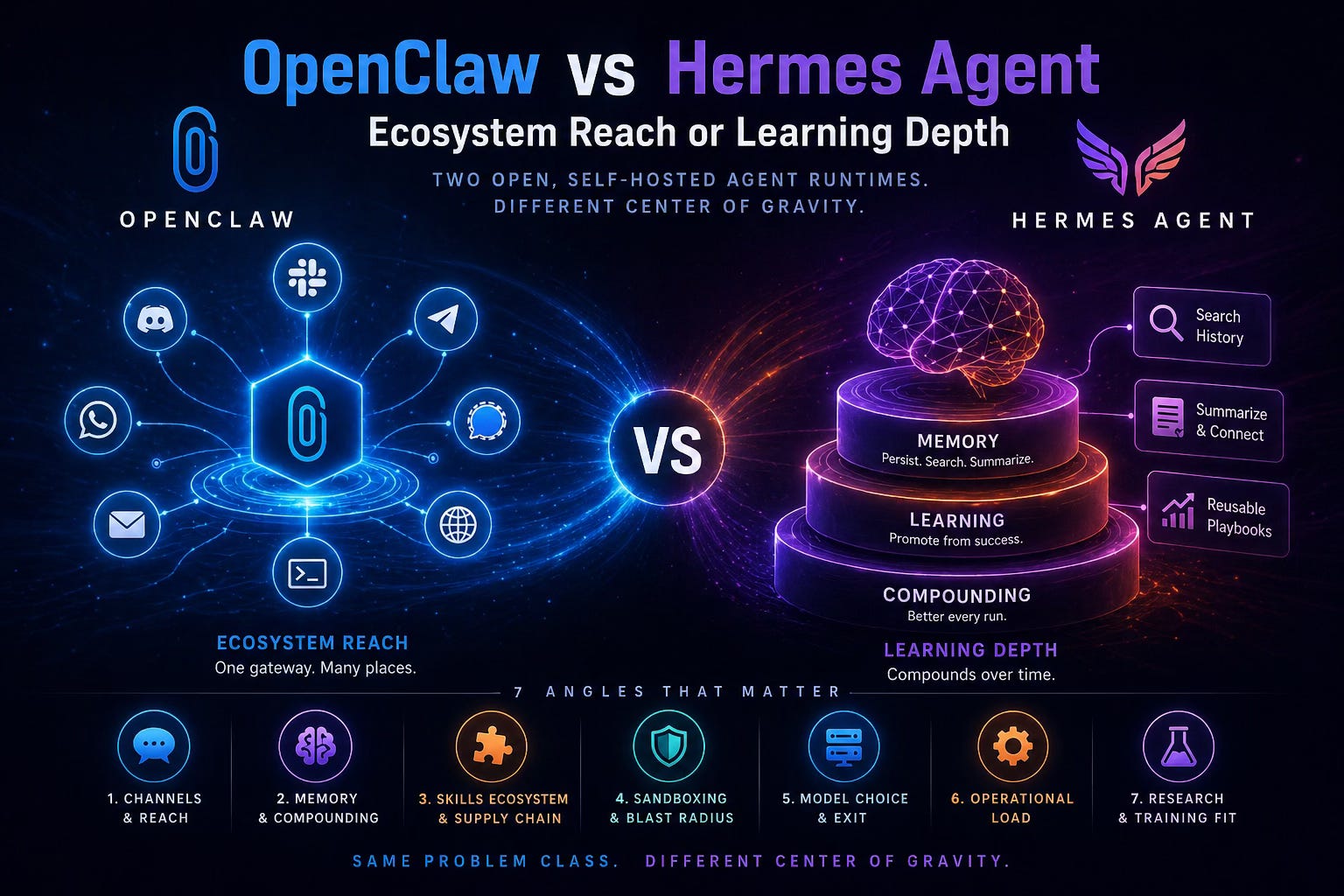
If you have only used chat in a browser, the "agent" you know is built to end when the session ends. The product is a stateless loop: model, tools, maybe a memory file you curate by hand. It can be excellent. It is not the same thing as a process that runs for weeks, holds a cross-channel presence, and keeps its own house in order.
OpenClaw and Hermes Agent are both aimed at that second thing: a persistent agent runtime on hardware you control, reachable from the places you already talk to people and bots (messengers, CLI, and so on). They are both MIT-licensed, both model-agnostic in spirit, and both far enough along that you can run them seriously if you accept the ops burden.
This piece is not a star-count contest. The structure is simple: seven angles that matter to operators. Under each angle, both stacks are compared in the same terms so you are not reading two parallel product reviews that never meet. The goal is a decision matrix you can score yourself, not a winner declaration.
The angles, in order, are: (1) channels and reach, (2) memory and compounding behavior, (3) skills ecosystem and supply chain, (4) sandboxing and blast radius, (5) model choice and exit, (6) operational load, (7) research and training fit. You do not need equal weight on every row. A security-heavy team might weight 3 and 4 heavily and treat 7 as optional. A product team chasing adoption might weight 1 and 6 and accept manual memory hygiene. Before you read, decide which two or three rows are veto-grade for your org. If a candidate fails a veto row in your bake-off, the rest of the matrix is entertainment.
Before the angles, two rules for any bake-off: one workload, one definition of done (not two unrelated demos), and freeze the model, tools, secrets, and logs so you are changing the runtime, not everything at once. Run one controlled failure per stack in a throwaway profile. Write down what would change your mind before you install either path.
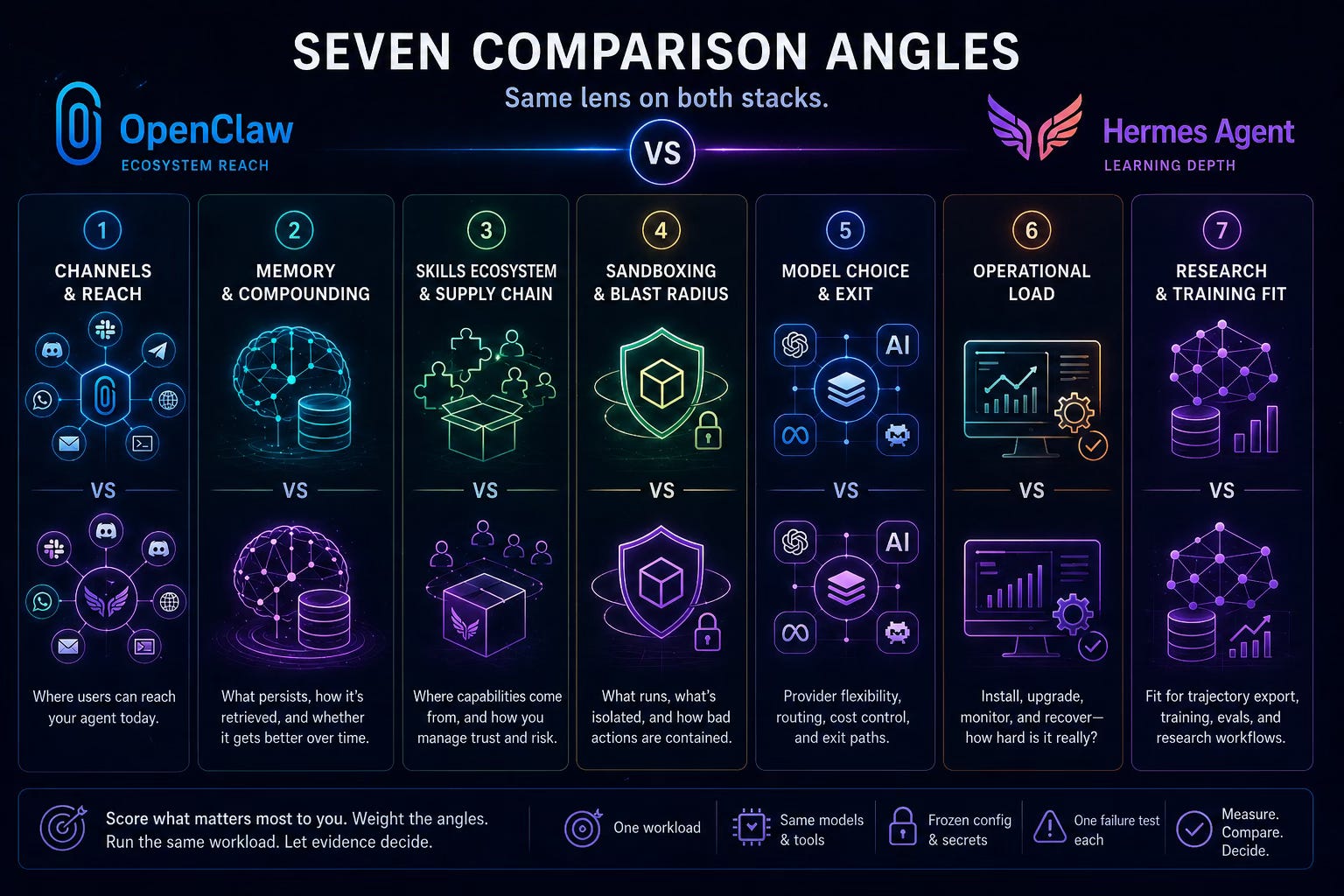
Figure: Seven comparison angles — same lens on both stacks (reach, memory, skills, sandbox, models, ops, research fit).
Session-native assistants have gotten better at persistence. They still start from a UX designed around disposable context. OpenClaw and Hermes Agent assume long-lived processes: gateways, tool policies, memory substrates, and upgrade paths that treat the agent as a service. That implies backups, patch policy, and clarity on who may install automation that reads mail or touches repos. Neither stack replaces human judgment about scope; they change whether judgment lives only in prompts or also in runtime policy and artifact hygiene.
Question: Where can users reach the agent today, without your team rebuilding internal habits?
OpenClaw popularized one gateway, many channels: messengers and surfaces routed into one runtime so the same logical presence shows up across apps. Long-tail coverage matters when procurement standardized on one vendor next quarter or when your exec lives in Signal and engineers live in Slack. Reach is OpenClaw's headline strength: breadth of integrations and hosting stories in the wild.
Hermes Agent covers the usual suspects (messengers, CLI, mail in the mix depending on release and config). Its pitch centers less on catalog size and more on persistence and growth over time; verify the channel list against your mandatory surfaces before you assume parity. Where Hermes shines is rarely "we wired more adapters first"; it is meet me where I already am plus everything afterward compounds.
Verdict hinge: If a specific long-tail channel is non-negotiable, start with the current integration matrix for each project, not with a blog post. If "as many options as possible" reduces friction across a chaotic org, reach favors OpenClaw-shaped setups. If your only surface is one internal chat system, you are testing quality of the single path (delivery, threading, rate limits), not count of logos in a README.
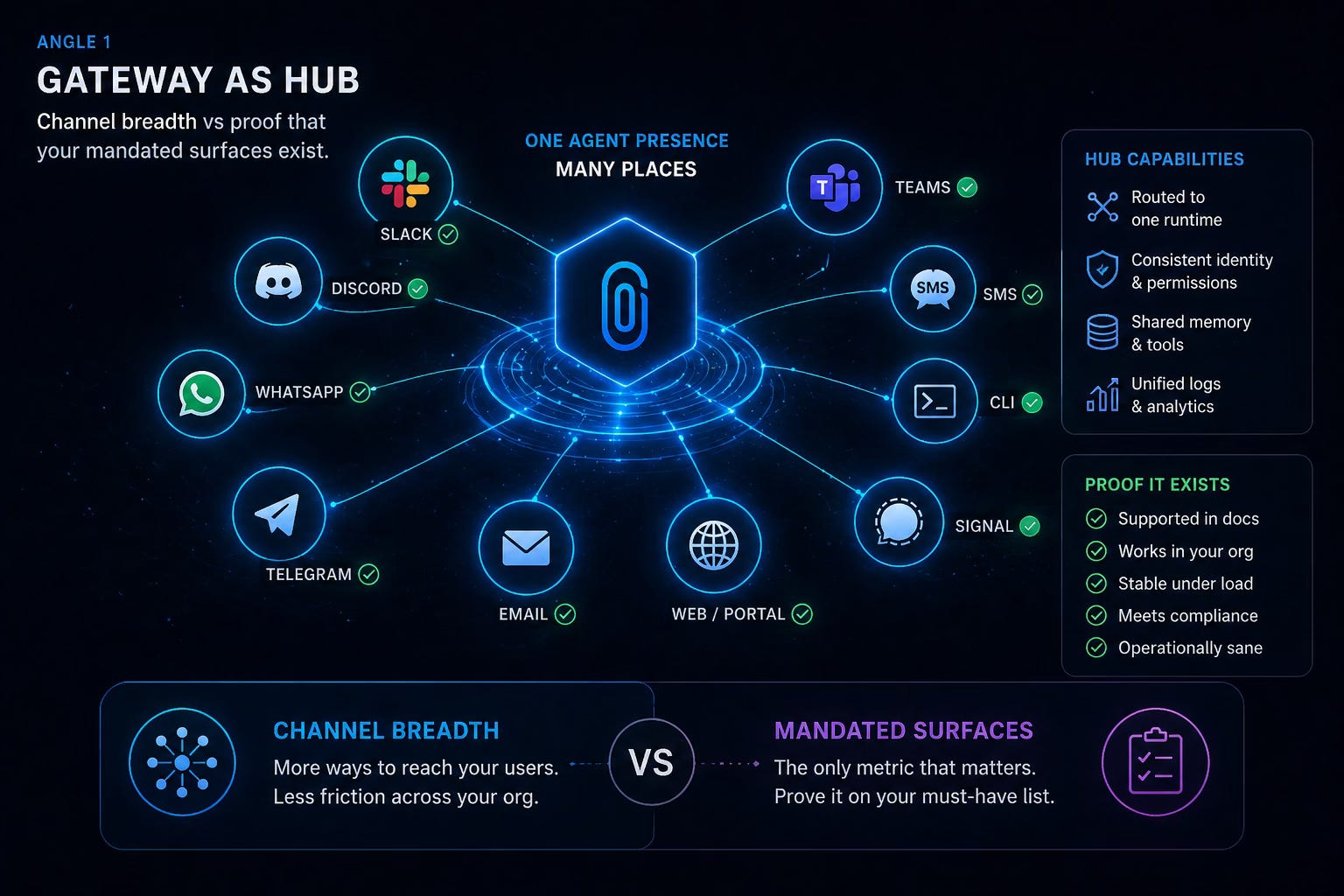
Figure: Angle 1 — Gateway as hub; channel breadth vs proof that your mandated surfaces exist.
Question: What persists automatically, how retrieval behaves under load, and whether follow-up work gets cheaper week over week?
Hermes Agent emphasizes persistent memory as product DNA: searchable history layered with summarization, continuity across sessions without you hand-maintaining a scratch file every Monday, and artifacts promoted from runs that succeeded so the agent accumulates playbook. That is the "grows with you" story in concrete terms.
OpenClaw carries structured persistence as part of running a gateway-backed assistant (sessions, relationships to context, accumulation over time). Strength varies by deployment and skill usage; operators often tailor memory behavior via configuration and ecosystem pieces. Compare both under your workload: Does retrieval stay usable after weeks of chatter? Does one operator stepping on another's conversation corrupt shared state? After a long weekend, does the agent still know what "the release" refers to without you pasting a recap?
Multi-operator note: If two humans share one agent, you are not scoring "memory" in the abstract. You are scoring namespace boundaries and conflict resolution when both file context at the same time. Run a two-person test week and look for silent overwrites, merged goals, and summary text that sounds like a third person who has not read your org chart.
Shared vocabulary trap: Both say "memory." Inspect what is stored, who can see it, how eviction works, and failure modes (stale summaries, hallucinated retrieval, accidental sharing if profile lines blur).
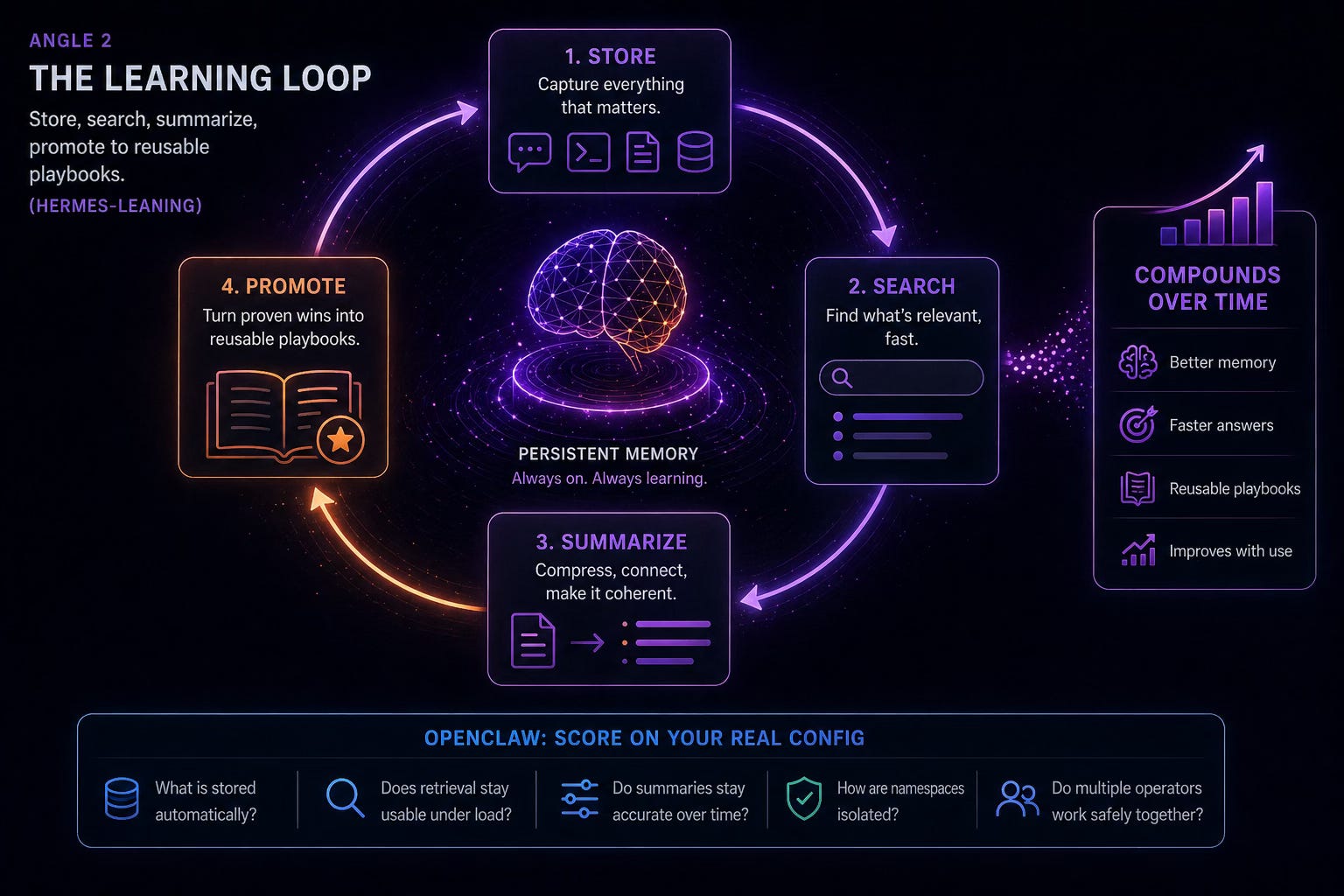
Figure: Angle 2 — Store, search, summarize, promote to reusable playbooks (Hermes-leaning); OpenClaw must be scored on your real config.
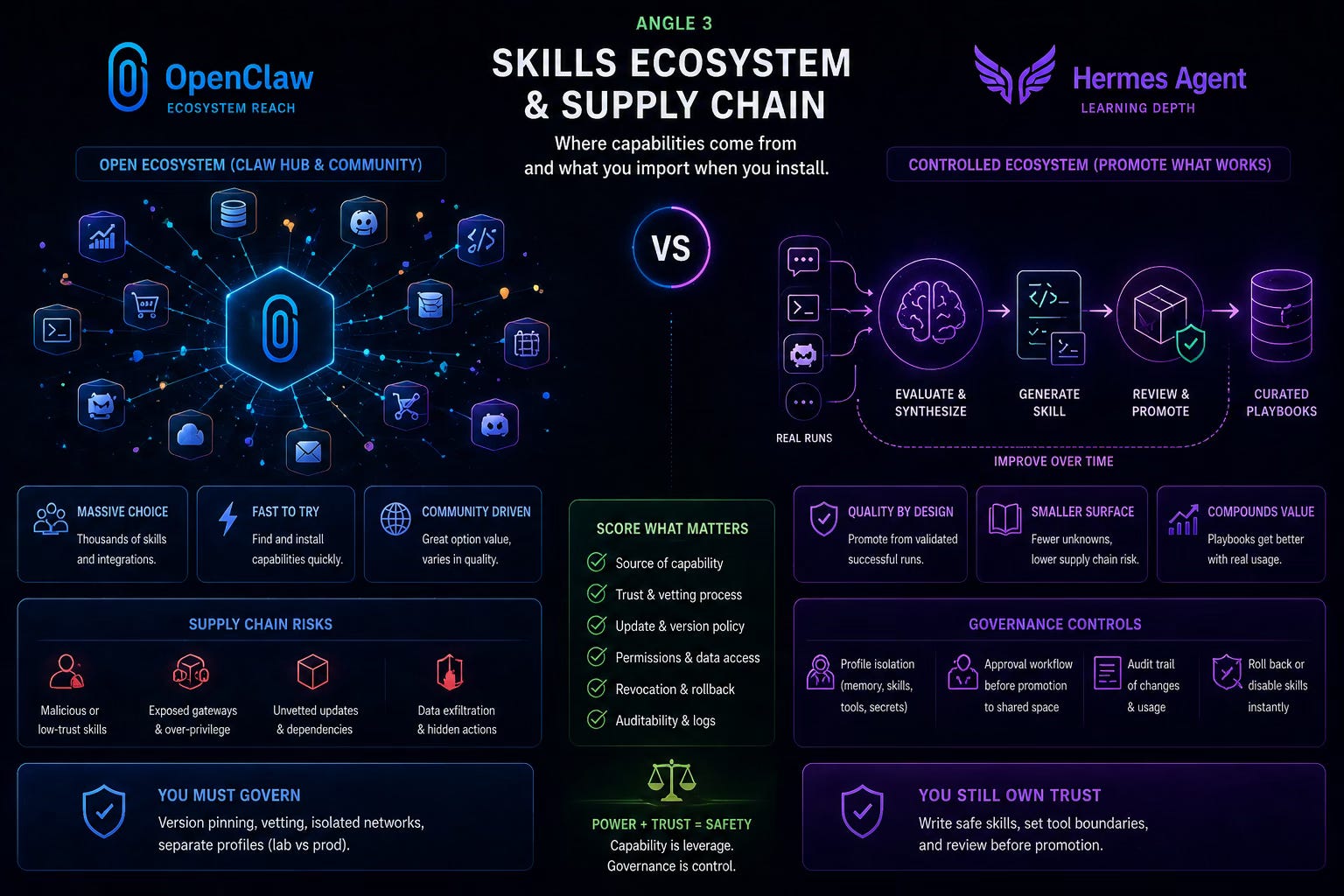
Question: Where do capabilities come from, and what are you importing when you say install?
OpenClaw sits on a large public skills ecosystem (ClawHub and community). That is option value: skills near what you need without writing from scratch. It is also supply chain: you are loading others' code into a high-privilege process. Documented incidents have included malicious or low-trust entries and exposed gateways when install velocity outran operator maturity. Governance is not optional: version pins, isolated networks, vetting rules for anything that can exfiltrate data or spend money, and split prod vs lab profiles.
Hermes documents auto-generated skills from successful runs and a more conservative relationship to a giant public bazaar; you may write more by hand early, or import selectively where stories exist. Smaller attack surface in the registry sense, not a promise of zero risk: your own prompts and tools can still hurt you.
Verdict hinge: Bazaar + your process for approvals → OpenClaw-shaped. Crystallized playbooks from real runs and tight control over what gets promoted → Hermes-shaped. If one team says "skills" meaning registry packages and another means learned routines, align definitions before you score this row.
Practical test: Install one low-trust community skill in a quarantine profile, not in production. Watch what it can read, which network calls it makes, and what the logs look like when you revoke it. The stack that makes revocation and auditing legible wins this row for regulated or high-stakes teams, even if the other stack has more packages in the directory.
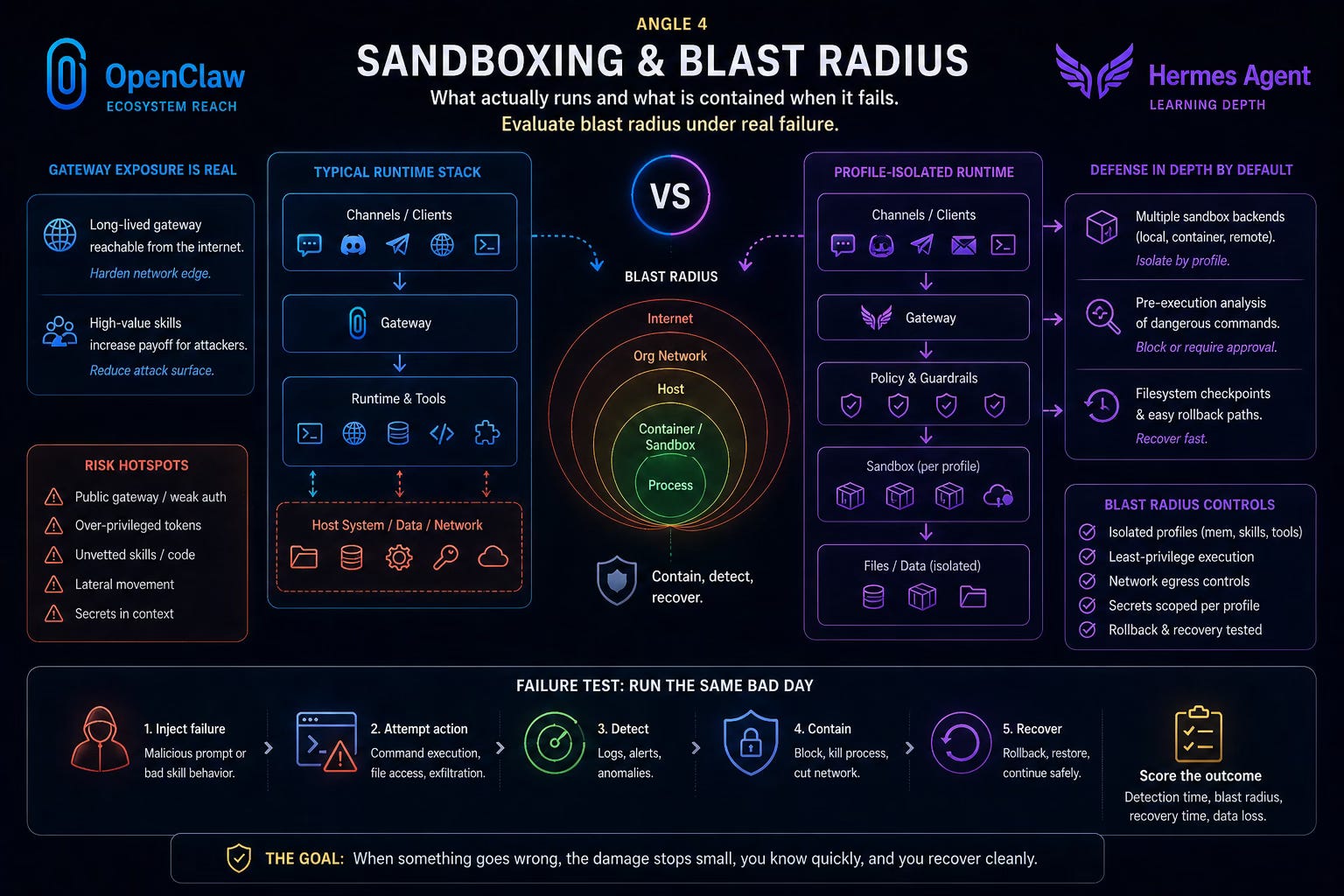
Question: What actually runs when the model calls shell, browser, or file tools? What is isolated, and what is the recovery path after a bad action?
Hermes foregrounds multiple sandbox backends (local, container, remote, etc., version-dependent), pre-execution analysis of dangerous commands in the documentation, filesystem checkpoints on some paths, and profiles that isolate configuration, memory, and skills so a lab install does not nuke production. The story is "defense in depth + smaller blast radius per profile."
OpenClaw operators must implement the same seriousness: gateway exposure is a real class of risk, and high-value skills increase the payoff for attackers. Sandboxing and least privilege are project and deployment dependent; the ecosystem size does not remove your need to read current security guidance and test failure injection.
Verdict hinge: Neither logo wins. You score this by your threat model: untrusted chat input, supply-chain skills, cross-tenant data, and insider mistakes. Run the same failure script on both stacks in a throwaway profile and read the logs.
Split the problem: Network edge (who can hit the gateway) and execution edge (what happens when shell runs) are different layers. OpenClaw stories often emphasize exposure of long-lived gateways to the internet if misconfigured; Hermes stories emphasize container profiles and scanners. Your deployment might fix the first layer with VPC rules while the second layer remains your sandbox backend. Score both independently so marketing language does not collapse two risks into one checkbox.
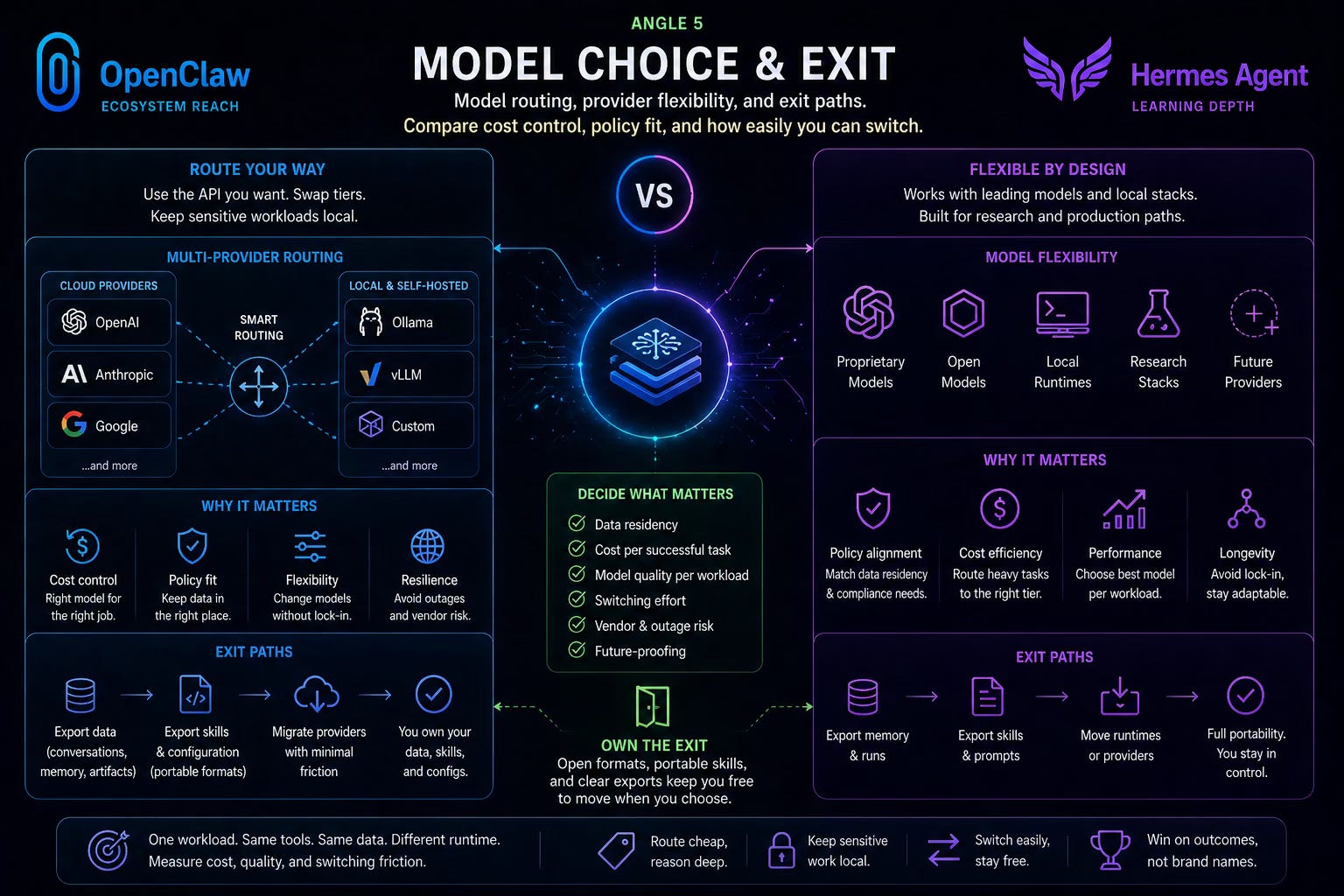
Question: Can you switch providers, split cheap triage from heavy reasoning, and export state if you leave?
OpenClaw is explicit about model agnosticism and routing: use the API you want, swap tiers, keep a local path for sensitive tool classes. That matters for cost discipline and policy (certain data never leaves a region).
Hermes is built to use major LLM providers and also supports serious local and research workflows; routing story is strong for teams that want one stack to span chat and trajectory generation without two products.
Exit: both are open source, but your data still needs a plan. Export memories, skills, and config; document where the SQLite (or equivalent) lives. Whichever stack makes that legible in your installation wins this cell for you.
Cost routing: If the business problem is "we are paying for the wrong model for 60% of requests," both stacks can help in principle, but you will only know if you log per-surface and per-workload cost in the bake-off. Do not compare list prices; compare dollars per successful end state for the one workflow you defined at the top of the article.
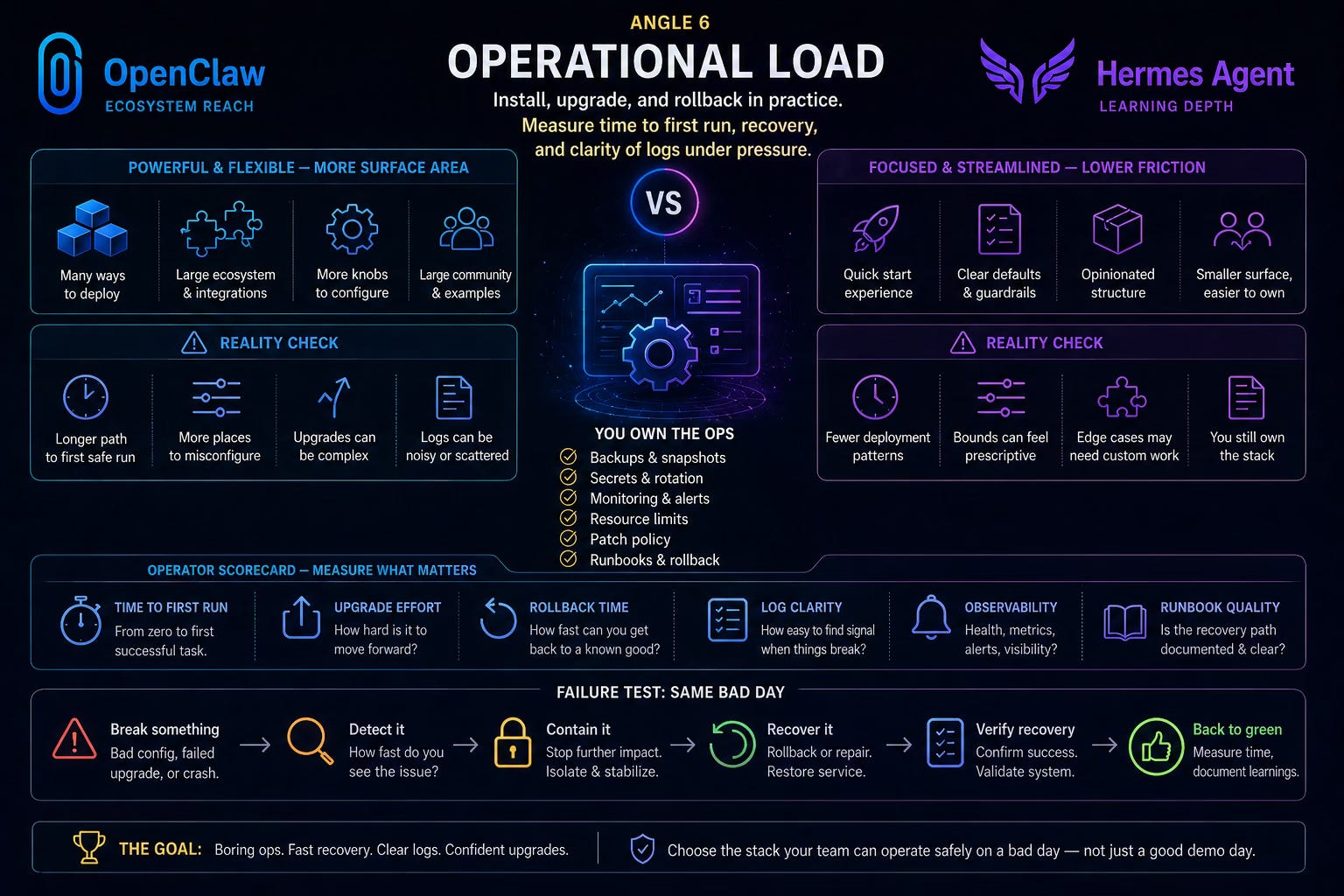
Question: How long from zero to first safe run, how often can you patch, and who can redeploy last week's config in under an hour?
OpenClaw has a long public history and a broad operator base: more writeups, more ways to foot-gun, more expectation that you own the full stack. Upgrade discipline matters: pin versions, read changelogs, keep a rollback path.
Hermes is often described as smoother to stand up for a focused use case; release cadence and maturity differ. Score this with a clock: time to first successful task, time to recover from a failed upgrade, and clarity of logs when the gateway misbehaves.
Verdict hinge: Large team with platform muscle may absorb OpenClaw's surface area. Small team with one owner might prefer the stack that matches mean time to rollback with their actual on-call reality.
Ops scorecard (write it down): (1) time to first working message end to end, (2) command you run for upgrade, (3) command or file set for rollback, (4) where logs land, (5) on-call runbook one-pager. If any of these is "we will figure it out when it breaks," stop and fix that before you pick a winner. A fast install on day one that you cannot patch on day thirty is a net loss.
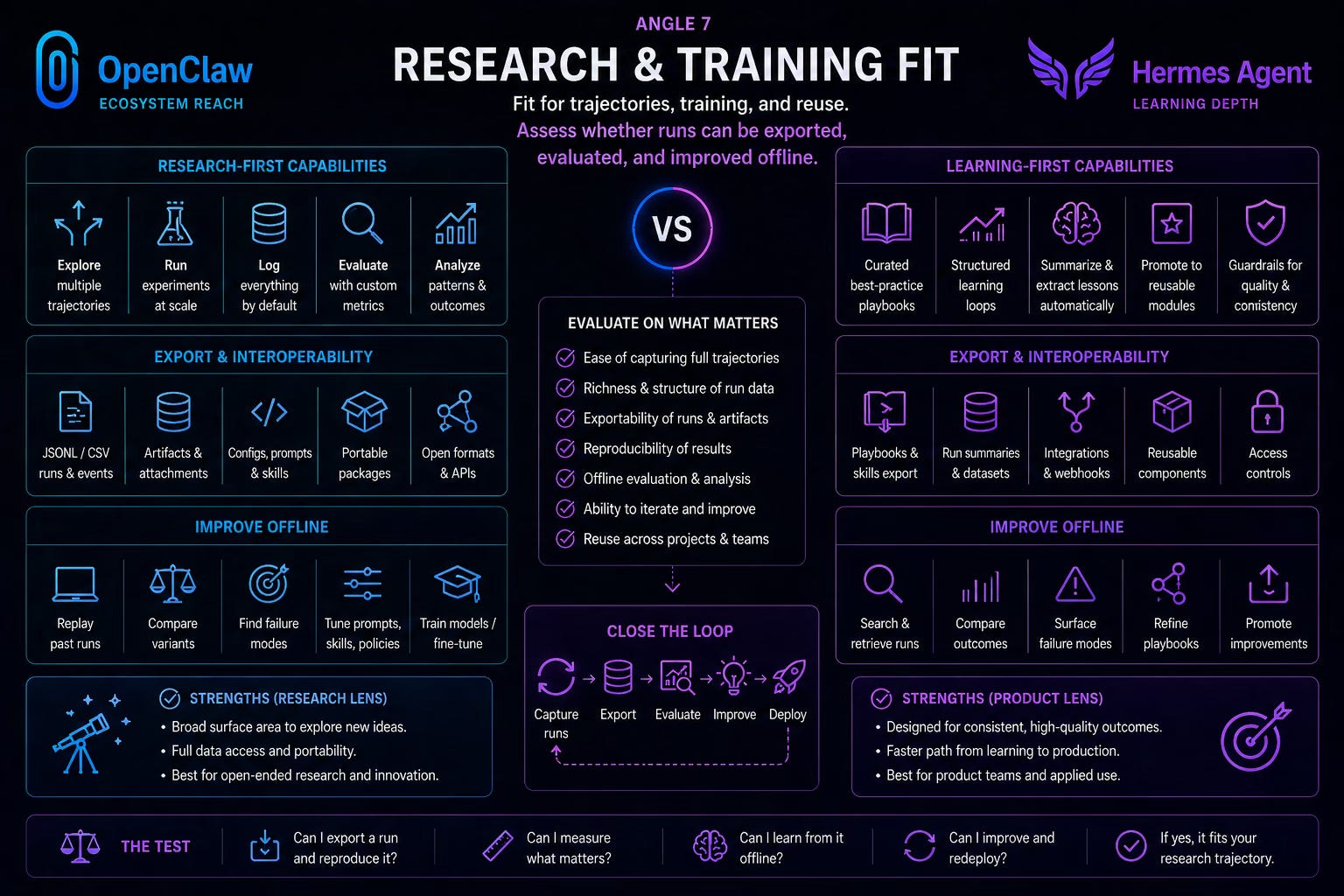
Question: Do you need the agent to emit structured runs for fine-tuning, evals, or offline learning, or is chat the whole product?
Hermes carries Nous Research lineage: documented paths toward trajectory export and reinforcement-learning-style workflows (e.g. integration with research stacks for batch runs) for teams that distill behavior from production-shaped tool use. You do not have to train models to benefit; you might still want exportable episodes for audit or offline QA, or to build an internal eval set that is not a copy of the marketing demo.
OpenClaw is not framed primarily as a training appliance; it is framed as infrastructure for living assistants with a huge skill and channel graph. If your "downstream" is product and integration velocity, that is enough. If your downstream is a data team and a model shop, score Hermes higher on this row.
Verdict hinge: Product and GTM on one side, lab and model org on the other. Many teams score this row N/A; that is a valid outcome.
Convergence: shared skill formats and cross-registry stories point to portable skills and hybrid deployments: a wide reach layer where people sit, and a memory-heavy engine where work must compound. The hard part is the contract (identity, secrets, one owner per task, idempotent handoffs), not the brand of the daemon. A common pattern in larger orgs is one team that wants reach and another that wants compounding memory. If you wire two runtimes without a written handoff, you will get duplicate work, double spend, and incidents that no single log line explains. Hybrids only work when the seven angles are owned: you know which system is canonical for memory, which for tool execution, and which idempotency key ties a user request to both.
Same words, different mechanics: under "skills," one side may mean registry packages; the other, promoted routines from success. Under "sandbox," one may mean Docker and dropped caps; the other, profiles plus scanners. Write your definitions in the first row of your scorecard so the team is not arguing about different things.
Build a scorecard: seven rows (angles above), two columns (OpenClaw, Hermes), evidence snippets per cell, not vibes. A cell that says "good" without a log line or timestamp is not evidence. A cell that says "failed on Tuesday when we revoked token X" is.
For each veto row you named in the intro, require a pass with artifacts before you schedule a wider rollout. Everything else is negotiable.
Run one production-shaped workflow on both stacks under frozen parity rules.
Run one failure injection per stack; record detection time, containment time, and the log line you used.
Name who owns rollback and who may install a skill. If you cannot, neither stack belongs in prod yet.
OpenClaw and Hermes Agent answer the same baseline question: how do I run an agent that does not reset every time I close a window? The angles above split that question into operator-sized pieces. Pick the column with better receipts on the rows you weight highest. If the receipts tie, prefer the stack your named owner can patch and roll back without a hero at three in the morning.
Want more practical assets — checkout our templates:
Multi-Agent Coordination Kit v1 — task checkout, budgets, escalation, audit trail, and scope (for anyone running more than one agent).
AI Marketing Automation Playbook (v1) — 10 workflows, tools, costs, copy-paste prompts
OpenClaw Bill-Down Kit (v1) — complete OpenClaw-shaped cost architecture: cache, heartbeats, context, routing, limits.
Paperclip ↔ OpenClaw Field Manual (v1) — complete manual about where the two systems meet: control plane, handoffs, state, and what breaks when the boundary is wrong
No posts
Comments
Nothing yet. Say the first thing.
Sign in to join the conversation.