
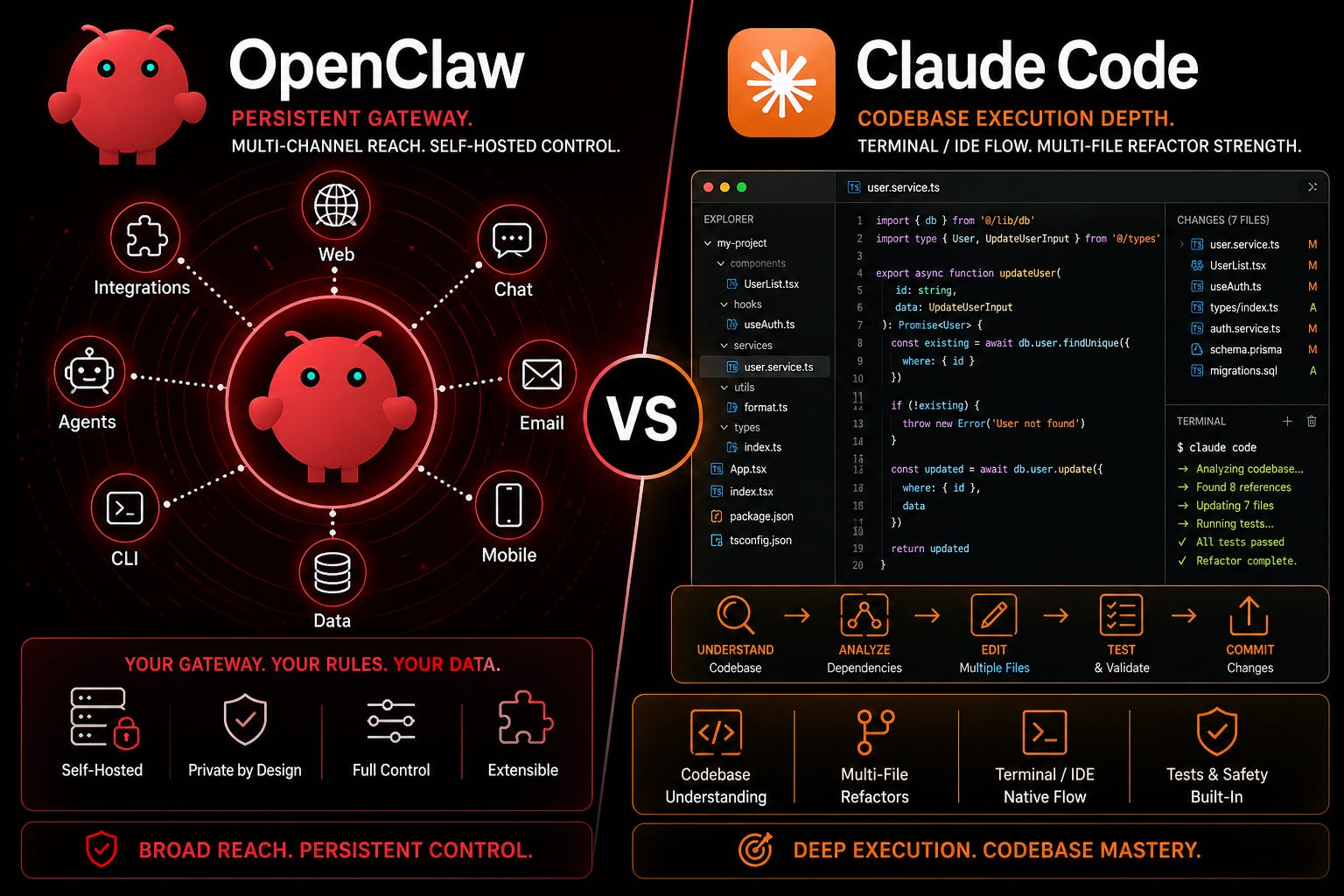
A team I spoke with last month made the same mistake I keep seeing in 2026. They said they were evaluating OpenClaw against Claude Code as if this were a clean replacement decision. Two weeks later, they had strong opinions and almost no decision signal. Why? They benchmarked both on a vague task: “help us ship faster.”
That question is too broad to be useful.
OpenClaw and Claude Code both look agentic on the surface. Both can run commands. Both can connect to models. Both can feel magical in a five-minute demo. Underneath that layer, they are optimized for different centerlines. OpenClaw is designed around a long-lived gateway and cross-channel operations. Claude Code is designed around software development execution inside terminal/IDE workflows.
For engineering readers, this is the real decision: which layer is your bottleneck right now? If your problem is where and how an assistant lives across your systems, that is one class. If your problem is deep repo-level code execution quality, that is another.
This article compares them through seven angles, each with the same structure so you can score them side by side instead of reading two disconnected product descriptions.
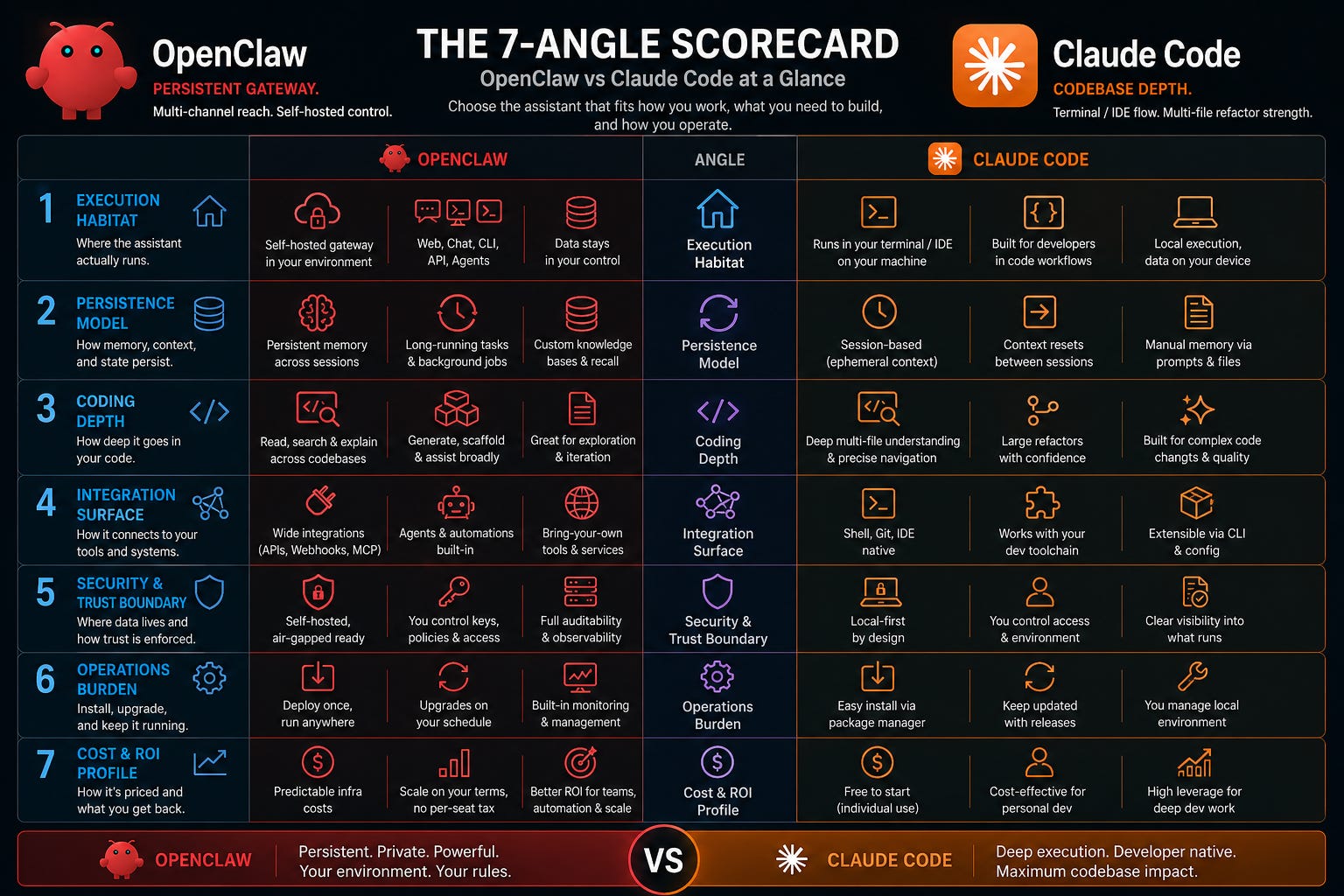
Before the angles, lock three rules into your bake-off:
Use one production-shaped workload, not two demos.
Freeze model family, tools, and success criteria.
Run one controlled failure per stack and inspect logs, not vibes.
If you skip those, you will choose based on interface preference instead of engineering fit.
For this comparison, a practical workload definition matters more than any feature matrix. A useful example for mixed teams is: incoming production issue arrives in chat, the assistant proposes root-cause hypotheses, opens a patch branch, runs test commands, and reports status back to the channel where the request started. That workflow touches messaging, memory, code edits, and failure handling in one loop. If your benchmark only checks “can it edit files,” you miss most of what OpenClaw is built to do. If your benchmark only checks “can it respond in chat,” you miss most of what Claude Code is built to do.
The second trap is scoring with adjectives. Replace “felt smooth” with a measurable line item: number of correction prompts required, elapsed minutes to first passing test, number of retries after a failed command, and amount of context you had to restate after pausing the run. This article gives angle-by-angle guidance, but the real output should be a scorecard with evidence snippets. You can use personal preference for tie-breakers, but only after both tools clear your non-negotiable rows.
Question: Where does the agent live while work is happening?
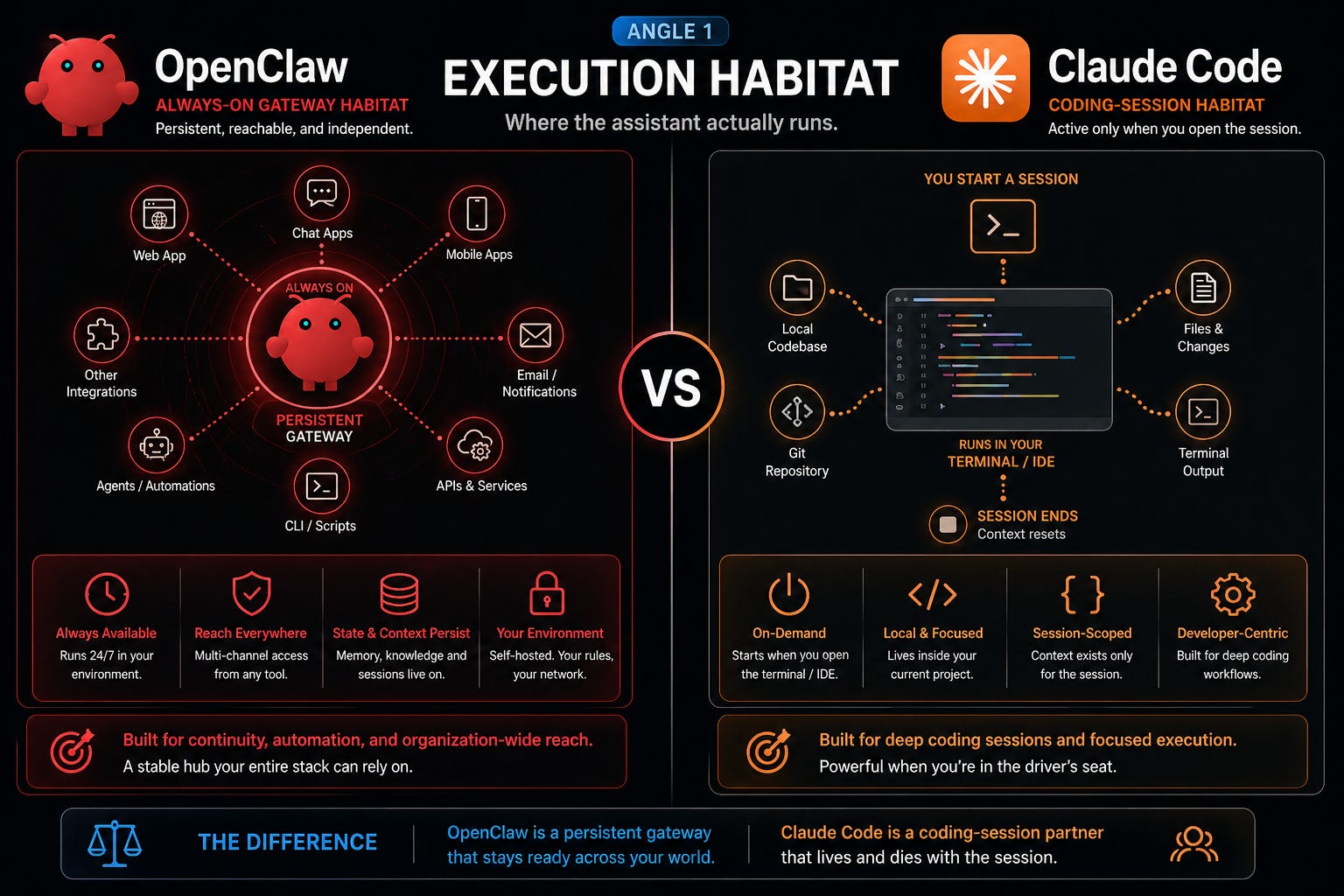
OpenClaw is built around a single long-lived gateway process that owns messaging surfaces and control-plane connections. The official architecture docs describe a daemon-like model: channels and clients connect over a typed WebSocket API, and the gateway becomes the operating center for ongoing agent behavior. This habitat makes sense when the assistant needs to exist beyond one terminal session and remain reachable from operational channels.
Claude Code is a coding environment-native tool. Anthropic’s docs position it as an agentic coding assistant that reads codebases, edits files, and runs commands from terminal and IDE surfaces. The primary habitat is development flow: project root, command-line tasks, implementation loops, and code review rhythm.
Neither habitat is “better” in isolation. Habitat fit determines everything that follows. If your daily work starts in Slack and branches into ops/coding/notifications, OpenClaw’s runtime-centric habitat is a natural default. If your daily work starts in the repository and ends in tests, Claude Code’s coding-native habitat has less interface friction.
A lot of teams misread this as “chat versus terminal.” That is too shallow. The real difference is where orchestration authority lives. In OpenClaw-style deployments, the gateway often becomes the durable control point. In Claude Code workflows, orchestration authority usually sits with the developer session and repo context. That distinction affects ownership boundaries. Platform or operations teams can own an OpenClaw runtime as shared infrastructure. Engineering teams can adopt Claude Code without introducing a new always-on service owner.
Question: What survives session boundaries, and how much continuity is native vs manually curated?
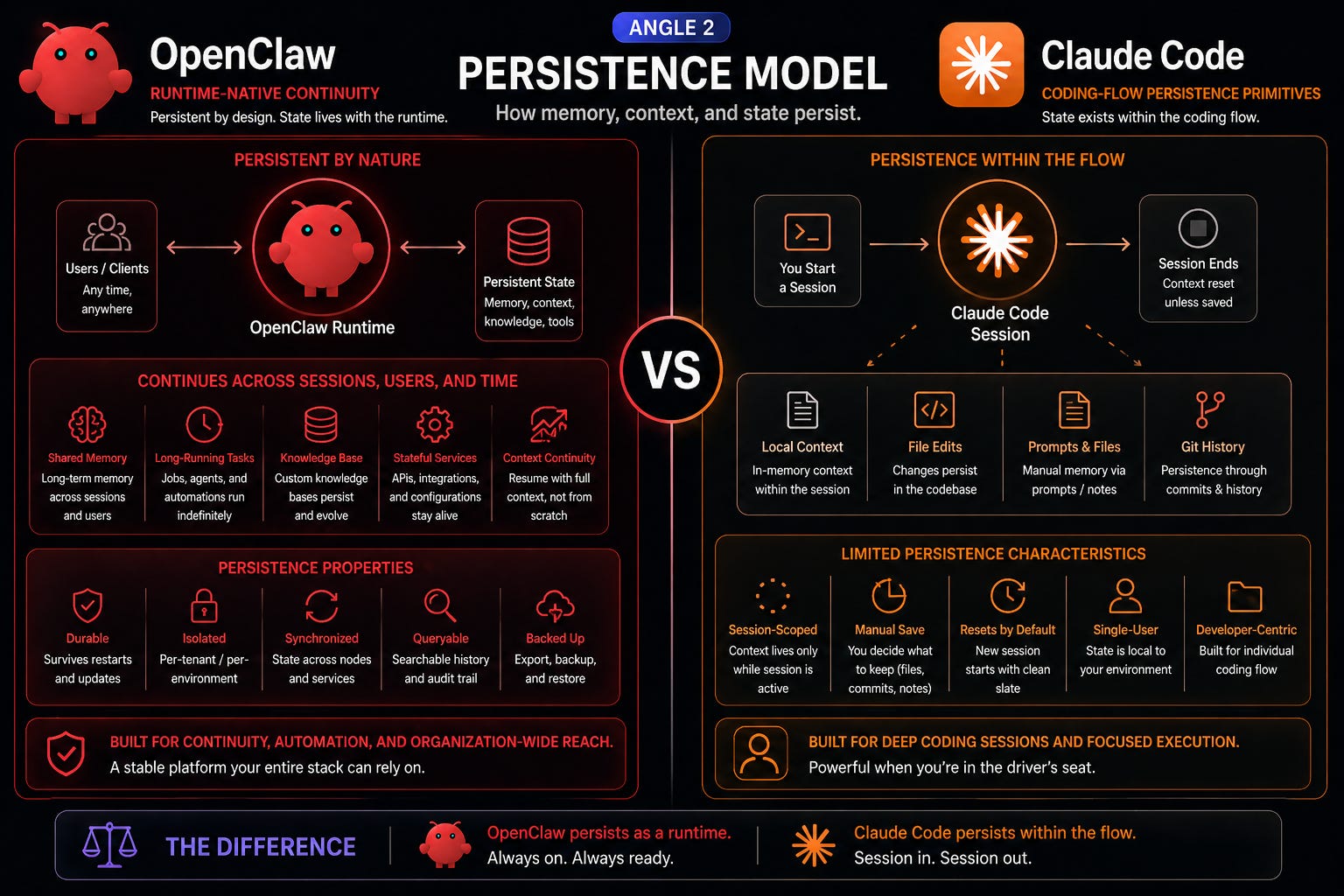
OpenClaw is explicitly built for persistent presence. Its architecture assumes a long-running process, connected channels, and ongoing state across interactions. In plain terms: continuity is a first-class concern, not a bolt-on.
Claude Code supports persistent instructions through CLAUDE.md and auto-memory mechanisms documented by Anthropic, but it is still optimized for coding workflows that commonly begin with an explicit task and end when the development session ends. Continuity exists, but the center of gravity remains implementation execution in repo context.
This difference shows up on week two, not minute two. If your evaluation ends after one benchmark run, you will underestimate continuity requirements. The right test is to pause for 72 hours, resume without re-priming, and measure how much recovery prompting each path needs.
Continuity also has a social layer. In channel-heavy setups, multiple humans may interact with one assistant over time. That creates expectations around thread memory, tone stability, and handoff quality between operators. OpenClaw’s runtime model is naturally aligned with that pattern. Claude Code can preserve durable project guidance, but its strongest mode is still “developer and agent working directly in a coding context.” If your workflow requires persistent cross-person conversational context and code execution, you should explicitly test whether you want one shared memory substrate or separate ones per role.
Question: On hard software tasks, which stack gives better end-to-end execution quality?
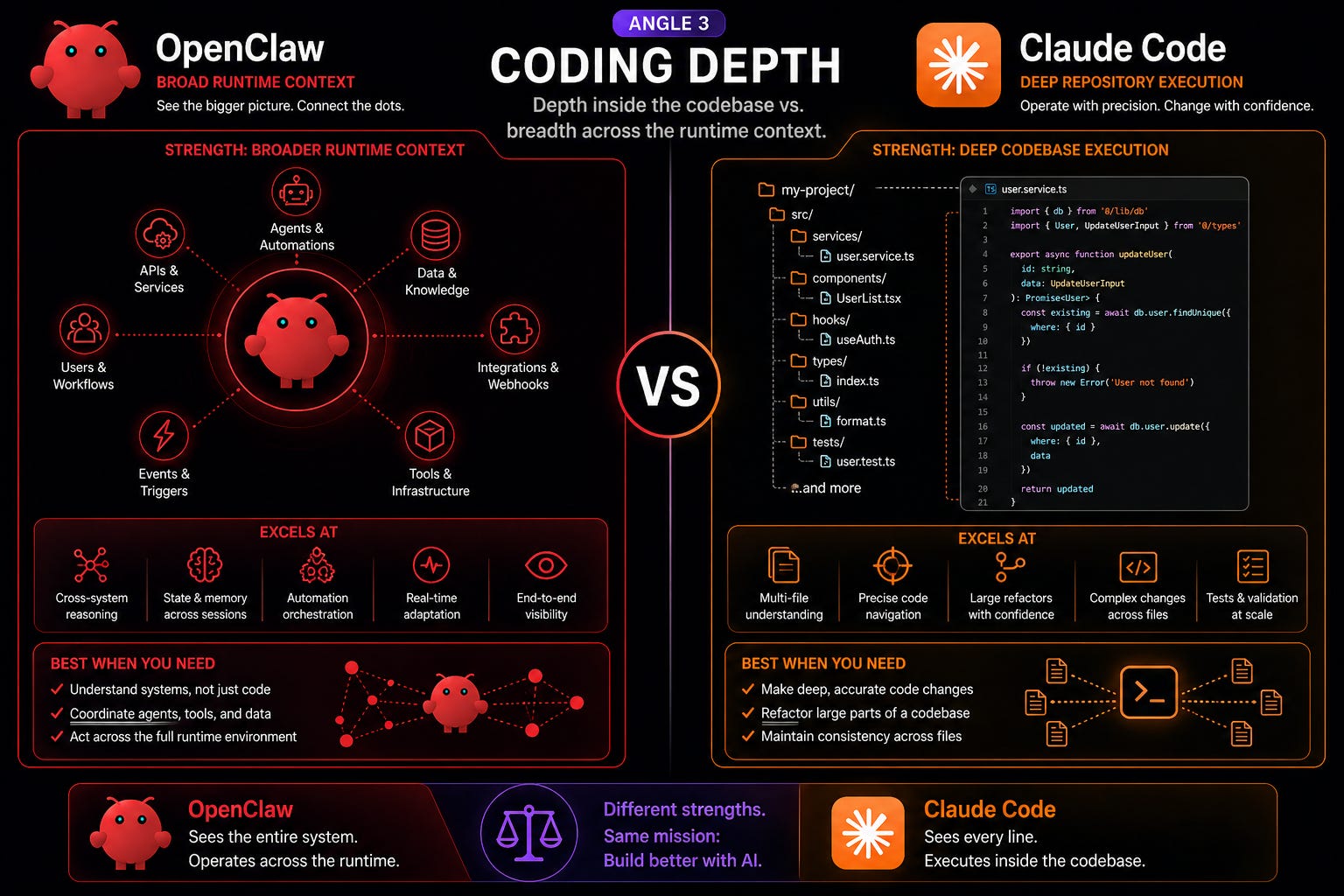
This is Claude Code’s strongest row. The official product definition is explicit: agentic coding, multi-file edits, command execution, and development tool integration. In practice, this maps to refactors, bug hunts, test loops, and project-wide changes where code quality and task completion matter more than channel presence.
OpenClaw can absolutely participate in coding tasks, especially when tools are configured and workflows are disciplined. But its product center is broader than coding depth alone. You are buying a runtime and integration surface, not just a code execution specialist.
If your team asks “which one helps me ship this refactor faster with fewer bad edits,” Claude Code usually has the cleaner fit. If your team asks “which one keeps working across engineering plus adjacent ops contexts,” OpenClaw’s broader runtime model may win despite lower code-specialized ergonomics.
When you score this angle, use two classes of tasks. First, a surgical code task: medium-size bug fix with strict tests. Second, a structural code task: multi-file refactor with architectural constraints. Claude Code should be expected to perform strongly on both. OpenClaw should be expected to succeed if your configured skills and command paths are mature, but you may see more setup sensitivity. That sensitivity is not a defect by itself. It is a signal that coding depth is not the only optimization target for the platform.
A practical rubric here is: correctness, reviewability, and cleanup cost. Correctness is obvious. Reviewability means “would a teammate accept this diff without rewriting the prompt history in their head?” Cleanup cost means “how much manual work is required after the agent’s output to ship safely?” The tool that produces fewer follow-on repairs wins this row, even if both eventually pass tests.
Question: How many surfaces does the assistant need to serve, and who depends on each?
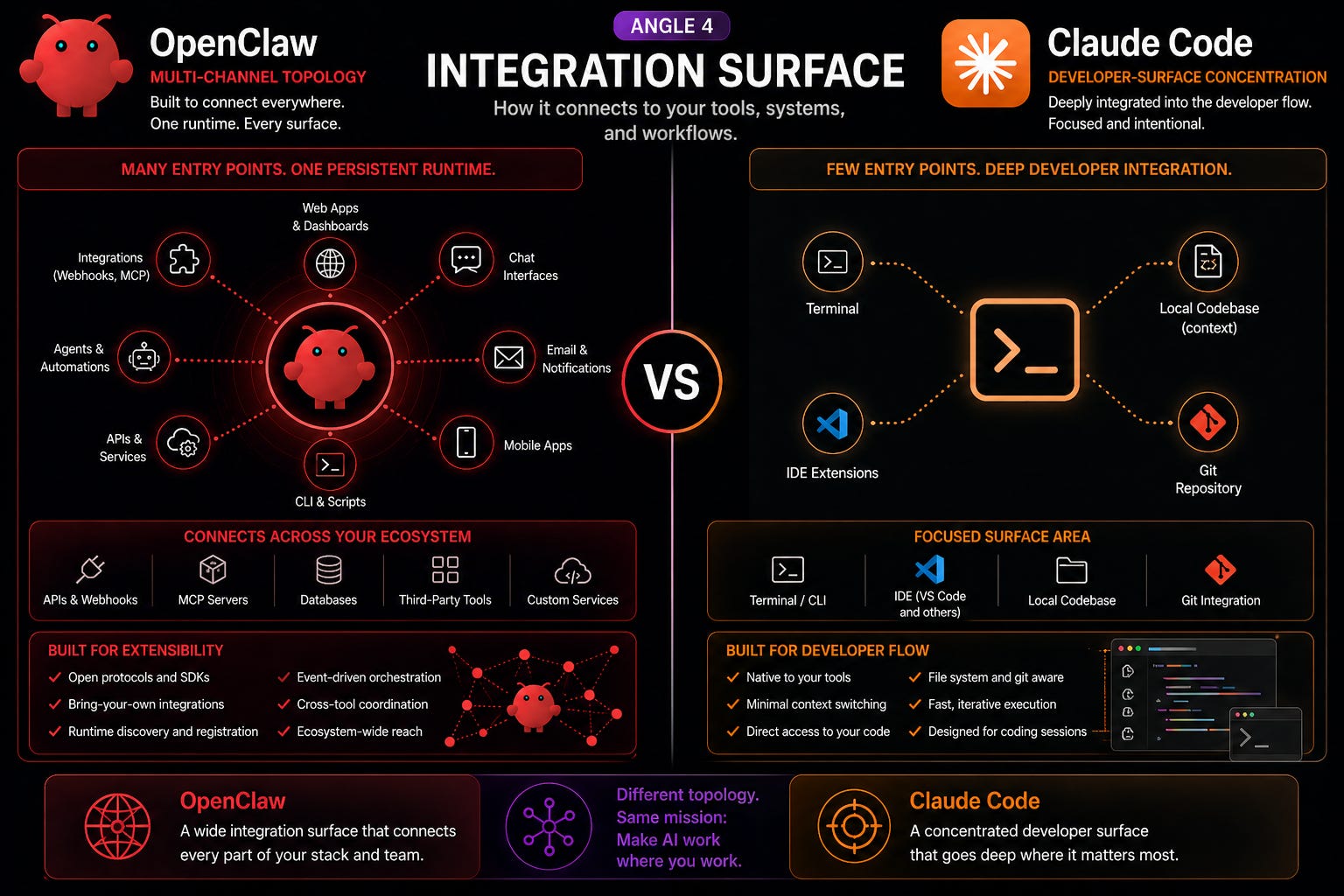
OpenClaw’s architecture is channel-centric by design. The gateway model is literally about owning multiple messaging and control surfaces. This is useful when one assistant must span team comms, alerting, mobile contexts, and operator access patterns that are not all inside an IDE.
Claude Code is not trying to be a universal messaging gateway. It is strongest where the interaction loop is code-first, in terminal and IDE contexts, with optional desktop/browser surfaces as documented.
This angle is where many teams accidentally overpay in complexity. If your assistant only needs to serve engineers in repo workflows, broad channel topology can be unnecessary overhead. If your assistant must be reachable by engineering, ops, and leadership across existing communication tools, forcing everyone into a pure coding interface fails social adoption before technical quality is even evaluated.
The key phrase here is interaction topology. List the users and surfaces that must participate in a task lifecycle. If all paths collapse to repo contributors, Claude Code’s surface concentration is an advantage. If the lifecycle includes non-coders, incident managers, or asynchronous approvals through messaging apps, OpenClaw’s channel topology can reduce process friction dramatically. Teams often miss that they are not comparing features; they are comparing organizational communication architectures.
A simple test: trace one real incident from first alert to final closure note. Mark each handoff and channel switch. Count where context is lost. Then simulate the same path with each tool. The winner is the one that minimizes human re-translation between systems.
Question: Where is control anchored: self-hosted runtime perimeter or vendor-managed coding product controls?
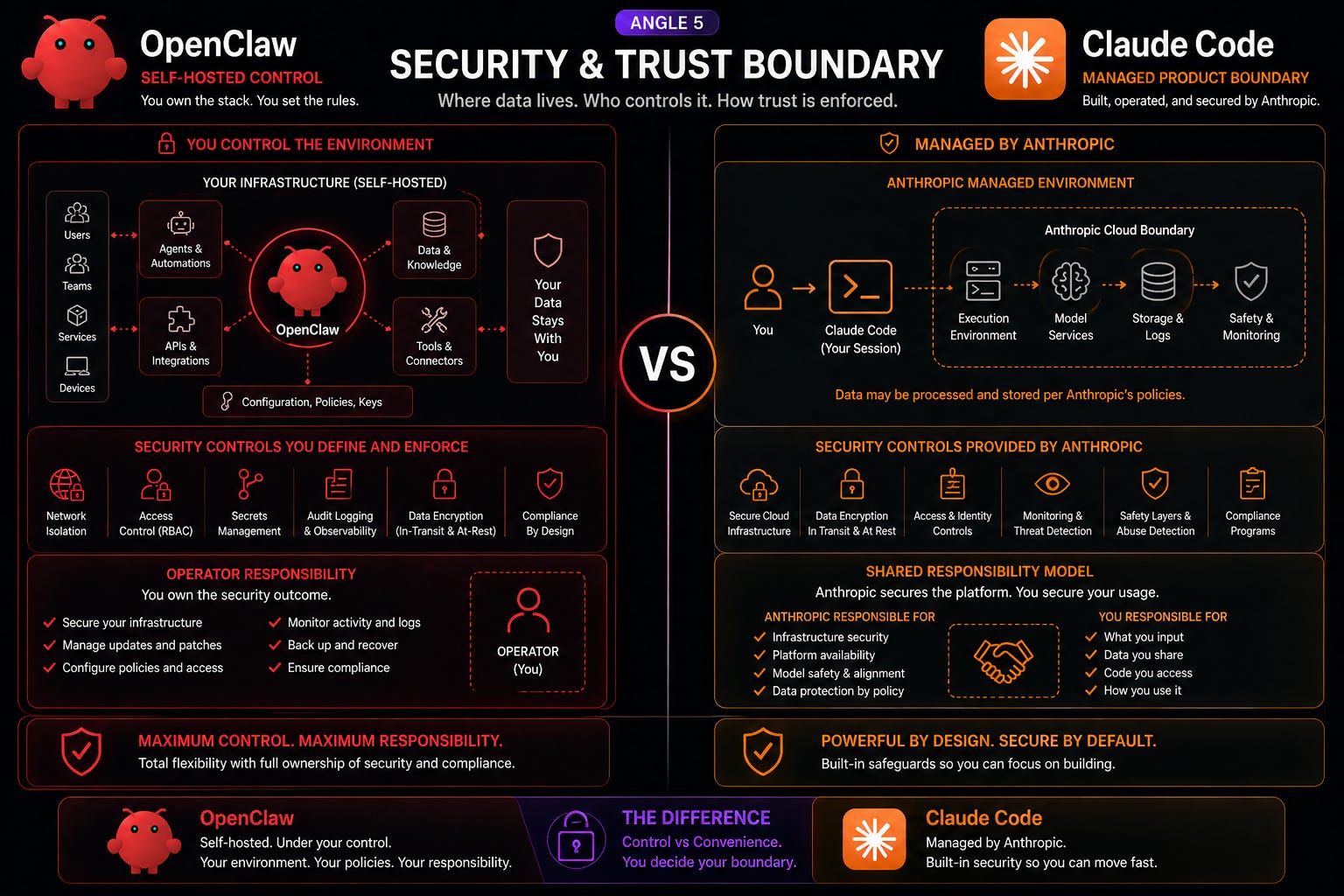
OpenClaw gives you high control because you run the runtime. The trade is that you own hardening discipline. OpenClaw docs and broader ecosystem discussions repeatedly emphasize gateway exposure risks when misconfigured. Self-hosted control is only a security advantage if your team actually operates it like infrastructure.
Claude Code gives you managed-product ergonomics and clear coding workflows, but your trust boundary and data handling posture sit in Anthropic’s product model and enterprise terms. That can be exactly what some teams want: less infra burden, clearer procurement path, fewer custom hardening decisions.
The wrong framing is “self-hosted means secure” or “managed means insecure.” The right framing is: which trust boundary can your org operate responsibly today? Security posture is capability plus discipline, not deployment slogan.
Split this angle into two separate checks: exposure risk and execution risk. Exposure risk asks who can reach your control plane and through what network path. Execution risk asks what happens after a tool call is triggered, including permissions and side effects. OpenClaw deployments can score very high when operators enforce strict network boundaries and least privilege. They can also score very low when convenience shortcuts expose the gateway. Claude Code centralizes more of that burden in product controls and policy configuration, which may improve consistency for teams without platform security maturity.
Auditability is the final discriminator. In a post-incident review, can you reconstruct what happened quickly and credibly? Choose the path that your security and engineering teams can investigate under pressure without reverse-engineering your own setup from memory.
Question: Who wakes up when it breaks, and how quickly can they restore service?
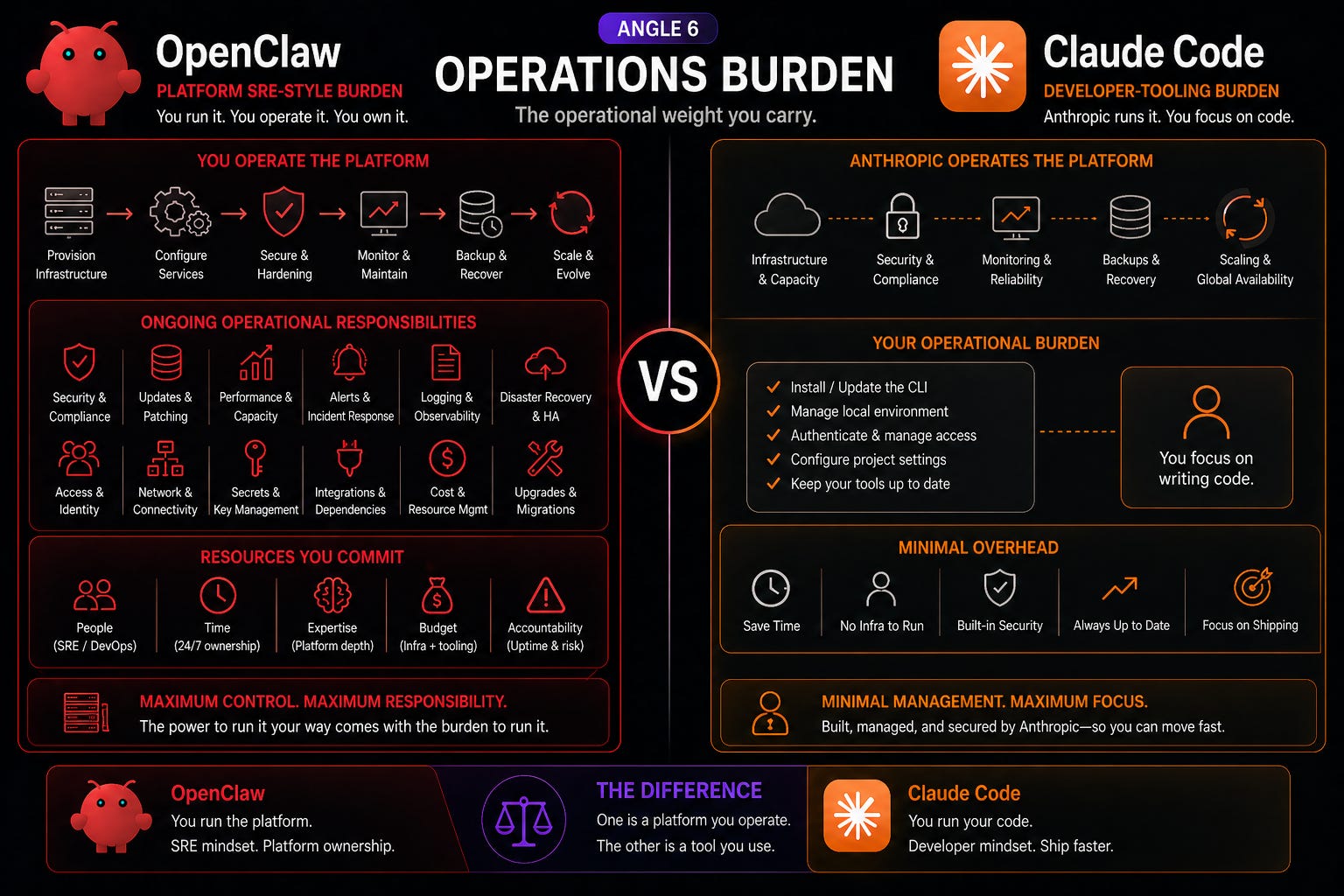
OpenClaw is an infrastructure-shaped choice. You get flexibility and control, but you inherit daemon lifecycle, configuration hygiene, version pinning, monitoring, and rollback playbooks. Teams that are already comfortable running internal platforms may consider this normal.
Claude Code reduces platform-operations burden because its primary interface is closer to developer tooling than always-on gateway infrastructure. Operational complexity does not disappear, but it shifts from “run this service safely 24/7” toward “manage coding-agent usage, workflow standards, and governance in software delivery.”
A practical test: define one incident scenario and force both stacks through it. Measure time to detect, time to contain, and time to return to a known-good state. The row winner is whichever process your current team can execute reliably, not whichever architecture looks elegant in a blog diagram.
This is where ownership clarity matters. Ask one concrete question: who is pager-responsible for this tool at 2:00 AM?If the answer is unclear, your architecture is not done. OpenClaw typically needs explicit runtime ownership. Claude Code typically needs workflow governance ownership. Both are legitimate, but they are not interchangeable.
Operational burden should be measured in weekly maintenance minutes, change-failure rate after updates, and rollback confidence. Track these for one month if possible. Short evaluations underreport maintenance drag and overreport novelty productivity.
Question: Are you optimizing for platform control economics or coding throughput economics?
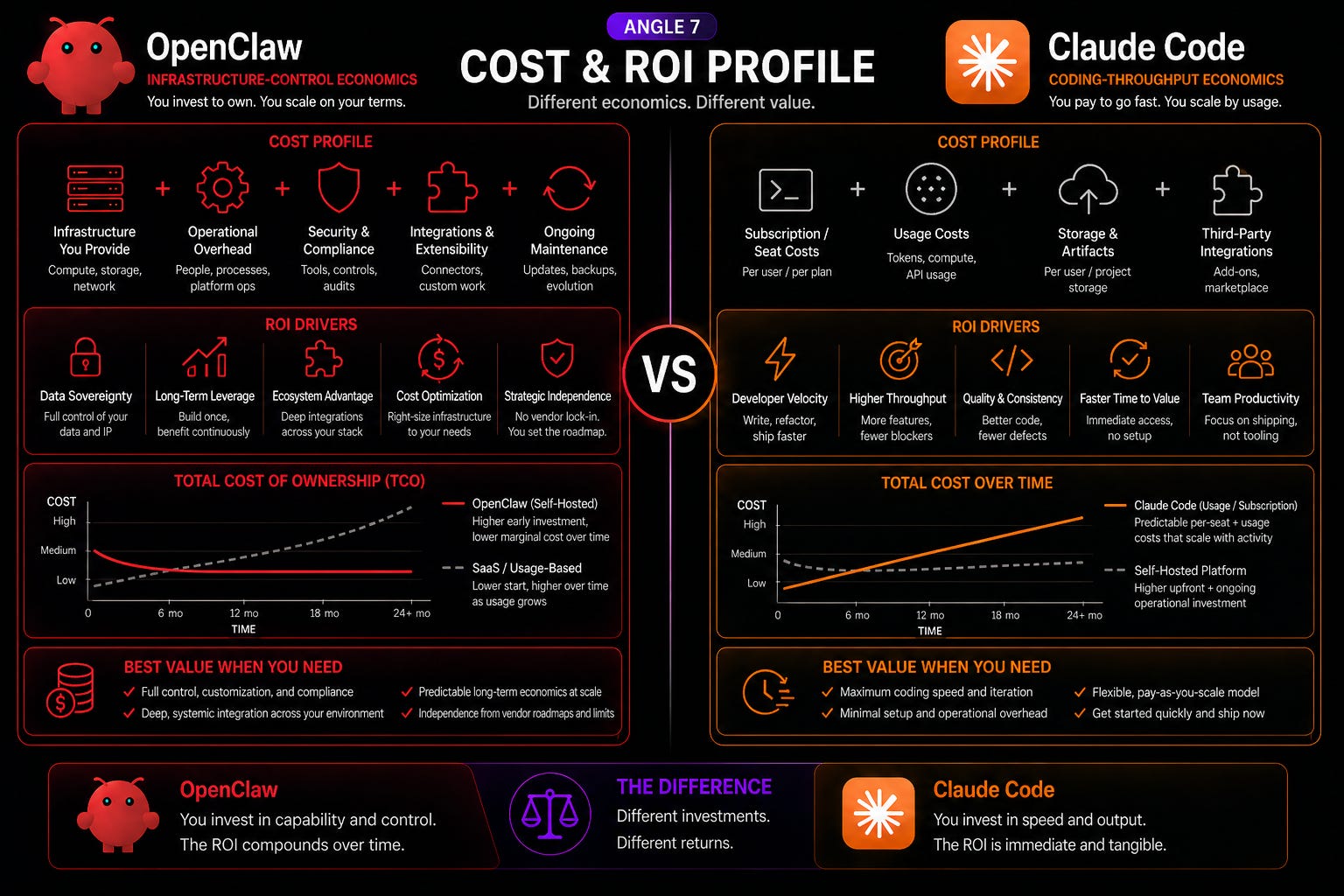
OpenClaw’s self-hosted model often looks cheaper at first glance because licensing posture differs and infra can be controlled. But total cost includes maintenance time, incident response, and governance overhead. Self-hosting shifts costs from subscription line items into engineering labor and operational risk.
Claude Code cost justification is usually clearer when your north star is engineering throughput on hard code tasks. If a tool cuts implementation and refactor cycles materially, the ROI signal can be direct: shipped output and reduced lead time.
The useful comparison metric for both is identical: dollars per successful end state for one real workflow, not list pricing or anecdotal token anecdotes. If you do not instrument this, every cost argument becomes ideology.
For this row, calculate three numbers: direct tool and model cost, operator time cost, and rework cost from imperfect outputs. Most teams only track the first number. The third number is often larger than expected, especially when generated changes need heavy cleanup. Claude Code tends to justify spend through higher coding throughput. OpenClaw tends to justify spend through cross-surface workflow consolidation and persistence value.
If you compare cost without comparing outcome quality, you will optimize for the wrong thing. A cheaper run that requires two engineers to babysit it is not cheaper in practice. A more expensive run that eliminates repetitive coordination overhead can be a net gain.
If your bottleneck is cross-channel, always-on assistant behavior with runtime control, start with OpenClaw and decide whether you need a coding specialist on top.
If your bottleneck is deep code execution quality and velocity inside repository workflows, start with Claude Code and decide whether you need a persistent runtime layer around it.
If both are true, the pattern is often layered:
OpenClaw as orchestration/presence runtime
Claude Code as high-skill coding executor for bounded tasks
That is not overengineering when responsibilities are explicit. It becomes overengineering when teams blur ownership and then debug identity, state, and handoff failures for three months.
If you adopt the layered pattern, define a contract before implementation: trigger source, escalation rules, idempotency key format, and ownership of final commit authority. Without that contract, “best of both worlds” turns into duplicate runs and unclear accountability. With it, the two tools can complement each other cleanly.
Multi-Agent Coordination Kit v1 — task checkout, budgets, escalation, audit trail, and scope (for anyone running more than one agent).
AI Marketing Automation Playbook (v1) — 10 workflows, tools, costs, copy-paste prompts
OpenClaw Bill-Down Kit (v1) — complete OpenClaw-shaped cost architecture: cache, heartbeats, context, routing, limits.
Paperclip ↔ OpenClaw Field Manual (v1) — complete manual about where the two systems meet: control plane, handoffs, state, and whatbreaks when the boundary is wrong
No posts
Comments
Nothing yet. Say the first thing.
Sign in to join the conversation.