
Selank And Adalank Start With The Same Basic Idea
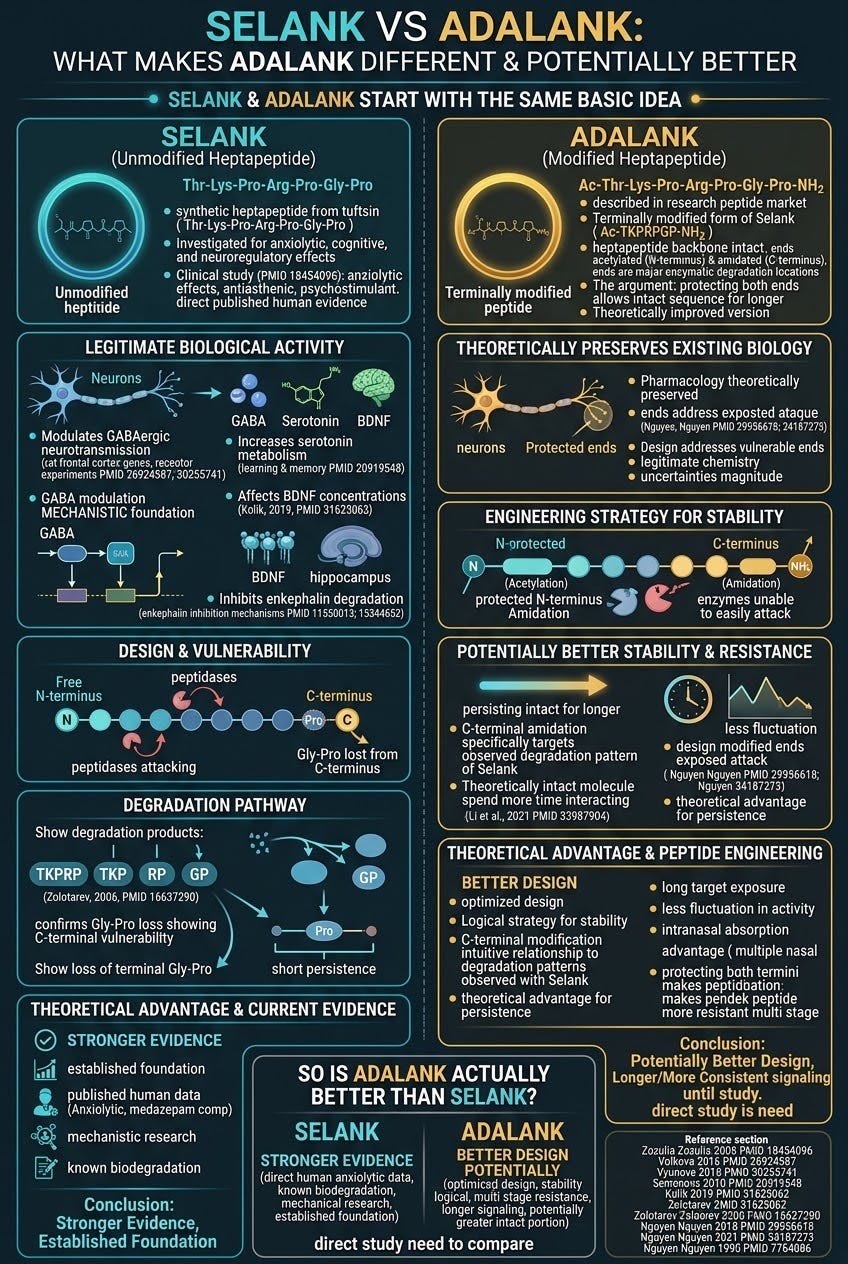
Selank is a synthetic heptapeptide with the sequence Thr-Lys-Pro-Arg-Pro-Gly-Pro, usually abbreviated TKPRPGP. It was developed from tuftsin, an endogenous immunoregulatory tetrapeptide, with the additional Pro-Gly-Pro sequence helping create a more stable and neuroactive molecule. Selank has been investigated primarily for anxiolytic, cognitive, and neuroregulatory effects. In a clinical study involving 62 patients with generalized anxiety disorder or neurasthenia, Selank produced anxiolytic effects comparable to medazepam while also showing antiasthenic and psychostimulant effects (Zozulia et al., 2008, PMID: 18454096). Selank therefore has something Adalank currently does not: direct published human evidence.
Adalank is generally described in the research peptide market as a terminally modified form of Selank, commonly represented as Ac-TKPRPGP-NH2. The seven-amino-acid Selank backbone remains intact, but the N-terminus is acetylated and the C-terminus is amidated. Those may look like small modifications, but the ends of short peptides are major locations for enzymatic degradation. The entire argument for Adalank is that protecting both ends could allow the Selank sequence to remain intact longer before being broken into smaller fragments. That is the main reason Adalank can theoretically be viewed as an improved version of Selank.
⸻
Selank Already Has Legitimate Biological Activity
Selank’s effects appear to involve several signaling systems rather than one simple receptor interaction. Experimental research suggests an important relationship with GABAergic neurotransmission. Selank has been shown to alter expression of genes involved in GABA signaling in rat frontal cortex, while receptor experiments have suggested modulation of GABA-related activity (Volkova et al., 2016, PMID: 26924987; Vyunova et al., 2018, PMID: 30255741). This provides a plausible mechanistic foundation for the anxiolytic effects observed in clinical research without requiring Selank to behave like a conventional benzodiazepine.
Other research suggests effects involving serotonin, neurotrophic signaling, and endogenous opioid metabolism. Selank increased serotonin metabolism in several rat experiments and has demonstrated effects on learning and memory (Semenova et al., 2010, PMID: 20919548). It has also affected BDNF concentrations in the hippocampus and prefrontal cortex in animal models (Kolik et al., 2019, PMID: 31625062). Selank additionally inhibits several enzymes involved in enkephalin degradation, which has been proposed as another contributor to its anxiolytic activity (PMID: 11550013; PMID: 15344652). Adalank is therefore not trying to create an entirely different pharmacology. The idea is to preserve this existing Selank pharmacology for longer.
⸻
What Adalank Changes
Short peptides are vulnerable to enzymes capable of removing amino acids from either end of the molecule. Aminopeptidases act around the N-terminal side, while carboxypeptidases can act from the C-terminal side. Terminal modification is consequently a common peptide-engineering strategy. N-terminal acetylation removes the free N-terminal amino group, while C-terminal amidation changes the terminal carboxyl group into an amide. Both changes can alter how easily certain peptidases recognize and process the molecule. Reviews of peptide drug development specifically identify N-terminal and C-terminal modification as established approaches for improving metabolic stability (PMID: 29956618; PMID: 34187273).
This is where Adalank has its strongest theoretical advantage. Instead of changing the central TKPRPGP sequence responsible for Selank’s known biology, the design modifies the two ends most exposed to enzymatic attack. N-terminal acetylation has experimentally improved protease resistance in other peptide systems, although the magnitude is highly sequence-dependent (Li et al., 2021, PMID: 33987904). C-terminal amidation is also widely used in biologically active peptides, although amidation does not universally increase stability and can sometimes alter activity itself (PMID: 7764886). The chemistry supporting Adalank’s design is legitimate. What remains uncertain is how large that advantage actually is for this exact molecule.
⸻
Selank’s Own Degradation Makes The Idea More Interesting
The stability argument becomes more relevant when we look at what actually happens to Selank after exposure to biological systems. Researchers using tritium-labeled Selank identified several major degradation products, including TKPRP, TKP, RP, and GP. The study also examined Selank pharmacokinetics following intranasal administration in rats (Zolotarev et al., 2006, PMID: 16637290). The formation of TKPRP from TKPRPGP is especially interesting because it demonstrates loss of the terminal Gly-Pro portion of the molecule, showing that breakdown of the Selank sequence can occur from the C-terminal region.
That gives C-terminal protection a stronger rationale than simply saying that modified peptides are generally more stable. Amidating the C-terminus could theoretically make that end less accessible to enzymes responsible for this type of degradation. N-terminal acetylation provides additional theoretical protection against aminopeptidase activity, although the published Selank degradation fragments provide less direct evidence that N-terminal cleavage is its dominant vulnerability. This is an important distinction. Adalank’s terminal modifications are scientifically reasonable, but the C-terminal modification has a particularly intuitive relationship to degradation patterns actually observed with Selank.
⸻
Why Greater Stability Could Make Adalank Better
If Adalank genuinely survives enzymatic degradation longer while retaining Selank’s biological activity, several advantages become possible. Greater stability could maintain a higher concentration of intact peptide for longer, extend target exposure, reduce fluctuations in activity, and potentially require less frequent exposure to maintain the same biological signal. These are pharmacokinetic advantages rather than fundamentally new mechanisms. In that scenario, Adalank would essentially allow the same TKPRPGP pharmacophore to spend more time interacting with the systems Selank already influences.
Longer persistence could theoretically be particularly relevant for intranasal peptide research because the nasal mucosa contains multiple peptidases capable of degrading peptides before or during absorption. Peptide metabolism is not limited to the bloodstream. Nasal tissue, liver, kidney, lung, skin, and other tissues all contain enzymes capable of degrading peptide therapeutics (PMID: 29956618). Protecting both termini could therefore make a short peptide more resistant at multiple stages. This is the strongest scientific argument for why Adalank could ultimately outperform native Selank: not because it necessarily hits different targets, but because a greater proportion of the administered molecule may remain intact long enough to hit those targets.
⸻
So Is Adalank Actually Better Than Selank?
From an evidence standpoint, Selank is currently the stronger compound because it is the molecule that has actually been studied. It has published human anxiolytic data, mechanistic research, known degradation products, and multiple animal studies examining cognition and neurotransmitter systems. If the question is which peptide has the more established scientific foundation, Selank wins easily. Calling Adalank superior based purely on the assumption that terminal modification improves every aspect of the molecule would make the same mistake as assuming a more sophisticated mechanism automatically produces better results.
From a peptide engineering standpoint, however, Adalank may represent the more optimized design. N-terminal acetylation and C-terminal amidation are logical strategies for protecting a short peptide against enzymatic degradation, and Selank itself has documented degradation pathways that make additional terminal protection biologically reasonable. If those modifications increase the persistence of intact TKPRPGP without compromising its activity, Adalank could provide longer and potentially more consistent exposure to the same signaling pathways. That is what could make Adalank better. Selank currently has the better evidence. Adalank potentially has the better pharmacokinetic design. Until the modified peptide is directly studied, those are not the same thing.
⸻
References
Zozulia AA, Neznamov GG, Siuniakov TS, et al. Efficacy and possible mechanisms of action of a new peptide anxiolytic Selank in the therapy of generalized anxiety disorders and neurasthenia. 2008. PMID: 18454096.
Volkova A, Shadrina M, Kolomin T, et al. Selank Administration Affects the Expression of Some Genes Involved in GABAergic Neurotransmission. Frontiers in Pharmacology. 2016. PMID: 26924987.
Vyunova TV, Andreeva LA, Shevchenko KV, Myasoedov NF. Peptide-based Anxiolytics: The Molecular Aspects of Heptapeptide Selank Biological Activity. Protein and Peptide Letters. 2018. PMID: 30255741.
Semenova TP, Kozlovskii II, Zakharova NM, Kozlovskaya MM. Experimental optimization of learning and memory processes by Selank. 2010. PMID: 20919548.
Kolik LG, Nadorova AV, Antipova TA, et al. Selank, Peptide Analogue of Tuftsin, Protects Against Ethanol-Induced Memory Impairment by Regulating BDNF Content in the Hippocampus and Prefrontal Cortex in Rats. Bulletin of Experimental Biology and Medicine. 2019. PMID: 31625062.
Zolotarev YA, Dadaian AK, Dolotov OV, et al. Evenly tritium-labeled peptides and their in vivo and in vitro biodegradation. Bioorganicheskaia Khimiia. 2006. PMID: 16637290.
Zolotarev YA, Sokolov OY, Kost NV, et al. Leu-enkephalin labeled with tritium in studying the Selank inhibitory effect on enkephalin-degrading enzymes of human plasma. 2004. PMID: 15344652.
The inhibitory effect of Selank on enkephalin-degrading enzymes as a possible mechanism of its anxiolytic activity. PMID: 11550013.
Li D, Yang Y, Li R, et al. N-terminal acetylation of antimicrobial peptide L163 improves its stability against protease degradation. Journal of Peptide Science. 2021. PMID: 33987904.
Nguyen KT, Mun SH, Lee CS, Hwang CS. Control of protein degradation by N-terminal acetylation and the N-end rule pathway. Experimental & Molecular Medicine. 2018. PMID: 30054456.
Metabolism of Peptide Drugs and Strategies to Improve Their Metabolic Stability. 2018. PMID: 29956618.
Recent Advances in Proteolytic Stability for Peptide, Protein, and Antibody Drug Discovery. 2021. PMID: 34187273.
C-terminal Amidated Peptides: Production by the In Vitro Enzymatic Amidation of Glycine-Extended Peptides and the Importance of the Amide to Bioactivity. 1995. PMID: 7764886.
No posts
Comments
Nothing yet. Say the first thing.
Sign in to join the conversation.