
In light of the podcast me and Derek are about to record on Mitochondrial stacks, SS-31 was a great topic to help some of the new researchers with. There's so many claims about the different benefits too.
SS-31 is getting pushed hard right now and it deserves the attention. It is the first mitochondria targeted drug to reach FDA approval and the mechanism is genuinely well characterized. But several of the benefits attached to it are either unsupported or contradicted by the human trials, and one of the findings that matters most to this audience almost never comes up.
----------------------------------------
What SS-31 Actually Is
SS-31, also called elamipretide, is a synthetic tetrapeptide from the Szeto-Schiller series. Four amino acids, administered subcutaneously. It works by concentrating in the inner mitochondrial membrane and binding reversibly to cardiolipin, a phospholipid found almost exclusively there. Cardiolipin holds the shape of the cristae and organizes the respiratory complexes into supercomplexes so electron transport runs efficiently. It also determines whether cytochrome c acts as an electron carrier or flips into acting as a peroxidase, which generates damage.
When cardiolipin gets peroxidized or depleted, cristae structure degrades, electron transport leaks, and ATP output falls while reactive oxygen species climb. SS-31 binds cardiolipin, prevents that peroxidase conversion, preserves cristae architecture, and improves the efficiency of oxidative phosphorylation (Szeto, British Journal of Pharmacology, 2014, PMID 24117165).
Biophysical work later showed it partitions into the membrane interface and modulates surface electrostatics rather than destabilizing the bilayer, which appears to be a core part of how it works (Mitchell et al., Journal of Biological Chemistry, 2020, PMID 322733). It is not a stimulant and it does not add fuel. It reduces waste in a system that is already running.
----------------------------------------
Claim 1: Clean, Sustained Energy
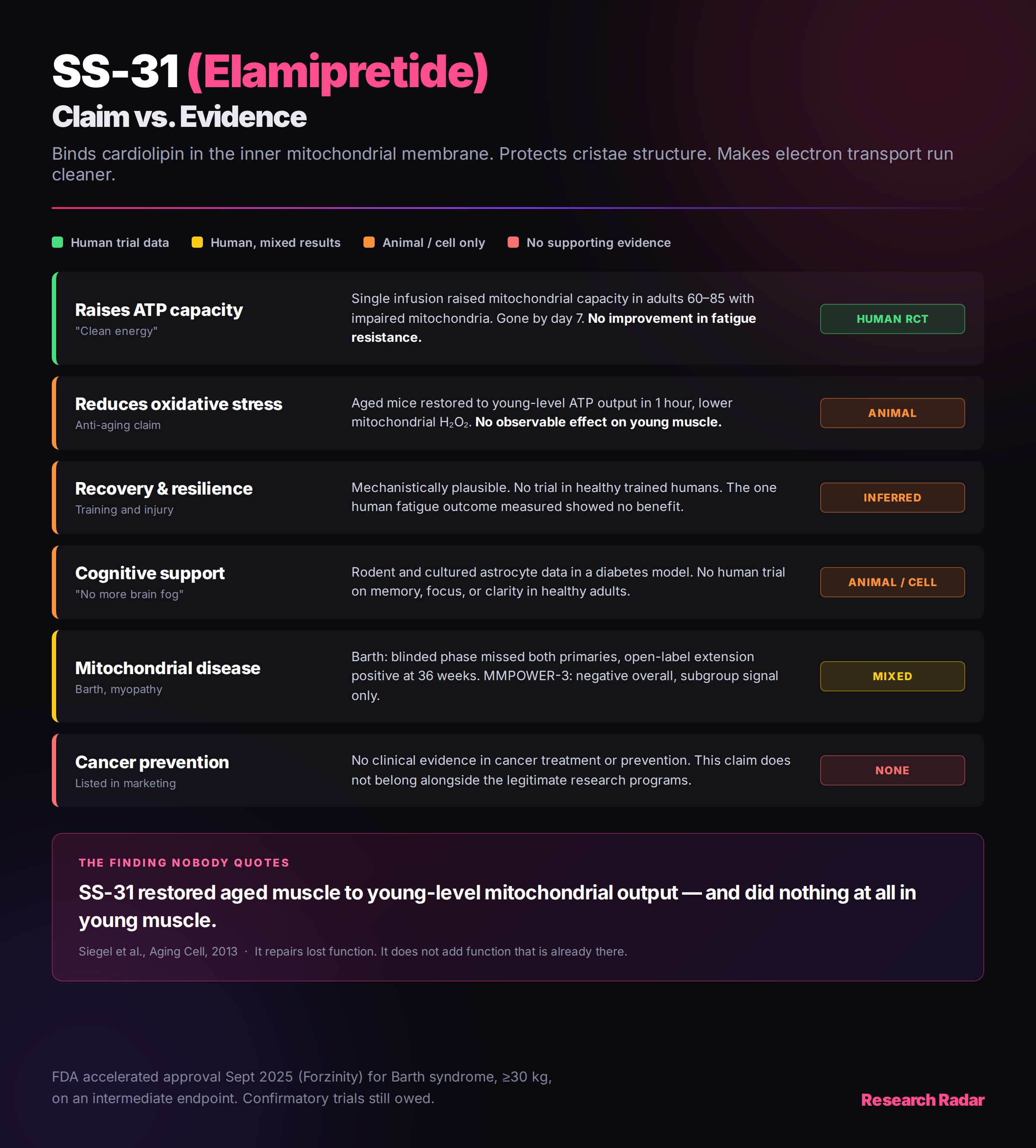
The mechanism supports improved ATP production. The human data supports it too, with a significant qualifier. Thirty-nine healthy older adults aged 60 to 85 were enrolled specifically because they had poorly functioning mitochondria. In a randomized double-blind placebo-controlled design, a single two-hour infusion raised in vivo mitochondrial capacity immediately after treatment compared to placebo. By day 7 the difference was gone, consistent with the drug's blood half-life (Roshanravan et al., PLoS One, 2021, PMID 34264994).
Despite the measurable increase in ATP capacity, there was no significant effect on fatigue resistance in that same trial. The energetic number moved. The performance outcome did not.
So clean energy is defensible as a mechanism claim and unproven as a felt-experience claim. Feeling wired or stimulated is not something SS-31 does. Nothing about cardiolipin binding produces that sensation, and anyone describing a mitochondrial peptide in stimulant language is borrowing from a different category of compound.
----------------------------------------
Claim 2: Reduced Oxidative Stress
Preventing cardiolipin peroxidation reduces mitochondrial ROS production at the source rather than mopping up radicals downstream the way a conventional antioxidant does.
In aged mice, a single 3 mg/kg dose restored resting and maximal mitochondrial ATP production and coupling efficiency to young levels within one hour, alongside a more reduced glutathione redox status and lower mitochondrial hydrogen peroxide emission. Eight days of treatment increased whole-animal endurance capacity (Siegel et al., Aging Cell, 2013, PMID 23692570).
That study contains the single most useful line for anyone considering this compound: SS-31 had no observable effect on young muscle. The aged animals were restored. The young animals showed nothing. This is a repair tool for dysfunctional mitochondria, not an enhancement tool for healthy ones. A 25-year-old with normal mitochondrial function is not the population where this has demonstrated anything.
----------------------------------------
Claim 3: Recovery And Resilience
The logic here is sound and the direct evidence is thin. Better mitochondrial function should support recovery, since repair processes are energy dependent. The framing that SS-31 gives cells the energy to repair themselves rather than stimulating repair directly is accurate to the mechanism.
What does not exist is a trial showing improved training recovery, injury healing, or stress tolerance in healthy trained humans. What is circulating is anecdotal. The one human trial that measured a fatigue outcome found no benefit despite improved energetics. Treat this as a mechanistically plausible extension, not an established effect.
----------------------------------------
Claim 4: Cognitive Support
The brain is genuinely energyexpensive and mitochondrial dysfunction is implicated in cognitive decline, so the reasoning is not unfounded. But the evidence is animal and cell culture. Work in diabetic mice and cultured astrocytes found that SS-31 protection of mitochondrial function reversed cell viability defects and restored neurotrophin production under recurrent low-glucose stress (Gao et al., Molecular and Cellular Endocrinology, 2021, PMID 33545179).
That is a rodent and cell culture finding in a disease model. There is no human trial demonstrating improved memory, focus, or mental clarity in healthy adults. Claims about clearing brain fog have no clinical trial behind them.
----------------------------------------
Claim 5: Longevity Support
The longevity rationale is the same as the oxidative stress rationale. Mitochondrial decline is a recognized hallmark of aging, and a compound that restores mitochondrial function in aged tissue is worth studying for age-related decline. Elamipretide is in active development for dry age-related macular degeneration and primary mitochondrial myopathy, which are the real programs.
Where this gets stretched is when cancer prevention or reversal gets added to the list. There is no clinical evidence for SS-31 in cancer treatment or prevention. Attaching that to an otherwise legitimate research profile is the kind of thing that gets this entire space dismissed.
----------------------------------------
The Clinical Trial Record
This matters because the trial history is more mixed than the summaries suggest. In Barth syndrome, the randomized double-blind crossover portion of the trial missed both primary endpoints. Twelve subjects, 40 mg daily, 12 weeks per arm. Neither the six-minute walk test nor the symptom assessment reached significance. The improvements came later in the open-label extension, where at 36 weeks the six-minute walk improved by 95.9 meters and symptom scores improved significantly, along with knee extensor strength and some cardiac parameters (Reid Thompson et al., Genetics in Medicine, 2021, PMID 33077895).
In primary mitochondrial myopathy, the MMPOWER-3 phase 3 trial did not demonstrate significant benefit across a genotypically diverse adult population. A prespecified subgroup with nuclear DNA variants did show six-minute walk improvement, and post hoc analysis narrowed that further to patients with mtDNA replisome disorders, which is the basis for a follow-up trial (Karaa et al., Orphanet Journal of Rare Diseases, 2024, PMID 39574155).
The pattern across both programs is that SS-31 shows the clearest effects where mitochondrial dysfunction is severe and specific. In broader populations the signal weakens.
----------------------------------------
The FDA Approval, Accurately Stated
Elamipretide is FDA approved, and the details matter. In September 2025 the FDA granted accelerated approval to Forzinity (elamipretide HCl) for Barth syndrome in adult and pediatric patients weighing at least 30 kg, to improve muscle strength. It is the first FDA-approved mitochondria-targeted therapeutic.
Accelerated approval means it was cleared on an intermediate endpoint, in this case knee extensor muscle strength, with continued approval contingent on confirmatory trials. Barth syndrome affects roughly 150 people in the United States.
So: real approval, real milestone, ultra-rare genetic indication, intermediate endpoint, confirmatory data still owed. That is different from a general wellness approval and the distinction is worth holding onto.
----------------------------------------
The Simple Explanation
SS-31 binds cardiolipin in the inner mitochondrial membrane, protects cristae structure, and makes electron transport run cleaner. That mechanism is well established and the compound earned the first FDA approval for a mitochondria-targeted drug.
What the human data supports is a rapid, reversible increase in mitochondrial ATP capacity in people who already have impaired mitochondria, and symptomatic benefit in specific genetic mitochondrial disease. What it does not support is a stimulant-like energy feel, improved fatigue resistance, cognitive enhancement in healthy people, or anything in oncology.
The finding worth sitting with is that it did nothing in young muscle. This compound restores function that has been lost. If nothing is broken, the research does not show it has anything to give you.
If you are researching it, the honest framing is a repair and longevity compound with a strong mechanism, a genuine regulatory milestone, and a clinical record that is real but narrower than the summaries claim.
----------------------------------------
Disclaimer: As always nothing in my breakdowns is meant to be medical or legal advice and is purely educational
No posts
Comments
Nothing yet. Say the first thing.
Sign in to join the conversation.