
Last time we did this with KPV, and the answer surprised a lot of people. The mechanism did not support cycling and nobody had ever reported it fading.
MOTS-c is a different animal. Same question, different answer, and the reason why is worth understanding.
This one has more human data than KPV, an active Phase 2a trial, and a mechanism with a specific, nameable reason to think twice about running it indefinitely.
Every study is broken down below in plain English.
This post is for research and educational purposes only. It is a review of published literature, nothing more.
Nothing here is medical advice. Nothing here is a protocol, a recommendation, or a suggestion that anyone use anything. I am not a physician and this is not a substitute for one.
MOTS-c is not an approved drug anywhere. It is also banned in competitive sport at all times under WADA category S4.4, with no therapeutic use exemption available. If you compete under a testing body, that is not a gray area.
If you are dealing with a metabolic condition, that is a conversation for a qualified physician who can evaluate your situation, run appropriate labs, and account for your medications. Please do that instead of reading a newsletter and drawing conclusions.
Research use only. Not for human consumption.
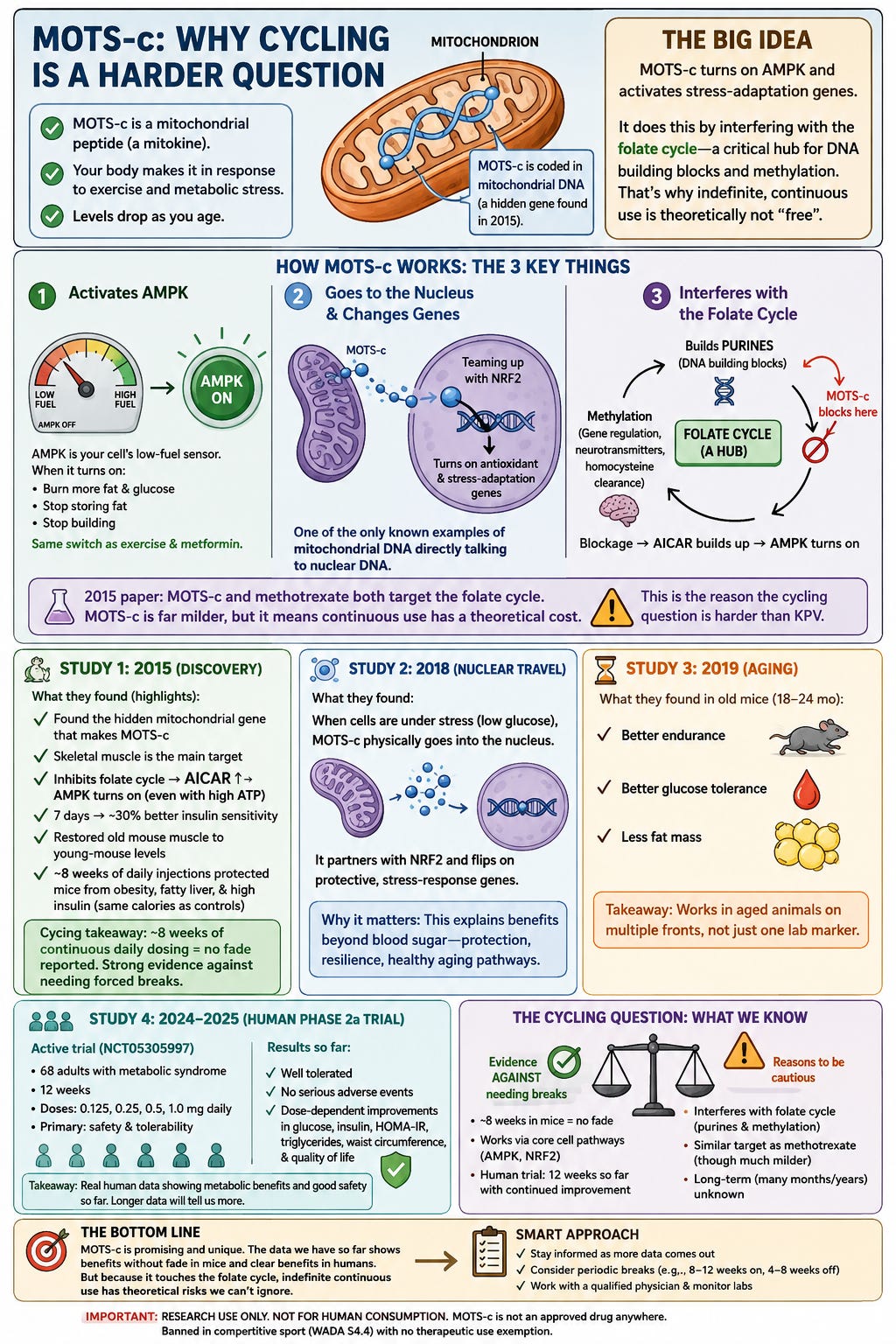
MOTS-c is a 16 amino acid peptide. What makes it strange is where it comes from.
Almost every protein in your body is coded in your nuclear DNA. MOTS-c is not. It is coded inside your mitochondrial DNA, in a stretch that was previously assumed to only make ribosomal RNA. USC researchers found a hidden gene sitting inside it in 2015.
So this is a signal your mitochondria send out to the rest of your body. Researchers call it a mitokine, or a mitochondrial hormone.
Your body makes it in response to exercise and metabolic stress. Levels drop as you age.
That last sentence is the entire reason people are interested, and it is also the entire reason the cycling question is harder here than it was with KPV.
Three things. The third one is where the cycling argument lives.
First: MOTS-c activates AMPK. AMPK is your cell’s low-fuel sensor. When it flips on, the cell switches into burn mode: pull in more glucose, oxidize more fat, stop storing, stop building. This is the same switch metformin and exercise flip.
Second: Under stress, MOTS-c physically travels into the cell nucleus and changes which genes get turned on. It works with a transcription factor called NRF2 to activate antioxidant and stress-adaptation genes. This is genuinely unusual. It is one of the only known examples of the mitochondrial genome directly talking to the nuclear genome.
Third, and this is the important one: The way MOTS-c activates AMPK is by interfering with the folate cycle.
The folate cycle is a hub. It builds purines, which are DNA building blocks. It also runs the methionine cycle, which handles methylation, which handles a lot: gene regulation, neurotransmitters, homocysteine clearance.
MOTS-c blocks part of that. Purine production stalls, a molecule called AICAR piles up, and AICAR flips AMPK on.
The original 2015 paper says this outright: MOTS-c and methotrexate both target the folate cycle. Methotrexate is a chemotherapy and autoimmune drug that people take folate alongside specifically to manage what folate cycle inhibition does over time.
That is not me saying MOTS-c is methotrexate. It is not, the effect is far milder. But it means MOTS-c has something KPV never had: a specific, nameable mechanism where indefinite continuous exposure is theoretically not free.
Hold onto that. It comes back at the end.
The discovery paper. Everything traces back to this.
What they did: Found the hidden gene, confirmed it was mitochondrial, then tested the peptide in cells and mice.
What they found:
Cells stripped of mitochondrial DNA made no MOTS-c, confirming where it comes from
Skeletal muscle appears to be the main target tissue
MOTS-c inhibits the folate cycle, AICAR accumulates, AMPK turns on
AMPK turned on even though AMP levels were low and ATP was high, meaning this is not the normal low-energy trigger. It is a different route to the same switch
Seven days of treatment increased whole body insulin sensitivity by roughly 30 percent in a clamp study
Seven days restored middle-aged mouse muscle insulin sensitivity to roughly young-mouse levels
Daily injections over about eight weeks protected mice against diet-induced obesity, fatty liver, and high insulin, on the same calorie intake as controls
Why this matters for cycling: that last bullet is the single best piece of evidence against forced breaks. Roughly eight weeks of continuous daily dosing and the protective effect held the whole way through. No reported fade.
What they did: Tracked where MOTS-c physically goes inside a cell when the cell is stressed, in this case by glucose restriction.
What they found:
MOTS-c moves into the nucleus
It needs AMPK to do it
Once there, it regulates a broad set of genes, especially ones carrying antioxidant response elements
It interacts directly with NRF2, the master regulator of the antioxidant stress response
Why this matters for cycling: two ways, and they point in opposite directions.
Against cycling: there is no cell surface receptor here to burn out. MOTS-c goes inside and works on gene expression. Receptor desensitization logic does not apply, the same way it did not apply to KPV.
For cycling: what it is activating is a stress adaptation program. Adaptive stress responses are classically things that respond to intermittent challenge and blunt under constant exposure. That is what hormesis means. If MOTS-c is a stress signal, continuous exposure may be exactly the wrong shape.
I do not think anyone has resolved this. But it is a real tension and I am not going to pretend it is not there.
The aging and performance study. Probably the most cited one, and the most misquoted.
What they did: Tested MOTS-c in young (2 month), middle-aged (12 month), and old (22 month) mice. Separately, they measured natural MOTS-c in 10 healthy young men before and after riding a stationary bike.
What they found:
Endogenous MOTS-c went up in human muscle and blood after exercise
MOTS-c treatment improved running capacity in mice at every age tested
The effect on running was independent of body weight, based on total work output
Treatment activated AMPK in skeletal muscle and increased GLUT4
Late-life treatment starting at 23.5 months improved physical capacity and healthspan markers
Lifespan trended longer (median about 6.4 percent, maximum about 7.0 percent) but the overall survival curve did not reach statistical significance
Two things to be precise about, because both get mangled constantly.
One, the human portion of this study was observational. Ten guys on a bike, measuring their own MOTS-c. Nobody in this study was injected with anything. If you see a page citing Reynolds 2021 for a human dose, that page is unreliable and so are its other numbers.
Two, and this is the part that matters most for our question: the late-life treatment was intermittent. Three times per week, not daily.
Our best long-term outcome data in mammals came from an intermittent schedule. Not continuous, and not a cycle with washout weeks either. Somewhere in between.
This is the human data, and it is a MOTS-c analog rather than MOTS-c itself. Still the most relevant human exposure record we have.
What they did: CohBar developed CB4211, a modified MOTS-c analog, and ran a randomized, double-blind, placebo-controlled trial. Phase 1a in 65 healthy volunteers to find a dose. Phase 1b in 20 people with obesity and fatty liver disease, defined as 10 percent or more liver fat. The tested regimen was 25 mg subcutaneous, once daily, for four weeks.
What they found:
Met its primary endpoint. Well tolerated, appeared safe, no serious adverse events
Significant reductions in ALT and AST, both liver damage markers
Significant decrease in glucose
A trend toward lower body weight
Also worth knowing: Phase 1a hit a snag early. There was an injection site issue, with evidence some drug was staying at the site. The protocol was amended and the study resumed.
Development was later discontinued. The company wound down; the peptide did not obviously fail.
Why this matters for cycling: four weeks of continuous once-daily dosing in humans, with biomarkers still moving in the intended direction at the end and no serious safety signals. That is our ceiling for human continuous exposure. It is a real data point and it is also only four weeks.
What it is: A registered Phase 2a randomized, double-blind, placebo-controlled trial of MOTS-c itself, not an analog. Roughly 120 adults with prediabetes and a BMI between 27 and 40, randomized 1:1 against placebo.
The design: Fixed subcutaneous dose, once daily, for 12 weeks. Primary endpoint is change in insulin sensitivity measured by the Matsuda index from an oral glucose tolerance test. Safety followed through week 16. Started February 2026, primary completion expected February 2027.
No results yet. The dose is not disclosed in the registry, so I am not going to guess at it.
Why this matters for cycling: notice the design. Twelve weeks, continuous, once daily, no washout. When actual investigators designed a controlled human study of this peptide, they did not build in breaks. That is not proof breaks are unnecessary, but it tells you what the people closest to the compound think is reasonable to test.
What they did: Looked at MOTS-c effects on muscle atrophy signaling.
What they found: MOTS-c reduced myostatin and atrophy-related signaling.
Why this matters: it is a direct counterweight to the biggest theoretical concern with chronic AMPK activation, which I get to next. If MOTS-c were purely a catabolic AMPK signal, you would not expect it to suppress myostatin. The muscle picture is more complicated than “AMPK up, muscle down.”
This is the strongest argument for cycling, and it does not come from a MOTS-c study at all. I want to be upfront that this is reasoning by mechanism, not direct evidence.
The MASTERS trial was a randomized, double-blind, placebo-controlled human study in older adults doing progressive resistance training, with or without metformin.
Metformin, like MOTS-c, activates AMPK.
What they found:
Metformin increased AMPK and ACC phosphorylation, confirming chronic AMPK activation
Metformin blunted the increase in mTORC1 signaling in response to training
Lean mass gains were reduced in the metformin group
There was a trend toward blunted strength gains that did not reach significance
AMPK and mTOR are opposing switches. AMPK says conserve and break down. mTOR says build. Chronically holding AMPK on can, in a real human RCT, cost you hypertrophy from training.
How much this transfers to MOTS-c is genuinely unknown. MOTS-c is not metformin, the AMPK activation route is different, exposure is far shorter given the half-life, and the myostatin finding above cuts the other way.
But if someone is running MOTS-c continuously through a hypertrophy block, this is the specific concern worth naming, and nobody has studied it.
I am not going to oversell this one either.
No confirmed cell surface receptor. Nobody has identified a dedicated MOTS-c receptor. It appears to act intracellularly and through nuclear translocation, with some evidence of transport-assisted entry.
Half-life is short and poorly characterized. Estimates after subcutaneous dosing run from roughly 45 minutes to a few hours. Human pharmacokinetic data is thin.
Nobody knows whether exogenous MOTS-c suppresses your own production. This is a real open question for any endogenous signaling molecule and it has not been tested. I could not find a single study looking at it.
Nobody knows what months of continuous folate cycle inhibition does. Not in humans, not in animals. Nobody has run homocysteine and methylation panels through a long MOTS-c protocol and published it.
And most of the circulating dosing conventions trace to a mouse study. The popular 3x/week rhythm comes from Reynolds 2021, where aged mice got 15 mg/kg by intraperitoneal injection. That is a mouse dose by a route nobody uses, in an animal with a very different metabolic rate.
One practical note that trips people up constantly: MOTS-c is dosed in milligrams, not micrograms. Anyone carrying over habits from growth hormone peptides is off by a factor of a thousand.
The endogenous pattern is pulsatile. Your body releases MOTS-c in bursts, in response to exercise and metabolic stress, then it clears. It is not a constant background tone. Continuous administration is a non-physiological pattern for a signal that evolved as a spike.
The folate cycle mechanism is the real argument. This is the one that is specific to MOTS-c and it is genuinely stronger than anything in the KPV literature. Sustained inhibition of one-carbon metabolism is a plausible methylation and homocysteine concern, and nobody has looked. The discovery paper itself draws the methotrexate comparison.
Hormesis cuts against constant exposure. If the mechanism is activating a stress adaptation program through NRF2 and antioxidant response genes, that is the class of signal that classically blunts under continuous exposure and works best intermittently.
The best long-term outcome data used intermittent dosing. Reynolds got healthspan improvements in old mice on a 3x/week schedule, not daily.
The AMPK and hypertrophy conflict. The MASTERS trial is a real human RCT showing chronic AMPK activation can blunt training-driven lean mass gains. Whether it transfers is unknown, but the mechanism overlaps.
Zero long-term human safety data. The longest human exposure on record is four weeks, and that was an analog. The 12-week trial has not reported.
There is no receptor to rest. No confirmed cell surface receptor has been identified. MOTS-c works intracellularly and by moving into the nucleus. The standard receptor-burnout justification for cycling does not have anything to attach to here.
The 8-week mouse data held the whole way. Daily dosing across roughly eight weeks, protection against obesity and fatty liver maintained throughout, no reported fade.
Four weeks of daily human dosing produced no tolerance signal. CB4211 biomarkers were still moving at week four.
The short half-life builds in a washout every single day. At 45 minutes to a few hours, even daily injection means the tissue sees a spike and then a long clearance. Daily dosing may already be closer to intermittent exposure than it looks on a calendar.
This is arguably replacement, not stimulation. MOTS-c declines with age, and lower levels track with worse metabolic markers. If the framing is restoring something that fell, cycling makes as much sense as cycling a hormone you are deficient in.
The people running the actual trial chose continuous. Twelve weeks, daily, no washout. That is what a Phase 2a design looks like when investigators think about it seriously.
Same as KPV in one respect: no study, in any species, has ever compared continuous MOTS-c against cycled MOTS-c. Zero. The 8-to-12-weeks-on, 4-weeks-off convention you see everywhere is borrowed from general peptide folklore, and most sites publishing it explicitly justify it with “prevents receptor desensitization.” For a peptide with no identified receptor, that reasoning is just wrong, even if the schedule happens to be fine.
But here is where MOTS-c parts ways with KPV, and it is the point of this whole piece.
With KPV, the argument for cycling was almost entirely precautionary. We had no data, so breaks were a hedge against unknowns, and the mechanism actively argued against receptor-based cycling.
With MOTS-c, there is a specific mechanistic reason to take breaks seriously, and it has nothing to do with receptors. It is the folate cycle. Sustained interference with one-carbon metabolism is not a theoretical nothing. It is the mechanism the discovery paper itself compared to an antifolate drug. Nobody has run the long-duration methylation and homocysteine work, which means nobody can tell you it is fine.
Add the hormesis problem. A stress adaptation signal that your body normally fires in bursts may work better as bursts.
So the reasoning inverts. The evidence-based case against continuous MOTS-c is not that it will stop working. Nothing suggests it will. It is that the mechanism has a cost nobody has measured, and the pattern it evolved to run on is intermittent.
Three things worth flagging:
The dosing folklore is mouse-derived. The 3x/week rhythm comes from 15 mg/kg intraperitoneal in aged mice. It has been treated as a human protocol for years without anyone checking.
Milligrams, not micrograms. This one causes real errors.
If you compete, it is banned. WADA S4.4, prohibited at all times, no exemption available.
Comments are open. If you are citing something I did not cover, link it. If I got a study wrong, say so and show me. I would rather fix the piece than defend it. Keep it to the evidence and the reasoning, since nobody here can assess anyone’s individual situation in a comment thread.
This post is provided for research and educational purposes only. It summarizes published preclinical and early clinical literature and is not medical advice, diagnosis, or treatment guidance.
MOTS-c is not an FDA-approved drug for any indication. The only completed human trial used an analog, not MOTS-c itself, over four weeks. Nothing here should be interpreted as a recommendation to obtain, administer, or use MOTS-c in any form.
MOTS-c is prohibited in competitive sport at all times under WADA category S4.4, with no therapeutic use exemption available.
Anyone with a metabolic condition, prediabetes, diabetes, liver disease, or any other health concern should consult a qualified physician. That is especially true for anyone taking prescription medication, particularly glucose-lowering agents, since an AMPK-activating compound can interact with existing treatment in ways a research summary cannot anticipate. It also applies to anyone pregnant or nursing, where no reproductive or developmental data exists at all.
Research use only. Not for human consumption.
Lee C, Zeng J, Drew BG, et al. The mitochondrial-derived peptide MOTS-c promotes metabolic homeostasis and reduces obesity and insulin resistance. Cell Metabolism. 2015;21(3):443-454.
Kim KH, Son JM, Benayoun BA, Lee C. The mitochondrial-encoded peptide MOTS-c translocates to the nucleus to regulate nuclear gene expression in response to metabolic stress. Cell Metabolism. 2018;28(3):516-524.
Reynolds JC, Lai RW, Woodhead JST, et al. MOTS-c is an exercise-induced mitochondrial-encoded regulator of age-dependent physical decline and muscle homeostasis. Nature Communications. 2021;12(1):470.
Kumagai H, Coelho AR, Wan J, et al. MOTS-c reduces myostatin and muscle atrophy signaling. Am J Physiol Endocrinol Metab. 2021;320(4):E680-E690.
CohBar Inc. Phase 1a/1b clinical study of CB4211 in healthy volunteers and subjects with NAFLD and obesity. NCT03998514. Topline results announced August 2021.
MOTS-c for improving insulin sensitivity in adults with prediabetes and overweight/obesity (MOTS-MET). Phase 2a. NCT07505745. Ongoing.
Walton RG, Dungan CM, Long DE, et al. Metformin blunts muscle hypertrophy in response to progressive resistance exercise training in older adults: the MASTERS trial. Aging Cell. 2019. NCT02308228.
Mitochondria-derived peptide MOTS-c: effects and mechanisms related to stress, metabolism and aging. 2023. PMID 36670507.
No posts
Comments
Nothing yet. Say the first thing.
Sign in to join the conversation.