
First: It’s been a bit since I’ve written here. I’ve been working on other essays I’m proud of. Check them out:
“The Infertility of Time”: on Solvej Balle’s series ‘On the Calculation of Volume’ and infertility for The Metropolitan Review
“Communication is Literally Impossible”": on the challenges of translation for The Republic of Letters
Also, my debut novel The Unmapping recently celebrated its one-year birthday. I hope you consider checking it out from your local library (or purchase it on the internet, available in paperback, e-book, and audiobook from all the usual places: Amazon, Bookshop, Barnes & Noble, Audiobrary. E-book is only $3.99!). If you’ve already read it, consider leaving a review!
I never saw it coming. After nine years in a relationship, including three years of marriage, you think you know someone. You’ve memorized their eating habits and conversational tics. You can spot their bad mood before they can recognize it in themselves. After years of reading and watching books and movies together, you know exactly what they’ll like and what they’ll hate. People change, yes, but the changes fit in the same personhood. My husband’s likes include: Ancient Greece, Napoleon, theoretical math, the history of bureaucracy. His likes include: growing his brain, feeding it with useful facts and information, the denser the book, the better. His hates include: bananas, carsickness, closed-mindedness, and a variety of media that, for nine years of our lives together, always included musicals.
We are a musical family now.
Our nieces and nephews will pretty much watch anything if it’s in the format of a musical. Once we discovered this, we realized that we could show them movies that were actually good—i.e. anything but Wonka—as long as they were musicals. Yes, as mentioned, my husband hated musicals, but he hated absurd kid logic even more. Stories should make sense! A lot of media made for kids seems to have forgotten this. You watch a kid movie and it makes you dumber. It is meant to be taken in like candy, laughed at and clapped at and forgotten. The plot and meaning often collapse under scrutiny. Movies like this are not made for thought. Which, fine. You wouldn’t expect something like Teletubbies: The Musical to be a literary masterpiece.
But then there is Les Misérables, adapted from Victor Hugo’s 1,500-page novel that many really do believe to be a literary masterpiece. We popped the popcorn and put the movie on in the basement, and it was a hit. The nephlings loved it. I wept, which meant I loved it. And my husband? He was blown away. The next time we had them over, we put on The Phantom of the Opera. The same thing happened. Kids loved it. I loved it. Husband came away a changed person.
Now the music from these shows is a well-known presence in our household. We put it on when we’re driving around or just bored at home. We reference the lyrics to each other. We each have our favored recordings and we argue over which is better. (I think Gerard Butler’s voice ruins the movie recording of Phantom; he says the same for Russell Crowe and Les Mis, but the movie recordings generally have better orchestration.) One person will hum while walking to the kitchen and the other will unthinkingly pick up the tune.
I have always enjoyed musicals, but secretly, in private. Not necessarily ashamed, but not bragging about it either. But now I could play this music in the open. The genre could be enjoyed by everyone. This led me to sign up to play cello in My Fair Lady.
My Fair Lady is a wonderful show. I know because I’ve now seen it in its entirety six times. This is the nature of performance.
Quick summary for those who haven’t seen it (with spoilers—it’s still worth watching). The poor flower girl Eliza Doolittle wants to improve her speaking skills (she has a dreadfully strong Cockney accent from outside London) because she dreams of working inside a flower shop as a lady, rather than selling single stems on the street. She meets Henry Higgins, a phonetics professor who agrees to teach her “proper” English. Henry Higgins is also an asshole. But he’s good at what he does. Not only does he teach her proper English, he feeds her good food and provides her with a nice bed and bath and buys her a wardrobe to fit in with the upper class.
After some setbacks and stumbles, they succeed in introducing her to high society, inadvertently convincing a rival phonetics expert that she is secretly a Hungarian princess! And of course, Eliza Doolittle and Henry Higgins fall in love in the process. But neither can admit it. Higgins is too proud and Eliza too fearful of the power dynamics. She’s afraid he’ll kick her to the curb. So she doesn’t let him. She leaves in the middle of the night. Henry Higgins panics. He searches the town for her. He finds her. They argue. She vows to marry simp Freddy, a puppy of a man who writes her love letters every day.1 “Pages and pages!” she complains-slash-brags. “You want me to be as infatuated about you as he is, is that it?” Higgins asks. “I want a little kindness,” Eliza responds. “I’m not dirt under your feet.” She leaves again, and Higgins is bereft again. But then she comes back. They end up together.
Everybody who sees this show adores Eliza Doolittle. She is clearly the star; the production is named after her.
But a lot of people hate Henry Higgins. At the production I played in, pretty much everyone I spoke to complained about Henry Higgins afterwards. Why did she return to such a pimple of a man?
This is a surface-level reading of the musical: Tough but talented Henry Higgins transformed Eliza into a fair lady. Full of dignity, she decided she didn’t need him anymore. But then she came back. She shouldn’t have done so. The original stage play version, Pygmalion by George Bernard Shaw, ended differently, after all—so the musical ending was a fluke!2 It was probably because Hollywood needs happy endings. At least the music was nice and the dancing was fun. The first time I saw the movie version many years ago, I probably had the same opinion.
Now that I’ve seen it six times from start to finish—many more times if you add up playing all the songs in practice and rehearsal—I hold the opposite opinion. This is Henry Higgins’s story and he is absolutely the hero.
Henry Higgins is rude. But at the time, Eliza Doolittle’s mannerisms were considered just as offensive, if not more. She whines and pleads. She wipes her nose on her sleeve. She spits and swears! These are all things we don’t care about now, but back then, it would be like peeing on someone’s stoop. Not cute. Also, Eliza’s friends and family are worse. She’s no stranger to black eyes. She suspects her great-aunt was murdered over a hat. Her father explicitly tells Henry Higgins to use violence on her if she gets out of line.
Meanwhile, Henry Higgins’s insults to her are adorable: he calls her “baggage,” “deliciously low,” a “squashed cabbage leaf.”
Yes, he’s terribly disrespectful. But this is also a key part of his story. In the end, it’s Henry Higgins who needs to learn how to speak properly, not Eliza. He’s a social menace. He offends people all the time, not just Eliza. He scares his mother’s friends away. He claims his best quality is that he treats everyone equally bluntly. Only Eliza, when she shows him the impact of his words, can get him to change for the better. And he does. He humbles himself before her and asks her to stay. “I can get along without you. Don’t you think I can’t!” Eliza says. “I know you can,” he responds. “You’ve never wondered, I suppose … whether I could get along without you?” (Cue my tears, which continue for the next fifteen minutes.)
Throughout the show, Eliza changes on the outside, but not the inside. She’s strong-willed and ambitious at the beginning. She’s strong-willed and ambitious in the end. Henry Higgins, meanwhile, is a completely different person. Eliza can see this. And she loves him.3
I love him, too.
I love his passion, what he represents, what the whole show represents. He cares most of all about the nuances and beauty of the English language.
The majesty and grandeur of the English language, it’s the greatest possession we have. The noblest thoughts that ever flowed through the hearts of men are contained in its extraordinary, imaginative, and musical mixtures of sounds. And that’s what you’ve set yourself out to conquer, Eliza. And conquer it you will.
For two hours a day, I watched the show and I took this in. (The musical has a run-time of three hours, and the songs account for about an hour). Sometimes the repetition was tiresome, as with Colonel Pickering’s pointless bumbling physical humor, but the language of the show was always interesting and fun. It’ll never not be funny when Eliza Doolittle proudly announces to a crowd of polite society in her newly refined accent that her hard-drinking aunt was murdered over a straw hat “that should have come to me.”
You may be wondering: but how could you see all this, if you were merely playing in the orchestra? Weren’t you hidden away in some dark cave-like basement, shunted out of sight with the rest of the musicians?
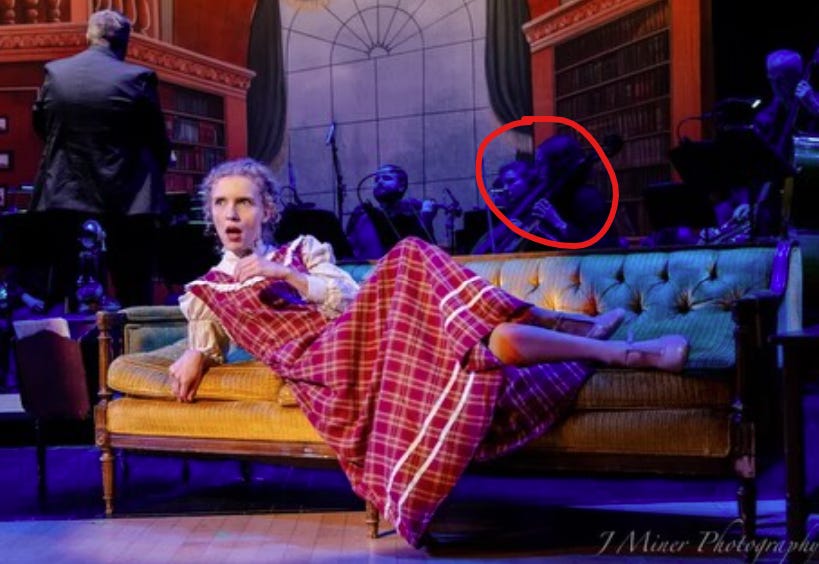
No. We were on stage.
This was a special rendition of a musical where the musicians would be featured. We were in the center of the stage. It was a large stage, so there was still plenty of room for the actors, who mostly acted in front of us, but sometimes behind and beside us. Sometimes, when the lights tightened to a single spotlight, we were hidden in the dark:
But more often we couldn’t avoid the wash lighting. As I was sitting on the edge of the group, this meant I would be clearly visible the whole play long.
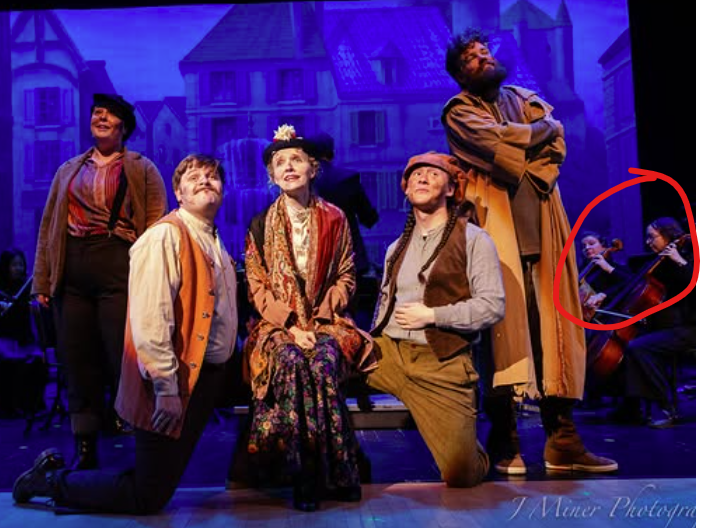
I thought a lot about how I should look during these performances. What should I do with my face? Smile, laugh, or be serious? Was I allowed to follow the actors with my eyes? There was also the matter of posture. When I play, I sit at the very edge of the chair with my back held straight. But there were lengthy breaks between some songs, so I would scoot all the way back to lean against the chair’s backrest. When the conductor grabbed his baton, I’d scoot my butt forward surreptitiously, like some sort of crab crawling forward on the bottom of the ocean, and when he lifted it, I’d lift the rest of my torso, like a zombie doing an ab exercise.
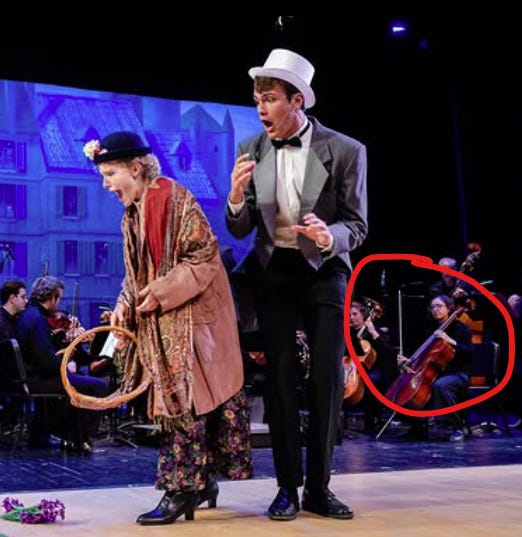
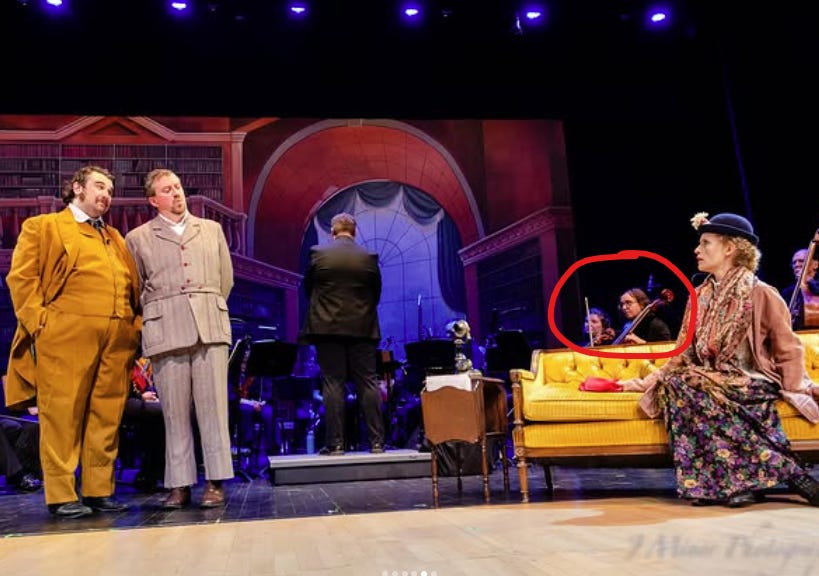
I honestly like knowing that I’m being watched during a performance, particularly when I know someone in the audience. I like to share the music I’m working on. Performance is an act of community. Anyone could watch a better-quality version of the play on film, or listen to the music on Spotify. People attend live shows to be part of something, and if there is an actual relationship with someone on stage, that experience is enhanced. So I usually am able to finagle my husband, my mom, and a few other people to attend my events.
But, with three different showings of My Fair Lady, the way things shook out, no one I knew planned to attend the Saturday night show. Instead I had to be okay with strangers watching me. I still did my best to compose myself. But I was also exhausted during this one. There had been a lot of late nights and early mornings in a row. I was reaching my limit. In the middle of the production, I had to yawn. I didn’t want to yawn. Everybody could see if I did! What would that say about the production of the show? So bad it’s boring its own musicians? If only I could tell everyone in the audience about the late nights. And about my iron deficiency, which occasionally causes yawn attacks, a sudden deep need for oxygen. I did everything I could to hold it in. I breathed deeply through my nose, deep into my belly. I counted to five with each inhale. But it became unbearable.
I yawned. Three times.
(After the show, I learned that two of my friends were in the audience; they just didn’t warn me! They claimed they didn’t notice the yawns.)
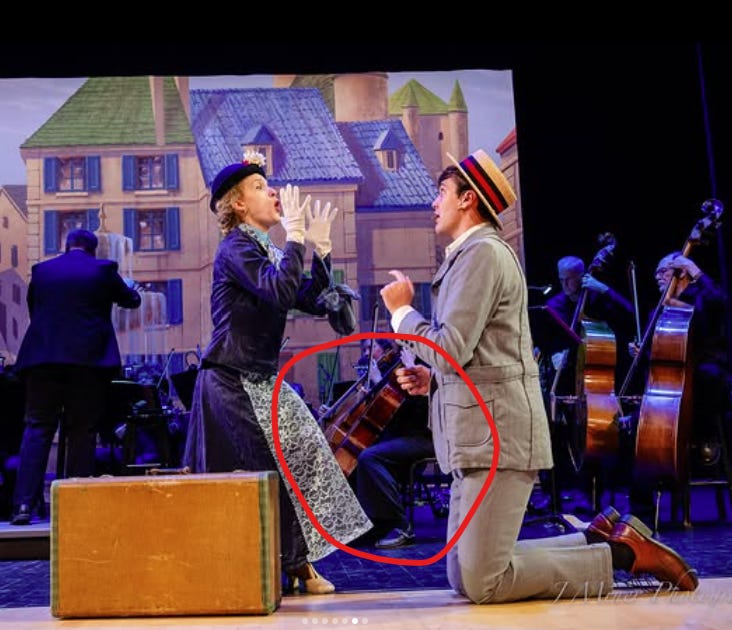
My Fair Lady is as the quintessential makeover story. It’s not just Eliza’s language that improves. Henry Higgins puts her in fine clothing that allows her beauty to shine. But looks don’t matter! cry our modern sensibilities. But they do. Aesthetics are meaningful. They signify care and self-respect. The entire English language was created as a way to ornament our thoughts so that others can see them and interact with them. Language is all about societal interactions. It would never have developed if we’d remained solitary creatures.
Even if no one was really watching me (and I’m sure they weren’t 99% of the time), I liked the idea of it because it makes me pay more attention to myself and my movements. To play a cello is to be aware of every inch of your body and move it all in tandem. This requires a lot of focus, and when the focus slips, mistakes happen. Aesthetics, when done right, bring the internal and external into harmony.
My husband and I bought our house in winter when the lawn was covered with snow. Come spring, we discovered that it was in dire shape. I never really wanted a lawn, though. I wanted a garden, a mini-ecosystem of native flowers. This set me off on a two-and-a-half-year (so far) journey researching local flowers, sedges, and trees, and slowly reshaping what I’ve come to call the “yarden,” a combination of clovers, planted flowers, and native wild sections. It always surprises me how much there is to learn. For instance, I recently discovered the difference between upright wood sorrel and black medic, two clover-like plants that look almost exactly alike, except for a tiny difference in the little yellow flowers. Wood sorrel is native and part of the natural food web. Black medic is invasive and crowds out native plants. Once I understood the difference, black medic looked ugly to me. It was a blight. But wood sorrel looks like it’s where it’s meant to be. The same went for the creeping bellflower, which looks lovely to the uninitiated eye, but now when I see it, I feel sick inside. Same goes for buckthorn, dame’s rocket, garlic mustard, and so on. This aesthetic was learned.
After two and a half years of working on the garden, we received this note by the door:
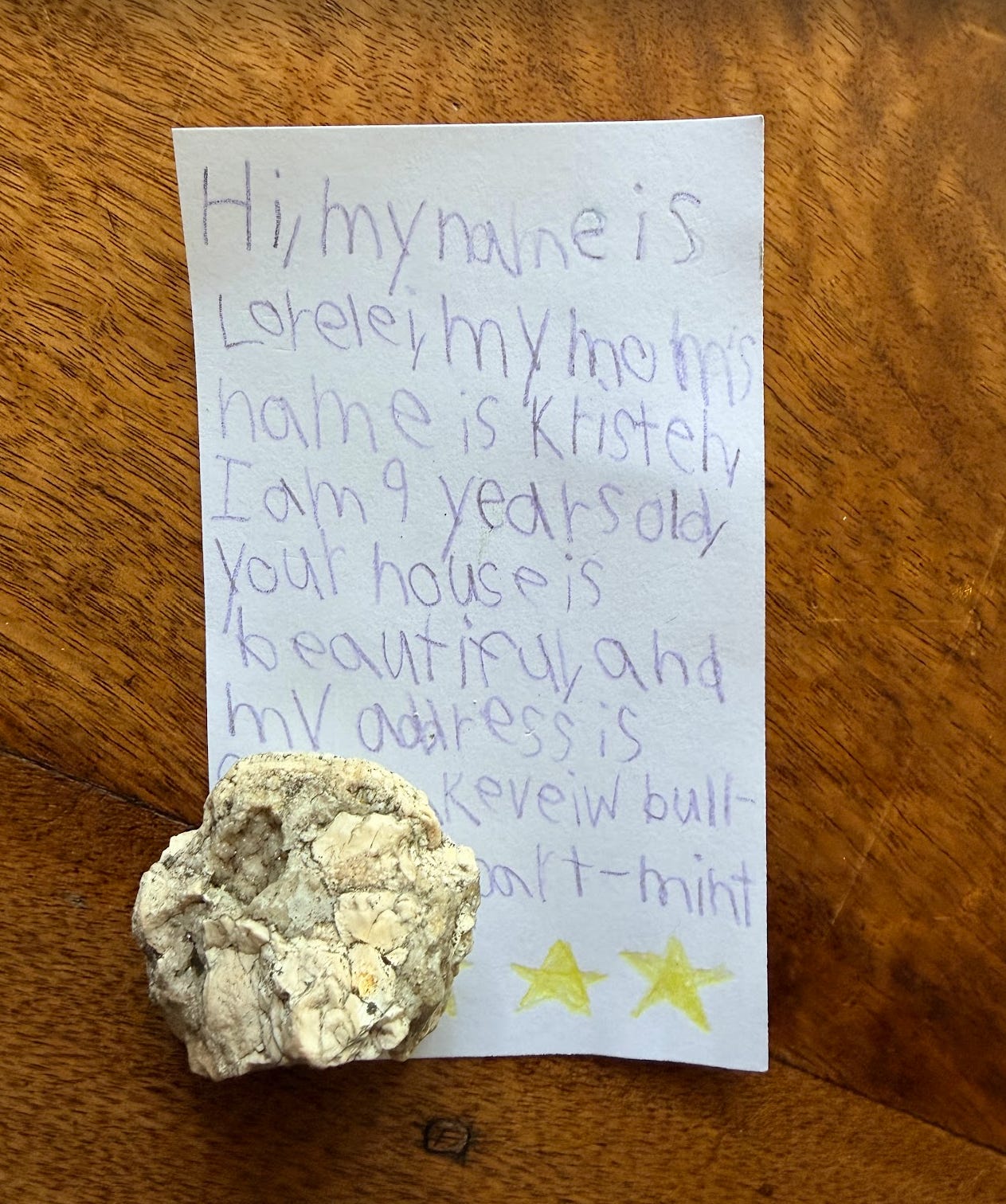
Even after two and a half years of effort, our yarden looks kind of crazy. It’s very green and there aren’t a lot of blooms at any given time. But the learned aesthetic got me here, and it’s not just for me; it was appreciated by a nine-year-old, which suggests there is something inherently good in it.
My husband didn’t like musicals, but now he does, and this opinion is correct.
In a way, saying “musicals are good” is like saying “books are good.” The genre is vast and has a lot of variance. Some musicals are really bad! Especially if you count the Chalamet-Wonka movie as a musical. But there are clear commonalities in the musical genre.
In musicals, people sing songs. The music is usually non-diegetic, that is, not literally happening in the story, but a stylized version of reality. This is a requirement.4 This is different from a movie or play about music, like Inside Llewyn Davis or Once or any musician biopic that features musicians and shows them singing their own songs. Sometimes there is diegetic music within a musical, as with the rehearsals and performances in The Phantom of the Opera, but there must be more than that: people must sing as part of the plot, to advance the plot.
So first, you have to be okay with the fact that people sing songs non-diegetically. Just like when you see a play, you have to be okay with the fact that people are on sets with stage lights visible. When you watch a movie, you are watching people on your screen, not standing in your living room. When you read, they are words on a page.
Also, musicals have a strange relationship with time. Specifically, things tend to happen too quickly. People fall in love immediately. Their lives change at the drop of a hat. In Les Mis, Valjean is able to convince the young Cosette to run away with him within five minutes, which would be creepy in any other medium. Again, it’s not real. It’s not meant to be. It’s art!
Then, there are the tropes. Most musicals follow similar story beats:
First, the main character needs an “I want” song near the beginning (“Wouldn’t it be Loverly” in My Fair Lady), or at the very least, an “I am” song (in the opening song in Les Mis, Jean Valjean says “My name is Jean Valjean” and Javert says “And I’m Javert.”)
At some point there should be a comedic villain song (“Master of the House” in Les Mis, “Prima Donna” in Phantom, “I’m an Ordinary Man” and “A Hymn to Him” in My Fair Lady.)
There needs to be an iconic song at the end of act one, uplifting in a complicated way, knowing darkness is to come. (“One Day More,” in Les Mis, “Embassy Waltz” in My Fair Lady, “All I Ask of You” — the darker reprise sung by Phantom— in Phantom.)
The second act includes a heartbreaking female solo, often about loneliness. (“On My Own” in Les Mis, “Without You” in My Fair Lady, “Wishing You Were Somehow Here Again” in Phantom).
So, musical haters can criticize the unoriginality of tropes. But I don’t think this strict structure is inherently a bad thing. As Lincoln Michel recently wrote, “Regardless of genre or style, nearly all fiction works through a balancing act of repetition and difference. When we enjoy something, we want to see it again and again… but also in new and surprising forms.” Within a given structure, you can tell infinitely many stories. And the musical structure’s inherent repetition is actually its strength.
I would like to be the sort of person who rereads books. You hear things about how rereading a good book will strengthen your brain and transform you into a sage or maybe a god. But I’m not that sort of person. There are too many books I haven’t read yet. I’m hungry to read. I’m hungry for new information, new authors, new stories.
And yet I am perfectly happy listening to the same songs over and over again. I have no real desire to seek out new music. There are hundreds of albums I already know I love. Each one took time to fall in love with. Music requires repetition.
Maybe the closest I’ll get to rereading books is reading the book series called On the Calculation of Volume by Solvej Balle. In this seven-book series, the narrator is trapped inside a day that repeats over and over again. The books are sometimes criticized as feeling repetitive, but I don’t think so at all. And yet there is a comforting sameness to the rhythm and prose, even while each book expands on the initial idea. In book three, the narrator starts paying closer attention to sounds:
“I attend concerts, I don’t just go once, I listen and listen, and each time there are other sounds: a hidden instrument, a note unfurling in the background, a marginal sound I hadn’t heard before, an unusual timbre, an unexpected echo.”
Gardening also requires a lot of repetition. Pull the same weeds. Sit in the same plot. Stare at the same plants for months on end, watching the tiny daily changes add up.
Repetition is an inherent good. It allows for closer attention and deeper contemplation. I want more repetition in my life, not less.
So I like that musicals are meant to be repeated. The songs can and should be played over and over, long after the curtain falls. They should be sung in the car and danced to in the living room. And, within each musical, there are motifs that are repeated and expanded upon. Repetition is what lifts musicals into a higher plane of art that’s hard to find in literature.
I once hated pickles and olives and every berry except for grape. Then, when I was a freshman in college, I decided I’d try all the foods I used to hate. Maybe my tastes had matured, but I attribute it more generally to a spirit of open-mindedness that comes when you’re a freshman in college taking classes like “history of China” and “musicology of jazz,” experimenting to find out what you like. Also, the food was really good. Fresh kalamata olives after a lifetime of plasticky salad olives. Juicy full pickles after jars of sad dill slices. I have a distinct memory of eating what I called my “gateway pickle” in the dining hall on West Campus. After that, even mediocre pickles were enjoyable, because now I understood what the flavor was reaching for.
Les Misérables was my husband’s “gateway musical.” It made him open to watching Phantom of the Opera and later My Fair Lady, and we’re already making a long list of future musicals to take on.56
That said, the gateway musical has to be a great musical. As mentioned, some musicals are very bad. One criticism of musicals as a genre is a supposed lack of nuance. And it’s true that most songs within a musical lack subtlety. They’re taking an emotion and heightening it beyond reality. A song has a chorus that repeats over and over. Like, we get it! You’re on your own, there’s no one else beside you. (I still love this song).
Sometimes, though, musicals will extend this simplicity to the overarching story. I can think of four musicals off the top of my head that feature a scrappy protagonist from an oppressed class that is able to overcome all odds and defeat the bad guys. The good guys are good and the bad guys are bad and goodness wins in the end. Even if the songs are good, these musicals can leave you with a hollow feeling.
A great musical has a variety of viewpoints that clash with each other. Each of them might be one-note on their own, but the juxtaposition creates a complication that stays with the viewer afterwards. In Les Mis, everyone is struggling with the idea of honor in different ways. After spending two hours fearing and hating Javert, who tried to sabotage the Paris rebellion and to ruin the life of verified-Good-Guy Jean Valjean, Javert’s ending is the greatest tragedy. Valjean, meanwhile, fails over and over to live an honorable life, despite his best efforts. In My Fair Lady, Henry Higgins is rude, but you learn to love him anyway, because his passion and will are part of who he is and are worthy in their own right. The Phantom in Phantom is complicated and lovable for the same reasons in a different light. When it’s over, you’re not sure how to feel.7
I’d strongly recommend Phantom or Les Misérables as a gateway musical, if you haven’t seen them yet.8 My Fair Lady is a bit old-fashioned and harder to love, but it’s also worth a try.
My Fair Lady was my first musical gig. It was an intensive experience. There were just two weeks between the first rehearsal and the final performance. Long rehearsals, late nights, and a weekend of performances where I did pretty much nothing other than practice and perform. And I was happy. Swimming in the music, falling in love it more each time. It’s a bit goofier than Les Mis and Phantom, but so heartrendingly beautiful at the end, my eyes never fail to leak.
I had to give the My Fair Lady book back to the conductor when it was over. But I wasn’t ready to say goodbye to music. I remembered I had piano sheet music from The Phantom of the Opera sitting in my mom’s basement. I went to her house to retrieve it and decided I’d try playing it on the spot. (Her baby grand piano is nicer than my electric keyboard.) I played “All I Ask of You” while my mom sat on the couch watching. My playing was shaky—it had been a long time since I’d played this piece—but she was moved to tears. Why? I laughed. Was I that bad? No, she said, it was my father and my grandmother she saw in me, both piano players, both now long dead. She’d never seen Phantom but she saw the love I felt when I played my favorite song, a song about love, filled with love, and, by performing it for her in her living room, I wrapped her up in it too.
Find your gateway musical. Then repeat.
-Denise
PS: Even if I don’t reread books in full, sometimes one will stick in my head and make me want to reexamine them. I mentioned them above but I’m repeating them here:
I mentioned Balle’s On the Calculation of Volume in this essay. I recently wrote a more extensive essay on the series in The Metropolitan Review:
I previously wrote about Tulubaikaporia in my belly button essay about Russian literature and grief, and noted that I wanted to return to this marvelous book by vanechka buymybookovich. I finally did so in a recent review for Republic of Letters:
PPS: Putting this out into the world: Someone should turn The Unmapping into a musical, please. I already decided the music will be jazz-themed.
PPPS: What are your favorite musicals?
Some people love Freddy because he has a beautiful song, but he’s the biggest wet noodle. He goes to Eliza’s house but refuses to go inside because he just wants to “drink in the street where she lives.” Pathetic!
I have opinions as to why the musical’s ending is an improvement upon the play’s, but they won’t fit into this newsletter
People love to see a bad man redeemed, but my theory is that a) Henry Higgins is “bad” in ways that modernity suggests are irredeemable, and b) he doesn’t get enough of a comeuppance for modern audiences to be satisfied with this redemption. He finally tells Eliza he respects her after she tells him she’s leaving. Then his heart is broken but this sadness lasts for about five minutes of stage time before Eliza returns. There is no physical or material suffering that he goes through to match his inner turmoil.
When I was in college, I went with my boyfriend at the time to NYC to see the Broadway musical “Come Fly Away.” All we knew is that it was a story about love, set to Frank Sinatra’s music. There was music, and there lots of was dancing, but no one on stage sang, or said a single word. We kept waiting for the story to begin, and it just… didn’t! “It’s not a musical,” we told each other afterwards. “It’s music…. hold the ULL.”
I put query on the musical subreddit specifically for requests for “a self-serious historical period piece, ideally set in France.” I received dozens and dozens of responses. There is a whole world out there!
I must note that he previously claimed to like only one musical ever, The Persecution and Assassination of Jean-Paul Marat as Performed by the Inmates of the Asylum of Charenton Under the Direction of the Marquis de Sade, also known as Marat/Sade, which happens to be a French period piece! Unfortunately, I had to inform him that since the music is diegetic, it’s not a real musical.
There’s so much more I want to say about how Phantom is a remake of My Fair Lady and how both signify the beauty and danger of Romanticist passion but this piece is too long already
No posts
Comments
Nothing yet. Say the first thing.
Sign in to join the conversation.