
The other day I bought avocados from the grocery store. I don’t often buy avocados. My husband asked why I bought them. “Why are you asking why?” “Because you never buy avocados.” “They looked good, so I bought them.” “There’s no special reason?” “No.”
If this were a short story, he said, there would be a special reason full of meaning.
When he and I first met, we both ate like shit. I would throw cans of beans and veggies together in a bowl with pasta sauce and cheese, sometimes with a scrambled egg if I was feeling feisty. He, meanwhile, was living on Soylent, a meal-replacement powdered drink. Neither of us cared about food; to us it was a necessity, you ate to live and that was that. Thankfully we’ve matured in our tastes (largely because we were both disgusted by how the other person ate, so found a happy medium), although the sentiment is still there. Food is food. Nutrition is good. We’re simple and boring in our grocery shopping, and any divergences are discussed ahead of time. Should we get ice cream today? How about something crazy like smoked salmon? Otherwise, we stick to a pretty normal routine that works for both of us, consisting of vegetables, fruit, meat, cheese, yogurt, nuts, and sauces. Sometimes chocolate. Husband cooks, I bake bread. We think about food as little as possible. We understand that food tastes good. But we don’t make a big deal about it. Why would we spend time and money eating at a restaurant when there is perfectly good—if a little simple—food at home?
Food provides energy, and energy is used to do things that are more fun than eating. Like gardening, stretching, playing instruments, and thinking very hard about why I bought avocados. Also, running. I like running. I’m not a runner. I don’t run races. I like running lazily through the countryside while listening to audiobooks, stopping to look at sandhill cranes, occasionally slowing to a walk when I feel like it.
But when a friend of mine asked if I wanted to do the Run Madtown half-marathon with him on his birthday, due to a combination of boredom, convenience, and curiosity, I said yes.
Recently the literary world was set aflame over a short story called “The Serpent in the Grove.” This story was awarded first place in a contest by a prestigious magazine, which came with a hefty monetary prize. And it was allegedly written by AI. AI-detectors say so, and a lot of the writing is florid in a way that loses meaning under scrutiny. A lot of people, Lincoln Michel in particular, have highlighted some particularly strange lines like (emphasis mine) “They called her Zoongie. Maybe it was a name; maybe rain took a shape and decided to keep it. She had the kind of walking that made benches become men.”1
But I’m most curious—and boggled—by the overarching metaphor of the story. The story is about a man who tries to kill his wife because his wife is boring and he has the hots for Zoongie (who, as noted above, is sexy enough to give benches boners). So he tampers with the planks on an overgrown, unused well that’s apparently full of snakes, and asks his wife very sketchily if she wouldn’t mind gathering water from it. The wife doesn’t trust him at all, so sends their three-year-old son away to hang out with the neighbor, but for some reason agrees to fetch the water anyway. The planks give out from beneath her and she falls down the well. Her neighbor, because she hears silence, somehow knows exactly what’s happening and comes over to save her. The husband, once he realizes he’s been caught, has a change of heart and goes to help save his wife. Together they pull her free with a mango vine. Everyone involved sort of knows the husband did it but they have no proof and he tries to be better afterwards. He feels bad: he calls himself a serpent. They go to church and the priest preaches about the snake in the Garden of Eden. The wife thinks her husband is the serpent.
If you’re not exactly sure what the central metaphor is (even though the husband calls himself a serpent, and his wife is calling him a serpent, so it should be pretty clear), the ending lines include:
The serpent in the grove was never only a snake.
It was the thing in a man that slid along stone for dark, and the thing in a woman that wrapped a vine around herself and climbed.
So the man is a snake, as noted. But also, so is his wife? This line suggests she was able to find some snakeish, evil part of herself that was also strong and allowed her to climb to life and freedom. That could be interesting. But it’s not what happened in the story. The wife did not save herself. She didn’t even yell for help. She held onto the rope as her neighbor and husband pulled her free.
(Also, despite the reference to snakes in the well, no actual snakes make a physical appearance in this story.)
All fiction is metaphor. Everything means something else. An avocado is an avocado. But in a story it means something more. It could mean the wife is looking for a shift in her routine. It could mean paranoia on the part of the husband (she’s changing something. What else is changing?) It could mean nothingness, a fruitless attempt to figure out the meaning as the meaning itself (the fruitlessness only emphasized after the avocado is eaten).
But don’t take it from me. In case you didn’t know that stories are metaphors, the next lines in “The Serpent in the Grove” after the passage above are:
A story is a well.
It eats sound until somebody throws a rope.
If grace is near and hands hold, something breathing comes up.
Some stories pull buckets of bone.
This one pulled a woman.
I’m at a loss here.
So I think writers were upset about the AI-written prizewinner not just because it feels like an attack on the human endeavor of fiction, but because the story felt so meaningless, and this meaninglessness was rewarded. It feels like an attack on meaning itself.
For most of my life, I’ve enjoyed running, but never understood why anyone would run a race. Why pay money to stress out over something I already do for fun?2 But over the past couple years, my relationship with my body and with exercise has changed. As my body has failed me in several important ways (which I’ve written about before) I’ve come to appreciate it when it works properly. I also have had to frequently go weeks at a time with very little exercise under doctor’s orders and I try to convince myself during those periods that I am fine with light walks and gentle stretches, but when those orders are lifted and I’m freed from my sedentary prison, I celebrate by attempting the splits, doing ten handstands, and running eight miles until it feels like my body has come home to itself.
This year, the aforementioned half-marathon happened to take place during a medical break, so I could run as fast as I wanted. I had exactly two and a half weeks to train. I trained by running, of course. I ran hills, did a few intervals, increased my daily distance, and pushed myself at the end of each run to go as fast as I could. (It still wasn’t very fast.)
And I trained by reading. There is one book every writer-reader must read. This is What I Talk About When I Talk About Running by Haruki Murakami. Running long distances, Murakami says, has much in common with being a novelist. It is a mind game more than anything else. It requires endurance. “If concentration is the process of just holding your breath, endurance is the art of slowly, quietly breathing at the same time you’re storing air in your lungs. Unless you can find a balance between both, it’ll be difficult to write novels professionally over a long time. Continuing to breathe while you hold your breath.”
But reading about running is boring if you’re not a runner, so there is another book I’ll talk about instead that was a key part of my training regimen. It’s called Endurance.
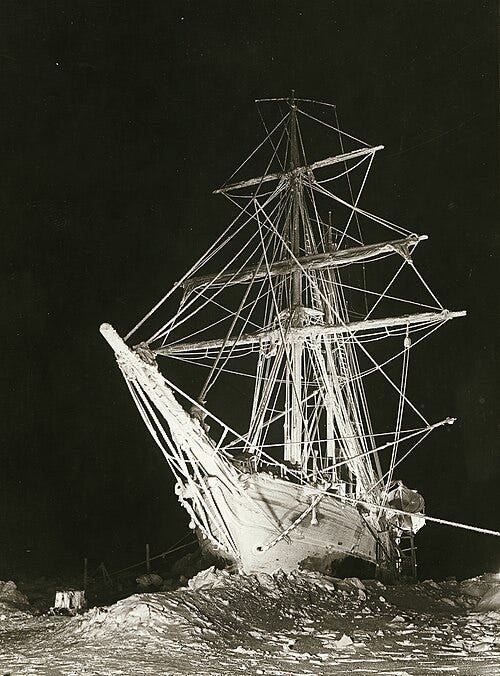
Endurance is the name of the ship that explorer Ernest Shackleton captained in his attempt to be the first person to traverse Antarctica overland. It is also the title of the book by Alfred Lansing (full title Endurance: Shackleton’s Incredible Voyage), which chronicles this endeavor. Shackleton and his crew planned to voyage by sea to a bay in the Weddell Sea, then walk 1,800 miles across the South Pole to reach the McMurdo Sound on the other side, where a relief ship would be waiting to take them home.
Shackleton was a charismatic man, according to Lansing, with a true talent—“a genius, even”—for leadership. He lived on snap judgments. All his interviews were conducted in five minutes or less. “If he liked the look of a man, he was accepted. If he didn’t, the matter was closed.” He supposedly selected a meteorologist because he “looked funny” and a physicist because he could sing.
And he wanted to cross Antarctica on foot simply because no one had done it before. Few had even ventured onto the continent at that point. He was one of those few. In 1901 he joined an Antarctic expedition led by Robert F. Scott and reached 745 miles from the Pole, the “deepest penetration of the continent at that time.” In 1907, he led the first expedition “actually to declare the Pole as its goal”; although he did not succeed, he got close, a record-breaking 97 miles away, and was still celebrated. But that wasn’t enough. Given the timing of his circumstances, he knew he would not be the first to reach the South Pole. He was right: A Norwegian accomplished this in 1912. Now he had to go further. He wanted to traverse the entire continent.
But he and his crew never reached their initial landing point. Sixty-eight miles from the coast, their ship was trapped in a pack of sea ice. They stayed aboard for eight months, through Antarctic winter, hoping the ice would let up come spring, but it only closed in tighter, eventually crushing and sinking it. They abandoned their ship, taking their stores and dogs and lifeboats, and the journey became a years-long effort to simply save themselves.
—
You will never complain about the cold again after reading this book. You will never complain about any physical hardship, really. The 28 men in Shackleton’s crew faced every physical trial it is possible to face. Starvation, thirst, and cold, broadly yes, but also smaller, more specific hardships. The saltboils that come from constant exposure. The constant wet of a melting, slushy ice world. Gangrene. Paranoia. Boredom. A foot amputation with no local anesthetic but plenty of chloroform.
Much of their adventure is about the act of waiting. Getting through each long day and long night and hoping. Stranded on an ice floe, they were at the whims of the winds. For eight months, they could do nothing but eat through their stores, kill sea lions when they could, and hope the winds would be kind. And they were, sort of. The winds pushed their camp further north, closer to open sea. They occasionally moved around from floe to floe, dragging three heavy lifeboats behind them, but mostly stayed put, and the waiting paid off. They were getting slowly closer to open sea and freedom.
And also, closer to peril. Now ice floes would crack beneath them, once swallowing up one of their tents and a man inside his sleeping bag (Shackleton pulled him free). The decision to push off their boats into water was made out of necessity. Ice floes everywhere were splitting apart. They would not hold much longer. They launched into the water, leading to a whole new set of terrors: navigating the roughest ocean in the world on three little mismatched lifeboats.
This is a thriller more exciting than fiction. They faced one near-death experience after another every day for nearly two years. If it were a story, someone would have died at some point, to provide more emotional heft to the others. But no one does. (That is, if you don’t count their sled dogs, along with their new puppies, whose throats were cut; this is the grimmest part of the story. They had no choice).3 If this were a story, they would mutiny, or turn against each other, or plot each other’s murder. But no one does.4 Barring a few minor disturbances, the men stuck together, their hardship bringing them closer. And they never, ever disagreed with Shackleton.
Shackleton was a leader through it all. He made every decision because decisions had to be made. When a plan was subverted by a storm or an unexpected wind, Shackleton made a new plan. Eventually the three lifeboats made it to Elephant Island, where the two smaller boats posted up while Shackleton’s continued on to South Georgia to bring help (i.e. a bigger, better boat). Nothing gets easier, but everything moves faster. After 17 days in the open ocean, Shackleton’s lifeboat reaches South Georgia but is unable to dock due to rough waters, so they navigate to the other side of the island, requiring Shackleton to traverse mountains and canyons that had never been crossed. The hijinks get kookier but you can feel the desperation, he’s so close, he’s been through years of pain, 800 miles of open sea, nothing can kill him now, so of course he’s going to tie a rope to a boulder to climb down a waterfall and slide down this glacier despite not being able to see the bottom. They make it to a British whaling station. They save the rest of his crew.
What was the point of Shackleton’s journey, and why is it still so celebrated? They came out physically worse than they started. They did not meet their goal. Some might say it was a stupid goal—the South Pole had already been reached, who cares about traversing the continent by land? Just so you can say so? Further, it was not the best planned. No one had ever successfully docked in the Weddell Sea, where Shackleton had intended to begin his journey. They were warned about the heavier-than-expected ice pack. But they went on anyway.
Yes, they had planned to traverse lands that had never been traversed, collecting observations that would have been invaluable to the studies of geology, magnetism, and glaciology. Even when their plans were subverted they continued gathering observations about complex climate systems and the movements of ice floes that benefited the field. Shackleton named a new coast (Caird Coast) and filled in the geography of the Weddell Sea.
But it’s the rescue that sticks in people’s minds. How close they all came to death, what they endured, how they survived. Navigating through hundreds of miles of the world’s worst waters on a 22-foot boat. Surrounded by ice floes in “ten-thousand different shapes” that smashed and broke each other and moved like a pack of predators. Tide rips and icebergs that pulled in their own directions. Thirty-foot waves underneath it all. And somehow, throughout this, a human spirit that remained unbroken.
When they abandoned their ship, leaving everything they could behind, Shackleton tore two pages out of the Bible. Psalm 23, and this quote from the Book of Job:
Out of whose womb came the ice?
And the hoary frost of Heaven, who hath gendered it?
The waters are hid as with a stone.
And the face of the deep is frozen.5
He left the rest of the Bible behind.
There was a sign at the race that I noticed near the beginning: “You’re so close to the end.” It was true. If I’d turned around and walked back, I’d have reached the finish line long before the winner. Further, if I’d gotten on a bike, or perhaps a car, I’d have been much faster than everyone else. Running is not an efficient form of movement.
But efficiency is just one goal. There are other, internal goals. Murakami writes: “In the novelist’s profession… there’s no such thing as winning or losing. Maybe numbers of copies sold, awards won, and critics’ praise serve as outward standards for accomplishment in literature, but none of them really matter. What’s crucial is whether your writing attains the standards you’ve set for yourself.”
Because I was going to run my first-ever half-marathon, my only goal was “finish, and try to run well.” I had no conception of my speed: I have no running apps, only the wildly inaccurate mile counter on the “Health” app. I figured I’d try for ten-minute miles because that seemed like a simple enough goal. That would mean a race completed in two hours and fourteen minutes. I’d run a trial the weekend before which I guesstimated to be 13 miles; it took me two hours and thirty minutes. My goal time would be sixteen minutes less than my trial time. That seemed achievable. But also, I’d just go as fast as I could and see what happened. No matter what, I’d get a personal record.
When I reached the starting line, I was surprised at how nervous I was. I reminded myself I didn’t care. I reminded myself my only goal was to finish and to do my best. But still. The adrenaline, the nerves, everyone around me pacing and grimacing, the worry that I’d have to poop, it was getting to me. My ankles felt weird. My heart hurt. A few minutes before kickoff, the race organizers unleashed sparkly beach balls upon the runners. They kept hitting everyone in the head. It made me angry. I wanted to pop them with a knife. I didn’t have a knife. Instead I searched for the pacers. “Pacers” are runners that go a specific pace throughout the race. They hold up a sign that says “ten-minute mile” and so on. I found the ten-minute mile pacer and lined up beside her. I was eager to get started so that the anxiety in my chest would ease.
Then we were off. I went faster than everyone around me. Were they just starting slow? Or was it my nerves pushing me faster? But I continued to go fast, weaving around to get ahead. I felt good. The air was perfect and my legs were strong. Around mile five or six, I realized the two-hour pacer was in sight.
Two hours! That seemed like an impossible goal. To run a half-marathon in under two hours requires an average pace of at least 9:09 per mile, which is not that impressive really, but I’d believed it was fully beyond my capabilities. But there it was, around the bend. The two-hour pacer in a hot pink shirt. I pushed a little harder, but had to back off when I got a small stomach cramp. I breathed deeply and a friend caught up with me and the cramp went away and we pushed each other to go faster. At mile eight there would be a big hill. I knew this hill well and I was ready for it. I had practiced hills until it hurt. I’d come to love the feeling that comes right after, when the ground evens out and your lungs say thank you and you feel like you can fly. During the race I took the hill slow and steady and I chanted a quote from Murakami: “Pain is inevitable! Suffering is optional!” By the time I got to the top I was ready to burst forward again. (It helped that my mom was placed on top ready to cheer. Thanks, mom!) So I did, leaving my friend behind. (Sorry, bud!) I’d planned to listen to the Brahms Violin Concerto and the Sibelius Second Symphony but now there were only a few miles left and I only had enough time for two movements of Sibelius, so I put it on, but could hardly focus on it. I was flying and I was pushing and I was getting closer to the hot-pink pacer. This goal I didn’t know I had suddenly was the only thing that mattered. Finally around mile twelve I surpassed her.6
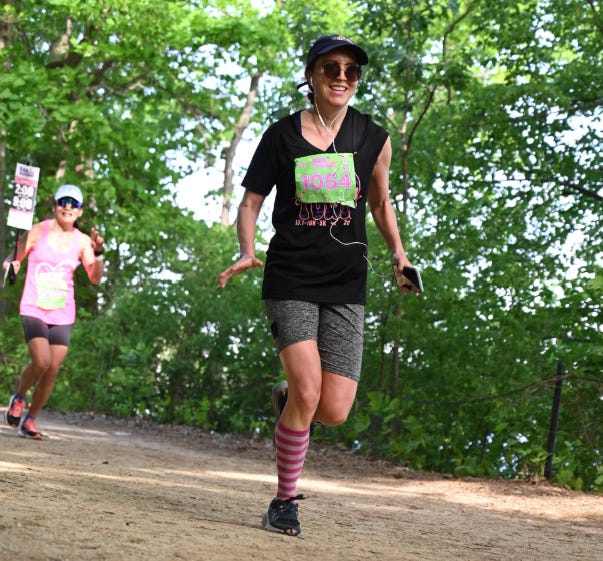
A simple test for whether or not something is good or bad, writing or otherwise, is this: is it full of meaning? Or empty of it? There are a hundred reasons why anyone runs a race. I myself had half a dozen. I had time to fill. The weather was good. My friend didn’t want to run it alone. I was planning to run a bunch that month anyways. Also: I wanted a new narrative after disappointing news. I had an opportunity to exceed my own expectations of myself. It was a test of endurance that allowed me to ask myself, If I can get through this, what else can I get through?
Probably not a lifeboat journey in 800 miles of Antarctic waters. But still.
The race was never only a race.
It was the thing in a woman that proves her body is still worthy.
The point is meaning. Finding meaning, creating meaning. This may strike you as tautologous, annoying, and/or vague. The word “meaning,” after all, is annoyingly vague. When you look it up in the dictionary, you get a lot of synonyms that don’t necessarily provide more information. “To signify.” “To mean.” (Duh.) But I’m just going to pick the synonym that I like best. “Intent.”
“Meaning” is a relationship between one entity’s intent and the physical world. There is me, who wants things, and there is the thing itself, that is acted upon, that is wanted. I want to eat an avocado. I want to be a person who eats avocados. I want to be someone who occasionally strays from the grocery routine. I want my husband to notice me. (He’s in the other room right now, sleeping, but I won’t wake him, it’s early.) I want to live in a house that is full of food that is healthy, nutritious, and simple. Food that I don’t have to cook to eat! Life, ready for me to enjoy it!
The danger of LLM-assisted fiction like in “The Serpent in the Grove” is the loss of meaning; i.e. the loss of intent. The loss of an individual mind making individual decisions. This is inherent to working with a large language model that pulls from millions of texts throughout the internet. Where is the meaning, where is the intent? Who’s pulling the reins? The danger is losing the Shackleton in our heads.
We’re becoming un-Shackled.
The purpose of an award like the Commonwealth Short Story Prize is not to find the most amazing writing in the world. It’s to help promising writers who are early in their career. There are regional prizes awarded to writers in different regions of the British Commonwealth: the Caribbean, Asia, Africa, Pacific, and Canada & Europe (which they consider one region). Theoretically this is to highlight writers with distinct regional voices. Not one amalgamated voice that’s a mishmash of MFA fiction.
Once upon a time, it took thoughtful effort for a writer to create an interesting metaphor, and it might have been challenging to read, but the reader could be relatively assured that there was some interesting meaning on the other side. Now, with stories like “Serpent,” we have all the signaling with nothing on the other end. It’s like someone decided to shipwreck themselves in Antarctica on purpose and kill a dozen sled dogs because Shackleton did it once, and Shackleton is still talked about 100 years later, so it must mean something important!
We need a story that is not just made of metaphors but is a metaphor. Simplicity, in all its complexity. A race is a race. You wake up, eat a bagel for energy, then start at the beginning and get to the end, which is sometimes the same thing.
7My husband and I eat less disgustingly now because we push each other to be better. I wouldn’t have signed up for the race if my friend hadn’t asked, and my husband wouldn’t have done it if I hadn’t asked, but we both did, and we both exceeded our expectations.8
Running a race is not about being the best, but getting to the end still matters. Intent provides the way forward. Otherwise we’re adrift. A fast race time is still not a goal I care about. But I care about pushing myself in many ways, new ways. And pushing against the world. I want to be a better writer. I want a bigger garden full of beautiful native plants, not creeping Charlie and dandelions. I want to be better at cello. I might even want to beat my own race record at a future half-marathon. We’ll see. All of the things I do are metaphors for something else even if that something else is hard to describe. Life. I am creating my life. Plants grow and music exists and there is a goal in the everyday. An avocado in my kitchen might mean nothing at all, unless I decide it means something, and this decision is all that matters.
-Denise
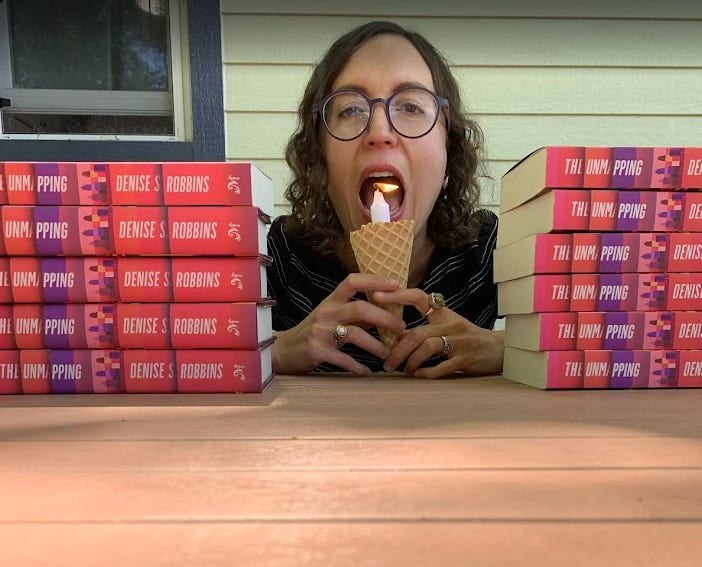
HAPPY BIRTHDAY TO MY DEBUT NOVEL, THE UNMAPPING. It was published on June 3, 2025. On June 3, 2026, which was this past Wednesday, I had an ice cream cone in its honor. Writing this post reminded me how in an interview with Connor Wroe Southard I talked about how the process of rewriting it in a month felt like running a marathon every single day for 30 days straight. It nearly destroyed me, but I did it. I’m super proud of this book and if you haven’t had a chance yet I hope you check it out from your local library (or purchase it on the internet, available in paperback, e-book, and audiobook from all the usual places: Amazon, Bookshop, Barnes & Noble, Audiobrary).
More writing around the internet
I wrote an essay for Madison Magazine about coming back to cello after 16 years away. My original draft of this had more about the composer Saint-Saëns and his brief stint moonlighting as an anonymous music critic named Phemius, named after the bard in The Odyssey. I’m aiming to return to that and expand it at some point this summer, maybe in honor of Nolan’s Odyssey movie, which I will definitely be watching no matter how terrible it may be (and maybe it won’t be!)
I missed this when it came out in April, but I interviewed—and was interviewed by—an author who also wrote a book of climate fiction, Amy Lilwall of “The Water That May Come.” Read our interview at the Climate Fiction Writers League: The Balance Between Immersion and Believability
New(ish) for Cap Times: New ‘Writing Forward’ podcast celebrates Wisconsin’s literary scene
Extra links
For another extremely cool story about leadership found in unexpected places, read John Psmith’s review of Anabasis by Xenophon
Conversely, for a story about a man that is sort of the antithesis to Shackleton, a bro who lifts weights to no real end, read Ben Sims’s “The Life of Liam Cromwell, Personal Trainer”
Cat
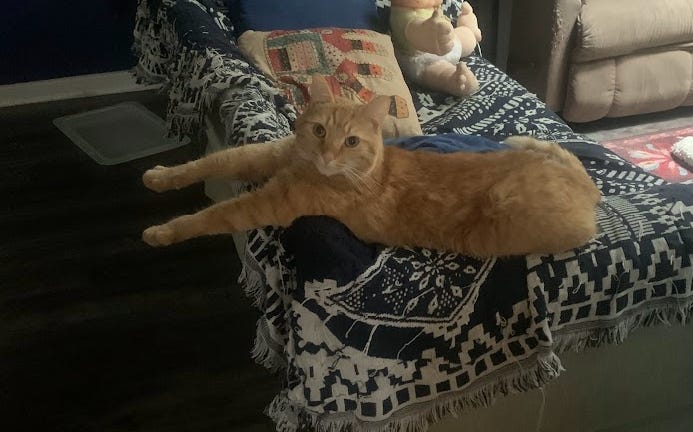
I think I deserve an award for refraining from using “-maxxing” anywhere in this essay, except here, because Mondo is definitely stretchmaxxing:
I actually think a lot of the writing is fun. The main characters’ neighbor is “big in the way of women who never apologise to furniture.” Wtf is that? I love it.
Before being invited to run the half-marathon, I had run exactly one formal race: a 5K my mom bullied me into for her 65th birthday, along with my siblings. She bought our bibs, we couldn’t really say no. I ran as fast as I could and got first in my division, but there weren’t that many people running in my division, or in the race in general. My mom scored the silver in hers. This was four years ago.
I’ll note that the voyage that set out to pick them up on the other side faced its own hardships, including one death and two disappearances. They were technically part of Shackleton’s expedition but not under his command.
Also, if this were a story, they definitely wouldn’t have eaten those albatross chicks once they landed on Elephant Island, but apparently none of them read the Rime of the Ancient Mariner, and even if they had, they were starving, so.
This is a quote from probably the most famous passage, when Job is asking G-d, why is this happening? Why are you putting me through so much pain? And essentially gets the response: Because I created weather. I’m all-powerful and you are a mere human. Why are you asking this silly question?
And by the way, my end time was 1:58:32, a 9:02 mile pace on average. Woohoo! No one cares but me!
I don’t necessarily mean physically (although that can be fun, too, I’m not above a good mosh pit or wrestling match).
His goal was to complete it in under two-hours, and he did it in 1:44:41, a 7:59 mile pace. I’m proud of you honey! No one cares but me!
No posts
Comments
Nothing yet. Say the first thing.
Sign in to join the conversation.