
I’m thirty-six years old, which is well before menopause, but was recently invited by a friend to a “hot flash” menopause-themed dance party. It started early and ended early and was presumably intended for old people, but there were no old people. I take that back. In the beginning, there were old people. And music from the 70s and lights that were on too bright so you could see people milling around sadly and we mostly sat at a table and drank and chatted. By around 8:15pm the old people had left and the lights dimmed and tequila had been consumed and the music transitioned to songs from the 90s, then the 00s. “Sandstorm” by Darude. “Since You’ve Been Gone” by Kelly Clarkson. It would end at 9:30. By that time the heat had broken and every mirror was fogged with condensation and every inch of skin was dripping with sweat, and by that point no one was over age 45, which according to the internet is the low range for menopause, in fact most people get menopause at age 50 and above, but at this party, at the end, there was no one 50 and above, no one was experiencing hot flashes except for the one communal hot flash of unventilated body heat.
Afterwards we went to an outdoor restaurant and someone insisted we find out our Enneagrams. When it comes to stuff like this, personality typing systems, I am a Schrödinger’s fan. I love it and I hate it, I love it even as I hate it, I feel both at the same time, strongly and wholeheartedly; blink and I’ll change my mind. But is it so bad? You answer a lot of questions, and at the end, you get a diagnosis: According to what you just said about how you feel about stuff, we’ve determined that you feel this way about stuff! And you’re like, yes, how astute. Anyways, I’m a Type 3, which is known as “The Achiever.” More specifically, I’m a 3w4, as in a 3 that leans towards 4, which is called “The Professional.” Nice! I achieve things, I’m professional. How astute.
There’s just one problem. This is the self I’ve created for myself. It’s not real.
I was thinking about this after reading a couple of recent essays by professional athletes about “confidence” versus “inner strength.” Confidence, Olympian runner Catriona Bisset writes, is tied up with external validation, and the most recent external validator is the most important. You can be an Olympic athlete with a zillion medals and accolades and then one bad race can shatter your confidence. Instead, you should build up and focus on inner strength, which pro-tennis player Andrea Petkovic defines as “a sense of self. It’s knowing who you are. It’s believing that what you do is meaningful.”
It seems impossible to completely extricate the inner self from external validators, unless this inner self belongs to a crazy person. Does it make sense to tell a baby fresh out of the womb that they are an Olympic champion? “Goo goo gah gah, give me gold medal.” What if you lose race after race, year after year? What if you have never ever won? When you ignore all external validators, where do you go but further inside yourself?
I can’t imagine the fear an Olympic runner must feel before the starting gun goes off. But maybe I don’t need to. There is no fear for a true Olympian. Only focus. They tell themselves “I am a champion” because there is no other way. They tell themselves this even if it’s a lie.
Another group of people who lied to themselves are the military bureaucrats responsible for dragging the U.S. into the Vietnam War.
At least, that’s the case being made in The Best and The Brightest by David Halberstam. This nonfiction book is about the bureaucratic forces that sucked the U.S. military into Vietnam and kept us there even though (mostly) nobody wanted it.1
This is a good book and is very readable even for a fiction lass like me, because it centers around several key characters: their backgrounds, their families, and especially their personalities. The book is called “The Best and the Brightest” because JFK brought in a slate of exciting young political outsiders to serve in his administration. They were Rhodes Scholars, Harvard professors, industry millionaires. Decidedly not bureaucrats. Some were weirdos (complimentary), some probably autistic (also complimentary), all were expected to inject hope into the land of U.S. politics, with a fervor akin to when Obama was elected. Hope and change. Fresh young blood. Yum.
There are two ways of thinking about a “policy of optimism.” The one more commonly discussed is the way the U.S. administration put a positive spin on things to the public and the press, even as they were internally conflicted. But this book goes into a deeper layer, how the bureaucracy lied to its very administration, so deeply that JFK and his companions were completely in the dark about the war’s true prospects, which were never great and only worsened with time. For most of the administration, during the first few years of conflict, most people genuinely believed everything was peachy because that reflected the information available to them. It was a strange dance; they had to believe that everything was fine, but also that they needed to get just a teeny bit more involved—sending funding, then troops, bombs, then security and infrastructure to support the South Vietnam government under President Ngô Đình Diệm, even as Diệm’s regime became increasingly hated and powerless and cruel against its own people, cracking down on Buddhist protesters in deadly confrontations. North Vietnam never posed a real threat—the JFK folks were told—so they just needed the troops there as a show of power, a bluff, to get the commies to cave and negotiate peace. Most weren’t actually trained for combat. With U.S. support, the myth went, South Vietnam would win easily, was already winning, had basically already won… then, oops! Diệm is killed, JFK is killed, and we’ve committed to sending thousands of Americans to their doom.
Where did it go wrong? Who is to blame?
People like to blame Robert McNamara for the war. McNamara was a statistician. He taught accounting at Harvard and analysis to the Air Force. He turned Ford from unprofitable to profitable in a few short years. Efficiency. That was how. He demanded improvements to the cars that wouldn’t raise the price. He approached his job as Secretary of Defense in largely the same way. Statistics, numbers, efficiency. He wanted the truth and the truth could be found in numbers.
And he was a raging personality. In one of my favorite passages, Halberstam writes:
“Those who knew him well could tell when he was angry, when he was going to explode. He would become tense, and if you looked under the table you could see him begin to hitch up his pants, a nervous habit, done because he knew he could not control his hands if they were on the table. The more restless he became, the more his antagonist assaulted his senses, the higher the pants would get, showing thick hairy legs. On bad days the pants might reach to the knees, and then suddenly he would talk, bang bang bang. You’re wrong for these reasons. Flicking his fingers out. One. Two. Three . . . He always ran out of fingers.”
He was a total Enneagram Type 1. The Reformer. Core traits: Principled, organized, and self-controlled. Core fear: Being corrupt. Under high stress, they decline into a Type 4, moody and bitter.
McNamara (Halberstam argues) wanted to do good. He didn’t care about money except in the ways it could be used for good. He joined as Secretary of Defense only because it would allow him to do more good than he could do as millionaire president of Ford. Allow me to quote again, a passage defining his character:
In 1955 he was asked to give the commencement address at the University of Alabama, and he wrote a speech which said finally that there had to be a higher calling for a businessman than simply making money. One of the Ford officials saw the advance text and insisted that the passage come out; McNamara was very bitter and thought of canceling the speech. “Damn it,” he told friends. “I’m making more money for them than they’ve ever had made before. Why can’t they leave me alone?” But friends told him that the Ford people had not said he couldn’t say this, they had simply refused to permit it in the advance text. So he went down to the commencement and when he got to the controversial passage in his speech, he shouted it out so that it could be heard all the way back to Detroit.
Later, under the Johnson administration, he would become a key voice of internal dissent. But under JFK he was relentlessly optimistic and surrounded himself by people who agreed with him. And so he fell into the trap of a quantitative fallacy so often it would be nicknamed the McNamara fallacy: making decisions solely based on quantitative measurements. He optimized for, as an example, “enemy body count,” not understanding that to the North Vietnamese government, bodies were expendable.
But I don’t believe the blame can be pinned on McNamara. In fact, he later became a key voice of dissent. Rather, he inherited his policy of optimism from someone else:
Paul D. Harkins, senior U.S. commander in Vietnam, was, unfortunately, a key figure. Halberstam calls Harkins “a man of compelling mediocrity,” adding that even though he had a career in the military, “He knew nothing about guerrilla warfare, in fact he knew remarkably little about basic infantry tactics.” His only redeeming quality, according to Halberstam, was his ability to play polo. Yet he was selected as head of the U.S. command in Saigon because he was diplomatic, good at logistics, and friends with the right people. He managed his office with a “flabby, foolish confidence.”
Harkins is highlighted in Halberstam’s book for repeatedly and viciously stifling opposition. “Rather than reflecting what was happening in the field,” Halberstam writes, “Harkins’ shop reflected his Washington orders, and the facts would be fitted to Washington’s hopes.” They whittled down reports and quashed interdepartmental briefings and removed people who disagreed.
Enneagram Type 6. The Loyalist. Core traits: Reliable, hardworking, and anxiety-prone. Core fear: Being without guidance.
But was Harkins really at fault? Harkins was chosen not by JFK but by another figure named Maxwell Taylor, and, as Halberstam writes:
In all those years [Harkins] felt that he was only doing what Max Taylor wanted, and there was considerable evidence that this was true, that his optimism reflected back-channel directives from Taylor.
So was Maxwell Taylor the real mastermind behind it all? This was another longtime military man. “[T]he linear descendant of the greatest American general of that era, Matt Ridgway; he was a man with a good combat record who was a hero to civilians and soldiers alike.” He was brave and cool. He parachuted into Normandy on D-Day. He hated nuclear weapons.
And he was responsible for bringing the U.S. into the Vietnam War.
When JFK sent him to South Vietnam to assess the situation, he came back recommending a huge expansion in U.S. ground involvement. This initial proposal was rejected, but it shaped the military policy going forward. More, more, more, with Taylor at the helm. A cable between Taylor and Harkins shows Taylor literally instructing him which questions to answer and how to answer them in his briefings.
Unfortunately for me, Taylor is an Enneagram Type 3. Core traits: Ambitious, driven, image-conscious. Core fear: Being worthless. Makes plans and uses logic to solve problems.
Above all, Maxwell Taylor did not want to fail. And so when reality didn’t fit his narrative, he changed reality.
But is the answer so simple? Taylor, like Harkins, was a military man. Taylor and Harkins knew each other at West Point. They learned obedience and learned to love the system and the system rewarded them for it. A soldier has to believe they will win. Otherwise why would they put their lives at risk? If you tell them they will lose, the words are magic: they become true. If you live your life embedded in a system that rewards you for following the line, a granular policy of optimism, it changes you.
So Taylor, Type 3, might have been a fine military adviser in another life (as a fellow 3 I may be biased), but he was put into a situation outside his experience—guerrilla warfare in Vietnam being very different from the conventional airborne and infantry battles of World War II—and forced the bureaucracy to follow his lead. Most importantly, there weren’t enough opposing opinions to contradict his own. If organized dissent is the key to victory, as Victor Davis Hanson argues in Carnage and Culture, with Taylor and Harkins’ tightfisted control, the U.S. never had a chance.
I’ve focused on the few that most clearly promoted the internal “policy of optimism” responsible for ramping up U.S. involvement in the war. But Halberstam discusses many other fascinating figures with a variety of opinions and party backgrounds. They were professors and scholars and inventors and writers and businessmen and adventurers. JFK didn’t just bring in ideologues. He truly tried to bring in fresh perspectives that would shake up the establishment and disagree with one another. His core advisers were idiosyncratic in different ways. His “best and brightest” were a slate of personalities. If JFK had known about Enneagrams, I imagine he would have tested them all and appointed one of each Type.
And yet these personalities were unable to overcome the bureaucratic momentum bringing them to war. In particular, Taylor and Harkins were able to leverage the military apparatus to do what they wanted, and a few charismatic outsiders were helpless to stand up to it. That’s because they ignored the strongest personality of them all:
The military bureaucracy is a Type 6, The Loyalist. That is to say, it is the most personality-less. This personality depends on other people telling you what to do and who you are. Bureaucracies in general are flattening; they are large machines that require many cogs to keep them running, and it’s best if these cogs stay in line and do what they’re supposed to do.
Maxwell Taylor was chosen as military adviser to JFK because, Halberstam writes, he seemed more rational and less bureaucratic than other war generals. But this independence of mind only went so far. He was still of the system and followed the policies that had brought him to success.
That is to say: Maxwell Taylor was secretly a Type 6, The Loyalist.
Type 6s “disintegrate” towards Type 3 in times of stress, and when this happens, they become competitive and arrogant. So this is the personality that Maxwell Taylor presented even as he was purely Type 6. To rise in the ranks in the military, you need to be a Type 6. That’s the way it goes.
If JFK had been aware that only Type 6s were running the military, were of the military, if he had understood what power a block of 6s have together, he might have worked harder to find truly differing opinions.
Similarly, if McNamara had been aware of his own Type 1-ness, he would understand his weakness for numbers-as-solutions, and maybe he would have been able to overcome it with equal vivacity.
In conclusion, when I become president, I’m going to have everyone in my administration take Enneagram tests in order to make sure there is a diversity of personalities. And then I will test each department itself.
Thirteen long years ago, I tested my Myers-Briggs type and discovered that I was solidly INFJ, “The Idealist,” known for creativity and empathy. (I was so into it at the time that I forced all my dates at the time to test their own Myers-Briggs so we could test compatibility). But when I asked the internet how a 3w4 Enneagram type maps onto Myers-Briggs, I received a whole bunch of letters that did not add up to anywhere near INFJ. When I flipped the script, it was the same. An INFJ can never be Type 3.
So what gives?
I decided to redo the Myers-Briggs test. I did two different questionnaires to confirm it.
I’m now an INTJ. My personality changed!
My “F” switched to a “T.” “F,” by the way, stands for “Feeling” as a primary decision-maker, while “T” stands for “Thinking.” I once focused on interpersonal dynamics and feelings, but now I am more focused on accomplishments and strict routines. This tracks perfectly with my 3w4 Enneagram.
Looking back at the past 13 years, it seems obvious that I have changed. We all come out of the womb soft and full of tears, fully driven by our emotions, and slowly learn to master them. Our skull bones harden. I take it as a point of pride that I’m less moody and irrational than I used to be. I took the test when I was 23 and still felt new in DC and had a boring job with no idea what I wanted to make of my life, aside from the vague idea of saving the world from global warming. I partied and dated and scooped up friends easily. I became obsessed with PB&J just because I thought that was hilarious. I fell asleep on the metro at 2AM once. Okay twice. Now I am 36 with a house and husband and family and community and creative pursuit that drives me. I am driven, I am strict with myself, I schedule social activities two days in advance at minimum, I haven’t eaten a PB&J in at least five years, and I am happy.
But it occurs to me that INFJ to INTJ isn’t that huge of a shift. It’s nice to know that the other three letters stayed the same, that there is some stability, even if imperfect. I reviewed my journals from that time in DC and discovered that I was just as driven then as I am now but in a completely different way. I was obsessed with meeting people and establishing social bonds. I went to every social event I was invited to. I joined book clubs and the board of a small nonprofit. I applied for jobs and joined a writing group. Everything was an experiment and I didn’t know what would work; I was lost, and so I needed people. I needed to focus on friendship and love to get me through those aimless years.
The self is malleable and changeable but still provides useful information. Strong personalities should be identified, encouraged, and optimized. Spoken like a 3w4, I know. But that’s who I wanted to be, so that’s what I became.
David Foster Wallace has written about how sports memoirs are generally disappointing, boring and full of platitudes. But that’s just who they are. Successful athletes think on a different wavelength. They think through the body. They have no use for words. They have no use for personalities. So maybe I shouldn’t be so offended when an athlete says to focus on “inner strength” because they’re not talking about the mind, not really, they’re talking about one specific mindset, the athletic mindset, a singular personality. They are all Type 1. They will only ever be Type 1.
My values are different now than they were when I was 23. But my approach to life is largely the same. And the older I get, the more I recognize myself. I recently danced drunk on tequila to Kelly Clarkson for chrissake (although it’s worth noting that this social outing was planned three weeks in advance, and that two days ahead of time, I messaged the organizer gently suggesting she remind the group of the upcoming event).
So the 3w4 in me wants to say that we should of course optimize for external validators, but the “me” in me understands there really is something like an inner self, even if amorphous, and this should be prioritized most of all. And, as a true 3w4, I do optimize for this with daily journaling and writing goals. I have set up my own specific external validation systems from a few select people I trust. The inner self may seem spongy but if I assume it exists I can improve it and make it so. The magic words, “I am who I am,” become real.
Maybe I should have just read those fun athletic essays about “confidence” versus “inner strength” and said, “Yes, I inherently agree.” Instead I felt the need to push back and read about Vietnam and go deep into Enneagram schematics and only when I got to the end of that journey could I say that yes, I do formally agree, and I have the logic to back it up.
Or something like it.
I’m not planning to be a military adviser.
-Denise
Further reading:
Carnage and Culture by Victor David Hanson
How Tracy Austin Broke My Heart by David Foster Wallace
For an opposing view of personality types, Why Normies Are Annoying
Odds and ends:
An excellent review of Phoebe Bridgers’ excellent new album (“Lost Boys” has been stuck in my head for 3 weeks now)
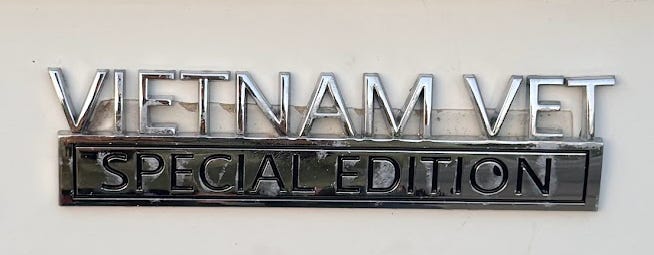
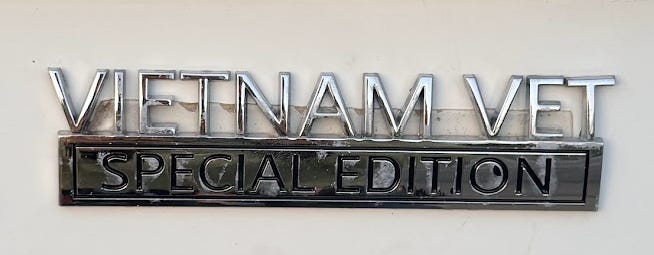
The “Vietnam Vet Special Edition” pickup truck that I now feel entitled to owning myself, having personally survived the quagmire of reading a bunch of things about Vietnam
My husband and I were on a road trip recently and when he drives he picks the listening entertainment, so here we are.
No posts
Comments
Nothing yet. Say the first thing.
Sign in to join the conversation.