
👋 Hello to 3,436 climate buddies 🌳
Delphi Zero explores the interplay of climate, energy, and security 🌳🔋🛡️
📧 If you are opening this essay in your email inbox, I recommend clicking on the title of this piece to enjoy the full-length version in the browser.
Hi friendo,
Welcome back to part 4 (out of 10) of the Sound of Antarctica: What the Quietest Continent Teaches Us About Paying Attention.
The Ocean’s Secret Highway
Last time, we watched a continent scream at 220 dB and asked how on earth a listening station in Australia could pick up the sound of ice breaking apart 9,600 kilometers away.
This time, we answer that question. Fasten your seat belt and let’s ride.
By Art Lapinsch
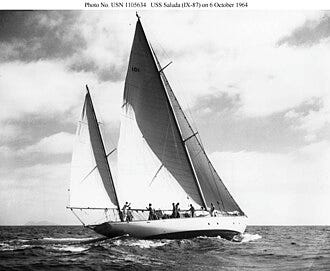
In the spring of 1944, a sailing vessel called the USS Saluda sat in the waters near Eleuthera in the Bahamas. Hanging off her side was a hydrophone, lowered deep into the ocean. On board were two scientists from Woods Hole Oceanographic Institution: Maurice Ewing and J. Lamar Worzel.
They were waiting for a bang.
Hundreds of miles away, a Navy ship was dropping 4-pound explosive charges into the deep ocean, set to detonate at a depth of 4,000 feet. The question was simple: would Ewing and Worzel hear them?
Maurice Ewing was not an obvious candidate for revolutionizing ocean science. He was born in 1906 in Lockney, Texas, the eldest surviving child of a farming family on the harsh flats of the Texas Panhandle. Three older siblings had died in early childhood. His parents stressed education above everything, and young Maurice (pronounced “Morris,” never “William,” though that was his legal first name) won a scholarship to Rice University, where he earned a bachelor’s, master’s, and doctorate in physics.
Ewing had a reputation for working harder than anyone. “Seasickness is like a toothache,” he once said. “You don’t notice it if your house is burning.” And his house was always burning. His biographer, William Wertenbaker, wrote that “Ewing was desperate to learn something most of the time.” When researchers at Columbia University invited him to try seismic measurements on the ocean floor, he agreed instantly. Years later he’d explain: “If they had asked me to put seismic equipment on the moon instead of the bottom of the ocean I’d have agreed, I was so desperate for a chance to do research.”
By 1940, war was coming. Ewing moved to Woods Hole and started doing defense research for the Navy. Without waiting for his contract paperwork, without pay, he and his former students wrote Sound Transmission in Sea Water, the manual that would become the standard reference for underwater acoustics throughout the entire war and long after.
It was during this wartime work that Ewing developed a theory. He believed that somewhere in the deep ocean, the physics of temperature and pressure would create a layer where sound could travel enormous distances with almost no energy loss. A natural pipeline, hidden a thousand meters below the surface.
The Saluda experiment was designed to prove it.
On April 3, 1944, the test came together. Shot 43. A charge detonated at 4,000 feet, 320 nautical miles away. And then, on the hydrophone hanging from the Saluda: bump bump bump bump bump bump. A series of pulses building up to a sharp climax. Ewing and Worzel described the end of the transmission as “so sharp that it was impossible for the most unskilled observer to miss it.”
They had found the highway.
But the experiment wasn’t done. When the results were analyzed, something unexpected showed up. Receivers stationed in Dakar, on the west coast of Africa, had also picked up the explosions. From the Bahamas. A distance of roughly 3,200 kilometers.
A 4-pound charge. Heard across an ocean.
We need to do a quick excursion.
Around the same time, a ship that had been assisting with the sound channel experiments, the USS Buckley (DE-51), was about to have a very different kind of April.
Weeks after helping test whether sound could cross an ocean, the Buckley joined a hunter-killer task group sweeping the Atlantic for German U-boats. In the early hours of May 6, 1944, the Buckley encountered U-66 near the Cape Verde Islands. What followed was one of the most absurd engagements of the entire Battle of the Atlantic: the Buckley rammed the submarine, the two vessels locked together, and the crew of a destroyer escort fought German submariners in hand-to-hand combat using small arms, coffee mugs, and shell casings. Hand grenades were thrown into the flaming conning tower. U-66 sank. The Buckley’s commanding officer, Lt. Cmdr. Brent Abel, received the Navy Cross.
The same ship, in the same month, helping discover how sound travels across oceans and then fighting a hand-to-hand battle with a German submarine.
War is strange.
So how does sound travel 3,200 kilometers through the ocean? Or 9,600 kilometers, as we saw with Iceberg A53a in Part 3?
The answer lives about 600 to 1,200 meters below the surface, in a layer of water called the SOFAR channel (Sound Fixing and Ranging channel). And the physics, once you see it, is beautifully simple.
Two forces are fighting each other as you go deeper into the ocean.
Temperature drops as you descend. Cold water means slower sound. So the deeper you go, the more sound slows down.
Pressure increases as you descend. Higher pressure means faster sound. So the deeper you go, the more sound speeds up.
These two forces pull in opposite directions. And somewhere around 600 to 1,200 meters (depending on location), they cancel each other out. That’s where the speed of sound reaches its absolute minimum.
Now here’s the magic. A sound wave traveling through the ocean naturally bends toward the zone of slowest speed. Why does sound bend back toward this zone? Imagine you’re driving and your right tires drop off the pavement onto gravel. The right side of the car slows down. The left side, still on asphalt, keeps going at full speed. The car turns right. Not because it “wants” to, but because one side is moving faster than the other.
Sound waves do the same thing. When part of a wave enters faster water (above or below the minimum zone), that part races ahead and the wave gradually curves back toward the slower zone. It’s not attraction. It’s geometry.
Think of it like bowling with invisible bumpers.
You roll the ball down the lane. It drifts toward the left gutter. But instead of falling in, an invisible bumper nudges it back toward the center. It drifts right. Another bumper pushes it back. The ball never reaches the gutter. It just keeps oscillating down the lane, losing almost no energy, until it reaches the pins.
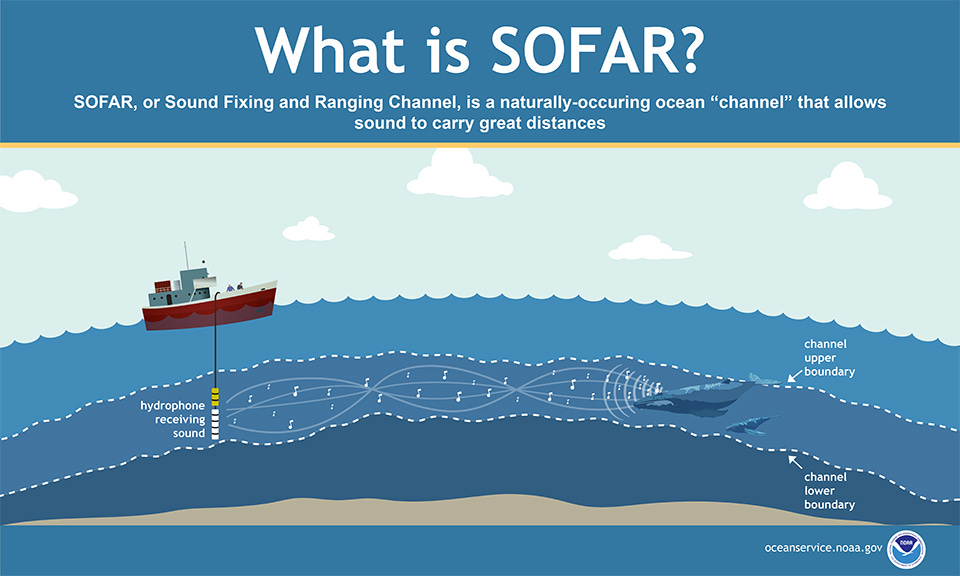
That’s the SOFAR channel. The “bumpers” are made of physics: temperature above, pressure below. Sound waves that enter this channel at a flat enough angle (under about 12 degrees) get trapped. They bounce back and forth across the channel axis, never hitting the surface, never hitting the seafloor. They just keep going. For thousands of kilometers. With almost no loss.
This is why a 4-pound explosive charge in the Bahamas can be heard in West Africa. This is why Iceberg A53a’s scream traveled from the Weddell Sea to a listening station in Australia. This is why, in Part 3, the CTBTO hydrophones sitting between 600 and 1,200 meters depth can monitor every major ocean basin on the planet from just 11 stations.
They’re parked on the highway.
One detail worth noting: the depth of the SOFAR channel changes depending on where you are. In the subtropics, it sits deep, around 1,000 meters. At high latitudes, near the poles, the channel rises all the way to the surface. The water is so uniformly cold that pressure becomes the dominant force almost immediately.
This means that in Antarctic waters, the sound highway starts at the ocean surface. When an iceberg calves or a glacier quakes, the sound enters the channel right where it’s generated. No energy wasted getting down to depth. As the wave travels northward into warmer waters, the channel sinks, and the sound follows it down. The highway slopes deeper as it goes, and the sound just rides the gradient.
It’s one of the reasons Antarctic ice events produce such efficient acoustic signals. The on-ramp is right there at the surface.
The SOFAR channel didn’t change between 1944 and today. The water didn’t get smarter. The only thing that changed were our questions.
Ewing immediately grasped the rescue potential. If a downed pilot, floating on a life raft in the middle of the Pacific, could drop a small explosive charge set to detonate at the right depth, the sound would travel through the SOFAR channel to listening stations on distant coastlines. Triangulate the arrival times at multiple stations, and you could calculate the pilot’s position to within 10 to 20 kilometers. Enough to send a rescue plane.
The Navy developed the SOFAR bomb: a small hollow metal sphere designed to implode when it sank to the channel depth. Ewing’s original idea was to put these spheres in pilots’ emergency kits. Simple, cheap, no radio needed, no battery, no electronics. Just gravity and physics. Drop it over the side of your life raft and wait.
The system was deployed in 1945 as the war neared its end. The concept worked. But the timing of history intervened. The war ended before the system could see widespread operational use, and eventually satellite-based emergency beacons would replace it entirely.
After the war, the Navy had a new problem. Soviet submarines were multiplying. By 1950, the U.S. realized that Soviet boats, built on the best of captured German technology, posed a serious threat. Frederick Hunt, who had led Harvard’s Underwater Sound Laboratory during the war, argued that the SOFAR channel could be used to detect submarines at ranges of hundreds of miles just by listening to the noise they generated.
The result was Project Jezebel, which became the Sound Surveillance System: SOSUS. A multibillion-dollar network of hydrophone arrays mounted on the seafloor, connected by undersea cables to onshore processing facilities. The first prototype was a 1,000-foot-long horizontal array of 40 hydrophones installed at Eleuthera in the Bahamas in 1951, the same waters where Ewing had first heard his explosive charges seven years earlier.
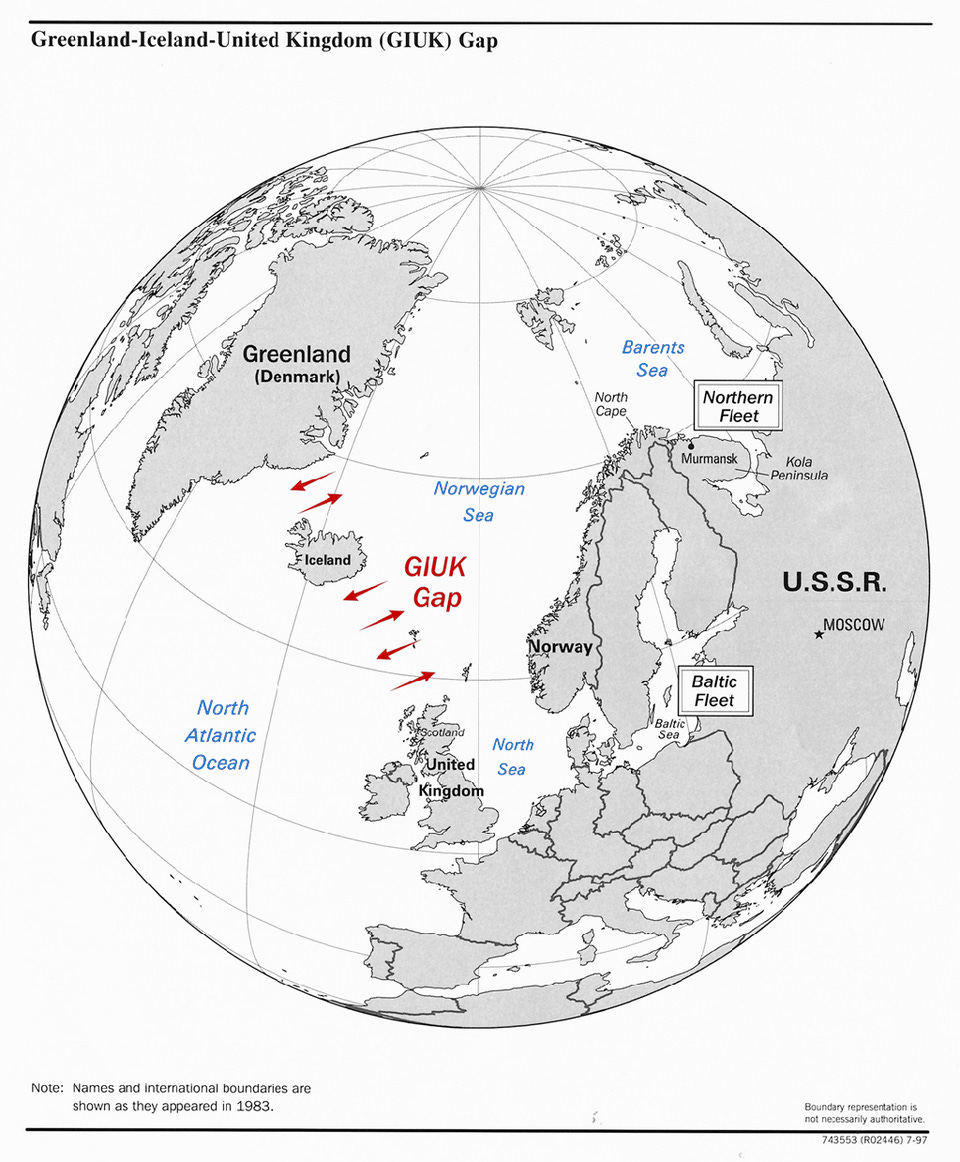
The system was staggeringly effective. SOSUS could detect radiated acoustic energy of less than a watt at ranges of several hundred kilometers, sensitive enough to distinguish the number of propellers on a submarine. For decades, it tracked Soviet ballistic missile submarines as they transited the GIUK gap between Greenland, Iceland, and the United Kingdom.
In 1962, a SOSUS station in the Bahamas played a role in the Cuban Missile Crisis by monitoring Soviet submarine movements around the Caribbean.
Everything about SOSUS was classified. The shore stations were disguised as “Naval Facilities” conducting “oceanographic research.” Even the service records of the sailors who operated the arrays were classified. The personnel who walked the rows of recording machines, analyzing sound signatures from hydrophones hundreds of miles away on the ocean floor, couldn’t tell anyone what they did for a living.
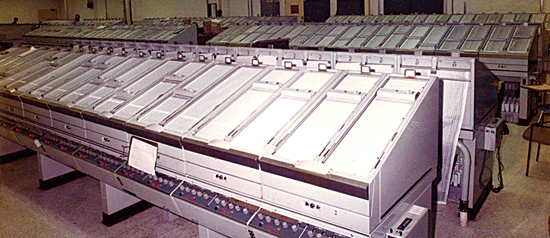
And here’s a detail I love: the early SOSUS operators started picking up strange, unknown sounds on their recordings. One recurring signal was so puzzling that analysts attributed it to the “Jezebel Monster.”
Years later, they figured out that the monster were actually vocalizing blue whales and fin whales.
The system designed to hunt submarines was accidentally eavesdropping on the largest animals on Earth.
The Berlin Wall fell in 1989. The Soviet Union dissolved in 1991. The Navy declassified SOSUS after 41 years of secrecy, and for the first time, civilian scientists were allowed access.
NOAA’s Pacific Marine Environmental Laboratory in Seattle was among the first to jump in. They used the Northeast Pacific SOSUS arrays to monitor low-level seismic activity on the Juan de Fuca Ridge. They detected submarine volcanic eruptions. They tracked blue whale migration patterns across the North Pacific.
And in 1999, a research team deployed six new autonomous hydrophones in the North Atlantic. They used a ship from Columbia University’s Lamont-Doherty Earth Observatory. The ship’s name: R/V Maurice Ewing.
The farm kid from Lockney, Texas, who was desperate to learn something, had a ship named after him. And that ship was being used to extend the very discovery he’d made 55 years earlier on the Saluda.
Submarines to volcanoes. Volcanoes to whales. Whales to climate. Three different decades, three different questions, all answered by the same invisible layer of water a thousand meters below the surface.
There's one more implication of the SOFAR channel that we'll return to later in the series. Because sound speed in water changes with temperature, and because the SOFAR channel can carry sound across entire ocean basins with minimal loss, you can measure ocean temperature at continental scale just by timing how long a sound takes to travel between two points. If the ocean warms, sound speeds up, travel time shortens. One of our readers had already teased it in the comments.
It's an elegant idea, and it's already been tested. But that's Part 9.
There’s an uncomfortable truth buried in this whole story.
Whales have been using the SOFAR channel for millions of years.
Blue whales, the largest animals ever to exist on this planet, produce calls between 15 and 25 Hz. These frequencies sit in the exact band that propagates most efficiently through the deep sound channel. Their calls can travel hundreds, possibly thousands of kilometers.
This isn’t coincidence. This is evolution solving the same physics problem that it took the U.S. Navy, a few billion dollars, and four decades of classified research to figure out. Solitary animals that need to find mates across vast, dark, featureless ocean basins evolved to communicate at precisely the frequencies that exploit the SOFAR channel’s waveguide properties. Talk about adaptation to the environment.
As we discussed in Part 3, there’s a fundamental divide in cetacean communication that maps directly onto this physics. Baleen whales (solitary, long-range, low-frequency) versus toothed whales (social, short-range, high-frequency). The medium dictates the strategy. Evolution figured it out millions of years before Maurice Ewing dropped a hydrophone into the ocean.
Unfortunately, the highway that whales have relied on for millennia is getting noisier. Commercial shipping, seismic exploration, naval sonar. All of it pumps low-frequency noise into the SOFAR channel. The same frequencies that blue whales use to communicate are the same frequencies that propagate most efficiently, which means they’re the same frequencies that human activity pollutes most effectively.
We’ll return to this in Part 8, when we talk about what happens when the last quiet ocean stops being quiet. For now, just hold the irony: we built a classified global surveillance system to exploit a phenomenon that a 100-ton animal had been using for longer than our species has existed.
And our exploitation of that phenomenon is now degrading the very channel those animals depend on.
The pattern in this series keeps tightening.
Part 1 established that the signal was always there, hidden behind human perceptual limits. Part 2 showed that new instruments can reveal signals invisible to existing ones. Part 3 demonstrated that infrastructure built for one purpose can be repurposed for another. Part 4 adds the mechanism: the reason any of this works, the natural highway that carries sound from pole to pole with almost no loss.
But the piece that sticks with me the most is the lineage.
Maurice Ewing built a system to rescue pilots. The Navy repurposed it to track submarines. NOAA repurposed it again to study volcanoes and whales and climate. The CTBTO built a new version to detect nuclear tests, and researchers in Australia repurposed that to monitor Antarctic ice.
The infrastructure didn’t change. The questions did.
The internet was a military communications network. GPS was a missile guidance system. The SOFAR channel was a pilot rescue tool. In every case, the most consequential use was the one nobody imagined when the thing was built.
So I’ll leave you with this: What infrastructure already exists around you, built for one purpose, waiting for someone to ask a better question?
Next time: We’ve learned how sound travels the ocean. Now it’s time to meet the animal that mastered it. The Antarctic blue whale produces a call so low, so far below human hearing, that we didn’t even know it existed until we put hydrophones in the SOFAR channel. Its song shows up on a spectrogram as a distinctive Z-shaped mark. And over the past few decades, that song has been shifting in ways nobody fully understands.
Part 5: The Z-Call.
Tag along for this 10-part series about Antarctica, acoustics, and paying attention.
This is Part 4 of “Sound of Antarctica,” a 10-part series on what the quietest continent teaches us about paying attention.
Comments
Nothing yet. Say the first thing.
Sign in to join the conversation.