
👋 Hello to 3,442 climate buddies 🌳
Delphi Zero explores the interplay of climate, energy, and security 🌳🔋🛡️
📧 If you are opening this essay in your email inbox, I recommend clicking on the title of this piece to enjoy the full-length version in the browser.
Hi there,
Welcome back to part 3 (out of 10) of the Sound of Antarctica: What the Quietest Continent Teaches Us About Paying Attention.
Glacial Screams
Last time, we listened to an ice shelf hum. This time, we’re turning up the volume way up 😱
By Art Lapinsch

You’re sitting in your living room. Someone across the room raises their voice at you. That’s roughly 70 decibels.
Now imagine they plug in an electric guitar and crank the amp. 110 decibels. Your ears are ringing. You reach for the door.
Now stand 25 meters from a jet engine at full thrust. 150 decibels. At this point, sound isn’t just loud. It’s a physical force pressing against your chest. Sustained exposure causes immediate, permanent hearing damage. WHAT?!!
Now keep going.
A lightning bolt striking the ground nearby registers around 170 dB. A hand grenade detonating at close range hits roughly 180 dB.
What the hell does that mean? How loud is that actually?
I want to take you down a quick rabbit hole. It’s going to be very important important information to grasp how extremely loud Antarctica can be.
When people talk about decibels, they usually refer to dB SPL - a logarithmic measurement of sound pressure.
The easiest way for humans to wrap their head around this is: With every additional 10dB the perceived loudness doubles. (IF +10dB THEN 2x of perceived loudness)
Examples:
60dB is perceived as double as loud as 50dB
70dB is perceived as double as loud as 60dB
80dB is perceived as double as loud as 70dB
90dB is perceived as double as loud as 80dB
100dB is perceived as double as loud as 90dB
Quiz Time: How much louder is 100dB compared to 50dB?
a) 5 times?
b) 10 times?
c) 32 times?
Think about it for a second and see if you come up with the right answer.
The answer is (c) 32 times.
50 dB of difference = five doublings of perceived loudness. 2 x 2 x 2 x 2 x 2 = 32.
This is why the decibel scale is so deceptive. The jump from 60 dB (a normal conversation) to 110 dB (that cranked guitar amp) isn’t “almost twice as loud.” It’s 32 times louder. The jump from 110 dB to 150 dB (the jet engine) is another 16x on top of that. And from 150 dB to 180 dB (the hand grenade)? Another 8x.
By the time you reach 180 dB, you’re experiencing sound that is roughly 4,000 times louder than a normal conversation. Your body doesn’t process this as “noise” anymore. It processes it as impact.
ps: kids, put earplugs in when you go to a club.
And here’s where things get strange. In air, sound has a ceiling.
At around 194 dB, the low-pressure phase of the sound wave creates a full vacuum between compression cycles. There are literally no air molecules left to carry the signal. Above 194 dB, sound stops being sound. It becomes a shockwave. Air, as a medium, simply breaks.
Explosions can push past this limit. The Tsar Bomba, the largest nuclear detonation in history, is estimated to have exceeded 220 dB at the source.
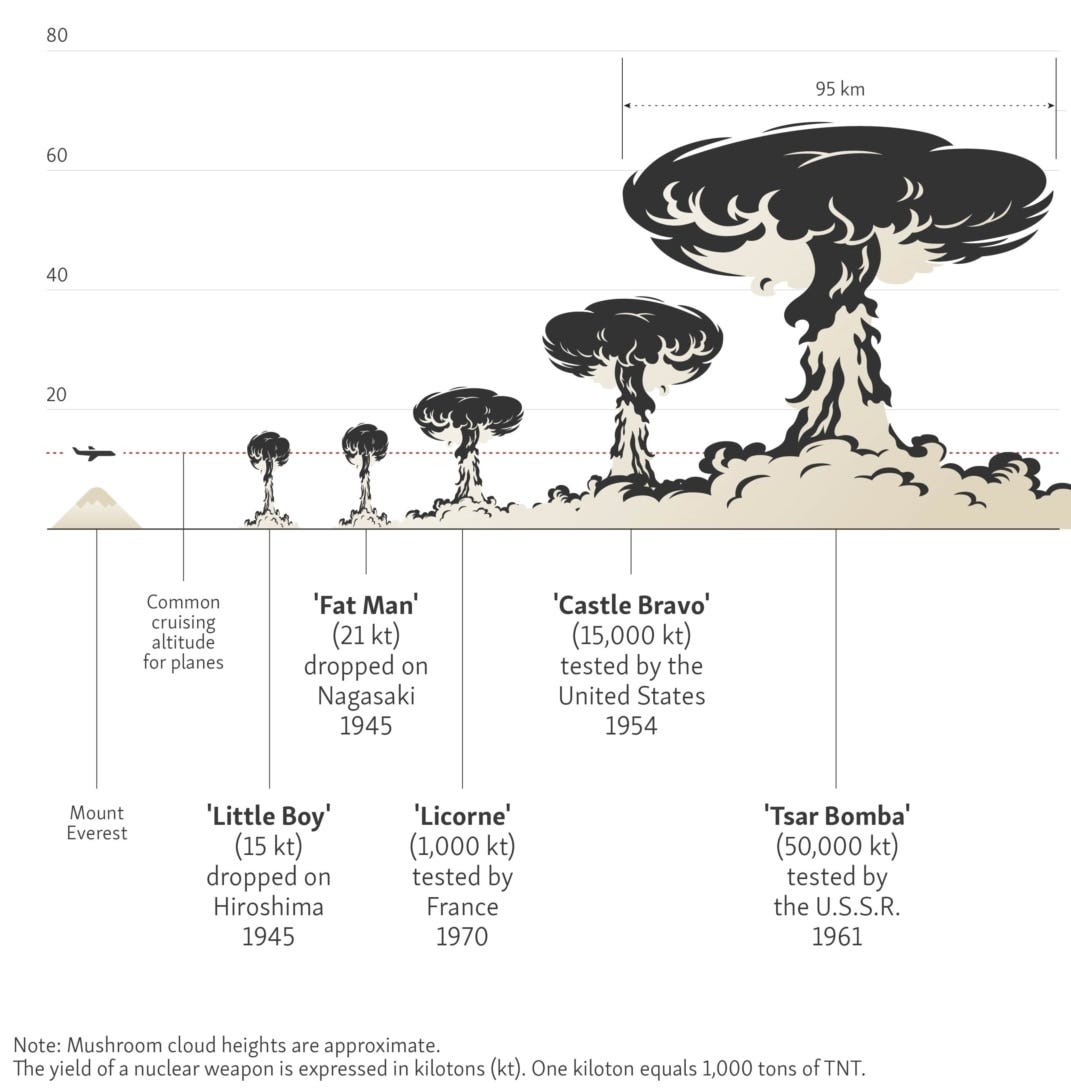
But at that point, what’s traveling through the air isn’t sound anymore. It’s a wall of compressed gas moving outward. The medium has given up.
Water doesn’t give up.
Water is roughly 800 times denser than air, and its molecules are packed tightly enough to transmit pressure waves that would be physically impossible in our atmosphere. The theoretical ceiling for sound in water sits somewhere around 270 dB.
In rough terms, 220 dB underwater is not as apocalyptic as it sounds if you're used to thinking in air decibels. The scales aren't directly comparable. But the point is: water can carry sound pressures that would literally tear air apart.
Which brings us to Iceberg A53a.
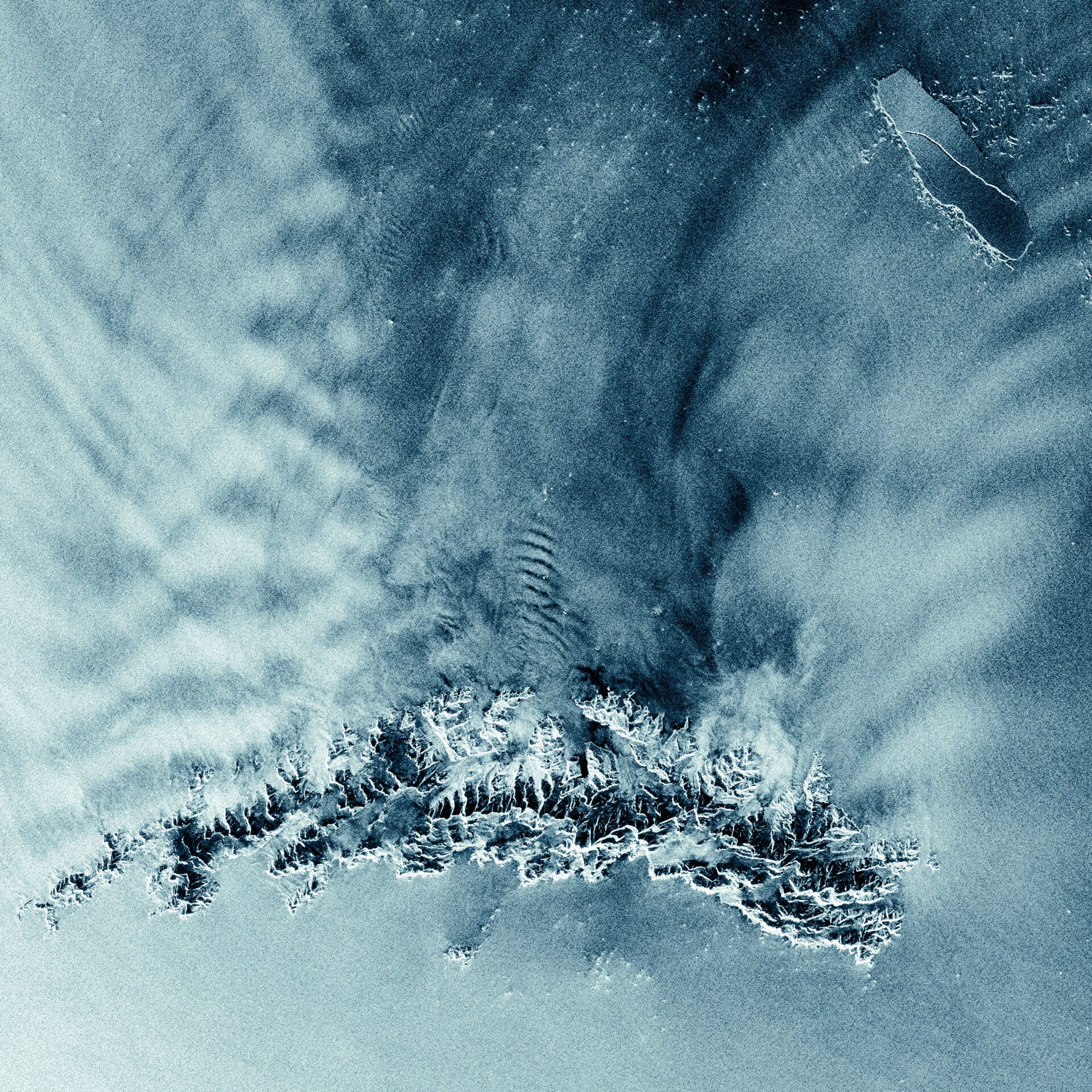
In 2004, a slab of ice roughly 1,100 square kilometers in area broke free from the Weddell Sea. Over the following months, it drifted north, ground against the seafloor of the Bransfield Strait, and eventually disintegrated in the Scotia Sea. The acoustic signature of that journey registered an average source level of approximately 220 dB and it was recorded at listening stations up to 9,600 kilometers away.
Nine thousand six hundred kilometers. That’s roughly the distance from Berlin to Tokyo.
A53a wasn’t unusual. Icebergs colliding produce multi-harmonic signals between 3 and 10 Hz that can last for hours. Matsumoto et al. (2014) found that iceberg acoustic energy dominates low-frequency sound levels across the entire Southern Hemisphere. The continent isn’t whispering, the way the Ross Ice Shelf does. It’s screaming. And the ocean is carrying that scream from pole to pole.
In Part 1, I described standing on a hill watching an iceberg calve in silence, then being hit by the sound seconds later. That was a small event seen from about a kilometer away. Scale it up by a factor of a thousand and add water as the medium, and you begin to understand why researchers can track individual icebergs from the other side of the planet.
In the 1990s, the international community built something extraordinary.
The Comprehensive Nuclear-Test-Ban Treaty Organization (CTBTO) established the International Monitoring System: a global network of 337 stations designed to ensure that no nuclear explosion on Earth goes undetected. Seismic stations feel the ground. Infrasound stations listen to the atmosphere. Radionuclide stations sniff for radioactive particles.
And 11 hydroacoustic stations listen to the oceans.
These hydrophones sit at depths between 600 and 1,200 meters, suspended in the SOFAR channel (more on that in Part 4), where sound travels most efficiently. Six stations use underwater hydrophone arrays; five use land-based seismometers that pick up ocean sound waves converting to seismic energy at coastlines. Together, 11 stations are enough to acoustically monitor every major ocean basin on the planet.
The system works. It detected all six of North Korea’s declared nuclear tests between 2006 and 2017. When the first test happened in October 2006, the IMS was only 60% operational, yet more than 20 seismic stations still picked up the event. Two weeks later, a radionuclide station in Yellowknife, Canada, 7,500 kilometers away, detected traces of xenon-133 in the atmosphere, confirming the explosion was nuclear.
When the Chelyabinsk meteor exploded over Russia’s Ural Mountains in February 2013, 17 CTBTO infrasound stations registered the event. They tracked the shockwave as it circled the Earth. Twice. Over three days. When the Beirut port explosion devastated the city in August 2020, the CTBTO network recorded it as well.
But the monitoring system’s unplanned second life is what interests me most.
Researchers at Curtin University in Australia realized that the CTBT hydroacoustic station off Cape Leeuwin in Western Australia, positioned to catch clandestine nuclear detonations in the Indian and Southern Oceans, was also capturing something else entirely. It was recording the acoustic signatures of Antarctic ice events from over 5,000 kilometers away. Gavrilov and Li demonstrated that they could track seasonal patterns of ice breakup, distinguish individual iceberg collisions, and follow the acoustic biography of specific icebergs as they drifted, grounded, and disintegrated. From a listening post in Australia. Pointed at a continent 5,000 kilometers to the south.
This is dual-use technology in its purest form. Infrastructure built to enforce nuclear arms control, repurposed for climate science. Cold War paranoia becoming climate early warning. The same hydrophones that would catch a clandestine detonation beneath the Pacific are now among our most valuable tools for monitoring the disintegration of Antarctic ice.
I’ve worked most of my life in tech. If there’s one pattern I’ve seen repeat across every domain I’ve worked in, it’s this: the most consequential infrastructure is almost always built for a reason other than the one that ends up mattering most. The internet was a military communications network before it became... everything. GPS was built for missile guidance before it guided your Uber. And the CTBTO’s hydroacoustic network was built to detect nuclear explosions before it started listening to the sound of a warming planet.
We’ll come back to this network in Part 4 (the physics of how sound travels those distances) and again in Part 9 (using the same stations to measure ocean temperature). For now, hold the image: 11 stations. Monitoring every ocean. Originally designed for bombs. Now listening to ice.
In late 2025, seismologist Thanh-Son Pham at the Australian National University published a paper in Geophysical Research Letters that landed like a gut punch.
Between 2010 and 2023, Pham detected 362 glacial earthquakes at the Thwaites and Pine Island glaciers in West Antarctica. 245 of those 362 events occurred at Thwaites’ marine terminus, where capsizing icebergs collide with the face of the “mother glacier.”
362 earthquakes. Over 13 years. And standard global seismic monitoring networks missed every single one.
Here’s why. Normal earthquakes produce a spectrum of seismic waves, including high-frequency body waves that propagate (= travel) through the Earth’s interior and are easily picked up by seismometers worldwide. Glacial earthquakes at Thwaites are different. They lack those high-frequency components. Their seismic signature is dominated by low-frequency surface waves that attenuate before reaching distant monitoring stations. To the global networks, these events are invisible. Pham had to develop a new detection algorithm using regional seismic stations on the Antarctic continent itself to find them.
This is a frequency problem, and it connects directly to a principle I find endlessly fascinating in acoustics.
Sound doesn’t behave the same way across all frequencies. Low-frequency waves travel farther because they lose less energy to absorption. That’s true in air. It’s dramatically more true in water, where low-frequency absorption is nearly negligible. A 10 Hz signal in the deep ocean can propagate for thousands of kilometers with minimal loss. A 10 kHz signal gets eaten alive within a few kilometers.
This is why the underwater world runs on bass.
In my conversation with marine biologist Anya Astafurova last year, we touched on something that stuck with me: in cetacean research, there’s a fundamental divide between baleen whales and toothed whales that maps directly onto this physics.
Baleen whales (blue whales, humpbacks, fin whales) are solitary creatures that communicate over vast distances. Their vocalizations sit in the low-frequency range, some below 20 Hz, because those frequencies can cross ocean basins. Toothed whales (orcas, dolphins, sperm whales) are social creatures that communicate over shorter distances. Their vocalizations sit in the high-frequency range, using echolocation clicks and rapid burst pulses.
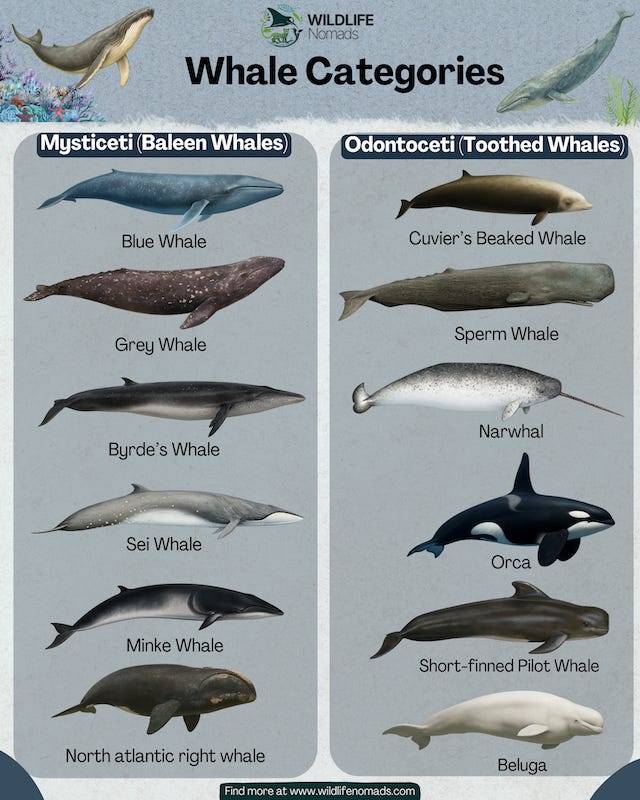
Evolution figured out the physics of underwater sound propagation millions of years before we did. Solitary animals need long-range communication and use low frequencies. Social animals need precision and use high frequencies. The medium dictates the strategy.
The same physics explain why Thwaites’ glacial earthquakes were invisible to distant monitoring. Their energy sits in a frequency band that doesn’t propagate well through rock to remote seismometers, but propagates extremely well through water. If you had hydrophones nearby, you’d hear them clearly. But the global seismic network, designed to detect the high-frequency signatures of tectonic earthquakes and nuclear tests, was tuned to the wrong channel.
Sound travels roughly 4.3 times faster through water (~1,500 m/s) than through air (~343 m/s). But speed isn’t even the most important difference. It’s reach. Water’s density means less energy is lost. And at low frequencies, the absorption coefficient in seawater is orders of magnitude lower than in air. A low-frequency sound can travel farther through water in a few seconds than it could travel through air in a lifetime.
And there’s one more detail from Pham’s paper that should tingle our spidey senses. Unlike Greenland, where glacial earthquake activity tracks seasonal air temperature (summer warmth drives summer calving), Thwaites shows no such seasonal pattern. The strongest driver of glacial earthquakes there is not surface temperature. Something else is controlling the rhythm of ice destruction. The most likely driver: ocean conditions that accelerated the glacier’s ice tongue by 20-40%, weakening the sea ice holding icebergs in place and triggering more capsizing events. But the ocean forcings themselves remain, in Pham’s words, “not well understood.”
At least he managed to pick up the signal and highlight this trend so that others can dig deeper.
After interviewing Dr. Julien Chaput for part 2, I figured that it might be a good tradition to at least try and reach out to the scientists that are covered in these essays.
Luckily, Dr. Son Pham was kind enough to engage in some email ping-pong and answer some questions. Thanks, Son!
The findings of the Thwaites (and Pine Island) glacial earthquakes were genuinely incidental. I did not expect that so many significant quakes would go unnoticed for so long.
The seismic network covering most of West Antarctica, i.e., POLENET, played a critical role in detecting and analysing the events. Unfortunately, many seismic instruments in the network will be discontinued after 2025. Thus, if I have access to such funding, I am very keen to upgrade them to a long-term seismic network of a similar scale to continue monitoring glacial quakes in the endangered glaciers.
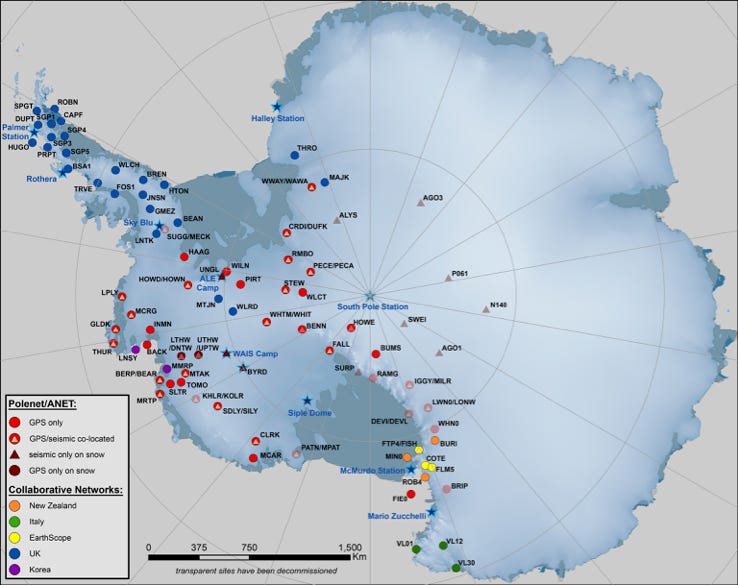
In addition, direct measurements from the ocean sites are also badly needed. To my limited knowledge, there were no ocean monitoring systems in the Amundsen Sea or in front of Thwaites in recent years that coincide with the seismic detections I made.
One must acknowledge that accessing these places is very logistically challenging. Nevertheless, I would invest in a long-term monitoring system that collects data on local ocean currents, temperature, and salinity in parallel with the on-land seismic network. I am not an ocean monitoring expert to call out exactly which instruments or technologies should exist.
Having the amphibious monitoring system would go a long way toward understanding the actual forcing of the so-far-unnoticed glacial quakes and their impact on the stability of the glaciers farther inland.
As an observational seismologist, I have the privilege of working with various types of mechanical waves every day, including acoustic waves traveling through air or other liquids, and elastic waves traveling through solids.
Honestly, many of them keep me awake at night.
As I noted in the article, I am recently puzzled by the quakes near the Pine Island Glacier. There are several guesses of the possibility, but the lack of complementary observations in such a remote part of the world prevents any solid conclusion as yet.
Acoustic monitoring doesn’t just detect different things. It detects them faster.
This is not because the speed of sound is faster than the speed of light. Obviously, it isn’t. It’s because acoustics can listen inside the system while satellites can only see what’s happening outside. A satellite photographs a crack after it has reached the surface. A hydrophone hears the stress building before the crack forms. The time advantage isn’t about signal speed. It’s about where the instrument is pointed: upstream in the causal chain rather than downstream at the result.
This matters enormously in practical terms. Satellites observe the surface. They take snapshots at fixed intervals, limited by orbital paths and cloud cover. They see outcomes. Acoustic monitoring observes the interior. It listens continuously, 24/7, regardless of weather or season. It hears precursors.
As someone who worked in adtech, this feels oddly familiar. The industry went through a decade-long obsession with “last-click attribution,” giving all the credit for a conversion to the final touchpoint before a purchase. Slowly, the smarter companies realized the real value was in multi-touch attribution, measuring the upstream signals that influenced the decision long before the click. The companies that tracked intent signals earlier in the funnel could predict conversions, allocate budgets more efficiently, and consistently outperform competitors who were staring at the final event.
Satellites staring at the calving event is last-click attribution. Hydrophones catching the acoustic precursors months earlier is upstream attribution. The insight is identical: if you only measure the final event, you’re always too late to influence it.
The pattern keeps compounding across this series. Part 1 established that Antarctica only appears silent because human senses are the wrong instrument. Part 2 proved that continuous acoustic monitoring can reveal structural change invisible to the naked eye. Part 3 adds two more layers: the infrastructure to listen already exists (built for nuclear arms control, repurposed for climate), and acoustic monitoring provides a genuine time advantage over visual observation.
Each piece sharpens the same question. It’s no longer just “are you listening?” It’s “are you listening early enough in the chain to do something about what you hear?”
The Ross Ice Shelf was singing for millennia. Icebergs have been screaming at 220 dB for as long as there have been icebergs. 362 glacial earthquakes shook Thwaites over 13 years while standard networks heard nothing.
The signal was always there. The question was never whether we could hear it. It was whether we were measuring at the right point in the chain, early enough to matter.
So, I’ll leave you with a closing question: What signal are you not hearing, not because it isn’t there, but because you’re measuring the wrong thing at the wrong point at the wrong time?

Next time: How does sound travel 9,600 kilometers through the ocean without losing its signal? The answer involves a WWII survival trick, a physics phenomenon that whales discovered millions of years before us, and a natural highway hidden 1,000 meters below the surface.
Part 4: The Ocean’s Secret Highway.
Tag along for this 10-part series about Antarctica, acoustics, and paying attention.
See you in two weeks 🌊
This is Part 3 of “Sound of Antarctica,” a 10-part series on what the quietest continent teaches us about paying attention.
Comments
Nothing yet. Say the first thing.
Sign in to join the conversation.