
👋 Hello to 3,446 climate buddies 🌳
Delphi Zero explores the interplay of climate, energy, and security 🌳🔋🛡️
📧 If you are opening this essay in your email inbox, I recommend clicking on the title of this piece to enjoy the full-length version in the browser.
Hi friend,
Welcome back to part 5 (out of 10) of the Sound of Antarctica: What the Quietest Continent Teaches Us About Paying Attention.
The Z-Call
Last time, we rode the SOFAR channel from the Bahamas to West Africa and asked what infrastructure already exists around you, built for one purpose, waiting for someone to ask a better question.
This time, we meet the animal that answered that question millions of years before we did.
By Art Lapinsch
Speed it up by a factor of eight and you might mistake it for the soundtrack of a spooky movie. A low, sliding tone that drops. Not a song in any way your ear would recognize. More like a machine powering down somewhere far away. Mechanical. Patient. Enormous.
Slow it back to its actual speed and it disappears entirely. The sound sits between 18 and 26 Hz, below the lowest note a human ear can register. You could be floating in the water directly above the animal producing it and you’d hear nothing. Your body might feel a faint pressure in your chest, a vibration you couldn’t quite locate. But your ears would report silence.
Now look at a spectrogram.
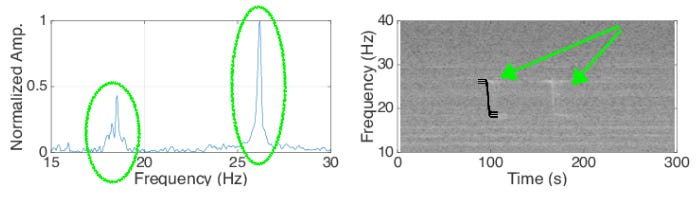
Three distinct units show up in sequence. The first is a sustained tone around 26 Hz. Then a rapid downward sweep. Then a lower sustained tone. Plotted on a frequency-versus-time graph, the three units trace the shape of the letter Z.
That’s the Z-call. The signature vocalization of the Antarctic blue whale. Among the loudest biological sounds on Earth, produced by the largest animal that has ever existed, at a frequency our species cannot hear without instruments.
Every element of that sentence is a superlative. And the animal is virtually invisible.
Here’s the absurdity of studying Antarctic blue whales.
A blue whale can reach 30 meters in length. It weighs as much as 25 elephants. Its tongue alone is roughly the size of a car. By every physical measure, it is the most conspicuous organism on the planet.
And you can spend weeks at sea in the Southern Ocean without seeing one.
The Southern Ocean spans roughly 20 million square kilometers of water. Blue whales are solitary by nature, surfacing briefly before descending to depths where no human eye can follow. They don’t breach the way humpbacks do. They don’t travel in visible pods like orcas. They come up, exhale, inhale, and slip back under. If you blink, if the swell is high, if the light is wrong, you miss them entirely.
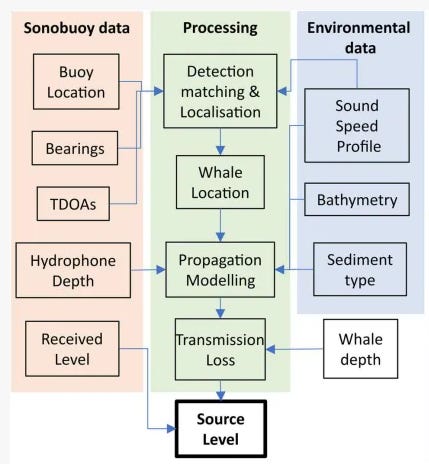
In 2024, Brian Miller and his team at the Australian Antarctic Division published the results of a monitoring effort that puts the challenge into perspective. Seven voyages. 100k+ kilometers of track line. Approximately 3,900 hours of acoustic monitoring. All to answer a deceptively simple question: where are the Antarctic blue whales?
The method was elegant. Sonobuoys, small expendable devices dropped into the ocean from the ship, each containing a hydrophone connected to a VHF radio transmitter. The hydrophone sinks to depth. The transmitter floats on the surface. Sound from the deep ocean travels up through the hydrophone and broadcasts in real time to the ship, which can be tens of kilometers away. Cheap, disposable listening stations scattered across the Southern Ocean like acoustic breadcrumbs.
The most comprehensive survey of Antarctic blue whale distribution ever conducted. And the word that keeps showing up is elusive.
This is the series motif made flesh. You don’t find a 30-meter animal in a 20-million-square-kilometer ocean by looking for it. You find it by listening. The instrument matters more than the effort. Hydrophones succeeded where decades of visual surveys fell short, not because the earlier scientists worked less hard, but because they were using the wrong sense.
Here’s where the story tilts.
In 2012, Alexander Gavrilov and his colleagues at Curtin University (the same team we met in Part 3, listening to icebergs from Western Australia) published a finding that the blue whale research community is still grappling with.
The frequency of the Z-call is declining.
Not erratically. Not in response to some obvious one-time event. Slowly, steadily, measurably. Year after year. The pitch is dropping. And it’s not just Antarctic blue whales. Similar downward frequency trends have been observed in blue whale populations across multiple ocean basins.
Gavrilov’s team documented both inter-annual and intra-annual decreases in the fundamental frequency of the Z-call. The shift is small in any given year but unmistakable over a decade. Something is changing in the way these animals vocalize, and it’s been changing for as long as we’ve had instruments precise enough to measure it.
The natural question is: why?
Nobody has a definitive answer. What exists is a set of hypotheses, each plausible, none proven, and not mutually exclusive.
Hypothesis 1: Population recovery. After decades of industrial whaling that reduced Antarctic blue whale numbers by roughly 99%, populations are slowly recovering. More whales in the ocean means shorter average distances between individuals. If you don’t need your call to travel as far to reach another whale, you can vocalize at a lower intensity and a lower frequency. You don’t need to shout when someone’s in the next room.
Hypothesis 2: Noise masking. The ocean is getting louder. Commercial shipping, seismic surveys, and military sonar all pump low-frequency noise into the deep sound channel. (We talked about this in Part 4.) If the noise floor is rising in the frequency band whales use to communicate, shifting to a slightly different frequency could help them be heard above the din. An evolutionary workaround for a human-caused problem.
This reminds me of a story I heard about city birds. Sparrows and house finches in noisy cities have been documented singing at higher frequencies than their rural counterparts. Also, a 2024 study using passive acoustic monitoring across urban gradients confirmed that bird song frequencies in cities are significantly higher than in rural areas, with low-frequency anthropogenic noise identified as a key driver.
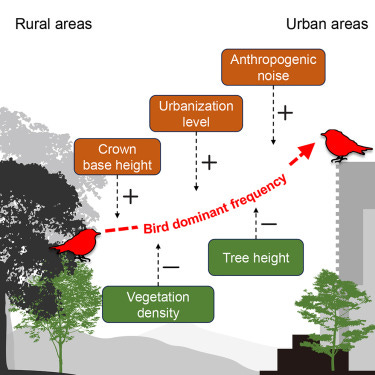
Same problem, different medium. When your environment gets louder, you adapt your signal or risk not being heard. It’s not just a marine phenomenon.
Hypothesis 3: Ocean temperature. Warmer water changes the speed of sound, which changes how efficiently different frequencies propagate through the SOFAR channel. If the acoustic environment is shifting, the optimal calling frequency might shift with it. The whales could be tracking a moving target.
Hypothesis 4: Something else entirely. Body size, hormonal changes, learned cultural drift, some interaction effect we haven’t considered. This is an active area of research. The honest answer is: we don’t know.
The cultural drift hypothesis is the most intriguing one to me. There’s more and more research coming out about the similarity of whale and human languages - like vowel inflections (similar to Mandarin language).
Just watch this 90-second video:
I find this genuinely thrilling. Not the not-knowing itself, but what the not-knowing implies. We are watching a species respond to environmental change in real time, on a global scale, in a behavior that’s fundamental to reproduction and survival, and we can measure the change to a fraction of a hertz.
The Z-call doesn’t exist in isolation. It tracks the health of the Southern Ocean.
Blue whales follow oceanographic structure. They congregate near current boundaries where nutrient-rich water upwells from the deep, fueling phytoplankton, which fuel krill, which fuel whales.
Follow the physics, find the biology. And when the physics shifts, the biology shifts with it. El Niño events rearrange distribution patterns. During the 2015-2016 El Niño, researchers documented a near-total stop of humpback whale singing in certain regions. The animals didn’t just move. They went quiet.
Krill is the linchpin. Antarctic blue whales eat almost exclusively Antarctic krill, and krill populations are under compounding pressure from expanding commercial fishing and retreating sea ice. The food web that supports the largest animal on Earth starts with ice, and the ice is changing.
The acoustic record captures all of this. Blue whales vocalize more at dusk and night, when krill migrate toward the surface. D-calls increase during summer feeding. Z-calls pick up in late summer and autumn, when breeding communication ramps up. The temporal patterns mirror the seasonal rhythms of the ecosystem with remarkable fidelity.
This is what makes blue whales more than charismatic megafauna. They are acoustic data points. Their song integrates temperature, circulation, ice extent, krill availability, and anthropogenic disturbance into a single measurable signal.
When the Z-call shifts, the ocean is telling you something.
Next time: Antarctica’s strangest sound haunted submarines and baffled scientists for 50 years. Nobody could identify it. They called it the “bio-duck.” The answer, when it finally came, told us something unexpected about the most pristine acoustic environment left on Earth, and what happens when that pristine baseline starts to degrade.
Part 6: The Bio-Duck Mystery.
Tag along for this 10-part series about Antarctica, acoustics, and paying attention.
This is Part 5 of “Sound of Antarctica,” a 10-part series on what the quietest continent teaches us about paying attention.
Comments
Nothing yet. Say the first thing.
Sign in to join the conversation.