
For over a century, the study of human cognitive evolution during the Middle and Upper Paleolithic has been dominated by a single, visual bias. Hominin symbolic behavior, capacity for abstract representation, and neurological complexity have overwhelmingly been evaluated through static, two-dimensional artifacts: the geometry of a retouch on a Mousterian scraper, the chemical composition of a charcoal depiction on a cave wall, or the spatial distribution of red ochre fragments across a hearth layer.
This visually centric approach has obscured a fundamental ecological and sensory truth: Pleistocene environments, and particularly the subterranean karstic spaces occupied by both Homo neanderthalensis and early Homo sapiens, were non-visual, highly resonant acoustic spaces. Paleolithic art and occupation sites did not exist as silent, illuminated gallery walls; they were experienced within pitch-black subterranean chambers illuminated only by flickering, low-frequency combustion light and animated by dramatic acoustic resonances.
In my view, the traditional focus on the visual “Cognitive Rubicon”—a theoretical threshold supposedly crossed exclusively by Homo sapiens through visual art—represents a critical epistemological oversight. By evaluating symbolic behavior through an isolated visual lens, scholars have ignored the multimodal sensory scaffolding that drove cognitive evolution across the Middle and Upper Paleolithic. Sound, specifically low-frequency acoustic resonance, standing waves, and the sonic signatures of lithic reduction, provided an active external scaffold for executive working memory, spatial processing, emotional regulation, and group social cohesion.
This paper presents an exhaustive psychoacoustic and archaeoacoustic analysis of Middle and Upper Paleolithic spaces, examining decorated subterranean caves (e.g., Le Portel, Niaux, Chauvet, El Castillo) alongside the soundscapes of Middle Stone Age (MSA) and Mousterian lithic reduction. Moving beyond simple correlation, I argue that hominins intentionally selected, manipulated, and navigated physical spaces based on their acoustic parameters. Sound was not merely a passive byproduct of human action; it was an active constituent of Pleistocene cognitive and symbolic life across multiple hominin lineages.
The study of prehistoric archaeoacoustics originated with pioneer studies by Iégor Reznikoff and Brigitte Dauvois in the late 1980s across the Franco-Cantabrian region. Investigating caves such as Le Portel, Niaux, and Font-de-Gaulle, Reznikoff observed a curious pattern: parietal art—specifically red ochre dots, hands, and depictions of megafauna—was not distributed uniformly throughout cave systems. Instead, artistic concentrations frequently coincided with specific spatial locations where vocal resonance was maximally enhanced.
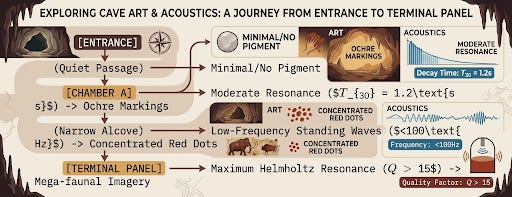
Geographically, this phenomenon spans diverse geological substrates across Europe and Africa:
Pyrenean and Cantabrian Karsts: Deep limestone networks (e.g., Niaux, El Castillo, La Pasiega) characterized by complex chamber geometries, stalactitic formations, and narrow alcoves capable of high-amplitude standing waves.
Ardèche Plateau: Massive, open subterranean chambers such as Chauvet Cave, presenting expansive reverberation times and spatial impulse responses that significantly amplify vocal vocalizations and percussive impacts.
MSA Rock Shelters and Open Sites: African and Levantine sites where open-air lithic reduction created distinct acoustic footprints that structured spatial organization and communal attention.
Early research into these acoustic landscapes was often dismissed as subjective because initial methodologies relied on human vocal sweeps and qualitative pitch-response logging. However, recent years have seen a quantitative revolution. The introduction of calibrated omnidirectional signal emitters, binaural dummy-head receiver arrays, high-density LiDAR scanning, and 3D Finite-Difference Time-Domain (FDTD) wave-equation modeling has replaced subjective impressions with hard physical metrics, including Reverberation Time (T30), Early Decay Time (EDT), and spectral Q-factors.
Simultaneously, biological and archaeological discoveries—such as the Aurignacian bone flutes from Hohle Fels (e.g., Specimen HF 17,925) dated to 40,000 to 35,000 years ago—confirm that early modern humans possessed sophisticated control over pitch, scale, and acoustic manipulation. Yet, limiting this acoustic mastery to Homo sapiens ignores the broad ecological and sensory continuity shared with Homo neanderthalensis. Neanderthals navigated the deep dark of Bruniquel Cave in France 176,000 years ago, constructing complex ring-like structures of broken stalagmites deep within a zero-light zone—an endeavor requiring complex lighting, spatial orientation, and acoustic navigation long before the Upper Paleolithic.
To evaluate the psychoacoustic properties of Paleolithic spaces without falling into speculative narrative, modern archaeoacoustics utilizes rigorous acoustic signal processing, 3D wave-equation numerical modeling, and spatial measurement methodologies.
The fundamental metric of any acoustic space is its Impulse Response h(t), which describes how an acoustic signal transforms as it propagates from a sound source to a receiver point within an enclosure. Quantitatively, the received signal y(t) is the mathematical convolution of the input source sound x(t) with the acoustic spatial impulse response h(t), plus environmental noise n(t):
y(t) = x(t) ∗ h(t) + n(t)
To capture h(t) accurately in cave environments without causing structural or acoustic damage to delicate parietal surfaces, researchers deploy logarithmic sine-sweep signals (20 Hz to 20,000 Hz) played through high-fidelity, omnidirectional dodecahedron loudspeakers. The sound field is recorded using calibrated 3D ambisonic or binaural microphone arrays.
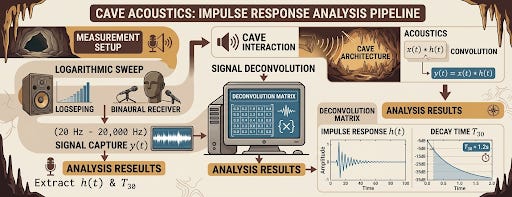
From the recorded sound signal, two primary acoustic metrics are computed:
Reverberation Time (T30): The time required for the sound pressure level to decay by 60 dB after the sound source has suddenly ceased, extrapolated from a 30 dB decay range (-5 dB to -35 dB).
Early Decay Time (EDT): Derived from the initial 10 dB of sound decay, representing the subjective perception of acoustic “reverberance” and spatial size as experienced by a human listener in real time.
Thanks for reading The Deep History Refuge! This post is public so feel free to share it.
To overcome the taphonomic issue of Holocene cave alteration, recent methodologies combine high-density airborne/terrestrial LiDAR mesh generation with Finite-Difference Time-Domain (FDTD) wave equation solver algorithms. FDTD discretizes spatial volumes into cubic grids and updates sound pressure (p) and particle velocity (v) fields across discretized time steps (Δt):
∂p / ∂t = - K ∇ · v, ∂v / ∂t = - (1 / ρ0) ∇p
Where K is the bulk modulus of air and ρ0 is ambient air density. By digitally editing the 3D LiDAR mesh—”stripping away” Holocene speleothems, restoring collapsed entrances, and clearing post-glacial sediment floors—FDTD simulations calculate the exact acoustic wave propagation and standing modes of the Pleistocene chamber during its actual period of hominin occupation.

In narrow cave alcoves or restricted terminal passages, sound waves reflect between parallel or concave rock surfaces, creating constructive and destructive interference patterns known as standing waves or room modes. For an idealized rectangular geometry, modal resonant frequencies (fm,n,l) are calculated using Rayleigh’s equation:
fm,n,l = (c / 2) √[ (m / Lx)2 + (n / Ly)2 + (l / Lz)2 ]
Where:
c is the speed of sound in air (typically 331.4 m/s at 0 °C, adjusted for cave temperature/humidity).
Lx, Ly, Lz represent the spatial dimensions of the cavity.
m, n, l are integer mode orders (0, 1, 2, 3...).
Where narrow alcoves open into larger chambers, the system behaves as a Helmholtz resonator. The fundamental resonant frequency (fH) of such a subterranean feature is modeled as:
fH = (c / 2π) √[ S / (V · Leff) ]
Where:
S is the cross-sectional area of the opening/neck.
V is the internal air volume of the interior alcove.
Leff is the effective physical length of the neck with end-corrections applied (Leff = L + 0.6 · r).
The acoustic footprint of stone tool manufacture (Chaîne opératoire) is quantified using high-frequency digital audio recording (96 kHz / 24 bit) and fast Fourier transform (FFT) spectral analysis. Accelerometers mounted directly to raw flint and quartzite cores measure structural vibration velocities, identifying distinct acoustic frequency peaks produced during hard-hammer vs. soft-hammer percussive strikes.
Unlock deeper insights into human evolution with full access to rigorous, multidisciplinary site breakdowns, technical data analyses, and critical evaluations of ancient hominin cognition. By upgrading to a paid subscription, you directly support independent, primary-source science journalism while unlocking exclusive deep-dives that challenge the dogmas of deep history. Join our community of researchers and enthusiasts to read the rest of this investigation and explore the full archive.
Comments
Nothing yet. Say the first thing.
Sign in to join the conversation.