
For more than a century, the study of early human technological evolution has been severely distorted by a fundamental taphonomic bias: the “Stone Age” conceit. Because stone artifacts survive across millions of years while organic materials decay, paleoanthropological narratives have disproportionately equated lithic reduction sequences with the complete scope of hominin cognitive and technical capacity. Early hominins were routinely portrayed as simple knappers whose interactions with organic materials were brief, opportunistic, and unstandardized. When wooden artifacts were acknowledged at all—such as the Middle Pleistocene spears from Schoeningen or the digging sticks from Clacton-on-Sea—they were framed almost exclusively as mobile, single-component hunting weapons or foraging tools.
In my view, this lithic-centric framework has obscured one of the most transformative cognitive leaps in early human evolution: the shift from mobile tool production to fixed landscape engineering.
The 2023 discovery by Larry Barham and colleagues of structural wooden architecture at Kalambo Falls, Zambia, dated to 476 ± 23 ka, fundamentally shatters the traditional boundary of Lower Paleolithic technical behavior. Unearthing two massive, interlocking wooden logs shaped by deliberate stone-tool chopping, scraping, and shaping provides unequivocal proof that hominins were constructing permanent or semi-permanent elevated platforms, walkways, or foundation structures nearly half a million years ago.
This engineering feat predates the emergence of our own species (Homo sapiens) by more than 150,000 years. It demands that we dismantle the entrenched “Cognitive Rubicon” dogma that restricts multi-component construction, prospective spatial planning, and structural joinery to modern humans. In this article, I analyze the geochronological, traceological, and cognitive data from Kalambo Falls to argue that Middle Pleistocene hominins—most likely Homo heidelbergensis / Homo rhodesiensis (a taxonomic designation subject to ongoing debate regarding whether African and European Middle Pleistocene specimens constitute a single hyper-variable species or distinct evolutionary lineages)—possessed fully recursive spatial working memory and practiced institutionalized landscape engineering.
Kalambo Falls is situated on the Kalambo River at the border between Zambia and Tanzania, just upstream from Lake Tanganyika. The site occupies a key geographic and ecological intersection within the East African Rift System. Originally excavated by J. Desmond Clark between 1953 and 1966, Kalambo Falls gained international fame for yielding a deep, stratified sequence spanning from the Acheulean into the Microlithic and Iron Age periods.
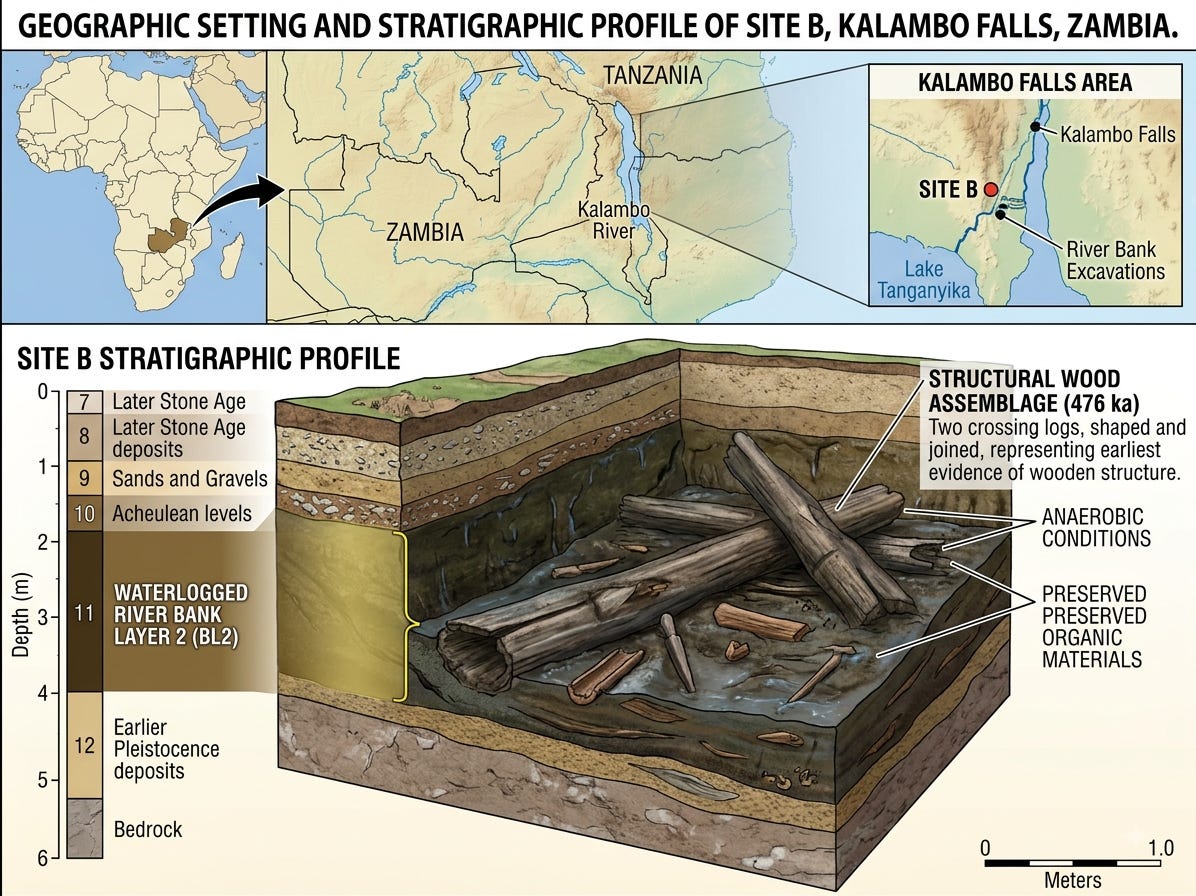
The crucial structural wood assemblage was recovered from Site B, situated within the riverine sediments of River Bank Layer 2 (BL2). The exceptional preservation of organic matter at Kalambo Falls is attributable to a unique, permanently waterlogged anaerobic environment. Fluctuating water tables created localized anoxic conditions that inhibited microbial decay, preserving delicate wooden plant tissues, seeds, and modified timber in near-pristine state across half a million years.
Thanks for reading The Deep History Refuge! This post is public so feel free to share it.
The stratigraphic integrity of Layer BL2 is remarkable. The structural logs were recovered in situ from fine-grained, cross-bedded fluvial sands beneath multiple conformable sand and gravel units. The absence of post-depositional channel scouring or heavy cryoturbation confirms that the wooden components remain in their primary depositional architecture.
Establishing an absolute chronometric framework for Lower Paleolithic waterlogged deposits has historically presented extreme technical challenges. Radiocarbon dating is useless beyond ~50,000 years, and volcanic ash layers suitable for Argon-40/Argon-39 geochronology are absent at Kalambo Falls. To overcome this, Barham and colleagues deployed state-of-the-art single-grain luminescence geochronology.
Single-grain pIR-IRSL (post-infrared infrared stimulated luminescence) targeting potassium feldspar (K-feldspar) grains extracted from surrounding fluvial sands. The protocol specifically utilized pIR-IRSL measurement at 225 degrees Celsius following an initial IR stimulation at 50 degrees Celsius. Crucially, the pIR-IRSL 225 signal exhibits minimal anomalous fading (with measured g-values near zero percent per decade) compared to conventional IRSL 50 signals, ensuring that the resulting 476 ± 23 ka age determination does not suffer from signal saturation or severe age underestimation. Standard quartz Optically Stimulated Luminescence (OSL) suffers from signal saturation at dose levels required to date early Middle Pleistocene deposits (typically above 150 to 200 Gray). K-feldspar grains, however, offer a much higher saturation threshold, making them ideal for deep-time dating.
To prevent signal underestimation caused by anomalous fading (a quantum tunneling phenomenon common in feldspars), the team applied a pIR-IRSL 225 protocol. This technique measures the luminescence signal stimulated at 225 degrees Celsius following an initial infrared stimulation at 50 degrees Celsius, selectively targeting stable, non-fading electron trap populations.
Environmental dose rates were derived from in situ gamma spectrometry combined with High-Purity Germanium (HPGe) gamma-ray spectroscopy of collected sediment samples. The calculated total dose rate for Layer BL2 sand matrix averaged 2.15 plus/minus 0.12 Gray per thousand years. Individual equivalent dose (De) distributions across hundreds of individual feldspar grains showed tight single-population clusters, ruling out significant sediment bleaching errors or micro-scale bioturbation.
To distinguish hominin stone-tool cut marks from natural taphonomic damage (such as fluvial abrasion, crocodile tooth scratches, or tree-root friction), the wooden specimens underwent rigorous microscopic traceological analysis.
Reflected Light Stereomicroscopy: Used to map macro-morphological chop facets, surface tool orientations, and cross-sectional cut geometries across the log surfaces.
Scanning Electron Microscopy (SEM): Deployed to analyze cellular-level deformation, micro-striation parallelism, and fiber shearing along cut surfaces.
The primary material evidence for Lower Paleolithic structural architecture at Kalambo Falls centers on two primary specimens: Log 1405 (the upper notched timber) and Log 1402 (the underlying foundation trunk), alongside worked wooden tools including Wedge 1434.
Log 1405 is a trunk section of Combretum species (bushwillow), measuring 1.41 meters in length and 25.6 centimeters in diameter. It displays deliberate structural modification in the form of a heavily worked, transverse overlapping notch carved into its midsection.
Detailed microscopic examination of Log 1405 revealed at least 18 individual cut facets along the inverted notch channel. Analysis of the kinematic sequence across these 18 facets demonstrates a deliberate 90-degree shift in the tool axis during working, as the hominin artisan rotated the striking angle to carve across the wood grain—providing definitive empirical proof of controlled hand-tool manipulation rather than random natural scraping. The cut facets exhibit distinct morphometric parameters:
Facet Length: Ranging from 12.4 to 48.2 millimeters.
Cross-Sectional Profile: Asymmetric V-shaped grooves with smooth, continuous tool-entry margins and abrupt, stepped termination points characteristic of percussive chopping with hand-held lithic cleavers or heavy flakes.
Microscopic Striations: Parallel longitudinal micro-grooves running along the floor of each chop facet, demonstrating the repeated application of a single hard-edged stone tool held at an angle of approximately 45 to 60 degrees relative to the wood grain axis.
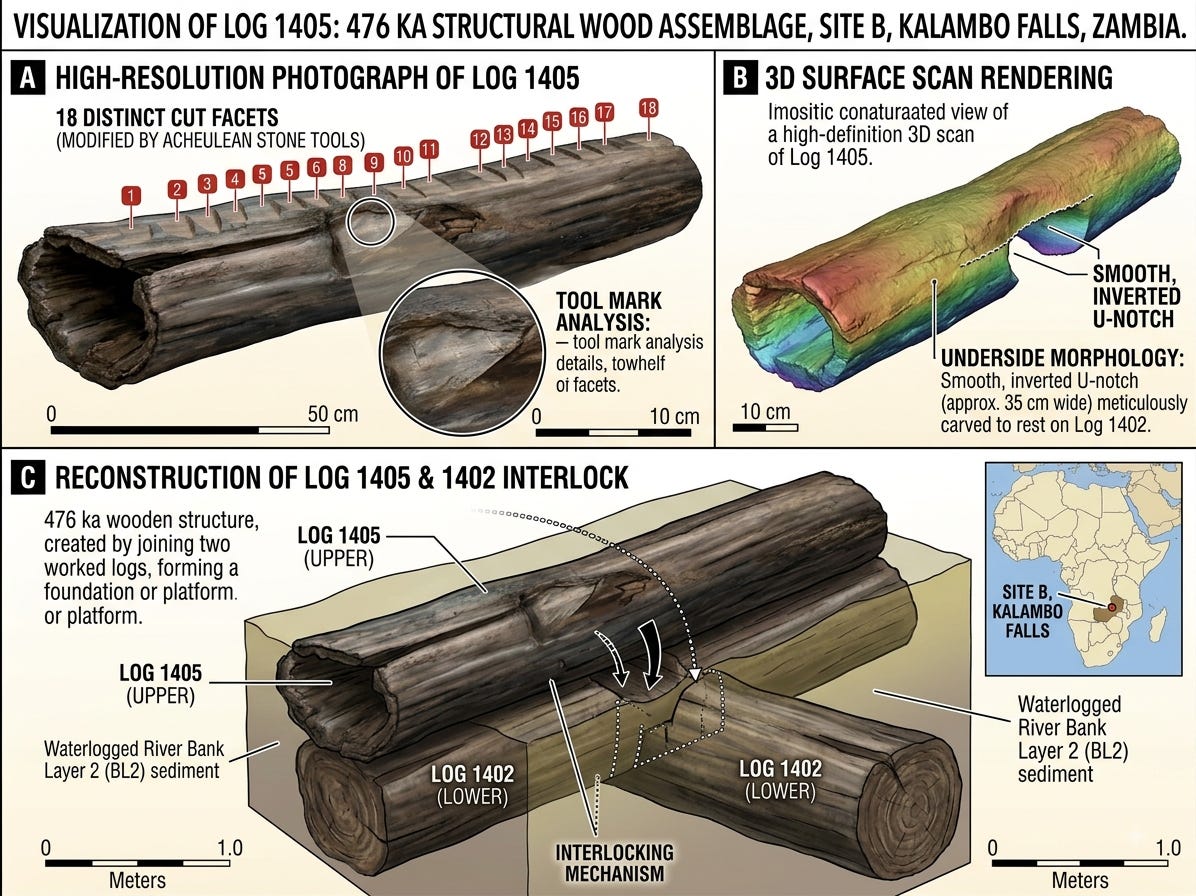
The structural coupling between Log 1405 and the underlying Log 1402 represents an intentional joinery mechanism designed to counteract physical forces within a riverine floodplain. By carving an overlapping notch, the builders created direct resistance to lateral shear stress caused by seasonal river currents, demonstrating that these hominins were engineering a stable, anchored platform specifically adapted to withstand local hydrodynamic forces. Log 1402 is a large, naturally anchored trunk lying perpendicular beneath Log 1405. The upper log’s carved notch fits directly over the rounded contour of Log 1402.
Direct Empirical Observation:
The notch on Log 1405 reduces the trunk diameter by approximately 35 percent at the point of contact.
The inner surface of the notch shows smoothing and crushing patterns consistent with load-bearing friction against Log 1402.
Primary Author Inference: Barham et al. infer that this interlocking arrangement served to stabilize the upper log, preventing lateral displacement or rolling within the marshy floodplain sediment.
Our Theoretical Interpretation: In my view, this configuration represents the world’s oldest known half-lap joint equivalent. By carving a custom recess into Log 1405, the Kalambo hominins actively solved a structural problem: how to secure two rounded, unshaped timbers together without cordage or metallic fasteners. This is not casual tool use; it is immobile, fixed architectural engineering.
The discovery of 476 ka joinery at Kalambo Falls has profound implications for our understanding of Middle Pleistocene hominin cognitive architecture. To fully appreciate its significance, we must break down the operational chain (chaîne opératoire) required to construct this interlocking structure using a task-tree model.
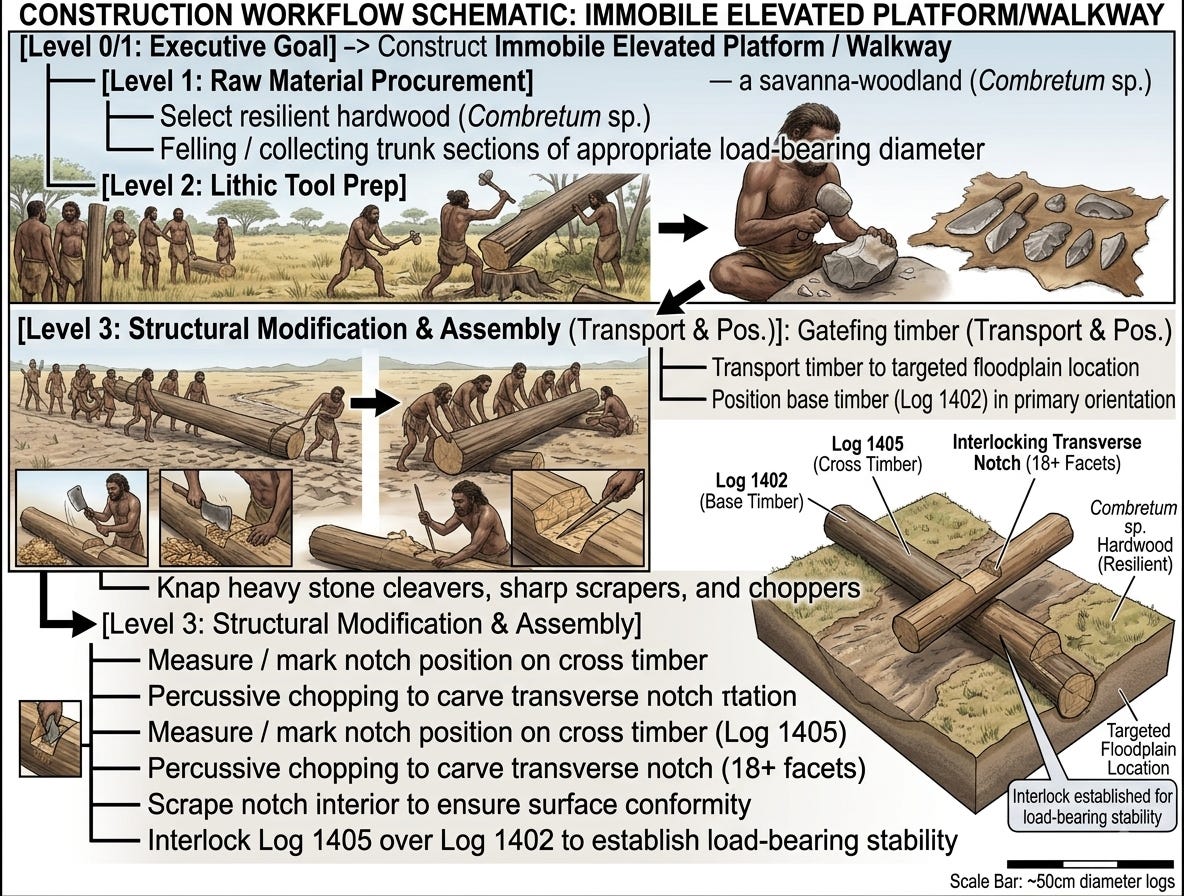
Constructing an interlocking wooden platform requires a multi-stage, non-linear operational sequence:
This operational chain requires hierarchical task recursion—the ability to hold a distant end-goal in working memory while executing subordinate sub-tasks. Framed within Alan Baddeley’s Working Memory model and Wynn & Coolidge’s Enhanced Executive Function paradigm, this process relies on active maintenance in the central executive to coordinate spatial manipulation, goal-directed motor planning, and delayed gratification across extended time horizons. Unlike single-stage lithic reduction (knapping a simple scraper), structural joinery requires prospective spatial planning. The hominin carver must visualize the negative space of the notch on Log 1405 before it is created, predicting how that negative space will interact with the positive, rounded contour of Log 1402.
For decades, researchers argued that complex multi-component construction was an exclusive marker of modern Homo sapiens. The Kalambo Falls architecture demonstrates that 476 ± 23 ka—long before the emergence of modern humans or Neanderthals—archaic hominins like Homo heidelbergensis possessed:
Prospective Memory: Planning spatial modifications for future utility rather than immediate consumption.
Material Science Awareness: Selecting Combretum timber for its exceptional density, decay resistance, and structural strength.
Place-Making & Residential Investment: Modifying the natural environment to create artificial dry surface platforms within wetlands, altering the local landscape to facilitate long-term foraging or habitation.
By demonstrating hierarchical task organization and spatial prospective planning long before symbolic artifacts proliferate in the archaeological record, the joinery evidence at Kalambo Falls directly informs the broader debate on early cognitive evolution, suggesting that structural engineering capacities may have co-evolved with or even preceded the linguistic recursion necessary for complex symbolic thought.
A rigorous scientific evaluation requires that we subject the Kalambo Falls claims to intense skeptical scrutiny. Could these wooden features have been produced by natural geomorphic processes or animal activity?
Fluvial Friction and Tree-Jam Friction: Skeptics might hypothesize that the interlocking arrangement of Log 1405 and Log 1402 resulted from natural fluvial accumulation, such as a log jam, or from megafaunal interference (such as hippopotamus or elephant trampling) and natural tree-on-tree friction wear. In high-energy river floods, tumbling logs can strike one another, producing severe crushing, bark stripping, and localized gouging. Counter-Evidence: High-energy flood impact marks are random, multidirectional, and accompanied by extensive micro-fracturing across the entire trunk surface. At Kalambo Falls, the cut facets on Log 1405 are strictly localized within the discrete 20-centimeter notch zone. The surrounding bark and heartwood display zero high-energy impact scarring. Furthermore, the 18 individual facets exhibit consistent, parallel orientation vectors that can only be produced by a targeted stone edge.
Megafaunal Trampling Marks: Trampling by large mammals (e.g., elephants or hippopotamuses) can crush and splinter waterlogged wood, producing longitudinal fractures and gouges. Counter-Evidence: Trampling damage results in wide, blunt, U-shaped depressions with irregular jagged borders. In contrast, the SEM analysis of Log 1405 confirms clean, V-shaped cross-sections with sharp, decisive cut margins that shear through cellular wood walls without crushing the adjacent cell walls—a signature diagnostic of sharp-edged lithic tools.
Micro-Settlement and Stratigraphic Intrusions: Could the structural logs represent a much younger, intrusive wooden feature (e.g., Late Stone Age or Iron Age) that settled into deeper, older sand layers? Counter-Evidence:The single-grain pIR-IRSL dating protocol directly sampled the sand grains in immediate contact with the wooden surfaces of Log 1405 and Log 1402. The De values were uniform throughout the surrounding sand matrix, showing zero evidence of bioturbative mixing or younger sediment infilling.
The structural wooden architecture at Kalambo Falls provides pivotal empirical evidence that transforms our understanding of Lower Paleolithic technical capabilities. Far from being restricted to opportunistic lithic reduction and basic foraging tools, Middle Pleistocene hominins engaged in deliberate, multi-component landscape modification and spatial planning. “Deep Time Joinery” signifies a foundational cognitive milestone in human evolution—demonstrating that the capacity to transform material environments into durable, constructed spaces was already firmly established nearly half a million years ago.
Barham, L., Duller, G.A.T., Candy, I., Scott, C.B., Cartwright, C.R., Peterson, J.R., Kabukcu, C., Chapot, M.S., Melia, F., Blegen, N., 2023. Evidence for the earliest structural use of wood 476,000 years ago. Nature 622, 107–111. DOI: 10.1038/s41586-023-06557-9
Clark, J.D., 1969. Kalambo Falls Prehistoric Site, Volume I: The Geology, Palaeoenvironment and Detailed Stratigraphy of the Excavations. Cambridge University Press, Cambridge.
Duller, G.A.T., Tooth, S., Barham, L., Hambach, U., 2015. Single grain optical dating of soils and sediments at Kalambo Falls, Zambia. Quaternary Geochronology 30, 222–228. DOI: 10.1016/j.quageochron.2015.02.011
Thieme, H., 1997. Lower Palaeolithic hunting spears from Schoeningen, Germany. Nature 385, 807–810. DOI: 10.1038/385807a0
Wynn, T., Coolidge, F.L., 2011. The Executive Brain: Archaeological Implications for the Evolution of Homo sapiens. World Archaeology 43, 62–80. DOI: 10.1080/00438243.2011.544898
Comments
Nothing yet. Say the first thing.
Sign in to join the conversation.