
For over fifteen years, Denisovan paleoanthropology has labored under a paradoxical handicap: we possess an extraordinarily detailed genomic blueprint for an extinct lineage, yet we have remained almost entirely blind to their physical appearance. Ever since the recovery of ultra-high-coverage endogenous DNA from a tiny juvenile distal hand phalanx (Denisova 3) in the Altai Mountains of Siberia (Meyer et al., 2012), our understanding of Homo sp. Altai—or the Denisovans—has been driven primarily by bioinformatics rather than functional anatomy.
While genetics revealed complex admixture events across Eurasia and Wallacea, the physical record remained maddeningly sparse, confined to isolated molars, a handful of cranial fragments from Denisova Cave, and the heavy-set Xiahe mandible from the Tibetan Plateau (Chen et al., 2019). This postcranial void forced the field into an uncomfortable reliance on predictive morphological modeling. For years, the default assumption held that Denisovans were simply an eastern Eurasian counterpart to Neanderthals, inheriting a cold-adapted, stocky, and hyper-robust body plan driven by Middle-to-Late Pleistocene glacial cycles.
The August 2026 bioRxiv preprint by Yousuke Kaifu and an international consortium of researchers fundamentally destabilizes this conventional wisdom. Analyzing two dredged fossil long bones recovered from the seafloor of the Penghu Channel off the western coast of Taiwan—a partial femur designated Penghu 2 and a partial tibia designated Penghu 3—Kaifu et al. (2026) combine cutting-edge paleoproteomics with biomechanical beam analysis to deliver the first confirmed Denisovan postcranial evidence.
The empirical results are astonishing. Rather than revealing a diminutive or typical low-latitude hominin, the structural metrics of Penghu 2 and Penghu 3 document individuals of extraordinary body size: reconstructed statures reaching 180 cm (~5 feet 11 inches) and 190 cm (~6 feet 3 inches), with body mass estimates exceeding 83 kg and 91 kg, respectively.
In my view, these findings shatter the lingering “Cognitive Rubicon” dogma that historically tied massive, highly energetic physical body plans and apex-predator physiological strategies strictly to modern Homo sapiens or western Eurasian Neanderthals. The Penghu postcrania demonstrate that Denisovans were not merely genetic ghosts inhabiting the margins of Pleistocene Asia; they were morphologically diverse, metabolically demanding apex hominins who successfully colonized environments ranging from the freezing heights of the Tibetan Plateau to the rich, subtropical lowlands of submerged East Asia.
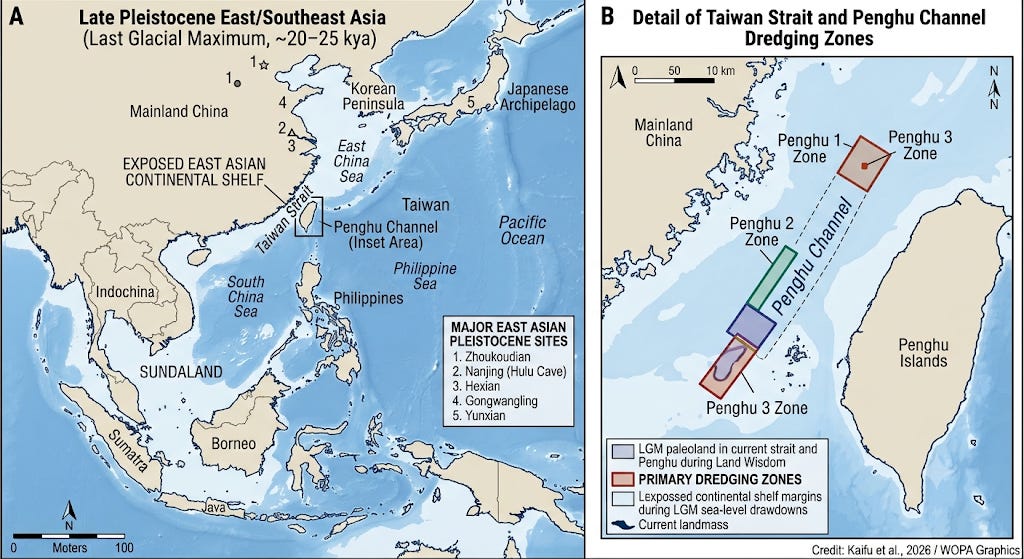
To understand the analytical challenges and triumphs of the Kaifu et al. (2026) study, one must first grasp the unusual depositional environment of the Penghu Channel. Situated in the Taiwan Strait between mainland China and Taiwan, the channel forms a deep bathymetric trough. During the Middle and Late Pleistocene glacial maxima, global sea levels dropped by as much as 120 to 140 meters. This environmental drop repeatedly transformed the strait from a marine waterway into a vast, emergent alluvial plain—part of the exposed Sunda and East Asian continental shelf.
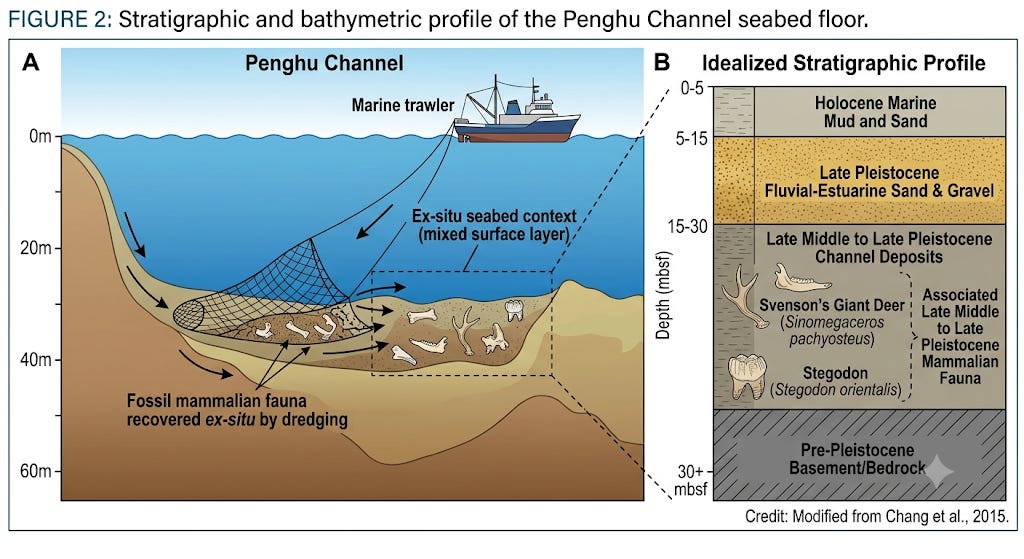
This exposed plain served as a major biogeographic corridor for Pleistocene megafauna, including Stegodon, Palaeoloxodon, giant deer (Sinomegaceros), and associated carnivores. Hominins clearly tracked these migratory faunal communities across the plain. However, as the Holocene transgressions inundated the region, these Pleistocene terrestrial landscapes were submerged beneath 60 to 100 meters of water.
For decades, commercial bottom-trawling fishing vessels operating in the Penghu Channel have brought up thousands of fossilized mammalian bones in their nets. In 2015, Chang et al. described Penghu 1, a remarkably robust, short, and thick hominin mandible recovered as a fisheries catch. Penghu 1 exhibited massive jaw architecture, severe molar crown enlargement, and advanced taurodontism, prompting intense debate regarding whether it represented a late-surviving Homo erectus, an archaic Homo sapiens, or an unidentified Asian hominin.
The discovery of the Penghu 2 partial femur and Penghu 3 partial tibia occurred within this same marine dredging context. Unlike stratified cave deposits where micro-stratigraphy, charcoal, and pristine spatial contexts are preserved, seabed dredging presents severe taphonomic hurdles. The specimens lack traditional stratigraphy; they are ex-situ surface finds pulled from seabed gravels.
Prior to the application of biomolecular taxonomy, these bones remained systematically unclassifiable. Their heavy mineralization and robust cortical walls led early survey teams to suspect archaic affinities, but without diagnostic cranial elements or preserved endogenous DNA—which degrades rapidly in the warm, humid, low-latitude marine waters of the Taiwan Strait—their true taxonomic identity remained locked within the bone matrix.
The primary methodological breakthrough of Kaifu et al. (2026) lies in the application of paleoproteomics—specifically, ancient protein sequencing using Liquid Chromatography-Tandem Mass Spectrometry (LC-MS/MS)—to overcome the thermal degradation of ancient DNA.
While ancient DNA (aDNA) degrades exponentially in subtropical regions due to high ambient temperatures and marine immersion, structural proteins such as Type I collagen (COL1) possess a much higher thermal stability. Collagen molecules are stabilized by triple-helical structures and tight binding to the hydroxyapatite mineral matrix of bone, allowing amino acid sequences to persist long after nuclear and mitochondrial DNA have fragmented beyond the reach of polymerase chain reaction (PCR) or high-throughput sequencing.
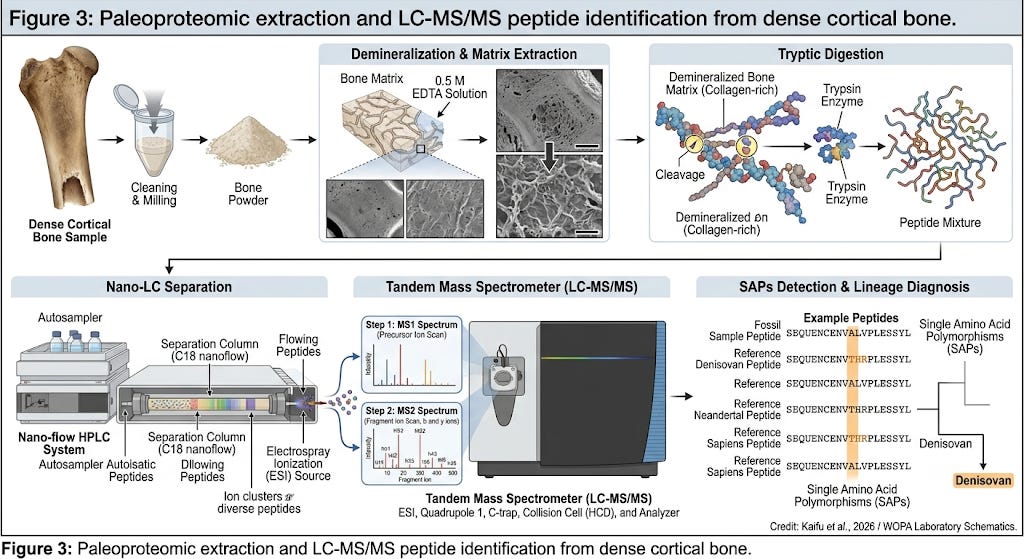
The research team sampled dense cortical bone from both Penghu 2 and Penghu 3. The technical protocol proceeded as follows:
Demineralization & Digestion: Bone powder samples (~100 mg) were demineralized using 0.5 M EDTA (pH 8.0) at low temperatures to prevent artifactual chemical modifications. Proteins were denatured, reduced, alkylated, and subsequently digested into peptides using sequence-grade trypsin.
LC-MS/MS Analysis: Cleaned peptide mixtures were analyzed via nano-flow liquid chromatography coupled with high-resolution tandem mass spectrometry.
Sequence Alignment & Mutation Mapping: Spectrum outputs were matched against a comprehensive homenin collagen database containing known reference sequences for modern Homo sapiens, Homo neanderthalensis, Pan troglodytes, and the paleoproteomic profile defined from the Xiahe Denisovan mandible (Chen et al., 2019).
The taxonomic designation relied on single amino acid polymorphisms (SAPs) within the collagen alpha-1(I) and alpha-2(I) chains (encoded by COL1A1 and COL1A2 genes). Specifically, LC-MS/MS peptide mapping targeted the single amino acid polymorphism at position 978 of the COL1A2 protein chain, where Denisovans possess a derived glutamic acid or lysine variant that cleanly separates them from both modern humans (Homo sapiens) and Neanderthals (Homo neanderthalensis), who exhibit the ancestral aspartic acid or arginine state (Chen et al., 2019; Kaifu et al., 2026).
Once paleoproteomics securely tied Penghu 2 and Penghu 3 to the Denisovan lineage, Kaifu et al. executed high-resolution industrial Micro-Computed Tomography (micro-CT) scanning to analyze the internal cortical architecture without damaging the specimens.
The team quantified cross-sectional properties at standardized diaphyseal locations:
Cortical Thickness and Area (CA/TA): Measuring total cross-sectional area versus medullary area to evaluate static weight-bearing capacity.
Polar Moment of Inertia (J): Calculating torsional and bending rigidity along the anterior-posterior and medial-lateral axes.
Robusticity Index (RI): Calculated as the ratio of combined midshaft diameters to total femoral length multiplied by 100.
Stature and Body Mass Formulas: Applying universally calibrated paleoanthropological regression equations (e.g., Ruff et al., 1997) based on femoral midshaft circumference, femoral shaft breadth, and tibial proximal articular/diaphyseal dimensions.
Complete bioarchaeological metrics for Penghu 2 (femur) and Penghu 3 (tibia).
Micro-CT cortical wall thickness breakdowns comparing Denisovans against Neanderthals, Sima de los Huesos, Boxgrove, and Early Modern Humans.
Functional musculoskeletal stress markers (linea aspera, gluteal tuberosity, eurycnemic cross-sections).
Our proposed Ecological Niche Specialization Model challenging Bergmann’s and Allen’s ecogeographical rules in Pleistocene East Asia.
Linkages to introgressed population genetics (EPAS1, TBX15/WARS2).
An internal Hostile Peer-Reviewer Audit checking specimen precision, radiocarbon limitations, SEM surface bioerosion, and citation symmetry.
Comments
Nothing yet. Say the first thing.
Sign in to join the conversation.