
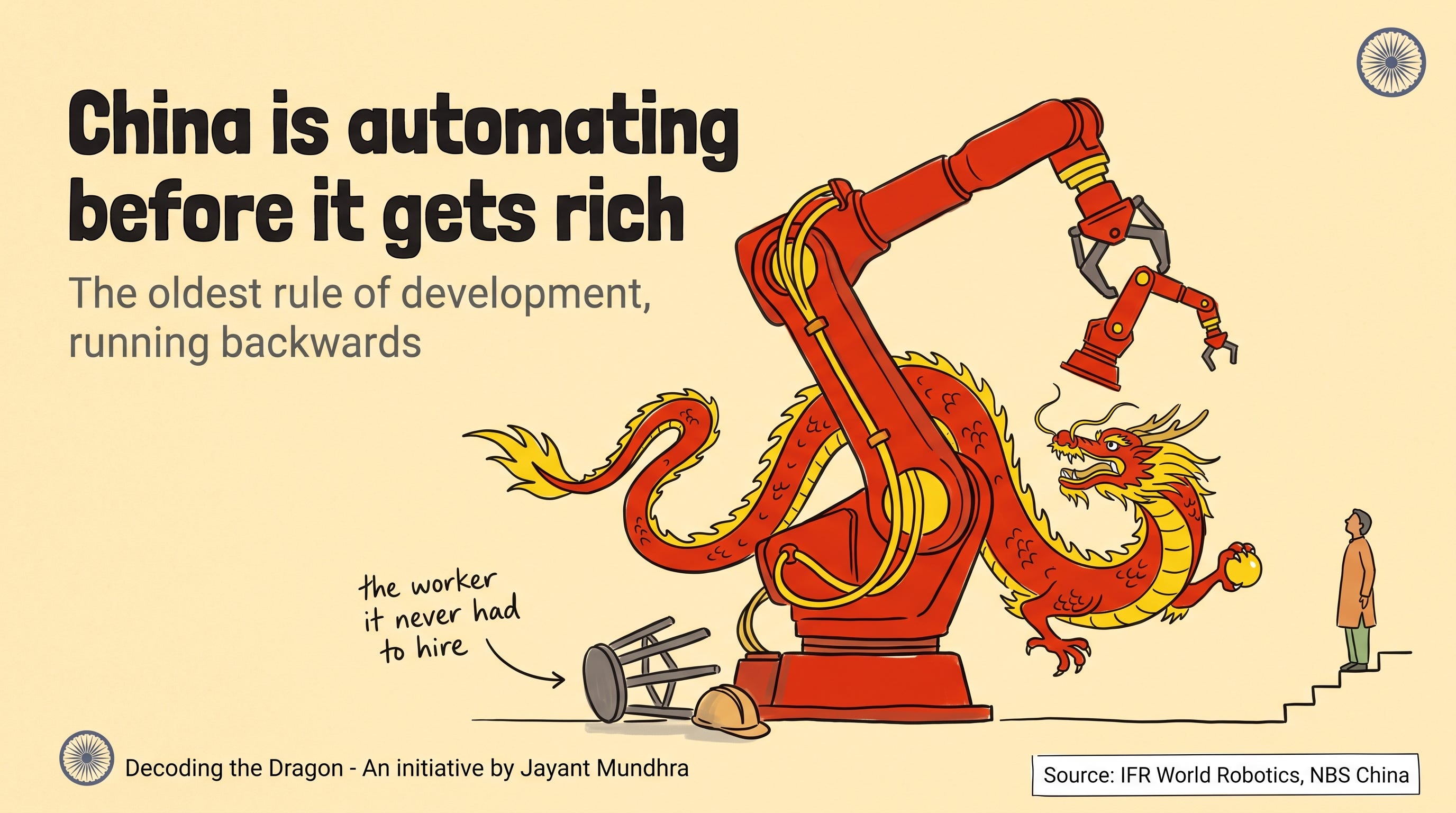
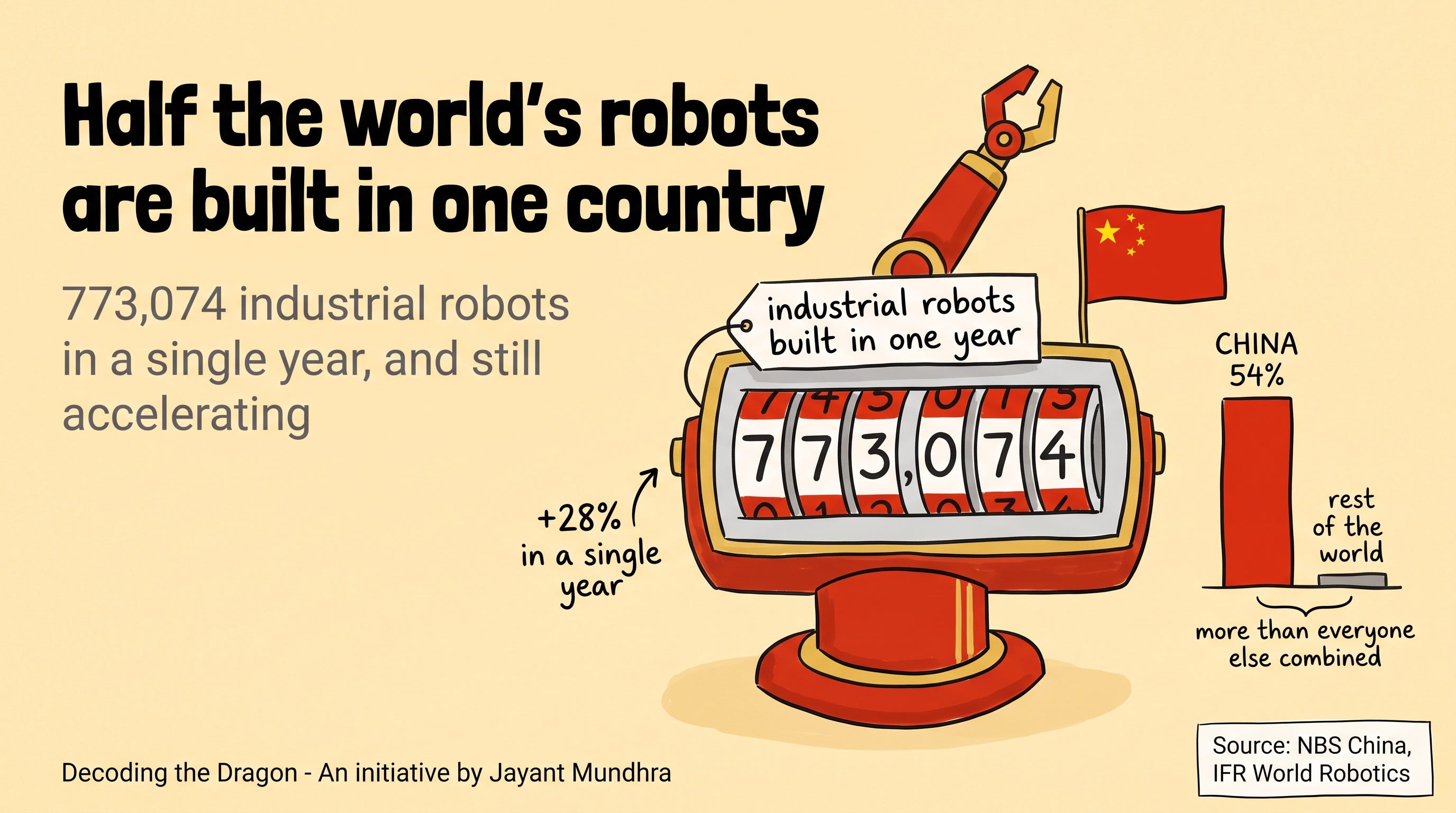
I keep coming back to one number, and it unsettles me more each time I look at it. In 2025, China's factories produced 773,074 industrial robots, up 28% in a single year.1 In just January and February of 2026, they built another 143,608, up 31% on the same months a year before.1
Now here is the part that breaks the textbook. China is doing this before it is rich. Its GDP per head is still a fraction of Germany's or Japan's. By every rule we were taught, a country at China's income level should still be soaking up cheap labour, not replacing it with steel and silicon. China is running the film backwards.
For a century, development had one script. A poor, agrarian country industrialises by renting out its cheapest asset: millions of low-wage workers. Light manufacturing pulls people off farms, exports grow, capital accumulates, wages rise over decades, and only then, once the country is middle income and labour is no longer cheap, does it buy robots to offset expensive workers.
Robots were the tool of the already-rich. You earned your way to automation.
China has torn that page out. It is buying robots at the income level where it is supposed to still be hiring people. And the scale is not incremental, it is absolute:
China installed 295,000 industrial robots in 2024, the latest full IFR count, more than the rest of the world combined and 54% of all global demand.2
Its operational stock crossed 2mn units in 2024, the largest of any nation and nearly half the world's ~4.7mn robots.2
Chinese-made brands took 57% of their own home market in 2024, the first time domestic firms outsold the foreign "Big Four" at home, up from about 28% a decade ago.2
In 2025, China flipped to a net exporter of industrial robots for the first time, with export volumes up 48.7% year on year in unit terms.3
This is the sort of structural break I find myself picking apart most mornings, and it is exactly the kind of thread we pull further in the Decoding the Dragon WhatsApp group, where I share a smaller China deep-dive like this with thousands of readers every day (t.ly/t7uhs).
Join the Decoding the Dragon community
The obvious question is why. Why would the workshop of the world automate away its own advantage? The answer is demographic, and it is brutal.
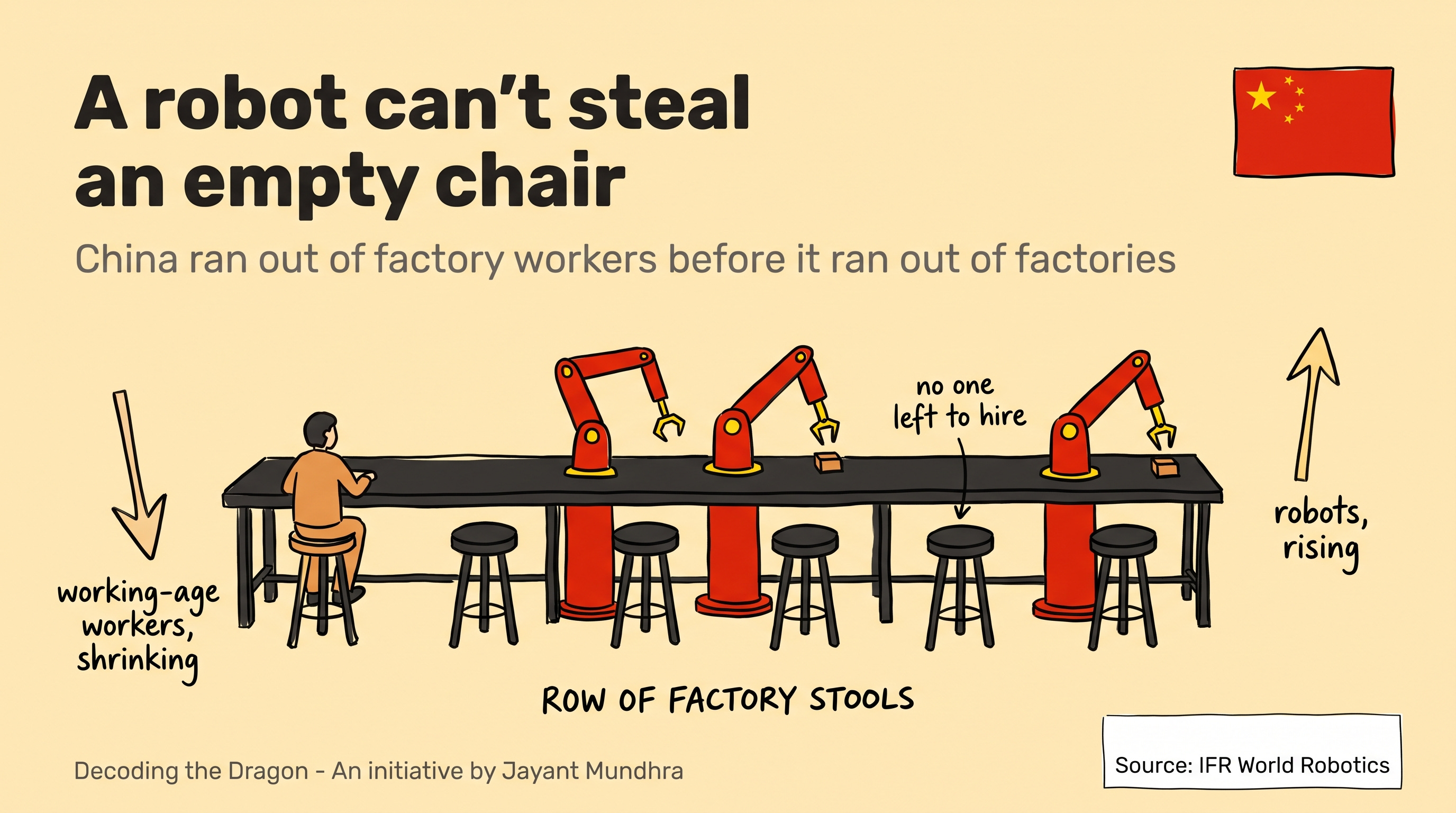
China has crossed what economists call the Lewis Turning Point, the moment a developing economy runs out of surplus rural labour to pull into its factories. Once that pool empties, workers stop being infinitely available. Employers have to compete for them, wages climb, and the cheap-labour model quietly dies.
The one-child policy, fertility below replacement for decades, and a fast-ageing workforce got China there far quicker than any Western country. So the labour shortage is real and it is structural, not cyclical.
Here is the tell. In China, the Western panic about "robots stealing jobs" barely exists, because employers cannot find the workers in the first place. Factory owners in the manufacturing belt report offering steep wage hikes and still struggling to hire. When you cannot fill a job, a robot does not displace a human, it replaces an empty chair.
So automation in China is not a prestige project. It is a survival strategy to keep output up while the workforce shrinks. That reframing matters, because it means the robot build-out will not slow when growth wobbles. It is load-bearing.
None of this is purely market magic. It is curated from the top. The blueprint was Made in China 2025, launched in 2015, which named robotics a priority sector and set a hard target: 70% domestic market share for home-grown robot brands.
They missed the headline number, but only just, and the direction is what counts:
Domestic brands hit 57% of the home market in 2024, up from roughly 28% a decade earlier.2
In the hardest, high-end components, precision reducers, ball screws, controllers, foreign firms still hold much of the premium market. This is the one place the plan genuinely underdelivered.
But in the mid-tier, localisation is now the norm, and it is where the volume lives.
Then Beijing moved the goalposts forward. The current push is "embodied intelligence", robots with AI brains, and the ambition is staggering. A national Humanoid Robot Action Plan targets 100,000 deployed humanoids by 2027, and a senior official says China's annual humanoid output alone should top 100,000 units in 2026.4 Shenzhen alone launched a ~$1.4bn AI and robotics fund in early 2025.4
The early results are almost comical in their lopsidedness:
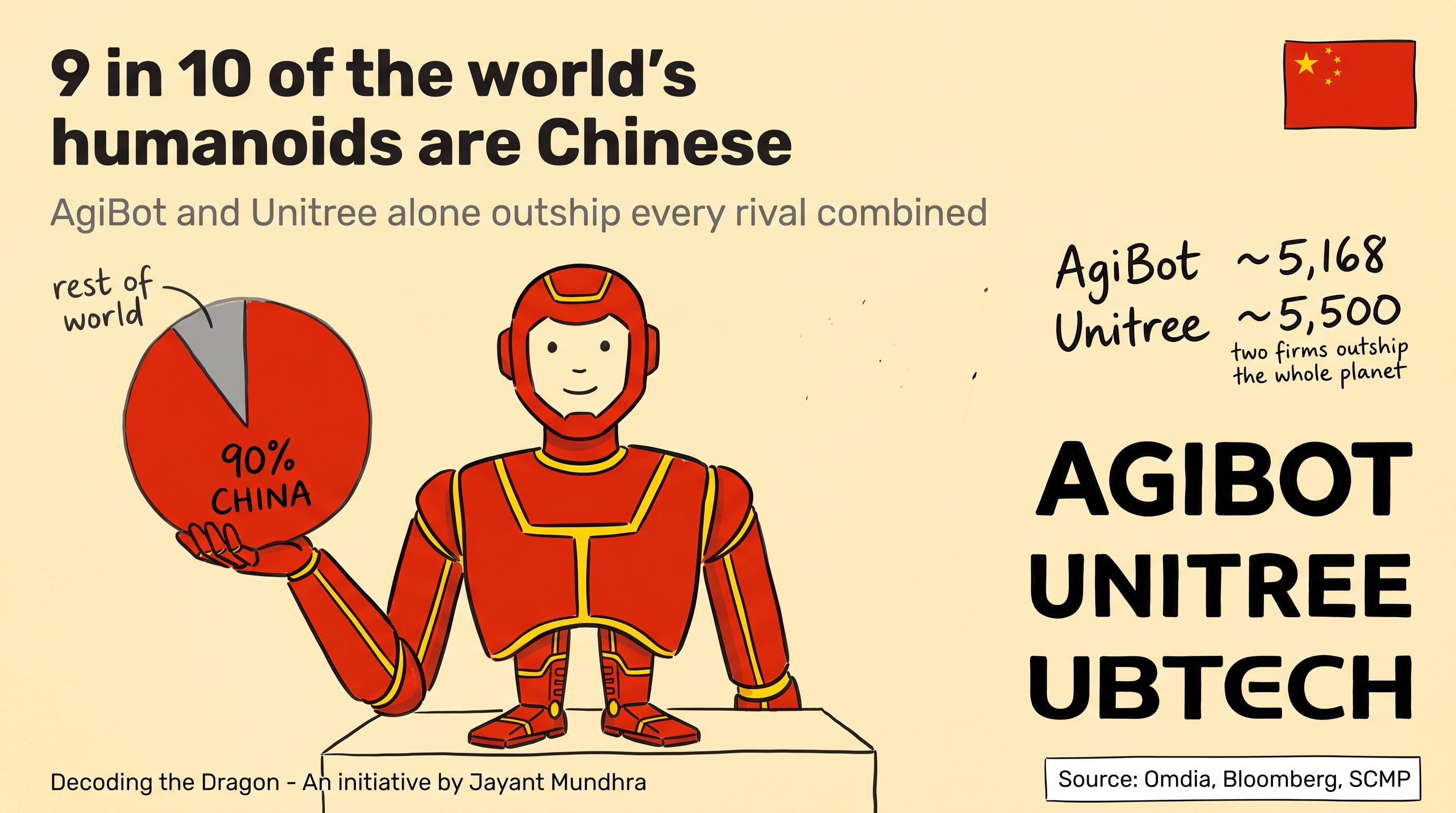
Chinese firms shipped close to 90% of the world's humanoid robots in 2025.5
AgiBot led globally with ~5,168 units, Unitree followed with ~5,500, and the two alone outshipped every other maker on earth combined.5
For most of the 2010s, three-quarters of China's robots came from the foreign Big Four: FANUC, Yaskawa, ABB and KUKA. Today a cohort of domestic champions has cracked that grip, and the interesting bit is how.
Estun Automation, China's largest domestic robot maker at ~9.5% share, is vertically integrated across servos, controllers and motion systems. It bought German welding specialist Cloos to buy credibility in heavy industry, and exports now make up 34% of its revenue.6
Inovance came at it sideways. It already dominated servo motors and drives, then moved up into full robots. Making its own core parts, it undercuts imported systems by 15% to 30% and supplied 27.3% of every SCARA robot sold in China in 2024.6
The collective effect is a pricing weapon. Chinese arms routinely sell 20% to 40% below equivalent Western models, and a wave of sub-$10,000 machines is putting automation within reach of small firms that could never afford a FANUC.7 This is the quiet part: China is not just automating its own giants, it is democratising automation for everyone downstream of it.
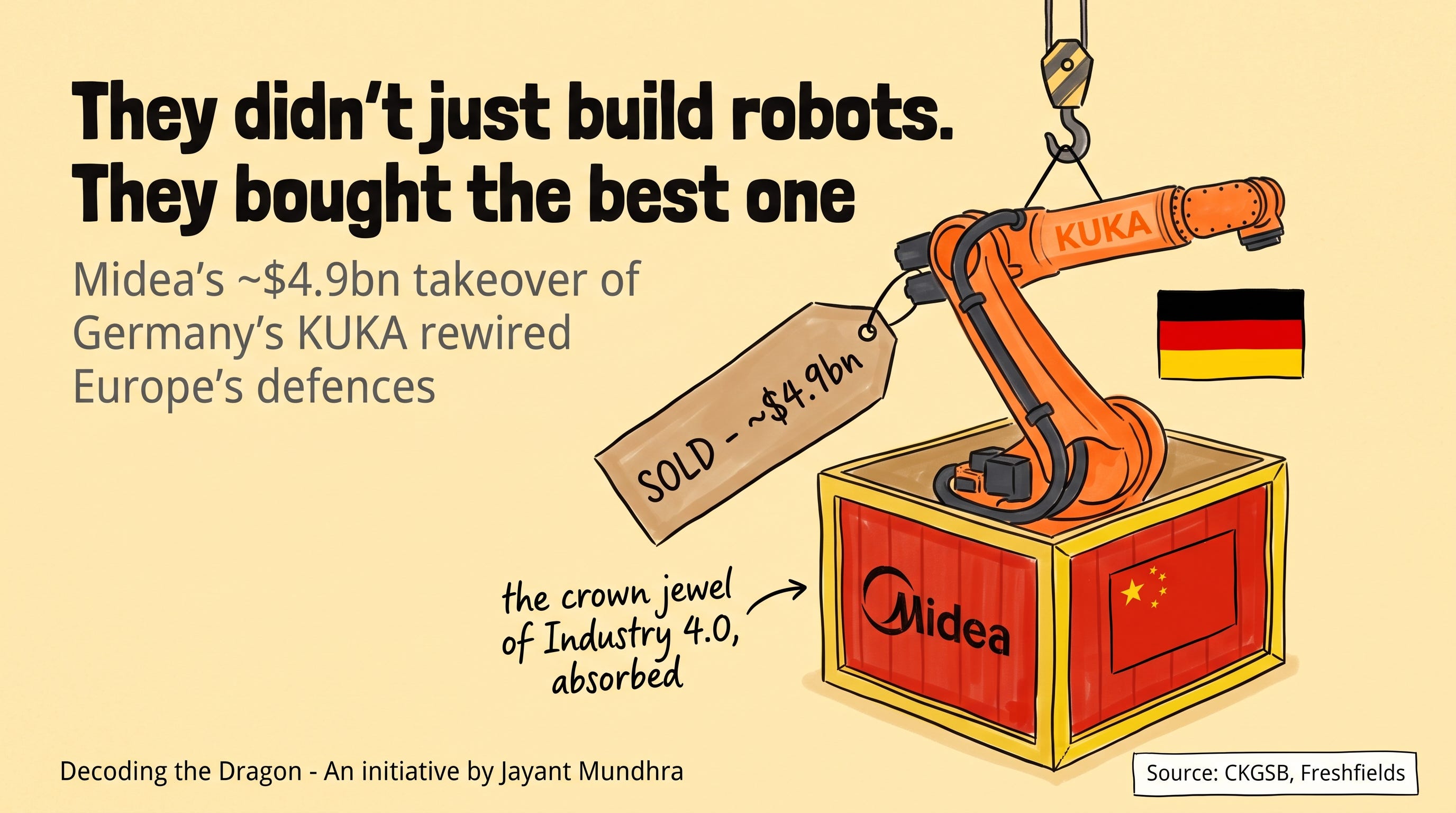
If you want one moment that captured the strategy, it is 2016, when appliance giant Midea bought Germany's KUKA, the crown jewel of European robotics, for ~$4.9bn, paying a fat premium for a company that symbolised Germany's Industry 4.0.8
Europe panicked, then legislated. Germany slashed its investment-review threshold, the EU built its first FDI screening regime, and in May 2026 the European Parliament approved even tougher rules covering AI, quantum and semiconductors.9 KUKA, meanwhile, was fully delisted and absorbed into China's ecosystem.8 The deal did not just buy a company, it bought a masterclass, and rewired Europe's entire posture towards Chinese capital.
There is a warning threaded through all of this for the West, and it is not subtle. A US net assessment called "The Robot Deficit" argues America may build the smartest robot brains but has hollowed out its ability to mass-manufacture the bodies, leaving it dependent on Chinese hardware.10 And that hardware is networked: researchers found an undocumented backdoor in Unitree's Go1 robot dogs that exposed live camera feeds.11 When the machine on your factory floor is a sensor-rich computer from a strategic rival, its origin stops being a commercial detail.
Now to the part that should keep Indian policymakers up at night. India holds exactly the demographic hand China held two decades ago: young, vast, hungry for factory jobs. The old script says India inherits the cheap-labour manufacturing that flees a richer, ageing China.
The automation frontier has cancelled that inheritance. Look at the gap:
India installed a record 9,120 industrial robots in 2024, a fine 6th place globally, but China installed more than 30 times as many.12
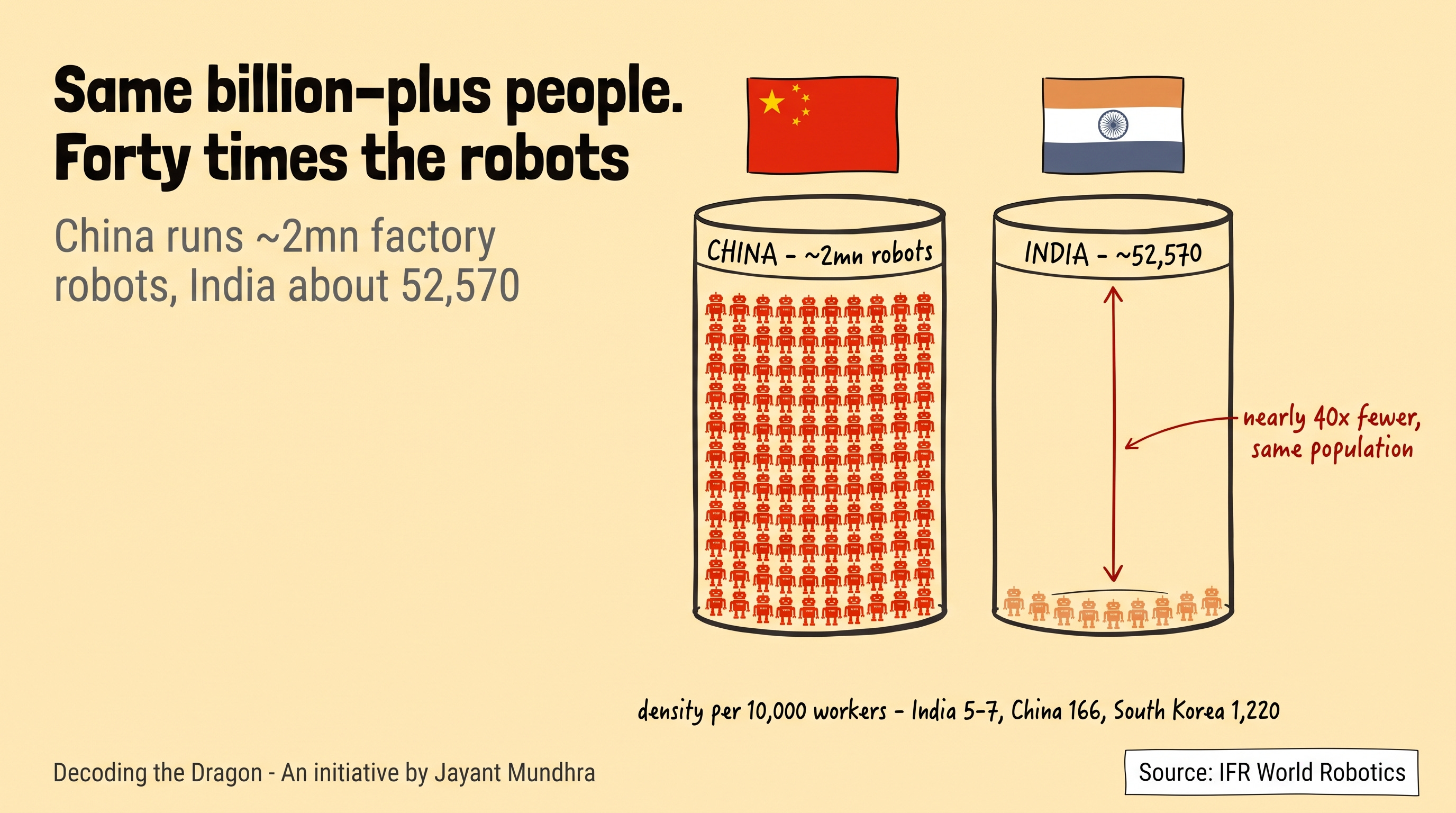
India's operational stock was ~52,570 robots in 2024. China's was ~2mn, a nearly 40-fold gap between two countries of roughly equal population.2 12
India's robot density is 5 to 7 per 10,000 workers. The latest IFR reading puts South Korea at 1,220, Singapore at 818, and even re-baselined China at 166.2 12
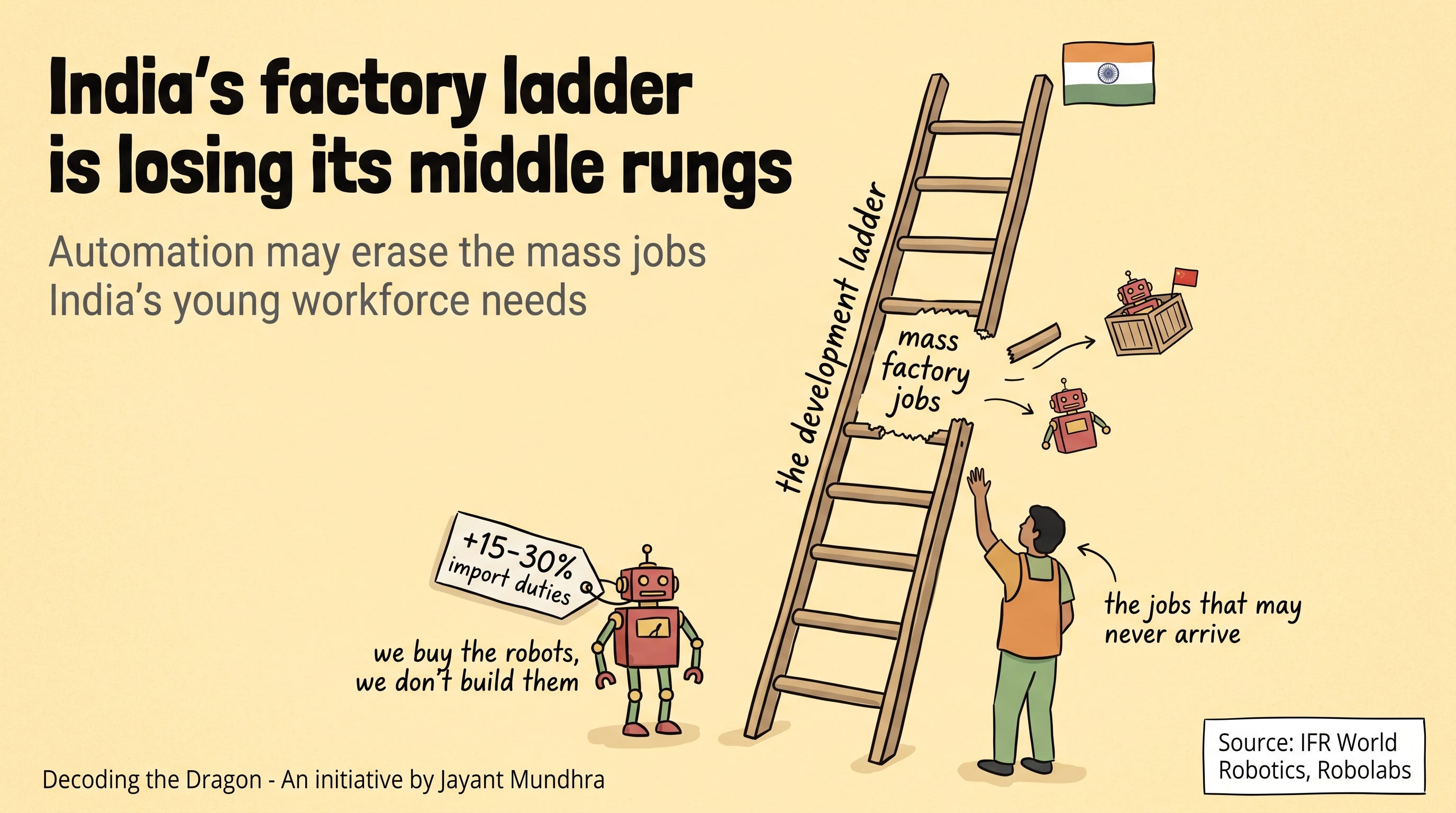
Here is the trap, and it has a name: premature deindustrialisation. If a Chinese sub-$10,000 arm can run defect-free around the clock, the wage gap that made an Indian worker attractive simply stops mattering. The routine factory jobs that were meant to employ tens of millions of Indians may never arrive, because they are being automated at source in Shenzhen before they can migrate.
So India is caught in a genuine bind, and I do not think there is a clean answer:
It must automate its own electronics and auto lines to stay globally competitive.
But automating fast kills the mass employment its demographics desperately need.
This tension is precisely the kind of thing worth arguing over rather than sloganeering about, and it is one of the debates I keep going back to with the Decoding the Dragon community (t.ly/t7uhs).
Join the Decoding the Dragon community
India is not standing still. Its robotics market was worth ~$2bn in 2025, automotive drives ~45% of installs, and the PLI schemes plus Tata's ~₹91k crore Dholera chip fab will pull in serious automation demand.13 14 But India has no multi-billion-dollar national robotics mission on the scale of Made in China 2025. It does not make robot core components at scale, and it imports them, adding 15% to 30% in duties and logistics to every machine, exactly when it can least afford the handicap.
Zoom out and this is not really a story about robots. It is about what "competitive advantage" means in the 2020s. For two centuries, the poor world's edge was cheap hands. China is proving that edge can be engineered away by capital, and that a state willing to subsidise the transition can automate its way through a demographic cliff instead of falling off it.
It fits the whole arc of Chinese strategy: dual circulation, tech self-reliance, moving up the value chain rather than defending the bottom of it. The robot build-out is just the physical expression of a country that decided it would rather own the machines than rent out its people.
Whether the IFR's World Robotics 2026 report (due around September) shows China's 2025 installations pulling even further ahead, and whether India crosses the symbolic 10,000-unit mark.
Whether China actually hits 100,000 humanoids of annual output in 2026, and what that does to unit prices.
Whether India announces anything resembling a funded national robotics or core-components mission, versus leaning on Make in India and PLI alone.
Whether Chinese robot exports to Vietnam, Mexico and Thailand keep surging, a sign that automation, not cheap labour, is now what follows the supply chain.
The country that used to sell the world its workers now sells the world the machines that replace them. That is the whole story, and India has perhaps a decade to decide which side of it to be on.
And well that is it for today's edition. That said, do check out my core WhatsApp community Biz News+ where I share 4-5 deepdives from the world of business, economics & public economics daily: https://t.ly/h2jq1
And, do check out my work on the following platforms as well: Instagram, LinkedIn and Youtube
Best,
Jayant
1. South China Morning Post, "China's industrial robot output accelerates as factories ramp up deployment", scmp.com
2. International Federation of Robotics, World Robotics 2025, ifr.org
3. Global Times, "China's robot exports near 20 billion yuan in Jan-May as overseas push quickens", globaltimes.cn
4. International Federation of Robotics, "China Makes AI-powered Robots Core of National Strategy", ifr.org
5. South China Morning Post, "Chinese firms outpace US rivals in 2025 humanoid robot shipments, as AgiBot takes lead", scmp.com
6. Robot Automation, "China's Industrial Robotics Landscape: Key Players, Market Trends and Growing Global Influence", robotauto.co.uk
7. Robotics & Automation News, "Inside China's multi-billion dollar industrial robotic arms market", roboticsandautomationnews.com
8. CKGSB, "Midea's Takeover of KUKA: A New Milestone for Overseas M&A", ckgsb.edu.cn
9. Invezz, "EU Parliament approves tougher foreign investment screening rules", invezz.com
10. Special Competitive Studies Project, "The Robot Deficit: Diagnosing the US-China Robotics Net Assessment", scsp.ai
11. SecurityWeek, "Undocumented Remote Access Backdoor Found in Unitree Go1 Robot Dog", securityweek.com
12. International Federation of Robotics, "India Rises to Sixth in Global Factory Robot Installations", ifr.org
13. Robolabs, "The State of Robotics Automation in India: Market Overview and Global Position", robolabs.ai
14. Tata Group, "Tata Group to Build the Nation's First Fab in Dholera", tata.com
Comments
Nothing yet. Say the first thing.
Sign in to join the conversation.