
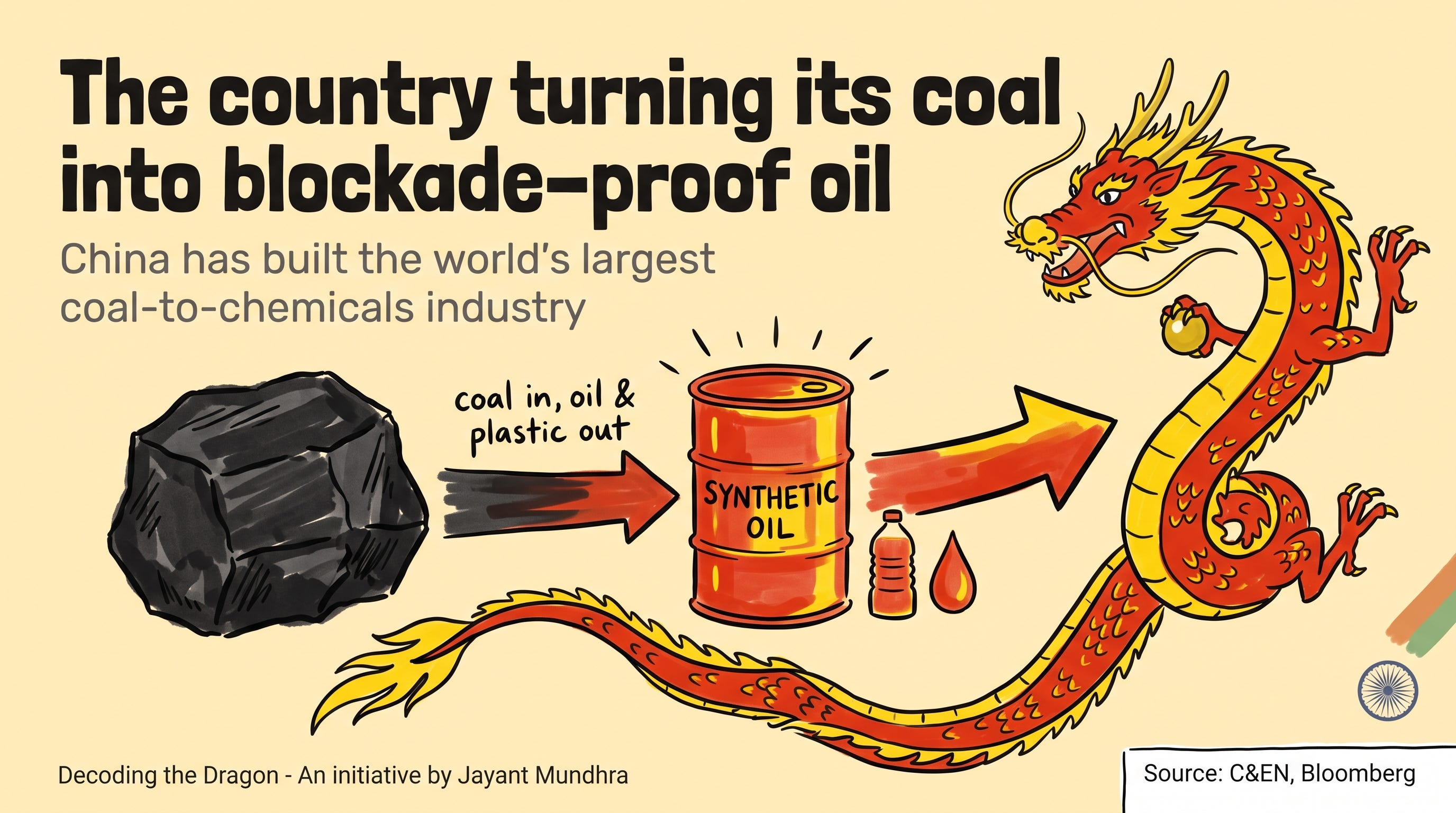
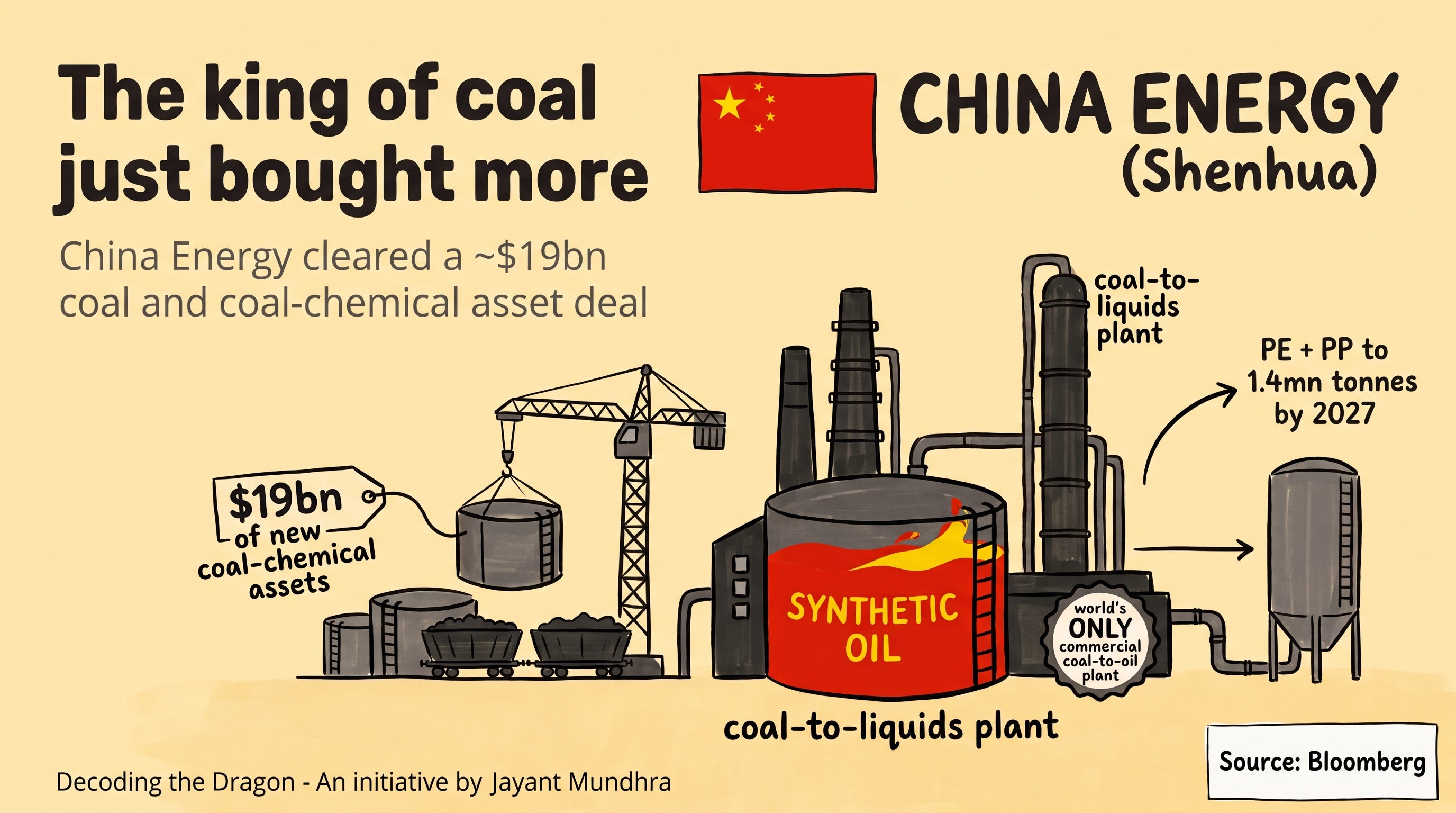
Here is a number that stopped me. In February 2026, Chinese regulators cleared China Shenhua Energy to buy roughly $19bn of coal, power and coal chemical assets from its parent, a deal that pushes the group's total asset base towards ~$125bn.¹
Read that again. In the same decade China is being crowned the undisputed king of solar panels and electric cars, its single largest listed energy company is spending the GDP of a small country to lock up more coal and turn it into plastic.
That is not a contradiction. It is a hedge. And once you see it, you cannot unsee it.
The shadow oil industry hiding behind the green boom
Everyone knows China's clean-energy story. Fewer people know that running exactly parallel to it is the largest coal chemical industry the world has ever built.
China no longer just burns coal for power. It has commercialised the chemistry to turn coal into the molecules a modern economy actually runs on:
Coal-to-liquids (CTL): synthetic diesel and petrol, at a national capacity of ~8.4mn tonnes a year.²
Coal-to-olefins (CTO): the building blocks of plastics, at ~19mn tonnes a year.²
Coal-to-gas and coal-to-ethylene glycol: ~7.5bn cubic metres of synthetic natural gas and ~12mn tonnes of glycol feedstock a year.²
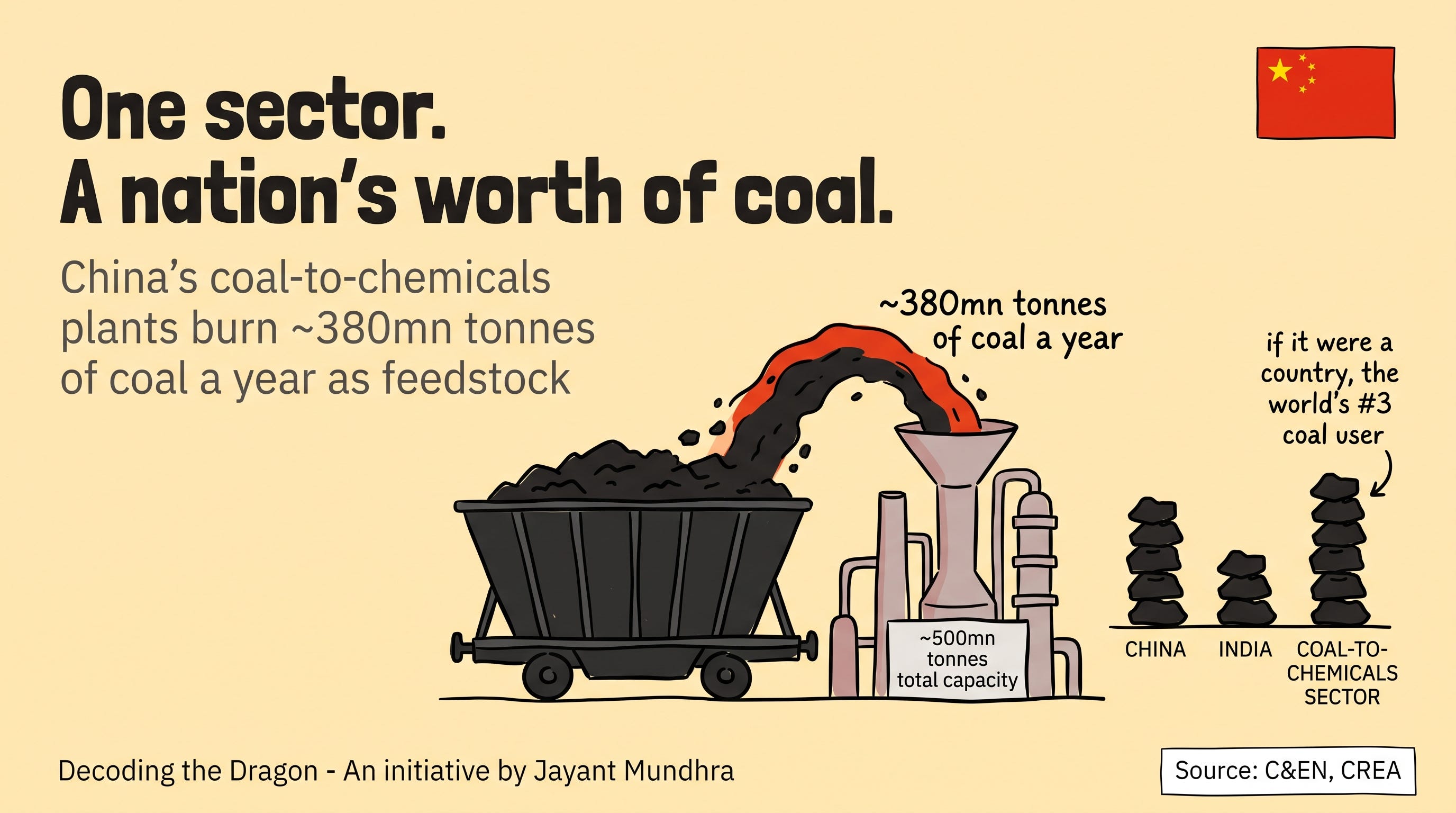
Add it all up and China's coal-to-chemicals plants can now process close to 500mn tonnes of raw material, consuming roughly 380mn tonnes of coal a year purely as a chemical feedstock.³ If that single sector were a country, it would be the world's third-largest coal consumer, behind only China and India.³
The thing is, this was never really about economics. It was about fear.
The fear at the centre of everything: the Malacca dilemma
To understand why a solar superpower keeps doubling down on coal, you have to understand the anxiety that has shaped Chinese energy policy for two decades.
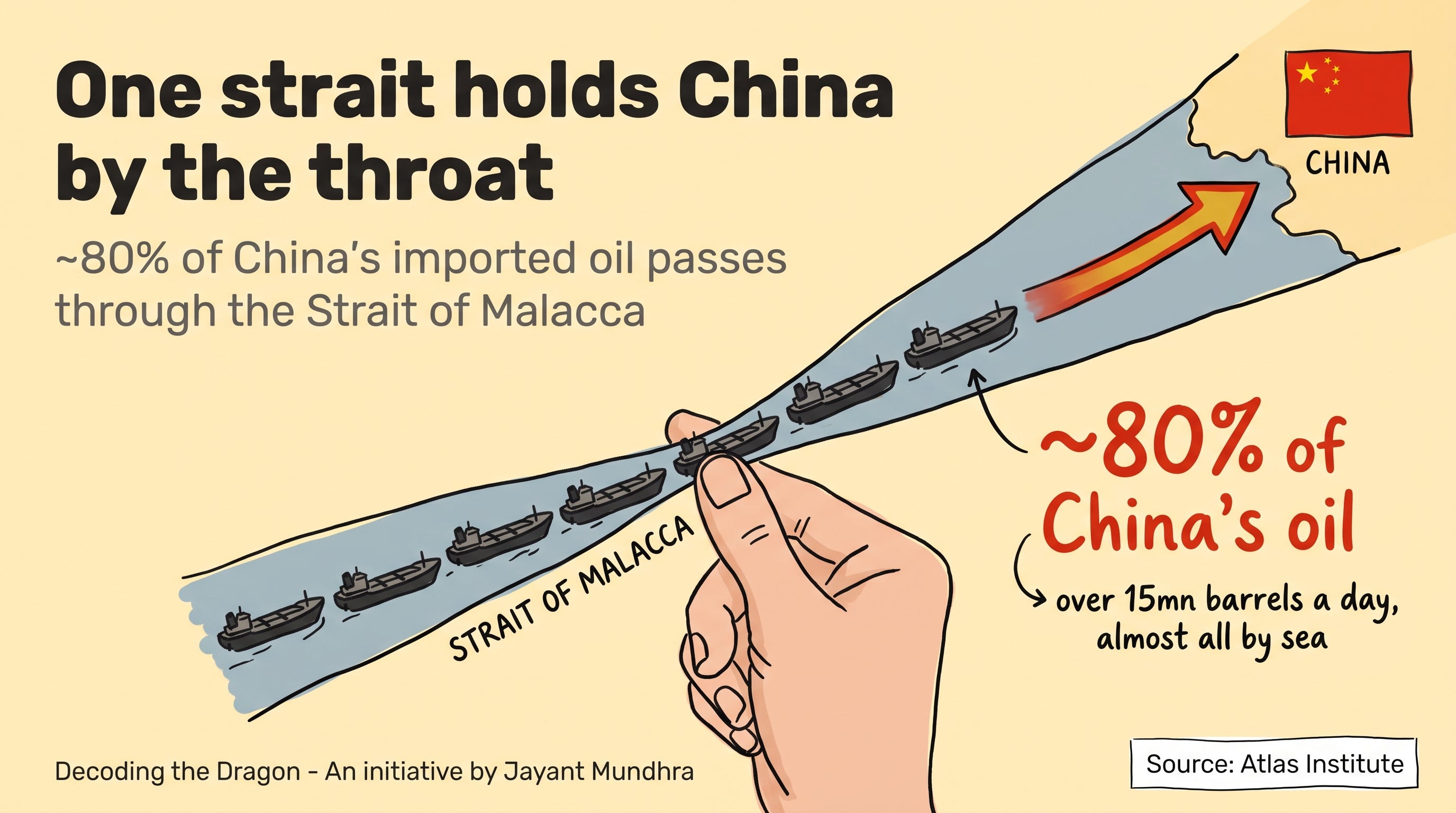
China imports the bulk of the oil it consumes, and its consumption has quadrupled to over 15mn barrels a day.⁴
Around 80% of those oil imports arrive by sea through a single narrow shipping lane: the Strait of Malacca.⁴
Back in 2003, then-leader Hu Jintao gave this vulnerability its name, the "Malacca dilemma", the risk that a rival navy could choke off China's energy at one chokepoint.⁵
Now sit with what a blockade would actually do. It would not just spike prices. It would starve the military of diesel and jet fuel, freeze internal logistics, and cut the manufacturing base off from the petrochemical feedstocks that go into everything from medical devices to packaging.
So Beijing built insurance. Pipelines from Russia and Central Asia, a strategic reserve, an electrified car fleet to kill oil demand at home. But the ultimate hedge, the one immune to any blockade, was the resource China has in absolute abundance underground: coal.
This licence-to-hedge instinct is exactly the sort of quiet, long-horizon state logic I find myself pulling apart most mornings, and it is what we go back and forth on in the Decoding the Dragon WhatsApp group, where I share a smaller China deep-dive like this with thousands of readers every day (t.ly/t7uhs).
Join the Decoding the Dragon community
The scale, and the corporations built to deliver it
This was not left to the free market. It was handed to state-owned giants who wield sovereign-scale capital.
China Energy (the old Shenhua) is the vanguard. It sits on vast coal reserves and now operates the world's only commercial-scale direct coal liquefaction plant, at Ordos in Inner Mongolia, which turns solid coal straight into ~1mn tonnes of liquid fuel a year.⁶ That $19bn acquisition I opened with? It is the same company deepening its grip, with a plan to double its polyethylene and polypropylene output to 1.4mn tonnes by 2027 and capture the downstream plastics margin for itself.¹
Then there is the sheer physical ambition of the new build:
Shaanxi Coal's Yulin Chemical project is designed to swallow 15mn tonnes of raw coal a year, the world's largest coal chemical project under construction.⁷
Its total investment runs to ~$24bn, with a second phase of 38 production units now being built to churn out polyolefins, biodegradable plastics and battery electrolyte.⁷
Once running, a single complex is expected to book over ~$12bn in annual sales.⁷
And here is the part that makes the strategists look clever rather than merely stubborn: right now, the economics work. In 2024, the modern coal chemical sector's profits jumped 178% to ~$1.65bn on revenue of ~$28bn,⁸ as falling domestic coal prices widened the margin against imported oil. What began as expensive national-security insurance is, for the moment, also a business.
How China actually cracked it, and the catch nobody mentions
There are two ways to liquefy coal, and China is the only country running both at commercial scale.
Direct liquefaction (DCL): dissolve pulverised coal and force hydrogen into it under extreme pressure. Ordos is the world's only commercial plant.⁶
Indirect liquefaction (ICL): first gasify coal into a syngas of carbon monoxide and hydrogen, then rebuild it into fuels or plastics. This is the workhorse route worldwide.
The bottleneck for both is the gasifier, and here China did something quietly strategic. In the early 2000s its plants leaned on imported gasifiers from Shell, Texaco and Lurgi. Beijing hated the dependence, funded a wave of domestic R&D, and now runs indigenous designs like the Opposed Multi-Burner gasifier out of its own universities. It swapped foreign oil dependence for domestic coal, then swapped foreign technology dependence for home-grown kit. That double substitution is the real achievement.
But there is a catch the glossy capacity numbers hide. Direct liquefaction is a spectacular energy converter and a mediocre energy source. Studies of the Ordos plant put its energy return on investment at a marginal 3.7 to 5.5, and once you bolt on the carbon capture needed to clean it up, that can collapse towards break-even.¹⁸ In plain terms, the process nearly eats as much energy as it makes. This was never about being efficient. It was about being unblockadeable, and China decided that was worth almost any price.
The bill: carbon and water on a frightening scale
Now the part China would rather you did not dwell on. This strategic autonomy is bought at a staggering environmental price, and it sits in direct opposition to China's own climate pledges.
On carbon, coal is a filthy feedstock because it is carbon-rich and hydrogen-poor. To make the chemistry work, plants run the carbon-heavy water-gas shift reaction, and the emissions pile up:
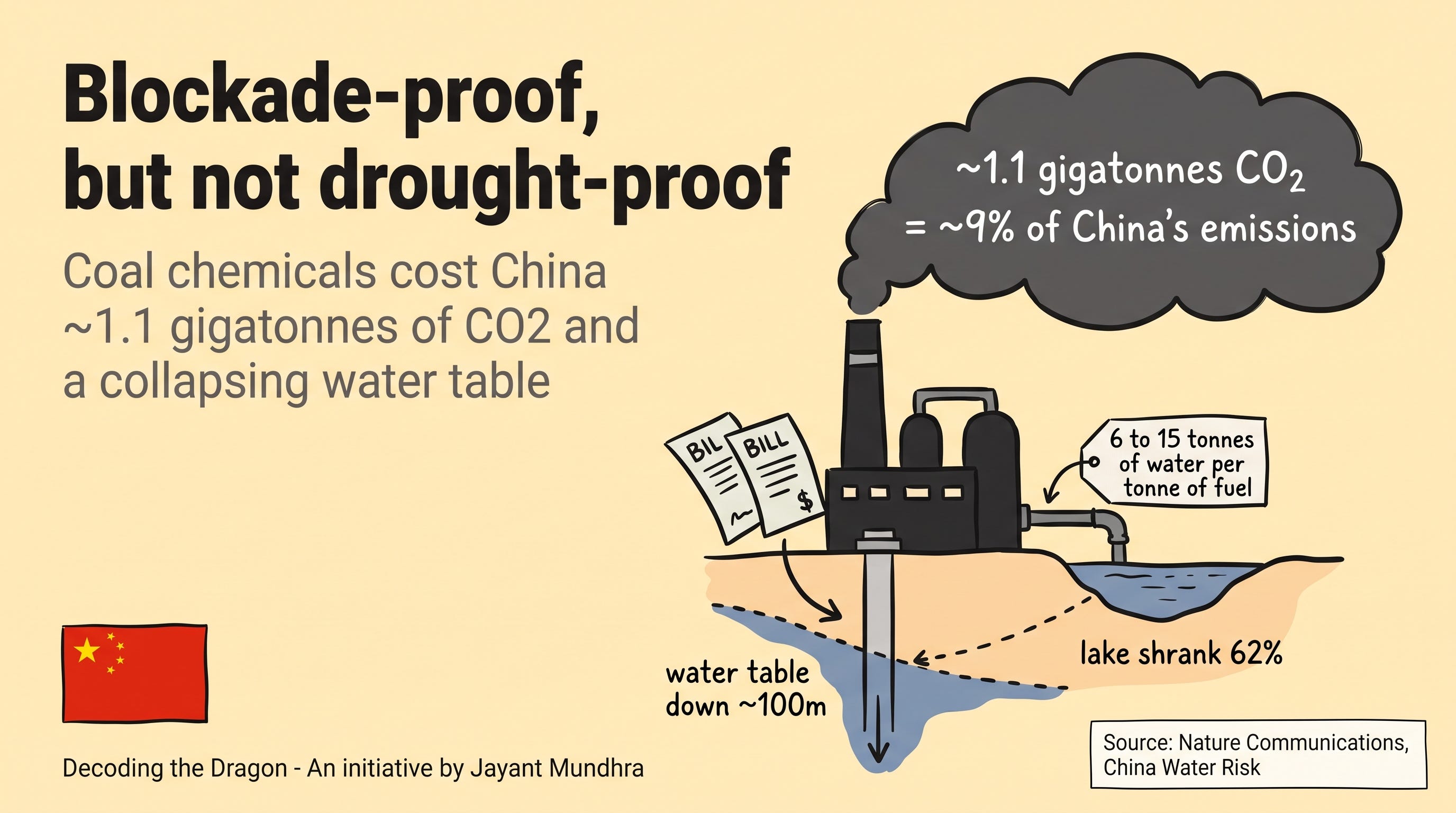
China's coal chemical production threw off ~1.12 gigatonnes of CO2-equivalent in 2020, about 9% of the country's entire greenhouse gas footprint.⁹
On current plans that climbs towards ~1.3 gigatonnes by 2030, quietly eating into the emissions cuts that all those solar farms are delivering.⁹
This is why analysts now flag the sector as the reason China's coal use keeps creeping up even as its power emissions start to fall.¹⁰
On water, the contradiction is almost cruel. Making synthetic fuel drinks 6 to 15 tonnes of freshwater per tonne of output, yet the plants are clustered in China's driest regions, Ordos, Yulin, Ningdong and Xinjiang, because that is where the coal is.¹¹
The fallout in Inner Mongolia is documented and grim. Around Shenhua's Ordos complex, years of groundwater extraction dropped the local water table by roughly 100 metres and shrank the largest nearby lake by 62%, turning grassland into advancing sand.¹² A blockade-proof economy, it turns out, can still run out of water.
China's escape hatch: green hydrogen
To square this circle, Beijing is now mandating the "low-carbon retrofitting" of the whole industry, and the fix is genuinely elegant.
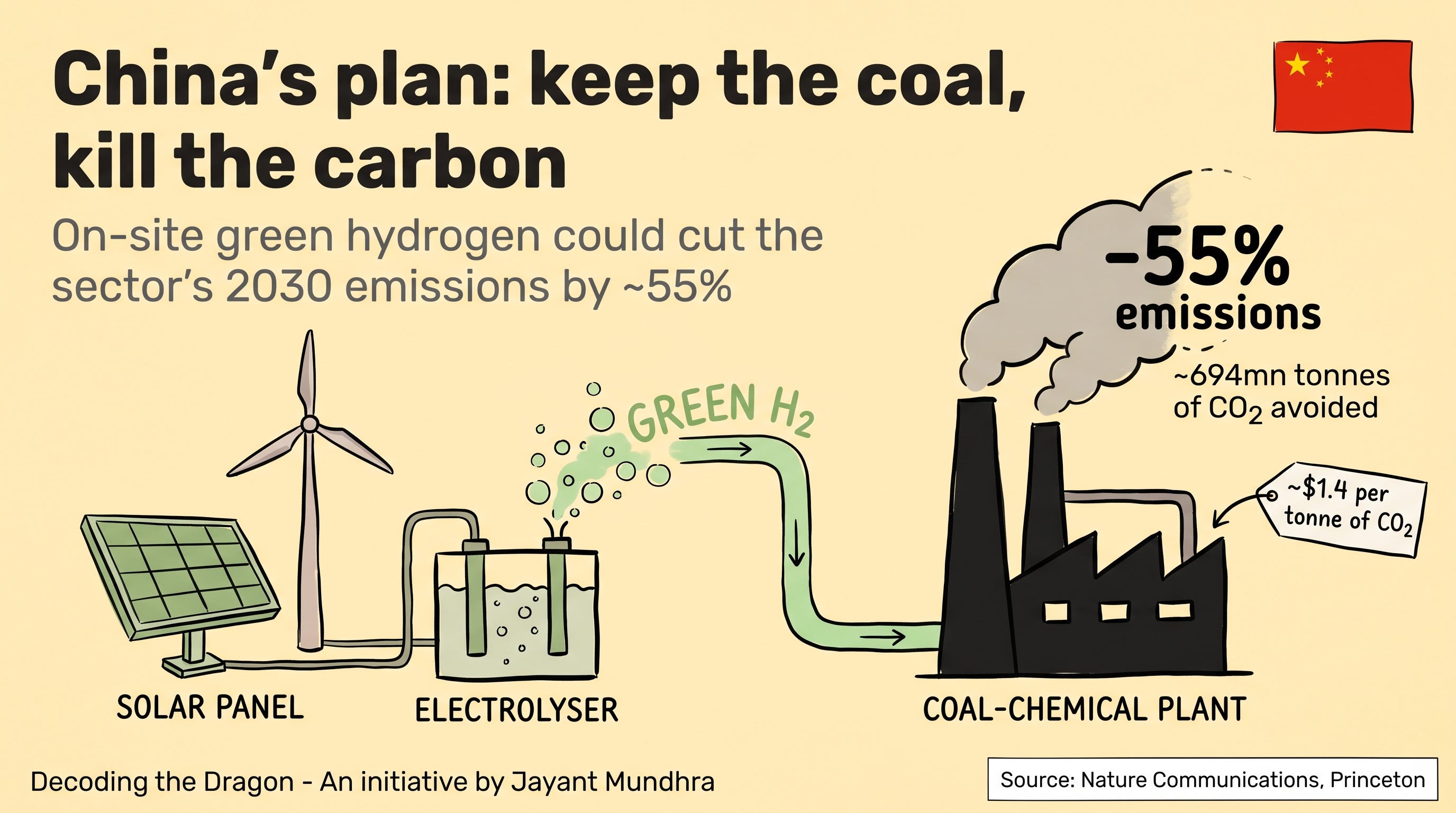
The trick is to attack the chemistry itself. Instead of making hydrogen from coal, plants can build utility-scale solar and wind on-site to run electrolysers, then inject that green hydrogen straight into the process. Do that and:
Wind-powered green hydrogen could cut the sector's 2030 emissions by ~55%, wiping out nearly 694mn tonnes of CO2-equivalent.¹³
Because Chinese solar is so cheap, the cost of abating a tonne of CO2 this way falls to roughly $1.4, absurdly economical.¹³
A landmark project in Ningxia is already producing green hydrogen for a coal-to-olefins line.¹³ China's bet is that it can keep its energy-security hedge and decarbonise it, by fundamentally rewiring the plumbing.
What it means for India
Here is where it gets uncomfortable for us, because India has an even worse version of the same problem.
India now imports ~88.6% of its crude oil, a dependence that keeps rising as domestic output falls.¹⁴
We produce under ~29mn tonnes a year against imports that touched a record ~5.2mn barrels a day.¹⁴
So of course India looked at China's coal-to-chemicals model and wanted it. In 2021 New Delhi launched a National Coal Gasification Mission targeting 100mn tonnes of coal gasified by 2030, backed by a ~₹8.5k crore incentive scheme, of which ~₹6.2k crore has already been disbursed across eight projects.¹⁵
But wanting the playbook and being able to run it are different things, and the wall India keeps hitting is not financial. It is geological.
Chinese and Western coal carries 10 to 15% ash. Indian non-coking coal carries 30 to 45%.¹⁶
Worse, that ash is intergrown with the carbon ("syngenetic"), so washing barely helps, and it forces what NITI Aayog calls a "technology mismatch": imported gasifiers built for clean coal choke on ours.¹⁶
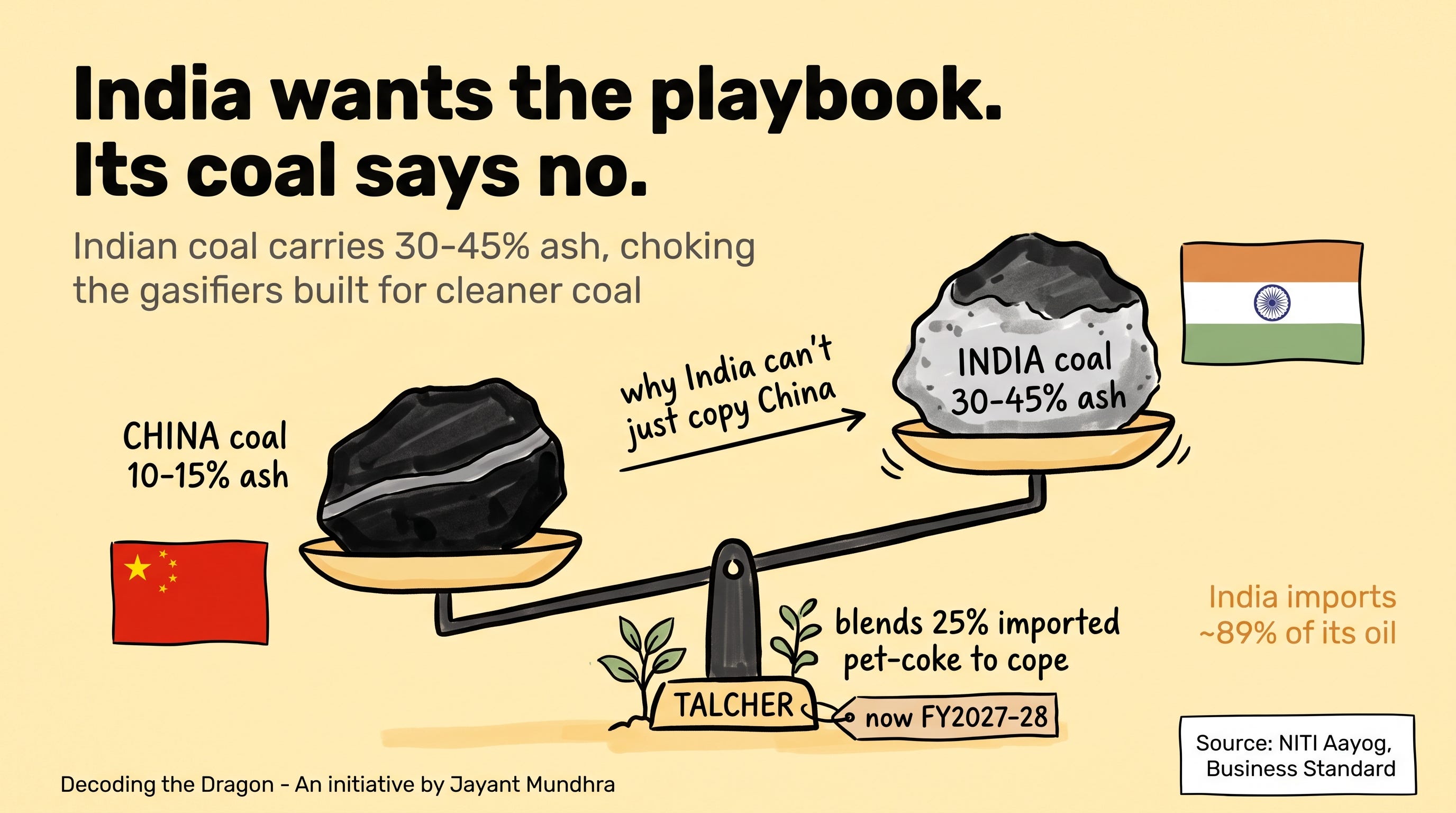
You can see this collision in the flagship Talcher Fertilizers project in Odisha, a ~$1.6bn (~₹13.3k crore) plant meant to make 1.27mn tonnes of urea from 2.5mn tonnes of coal.¹⁷ To make the chemistry behave, engineers have to blend in up to 25% imported pet-coke just to dilute the ash.¹⁷ The plant, once targeted for 2024, has now slipped to FY2027-28.¹⁷ That single delay is the whole Indian story in miniature.
This is precisely the kind of India-versus-China structural comparison I keep coming back to, and it is the thread we chase every day in the Decoding the Dragon community (t.ly/t7uhs), where these gaps get pulled apart number by number.
Join the Decoding the Dragon community
What to watch
Whether China Shenhua's ~$19bn asset absorption actually closes on its stated terms, and how much fresh coal-chemical capacity it green-lights next.
The commissioning timeline for Yulin Chemical's second phase, still officially aimed at 2027.
Whether Talcher hits even its revised FY2027-28 date, the single best real-time gauge of India's gasification ambition.
Any move by the NDRC to bring coal chemicals more forcefully under China's national carbon market, which would reprice the whole sector overnight.
China has proven you can build an entire shadow oil industry out of coal to make yourself blockade-proof. India is discovering that whether you can copy it depends less on your ambition and more on the ash in your rocks.
And well that is it for today's edition. That said, do check out my core WhatsApp community Biz News+ where I share 4-5 deepdives from the world of business, economics & public economics daily: https://t.ly/h2jq1
And, do check out my work on the following platforms as well: Instagram, LinkedIn and Youtube
Best,
Jayant
References
1. Bloomberg, "Coal Miner China Shenhua Gets OK for $19 Billion of Acquisitions", link
2. Blooming, "China's Coal Chemical Industry Enters New Phase", link
3. C&EN (ACS), "Coal is set to surge as a chemical raw material", link
4. Atlas Institute, "Navigating the 'Malacca Dilemma' in 2025", link
5. Wikipedia, "Malacca dilemma", link
6. Wikipedia, "Erdos CTL", link
7. Blooming, "Shaanxi Coal Group Yulin Chemical 15 Million TPA Project", link
8. Blooming, "China's Coal Chemical Industry Surges on Green Transition", link
9. Nature Communications, "Deploying green hydrogen to decarbonize China's coal chemical sector", link
10. Climate Change News (CREA), "China's emissions fall but growing coal-to-chemicals sector raises concern", link
11. CREA, "China's coal-to-chemicals growth risks climate goals", link
12. China Water Risk, "Coal-to-Chemicals: Shenhua's Water Grab", link
13. Princeton / Nature Communications, "Green Hydrogen Can Help Decarbonize China's Coal Chemical Sector", link
14. OilPrice, "India's Oil Import Dependence Climbs to Nearly 89%", link
15. Construction World, "Coal Gasification Mission Aims for 100 MT by 2030", link
16. NITI Aayog / Drishti IAS, "Coal Gasification", link
17. Business Standard, "IRFC extends loan for Talcher Fertilizers' Coal Gasification Urea Project", link
18. Energies (MDPI), "EROI Analysis for Direct Coal Liquefaction, the Shenhua DCL Project", link
Comments
Nothing yet. Say the first thing.
Sign in to join the conversation.