
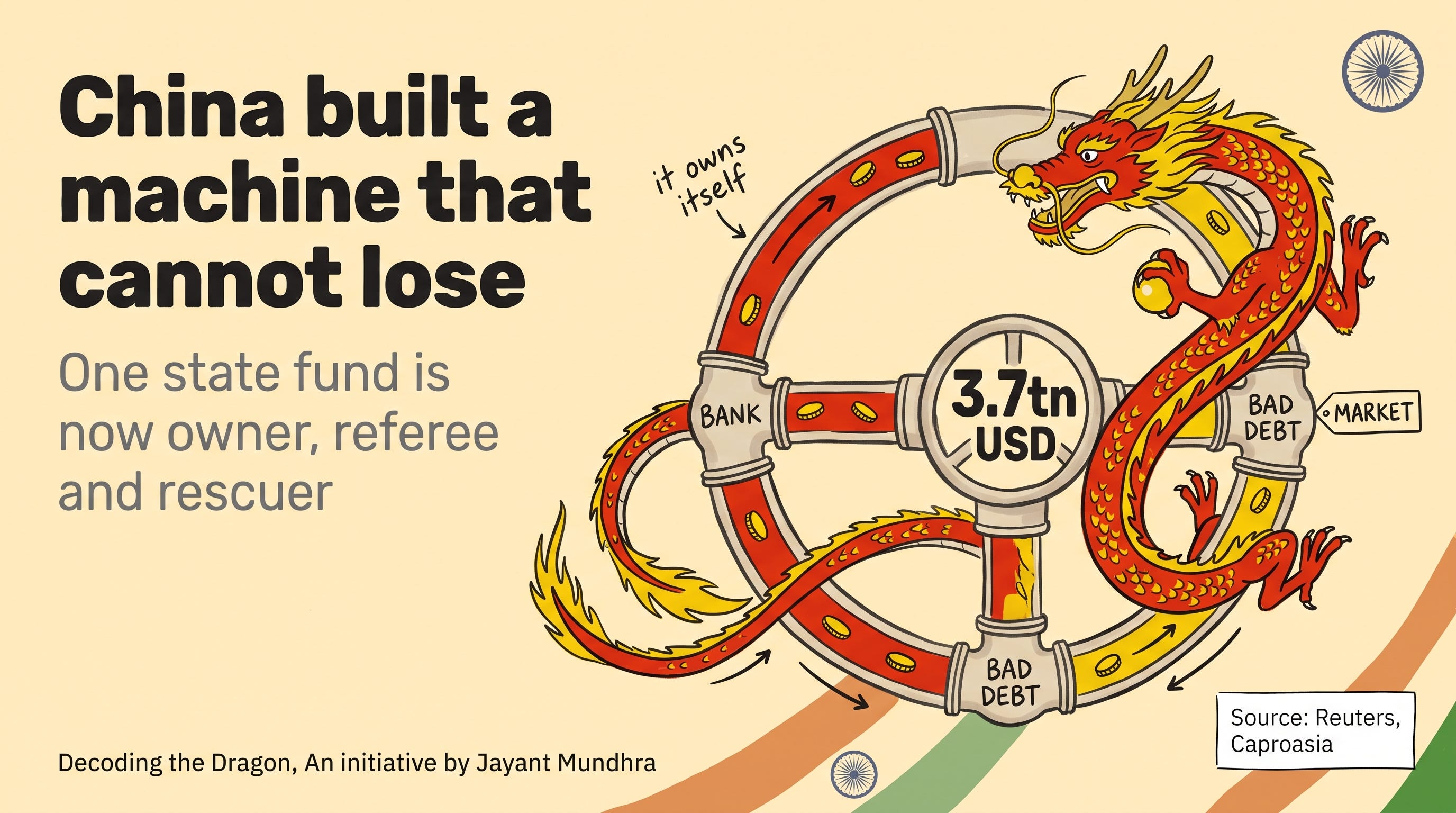
Here is a number that stopped me cold this week. There is now a single Chinese entity, one you have probably never heard of, that sits on top of roughly $3.7tn of assets.1 2
That is larger than the entire economy of India. It is bigger than every Indian bank, insurer and mutual fund put together. And it is not a bank, not a ministry, not a listed company in any normal sense. It is Central Huijin Investment, the domestic arm of China's sovereign wealth machine, and over the past eighteen months it has quietly become the most powerful financial institution on earth.
The thing is, most people still think of a sovereign wealth fund as a fairly boring thing. A country runs a trade surplus, parks the spare dollars in US Treasuries and foreign shares, and clips a coupon. Norway does it. The Gulf does it. That is the textbook.
China took that textbook and rewrote it into something far stranger, and far more interesting for India.
China's version began exactly where the textbook says it should. By 2007 the country was drowning in foreign exchange, about $1.4tn of it, earned from two decades of exporting to the world.
Rather than let it sit in low-yielding American debt, Beijing set up the China Investment Corporation, or CIC, in September 2007.
The mechanics were clever. The finance ministry issued special bonds and used the proceeds to buy $200bn of reserves from the central bank, which became CIC's starting capital.4
That structure forced discipline. CIC had to earn enough to service those bonds, so it could never be a purely political vehicle.
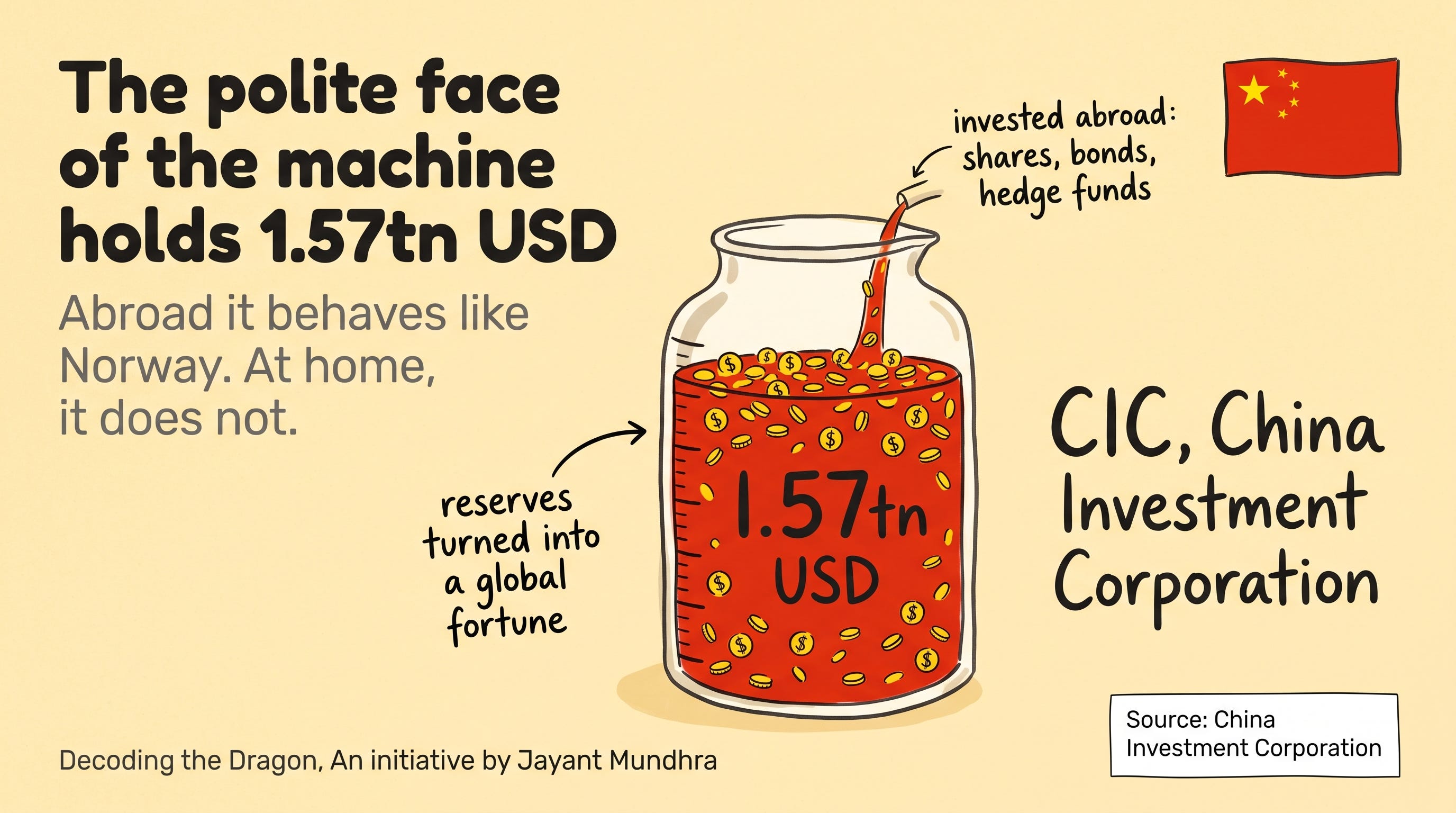
Nearly two decades on, it has grown into a giant. CIC reported total assets of $1.57tn and net assets of $1.37tn in its latest annual report, with a ten-year annualised return of 6.92% in dollar terms.3
So far, so Norway. CIC's international arms invest in global equities, hedge funds, property and private equity, and they are at pains to say they are passive financial investors chasing risk-adjusted returns, not strategic control.
But look one layer down and the whole thing changes character. Because CIC has a third subsidiary that never leaves home, and that subsidiary is where the real story lives.
Central Huijin does not invest abroad. It exists to own China's financial system from the inside.
It was born in 2003, before CIC itself, as a vehicle to recapitalise state banks buried under bad loans, and it was later folded into CIC.5 Today it is the controlling shareholder of the "Big Four" state banks, ICBC, China Construction Bank, Bank of China and Agricultural Bank of China, holding majority or near-majority stakes in each.5
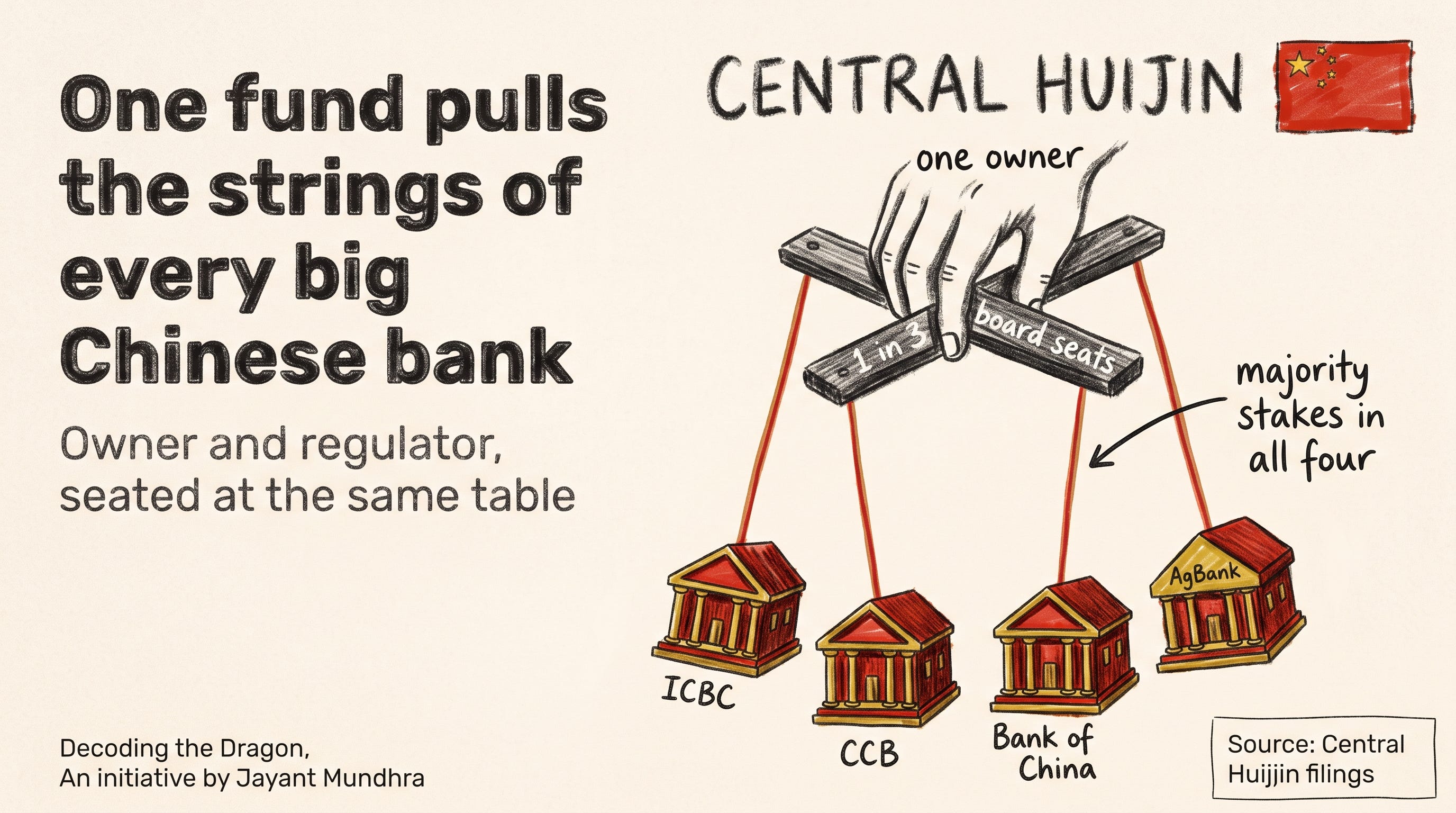
And it does not hold these stakes passively. Central Huijin insists on seating up to one-third of the directors on its banks' boards.5 It is, in the words of one analyst, the "shareholder-in-chief" of the entire sector.
Now here is where it gets genuinely strange, and this is the mechanism I find myself picking apart most mornings. The people who run this owner also run the regulator.
CIC's own board, by its articles, must include nominated officials from the finance ministry, the central bank, the commerce ministry, the planning commission and the foreign exchange regulator.
Those are precisely the bodies that regulate the banks Central Huijin owns.
So the state is simultaneously the owner, the referee and the lender of last resort. It writes the rules, plays the game, and backstops the losers, all at once.
This is exactly the kind of quiet structural design that we spend our mornings pulling apart in the Decoding the Dragon WhatsApp community, where I share a smaller China deep-dive like this with thousands of readers every day (t.ly/t7uhs). If you find this plumbing as fascinating as I do, that is the room for you.
→ Join the Decoding the Dragon community
When this apparatus is switched on, markets call it the "National Team": a coordinated coalition of Central Huijin, the pension fund, brokerages and margin lenders that moves in unison.
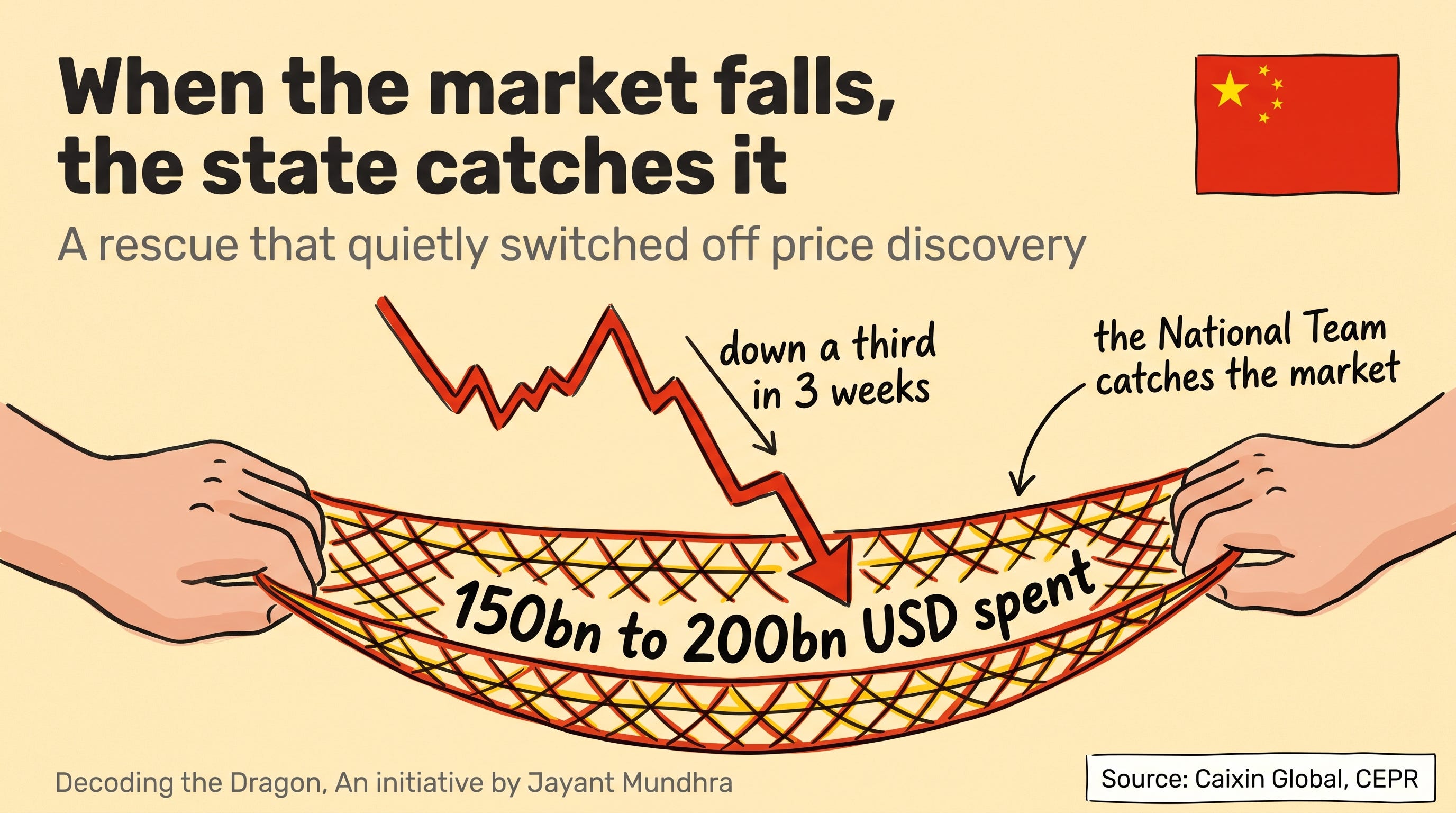
The central bank pumped liquidity into the China Securities Finance Corporation, the CSFC, the central hub for margin lending.
The National Team then bought shares directly, on an enormous scale. Estimates of the total run from roughly $150bn to well over $200bn, enough to end up holding stakes across a large share of the listed market.10
Traders learned to spot mysterious buying surges in the final hour of trading, the state defending its lines.
It worked, in that it stopped the panic. But it left scars. Liquidity in the rescued stocks dried up, volatility rose, and the state became a permanent, un-sellable blockholder sitting on half the market. Price discovery, the thing a stock market is actually for, got quietly switched off.
There is a parallel, less visible arm here too. The foreign exchange regulator runs its own domestic vehicle, Wutongshu, or "buttonwood tree", set up in 2014. In 2015 it used the nation's reserves to inject $48bn into China Development Bank and $45bn into the Export-Import Bank.11 The regulator, once again, acting as a market player.
What is fascinating is how much more sophisticated the state has become. It learned from 2015.
When Chinese stocks slumped again in early 2024, Central Huijin did not pick individual stocks. It bought broad index ETFs, declaring itself "patient capital".
By the end of August 2025 it had amassed around $180bn in ETFs, spanning the CSI 300, the chip-heavy Star 50 and the CSI 1000.6
The buying helped push China's ETF market past Japan's to become Asia's largest, and it handed the fund over $50bn in paper gains as stocks rallied to multi-year highs.6
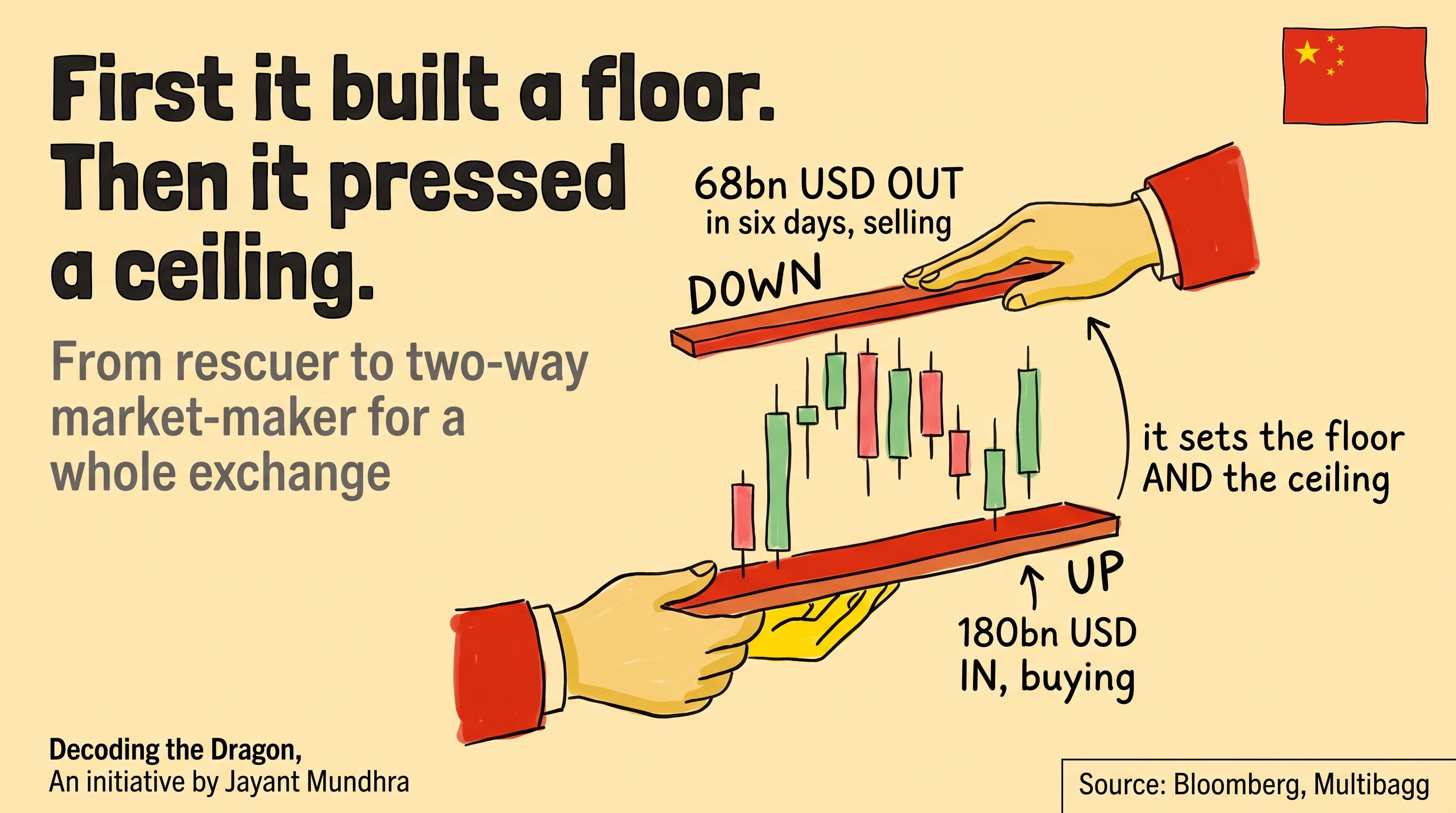
Then came the move that reveals the machine's true nature. In January 2026, within just six trading sessions, Central Huijin sold roughly $68bn across 14 ETFs, slashing some holdings to the bone.7
Read that again. This was not a rescue. It was the opposite. Having built a floor under the market in 2024, the state was now pressing a ceiling down on it, draining speculative froth out of the AI and rocket-stock names before it turned into a bubble. By April 2026 it had trimmed several holdings below the 20% disclosure threshold entirely.8
That is the whole game in one gesture. The state can set the floor and the ceiling. It decides how high the market goes and how low it falls. It has moved from one-way rescuer to two-way market-maker for an entire national exchange.
And then, in early 2025, Beijing pulled everything under one roof.
Between February and September 2025, the finance ministry transferred, at no cost, its controlling stakes in the country's three largest bad-debt managers, plus the CSFC margin-lending hub, straight into Central Huijin.1 12
China Cinda, 58%. China Orient, about 72%. China Great Wall, about 74%. The CSFC, about 67%.1
The Cinda transfer formally completed in September 2025, with the finance ministry exiting and Central Huijin becoming the direct controlling shareholder.12
The effect on scale was staggering. Central Huijin's total assets jumped from about $1.1tn in 2024 to at least $3.72tn by March 2025.2
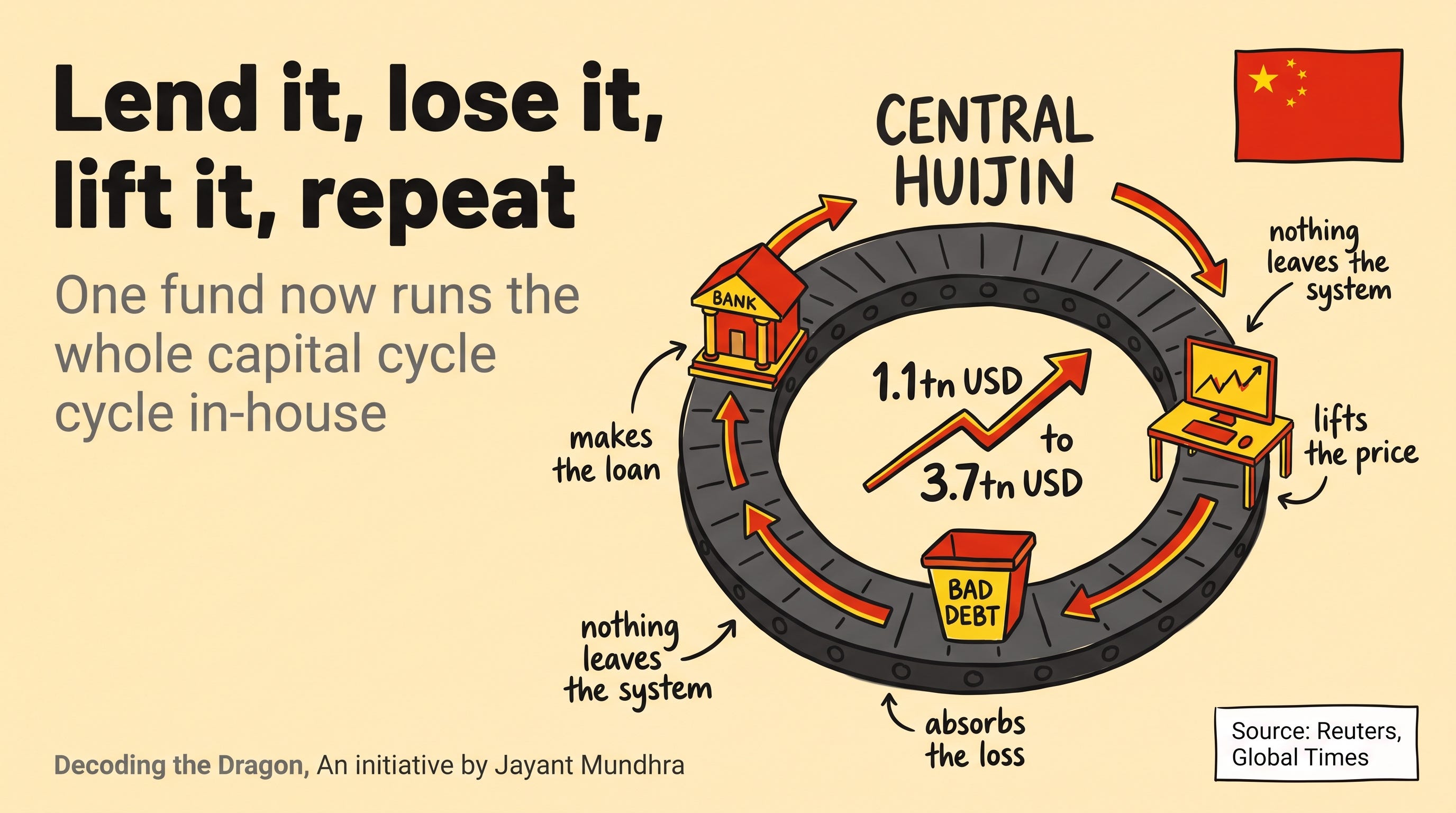
Now hold the full picture in your head. Under one umbrella you now have the commercial banks that create the credit, the bad-debt managers that absorb the loans when they sour, and the margin desk that stabilises the stock market. Central Huijin can lend, then buy its own bad loans, then prop up its own share prices, without ever going to an outside market.
It is a closed loop. A self-contained financial ecosystem that can absorb a shock at every stage of the capital cycle internally. That is the apex of what scholars call the "investor state", and there is nothing else like it on the planet.
Here is why none of this is an abstract China-watching exercise for us. India runs its own version of state capital, and the contrast is the most useful mirror I know.
India's model splits in two, and neither half looks like Central Huijin, which is the point.
NIIF, the growth engine. The National Investment and Infrastructure Fund is deliberately the anti-Huijin. The government caps its own stake at 49% and hands the majority to outside investors like Abu Dhabi's ADIA, Temasek and Canadian pensions. It manages about $4.9bn today, and after a fresh ₹30k crore commitment in June 2026 that took its government backing to ₹60k crore, it is aiming to double to roughly $10bn.14 It crowds private capital in. It does not own the banks.
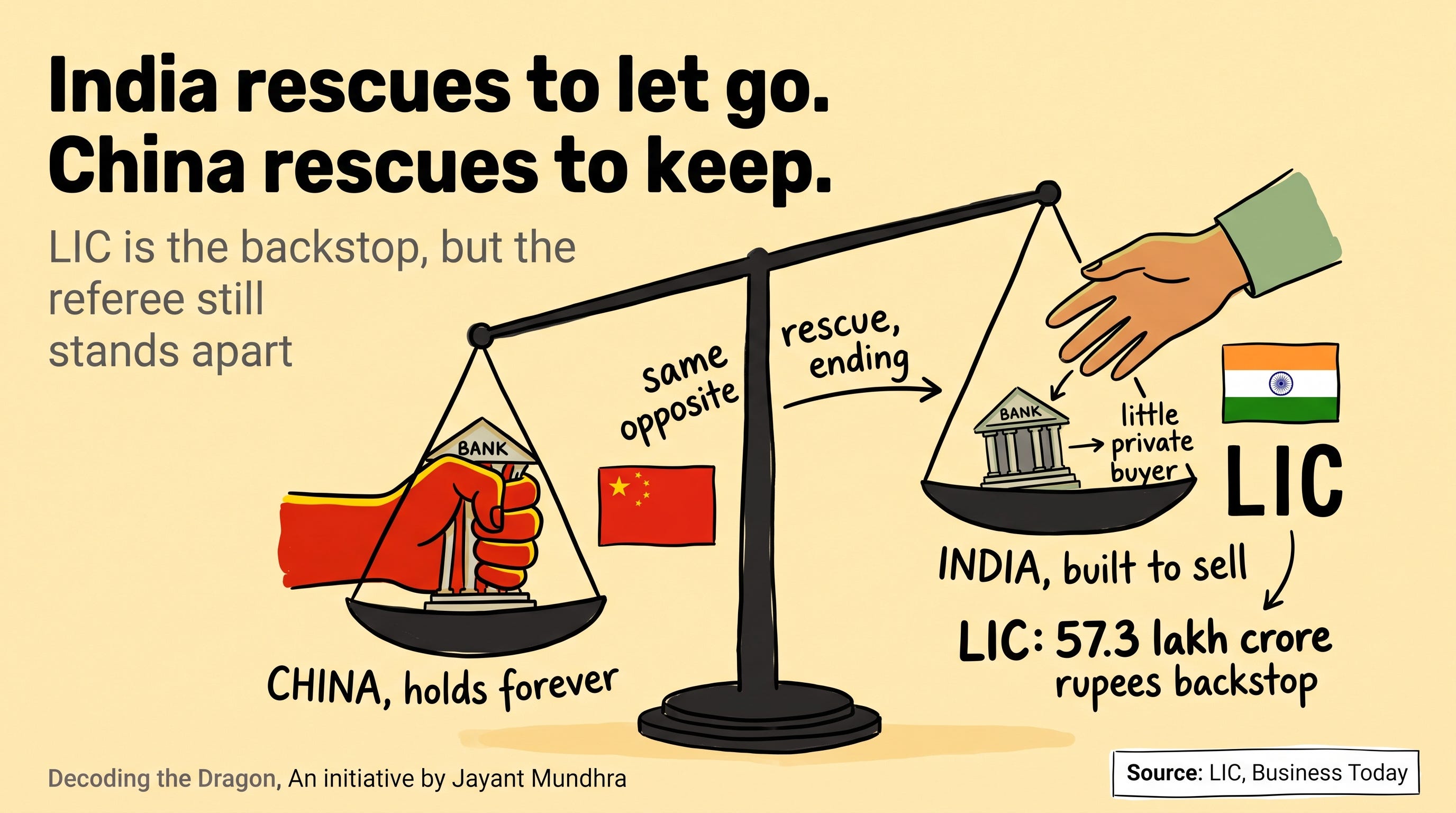
LIC, the quiet backstop. This is the one that should make us pay attention. The Life Insurance Corporation, with around ₹57.3 lakh crore, close to $605bn, of assets in FY26 and the dominant share of the market, is India's implicit National Team.13
Think about what LIC actually does. When the government sells a stake in a public-sector company and the market is lukewarm, LIC steps in and mops up the shares. Historically, it has absorbed a large share of the government's entire disinvestment haul. It rescued IDBI Bank in 2019, buying 51% for about ₹21.6k crore and pulling it out of the regulator's intensive-care framework.
This is where the philosophies part ways, and where India comes out looking healthier.
Central Huijin buys a bank and holds it forever, as a permanent instrument of state control.
LIC bailed out IDBI to stabilise it, and the state is now trying to sell it back to the private sector. The government and LIC are jointly offloading a combined ~60.7% stake, though the sale has stalled since financial bids came in below the reserve price in early 2026, with fresh bids now invited and completion pushed to FY27.15
That messiness is, oddly, the good news. India's rescue is designed to end in an exit. And crucially, LIC answers to an independent insurance regulator and the RBI. It does not sit on their boards. The referee and the player are still, mostly, different people.
Step back and this is really a story about where the line between the state and the market is drawn, and who gets to draw it.
China has spent two decades erasing that line on purpose. The sovereign fund abroad looks like Norway to keep Western markets comfortable. The sovereign fund at home owns the banks, runs the margin desk, holds the bad debt and moves the index at will. This is the machinery behind Xi Jinping's push for financial "self-reliance" and control, the same instinct that drives the common prosperity campaign and the tech crackdowns.
It buys China something real: a financial system that cannot easily be broken by a foreign shock, because the state can absorb losses anywhere in the chain. China's $3.42tn of headline reserves get the headlines, but this internal plumbing is the deeper source of resilience.9
It also costs China something real: a market that no longer prices risk honestly, capital that flows to whatever the state wants rather than what earns the best return, and a permanent question mark over whether any Chinese share price is a real price or a policy price.
For India, the lesson is a double-edged one, and I would not want us to draw the wrong blade.
The negative signal is the temptation. Every time a disinvestment flops or a bank wobbles, the easy answer is to lean harder on LIC, on the state banks, on the "national champions". Do that often enough and you drift, one bailout at a time, toward the Huijin model, where the state can never let go because it owns everything. LIC quietly holding up undersubscribed government sales is exactly how that drift begins.
The positive signal is that India has, so far, chosen the harder and better path. Separating the regulator from the owner, capping the state's stake in NIIF, designing bailouts to end in privatisation, these are not accidents. They are the difference between a market that discovers prices and one that is told them.
The IDBI sale, stuck as it is, is the test case worth watching. If India sees it through to a genuine private buyer, it proves the exit ramp works. If it quietly parks the bank back with LIC, we will have taken one more step down the Chinese road without meaning to.
Whether the IDBI Bank sale finds a buyer above the reserve price in FY27, or gets absorbed back into LIC's book.
Central Huijin's next disclosure: does it keep trimming ETFs, or flip back to buying if Chinese stocks wobble again.
Whether the three bad-debt managers, now inside Huijin, start reporting cleaner books, or whether the losses simply get absorbed and hidden inside the colossus.
Any move to formally define Central Huijin's role, a signal Beijing wants to make the "investor state" permanent rather than crisis-driven.
The deeper I go into China's state-capital plumbing, the more I think the real contest is not who has the biggest fund. It is who can keep the referee and the player apart, and this is the sort of thread we keep pulling in the Decoding the Dragon community every morning (t.ly/t7uhs).
→ Join the Decoding the Dragon community
China built the most powerful financial machine in history by fusing the owner, the regulator and the rescuer into one body. India's edge is that it still, for now, keeps them three.
And well that is it for today's edition. That said, do check out my core WhatsApp community Biz News+ where I share 4-5 deepdives from the world of business, economics & public economics daily: https://t.ly/h2jq1
And, do check out my work on the following platforms as well: Instagram, LinkedIn and Youtube
Best,
Jayant
1. Caproasia, "China Ministry of Finance Transfers Ownership of 3 Largest State-Owned Bad Debt Asset Managers to Central Huijin", caproasia.com
2. Reuters, "China's new financial captain faces tough mission", reuters via tradingview.com
3. China Investment Corporation, "CIC Released the Annual Report 2024", china-inv.cn
4. China Investment Corporation, Wikipedia, en.wikipedia.org
5. Central Huijin Investment, Wikipedia, en.wikipedia.org
6. Bloomberg, "When China's Stock Market Tanks, the National Team Rides into Action", bloomberg.com
7. Multibagg, "China national team ETFs: $67.5B sale marks 2026 shift", multibagg.ai
8. Bloomberg, "China's National Team Cut ETF Stakes Below 20% Disclosure Mark", bloomberg.com
9. State Administration of Foreign Exchange, "China's Foreign Exchange Reserves at the End of June 2026", safe.gov.cn
10. Caixin Global, "How a Stock Market Crash Created China's National Team", caixinglobal.com
11. Boston University Global Development Policy Center, working paper on SAFE and China's policy banks, bu.edu
12. Global Times, "Control of four Chinese financial institutions to be transferred to Central Huijin Investment", globaltimes.cn
13. Business Upturn, "Life Insurance Corporation of India reports FY26 results", businessupturn.com
14. Whalesbook, "NIIF Targets $10 Billion AUM Growth in Three Years", whalesbook.com
15. Business Today, "IDBI Bank stake sale: Financial bids received; evaluation underway", businesstoday.in
Comments
Nothing yet. Say the first thing.
Sign in to join the conversation.