
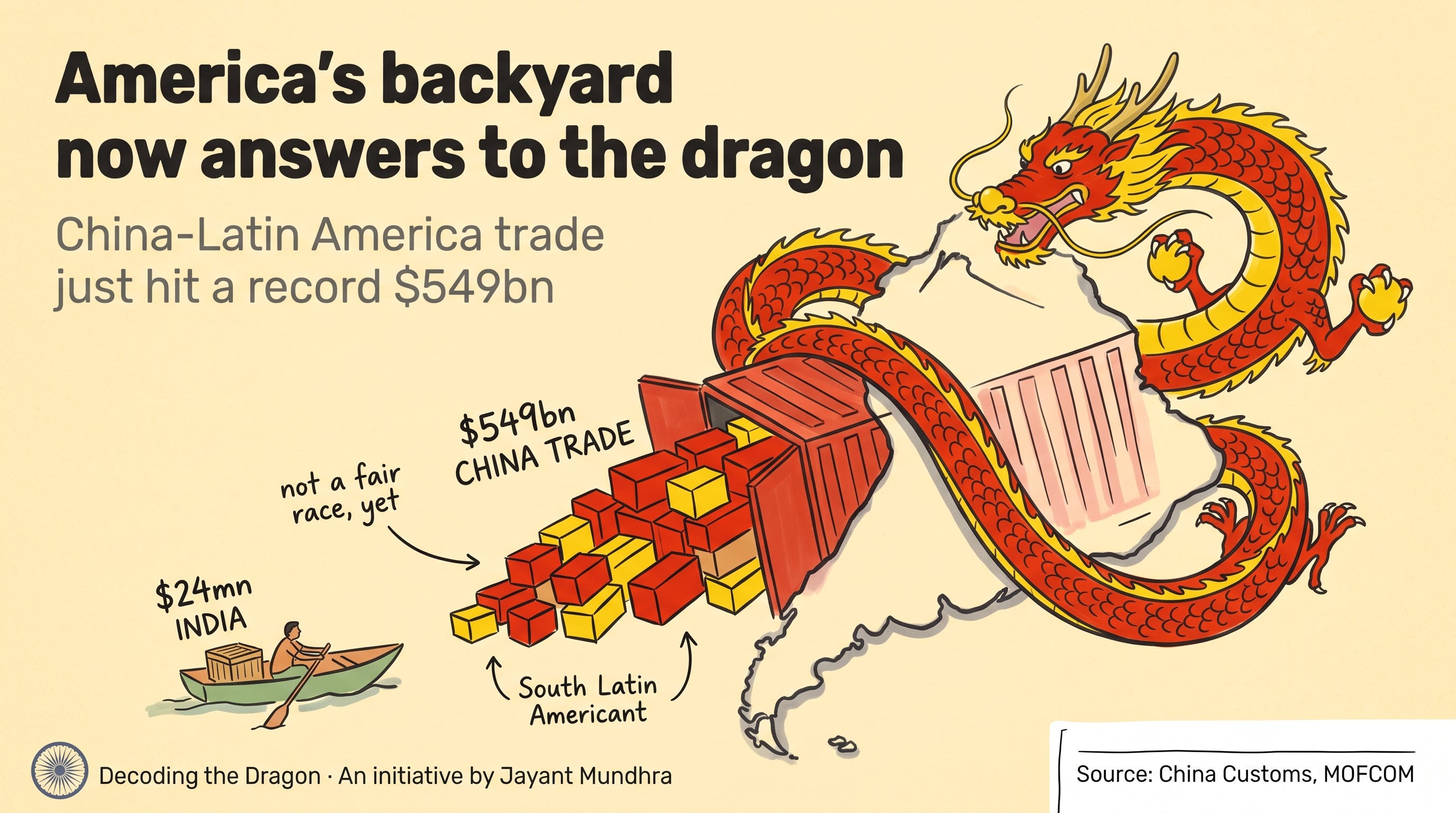
I want to start with a number that quietly redrew a map. In the year 2000, China bought less than 2% of everything Latin America sold to the world.1 Last year, China and Latin America traded a record $549bn.1
Now sit with that for a second. In a single generation, China went from a rounding error in the Americas to South America's largest trading partner. And it did not stop at buying soybeans and copper. It started building the ports the soybeans leave from, the grids the mines run on, and the railways that will carry it all to the Pacific.
This is the part that fascinates me. Latin America is meant to be America's backyard. The United States has treated it as its own sphere since 1823. Yet the biggest builder in that backyard today is Beijing. And in 2026 the pushback has finally turned kinetic. So let us decode what China actually built, why Washington is suddenly panicking, and where a very late India fits in.
For twenty years the China-Latin America story was boring and one-way. South America dug things up, soybeans, iron ore, crude, lithium, and shipped them east. China sent back phones, machines and cars. Pure commodities-for-manufactures.
What changed is that China stopped being a customer and became the landlord. It is now the financier, builder and operator of the continent's core infrastructure.
More than 20 Latin American and Caribbean countries have signed on to China's Belt and Road Initiative.
Colombia, long the most pro-Washington economy in the region, formally joined in May 2025 as the 22nd, signing up from the Great Wall itself.2
Chinese firms now run the container terminals, the transmission lines and the salt flats, not just the export contracts.
The flagship of this shift sits about 60km north of Lima. And in the last few months it has become the single clearest test of who really controls the Americas.
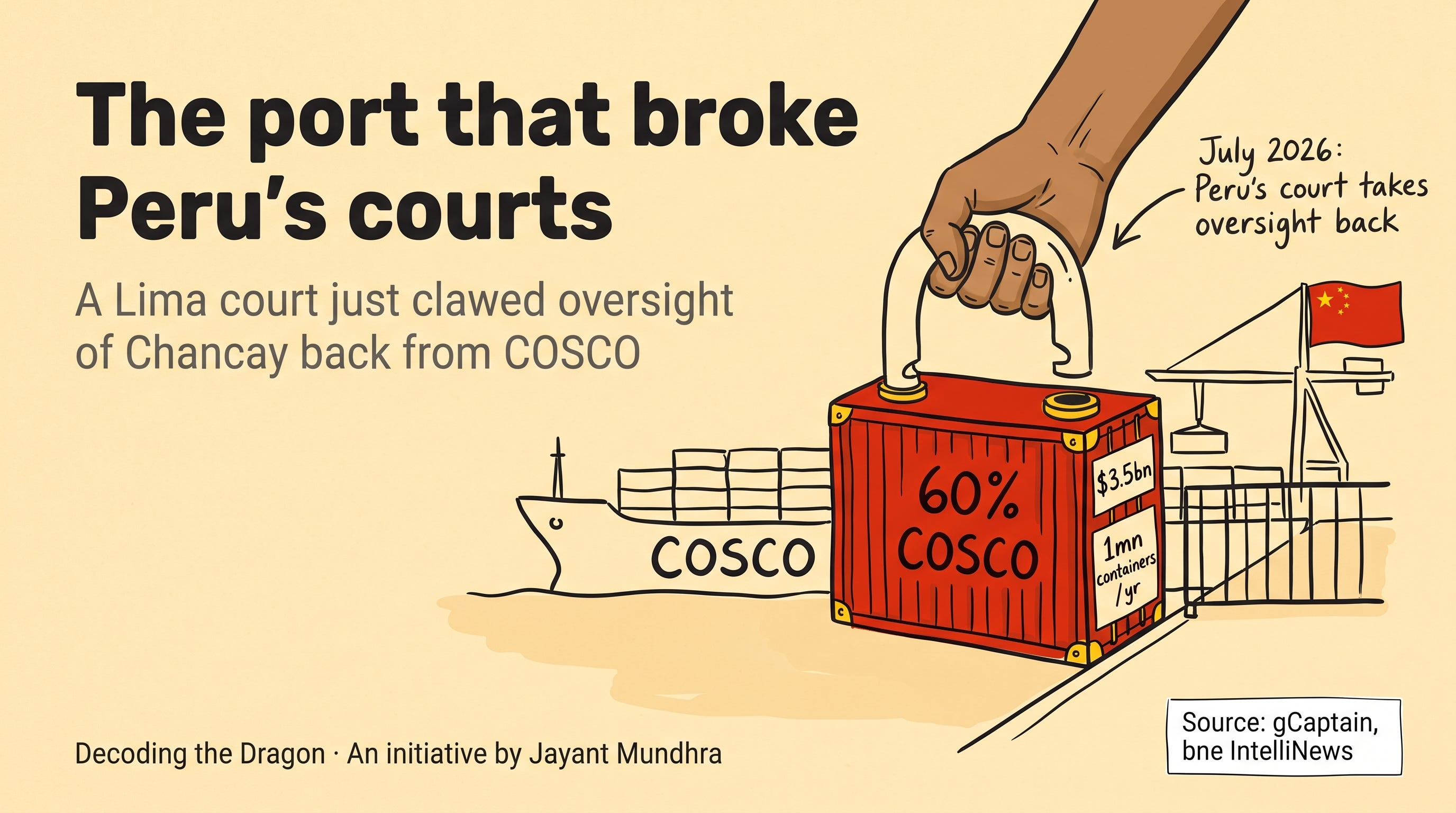
The Port of Chancay opened in late 2024 and it is a genuine marvel. It is a deep-water mega-port built to send South American cargo straight across the Pacific, skipping the ports of the United States, Mexico, and the drought-hit Panama Canal entirely.
It is run by a joint venture that is 60% owned by China's state shipping giant COSCO, with Peru's Volcan holding 40%.3
The first phase cost about $3.5bn and handles up to 1mn containers a year.3
It cuts shipping time to Asia by up to 20 days.3
Here is where it got strange. COSCO argued that because Chancay was built with private money and had no state concession, Peru's transport regulator Ositran had no business overseeing it. In January 2026 a Lima court agreed, and ordered the regulator to stop supervising the port entirely.4 For a few months, a foreign state-owned company effectively ran a sovereign enclave on Peruvian soil.
And then, this month, it flipped. In early July 2026, Lima's Second Constitutional Chamber threw the exemption out.5 The court's logic was elegant: what triggers state oversight is public use, not who owns the asset. Chancay serves the public, so Peru's regulator gets to regulate it, private money or not.5
This reversal matters more than it looks. It is the first real crack in the model. And it is the closest thing Washington has to a win.
The US had gone in hard. The State Department warned bluntly that "cheap Chinese money costs sovereignty".6 Its ambassador to Peru made headlines saying that with the Chinese "looting your sea", Peruvians would have to make "hamburger ceviche".6 Beijing hit back that the US was spreading disinformation about a commercial port.6 This kind of quiet institutional tug-of-war, a court ruling that decides who controls a continent's trade gate, is exactly the sort of thread I end up pulling apart most mornings in the Decoding the Dragon WhatsApp group, where I share a smaller China deep-dive like this with thousands of readers every day (t.ly/t7uhs).
Join the Decoding the Dragon community
Chancay only pays off fully if China can feed it from deep inside the continent. So the next move is a railway of almost absurd ambition.
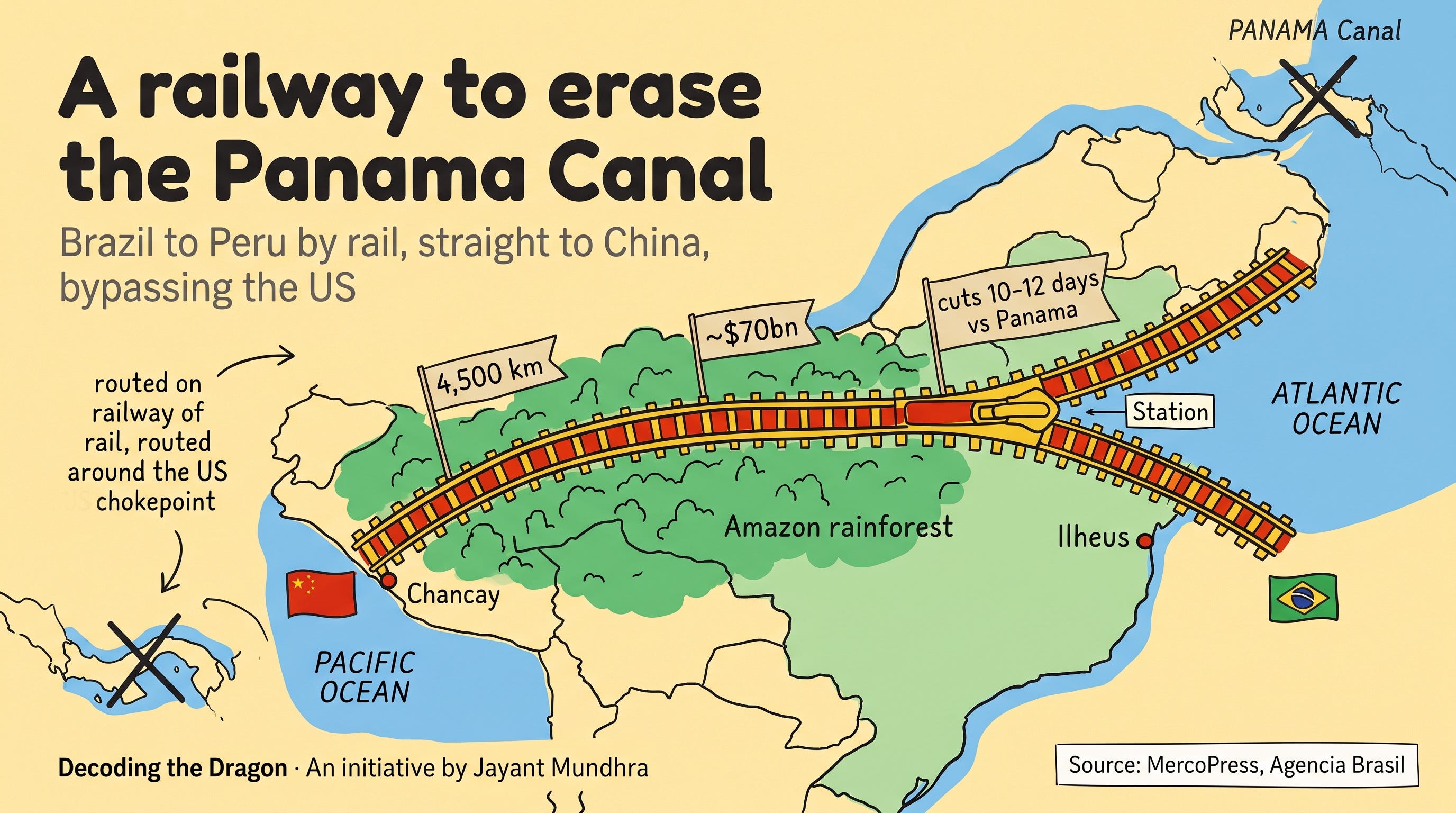
In July 2025, Brazil and China signed a memorandum to study a transcontinental line, the Bi-Oceanic Railway.7 The plan is to run track roughly 4,500km from the port of Ilhéus on Brazil's Atlantic coast, across the Amazon and over the Andes, straight to Chancay on the Pacific.7
The estimated cost is upward of $70bn.7
Backers say it would cut Asia-South America shipping times by another 10 to 12 days versus the Panama Canal.7
Moving goods across the interior by truck today is at least ten times costlier than bulk shipping, so the economic logic is real.7
It is still only a five-year feasibility study, and the engineering, the Amazon rainforest, the indigenous territories, and the sheer money make it a long shot.7 But the intent is the point. China is trying to build a closed loop that carries South America's commodities to Asia without ever touching a US-controlled chokepoint.
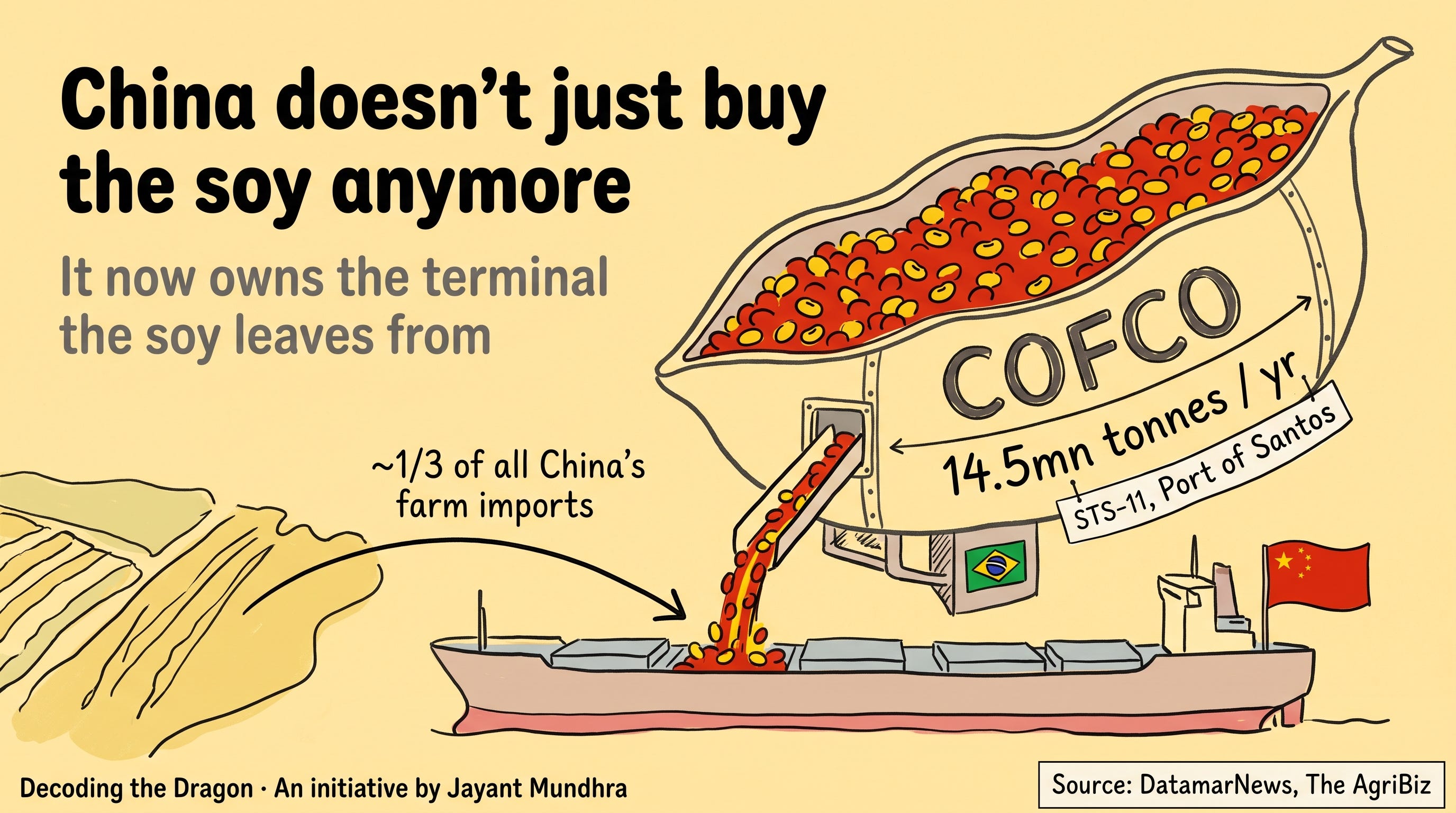
While the ports and railways grab headlines, the deeper play is food. Brazil now supplies roughly a third of all of China's agricultural imports, and Beijing has moved to own the whole chain, not just buy the crop.
China's COFCO is finishing a giant new terminal at the Port of Santos, its STS-11, designed to move 14.5mn tonnes of grain and sugar a year at full tilt in 2026, its largest export facility anywhere in the world.8
Through past deals in seeds and trading houses, Chinese state-linked firms sit across Brazilian corn and soy genetics, not just the commodity flow.
For the United States, this is a slow-motion decoupling from its own farmers. Every extra tonne of Brazilian soy locked into a Chinese-owned terminal is a tonne American growers do not sell. China is deliberately turning the US farmer from an indispensable supplier into a backup one.
Then there is power, and this is where the lock-in is deepest, because grids last for generations.
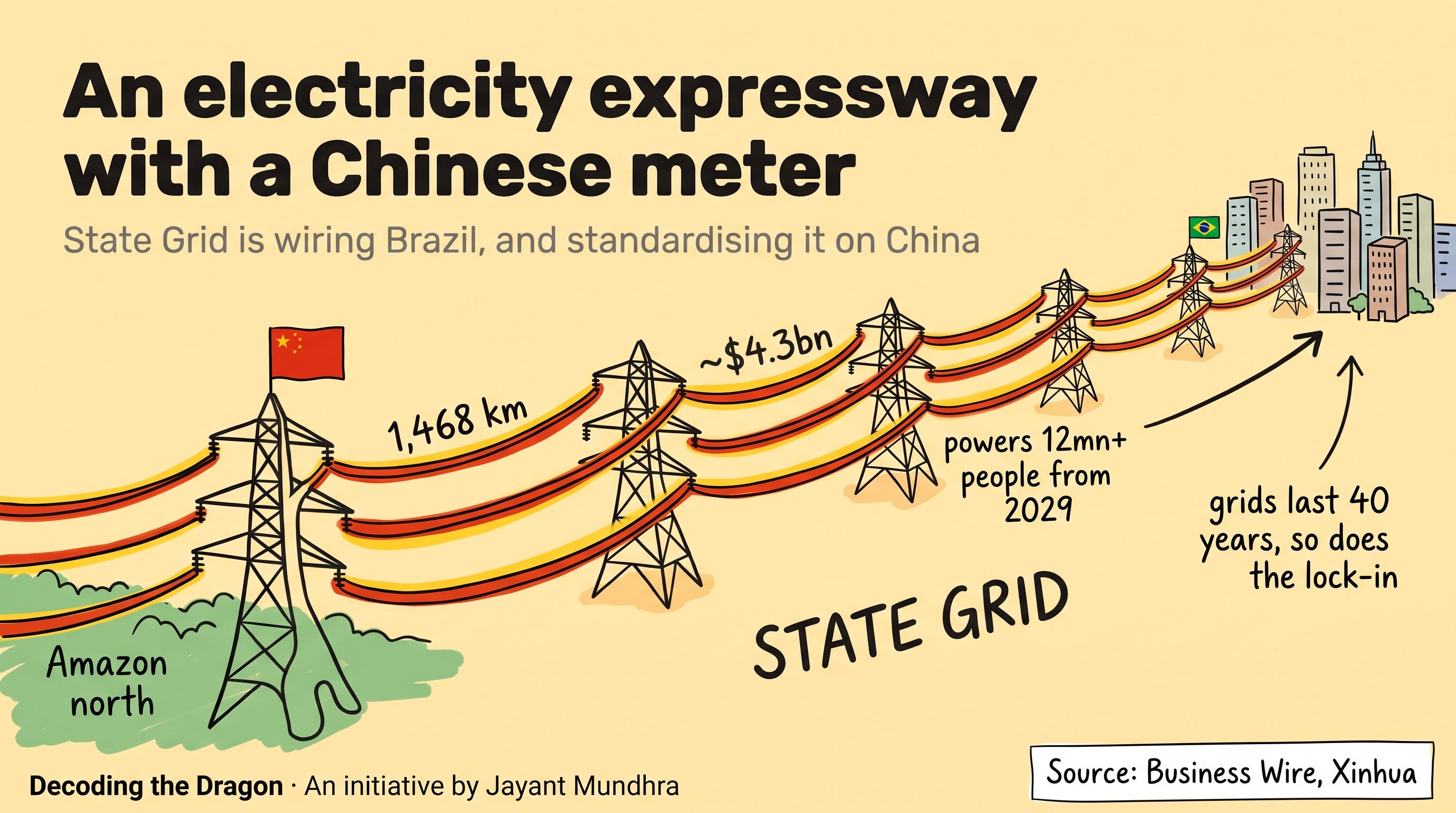
China's State Grid has become the dominant force in Brazil's electricity system. Its signature technology is ultra-high-voltage direct current, the only practical way to move huge volumes of power across Brazil's vast distances, from the hydro and wind of the north to the cities of the south.
Its Belo Monte lines already run at 800 kilovolts across more than 2,500km, an "electricity expressway" serving over 20mn Brazilians.
In mid-2025 it broke ground on its biggest yet, the Graça Aranha to Silvânia link: about 1,468km of UHVDC line, due to power more than 12mn people from 2029.9
The investment is around R$23bn, roughly $4.3bn, the largest transmission project in Brazil's history.9
Here is the clever bit. The financing runs through the BRICS-backed New Development Bank, in a mix that lets China fund Western Hemisphere infrastructure while sidestepping the US dollar.9 Standardise a country's grid on your engineering, your hardware, your maintenance, and you tie its largest economy to you for decades.
If food and power are about securing supply, lithium is about owning the future. China controls roughly 70% of the world's lithium refining and over three-quarters of global battery-cell output, so it needs the raw metal, and most of the world's best brine sits in the "lithium triangle" of Argentina, Bolivia and Chile.10
For years China simply hoovered it up. But 2026 is the year resource nationalism bit back.
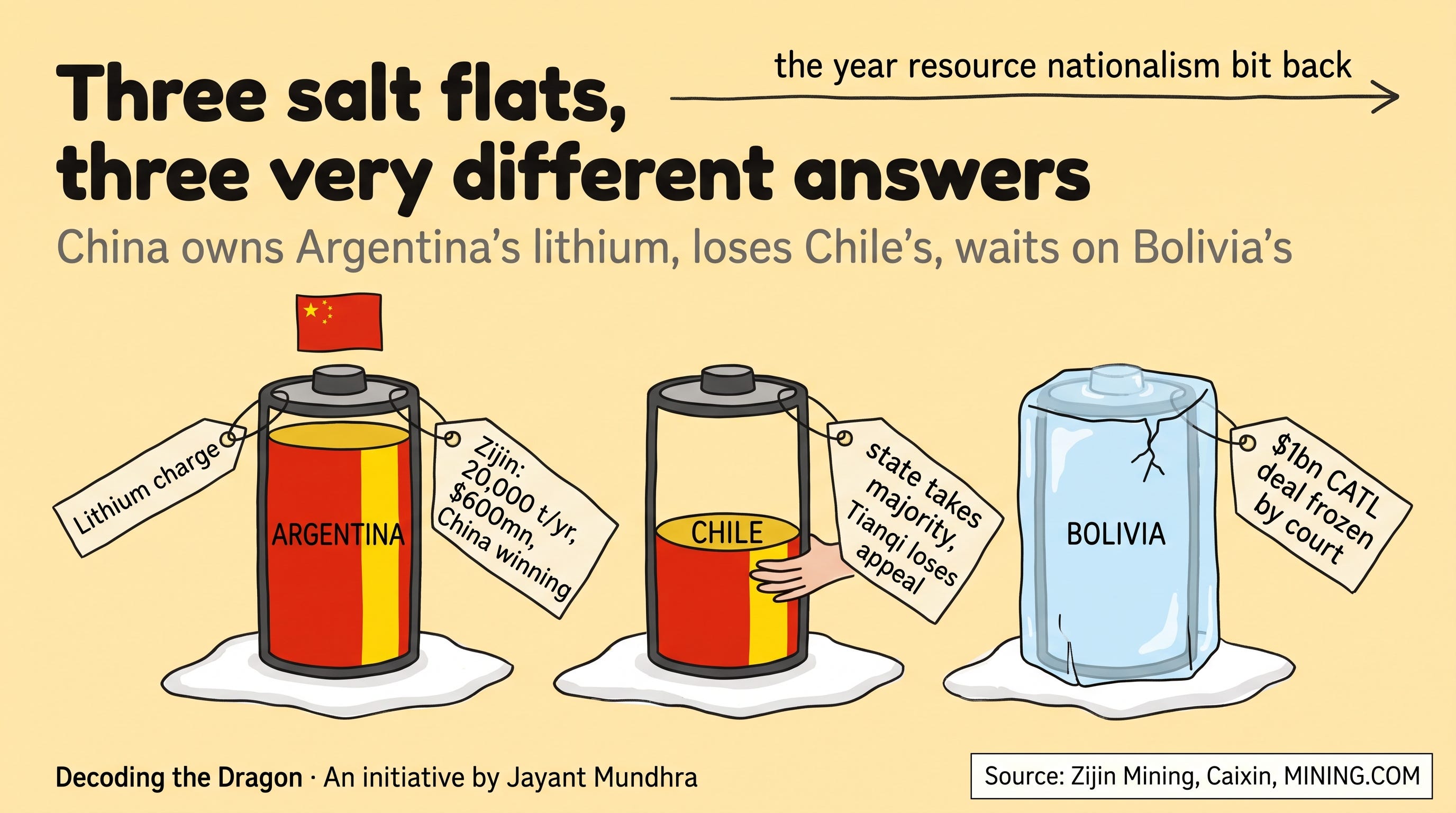
Argentina stays wide open, and China is winning there. Zijin Mining fired up its Tres Quebradas brine project in September 2025 at 20,000 tonnes of lithium carbonate a year, after sinking about $600mn into it.11
Chile went the other way. The state is taking majority control of its lithium through Codelco, and China's Tianqi, which paid $4.1bn for its SQM stake, lost its final appeal against the takeover at Chile's Supreme Court in January 2026.12
Bolivia, holder of the world's largest reserves, has stalled. A local court suspended its $1bn deal with a CATL-led Chinese consortium, freezing the plants that were meant to finally industrialise the Salar de Uyuni.13
So the picture is not a clean Chinese sweep. It is dominance in the free-market state, a bloody nose in the nationalist one, and paralysis in the biggest prize of all. That gap is precisely where a latecomer might squeeze in.
This is the thread I care about most, because India is exposed twice over. We import almost all our copper concentrate, and even when we secure raw minerals, we mostly have to send them to China to be refined.14 That is a double dependency on the one country we least want to depend on.
India's answer is a small, state-backed vehicle called KABIL, and in April 2026 it hit a genuine milestone.
KABIL won environmental clearance from Argentina to start deep exploration at its Cortaderas blocks in Catamarca, right inside the lithium triangle.14
The plan is 11 boreholes across about 15,700 hectares, to prove up the brine.14
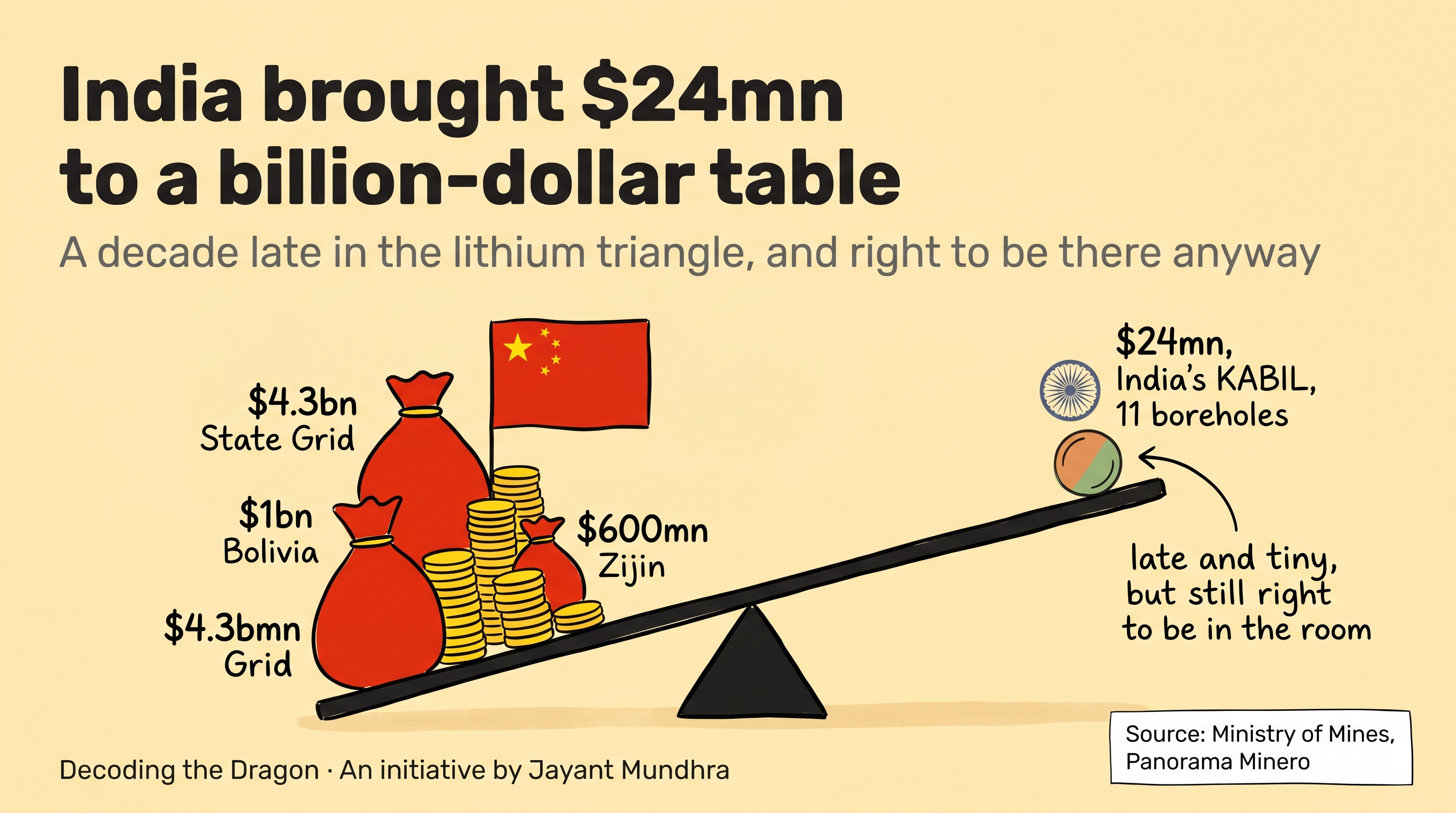
The committed spend so far is around ₹200 crore, about $24mn.14
Now hold that $24mn next to the numbers we just walked through. Zijin alone put $600mn into one Argentine project. China's Bolivia deal was $1bn. State Grid is spending $4.3bn on a single power line. India is showing up to a game where the table stakes are 20 to 200 times what it has put on the table.
That is not a reason to sneer at KABIL, it is the opposite. India is a decade late and orders of magnitude smaller, and it is still right to be in the room, because the alternative is total dependence. India's edge is not capital, it is timing and diplomacy: negotiating trade pacts with an explicit minerals mandate, and offering Bolivia and Argentina a partner that is not Beijing at exactly the moment they are wary of Beijing. This is the kind of India-versus-China gap I keep coming back to, and it is what the Decoding the Dragon community digs into most days if you want to follow the thread (t.ly/t7uhs).
Join the Decoding the Dragon community
The US has finally noticed, and its response has a name. In November 2025 the White House published a National Security Strategy built around a "Trump corollary" to the Monroe Doctrine.15 The core line is stark: the US "will deny non-Hemispheric competitors the ability to... own or control strategically vital assets" in the hemisphere.15
And unlike past doctrines, this one has teeth.
In January 2026 US forces launched Operation Absolute Resolve, capturing Venezuela's Nicolás Maduro and flying him to New York for trial.16
Washington leaned on Argentina's Javier Milei to suspend a Chinese radio telescope in San Juan, reportedly tying $20bn of economic support to cutting strategic ties with Beijing.17
It backed a BlackRock consortium's $22.8bn move to buy the Panama Canal-adjacent ports of Hong Kong's CK Hutchison, though that deal is now a mess, with China's COSCO demanding a controlling stake and Panama voiding the underlying concessions.18
Here is the structural flaw, and it is a big one. The US strategy is almost entirely stick and no carrot. It sanctions, it deploys warships, it warns about "debt traps". But it offers no capital at China's scale to replace what China is building. And when a Latin American leader is told to reject Chinese money, the obvious reply is: fine, what are you offering instead?
Step back and the shape is clear. China is not in Latin America for quick profit. It is buying long-life assets, ports, grids, railways, refineries and mines, that quietly reorient an entire continent toward Asia and away from the US.
The Chancay reversal shows the model is not unbreakable. Courts can push back, resource nationalism can bite, and the US can win the odd round. But winning rounds is not the same as offering an alternative. As long as Washington's plan is denial and Beijing's plan is construction, construction tends to win.
For India, the lesson is uncomfortable and useful. The countries that will define the battery century are being locked up now, at a scale we cannot match. Our only realistic path is to be the credible third option, fast, diplomatic and honest, in exactly the places where China has overreached and the US has nothing to build with.
Whether Peru's government and courts hold the line on Chancay oversight, or COSCO wins it back on further appeal.
Whether the Brazil-Peru railway feasibility study produces a fundable route, or quietly dies in the Amazon.
Whether Bolivia's suspended lithium deals are revived, re-tendered, or reopened to non-Chinese partners like India.
Whether KABIL's Cortaderas boreholes actually hit commercial-grade brine, turning India's $24mn from a gesture into a foothold.
China spent twenty years learning that in the Americas, whoever pours the concrete writes the rules, and the US is only now realising it forgot how to pour.
And well that is it for today's edition. That said, do check out my core WhatsApp community Biz News+ where I share 4-5 deepdives from the world of business, economics & public economics daily: https://t.ly/h2jq1
And, do check out my work on the following platforms as well: Instagram, LinkedIn and Youtube
Best,
Jayant
1. Ecns / China Daily, "China-Latin America trade volume hits record-high in 2024", link
2. CPPCC / Rio Times, "China, Colombia sign cooperation plan on BRI", link
3. Rio Times, "Chancay port, Cosco, Volcan and the megaport", link
4. bne IntelliNews, "Peru court ruling curbs state oversight of Chinese-backed Chancay port", link
5. gCaptain, "Court Upholds Peru Control of Chinese Port in Win for Washington", link
6. NPR, "In blunt warning, the U.S. says Peru could lose its sovereignty to China", link
7. MercoPress / Agência Brasil, "Brazil and China to assess railroad to Peru feasibility", link
8. DatamarNews, "Cofco Expands Export Capacity in Brazil with Terminal in Santos", link
9. Business Wire / Xinhua, "Construction of State Grid UHVDC transmission project in Brazil started", link
10. Energy Solutions Intelligence / IEA, "China's lithium refining monopoly", link
11. Zijin Mining, "Zijin Commences Production at 20,000-tonne Lithium Carbonate Project in Argentina", link
12. Caixin Global, "Tianqi Lithium Loses Final Appeal Against Chile's SQM State Takeover", link
13. MINING.COM, "Bolivian court pauses Chinese, Russian lithium deals", link
14. Insights on India / Panorama Minero, "KABIL receives environmental clearance in Argentina for Catamarca lithium", link
15. NPR / White House, "White House calls national security strategy Trump's version of the Monroe Doctrine", link
16. House of Commons Library, "The US capture of Nicolás Maduro", link
17. Science / AAAS, "Argentina's move to woo Trump has derailed South America's largest radio telescope", link
18. CNBC, "Panama cancels China-linked port deal, hands canal terminals to Maersk, MSC", link
Comments
Nothing yet. Say the first thing.
Sign in to join the conversation.