
I often get asked about what types of thread/elastic/trims I use for the zero waste garments I create. After speaking with multiple students and young designers this week I decided to collate all of that information into one spot. This is by no means all encompassing or right for everybody, these are my opinions on the most sustainable trims to use in your creations.
First things first - I aim to create all of my garments out of mono-materials. Meaning, For a 100% cotton garment I use 100% cotton/lyocell/cellulosic based thread that can be reclaimed and/or composted together. Any garments that use non-mono notions should be designed for them to be able to be removed - think buttons/elastic/etc. The below list is developed around these assumptions.
A note on certifications- Throughout this list you’ll see references to a few key certifications worth knowing. OEKO-TEX Standard 100 tests finished textile products for harmful substances
Class I is the most stringent, meaning the product is safe enough for direct contact with infant skin.
GOTS (Global Organic Textile Standard) certifies the entire supply chain of organic fiber products, covering both environmental and social criteria from field to finished product.
C2C (Cradle to Cradle) is a product design certification that evaluates materials for safety, recyclability, and circular economy principles, a Gold level C2C Material Health Certificate means the dyes and chemicals used meet the highest tier of the standard.
OCS (Organic Content Standard) verifies and tracks the presence of organically grown material in a final product but, unlike GOTS, does not cover processing or social criteria.
None of these certifications are perfect or cover everything, but they are the most rigorous third-party verification currently available in the notions space and worth prioritizing when you have a choice.
(Note - I am not getting commissioned to share this information and do not profit from any purchases made of these items)
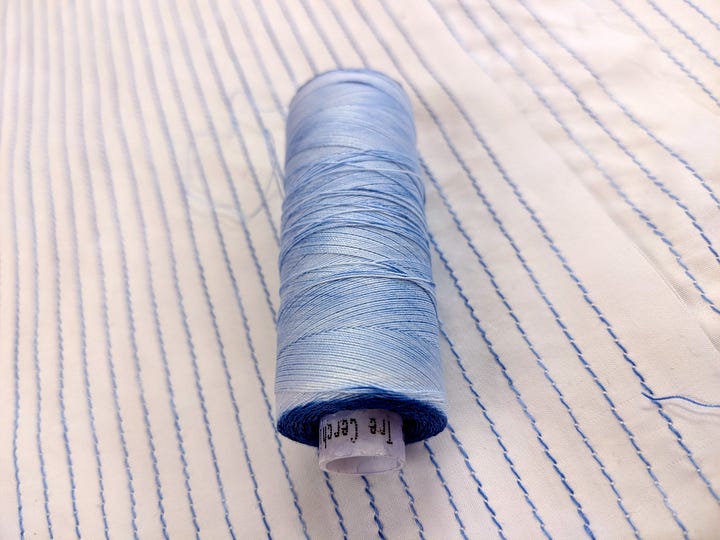
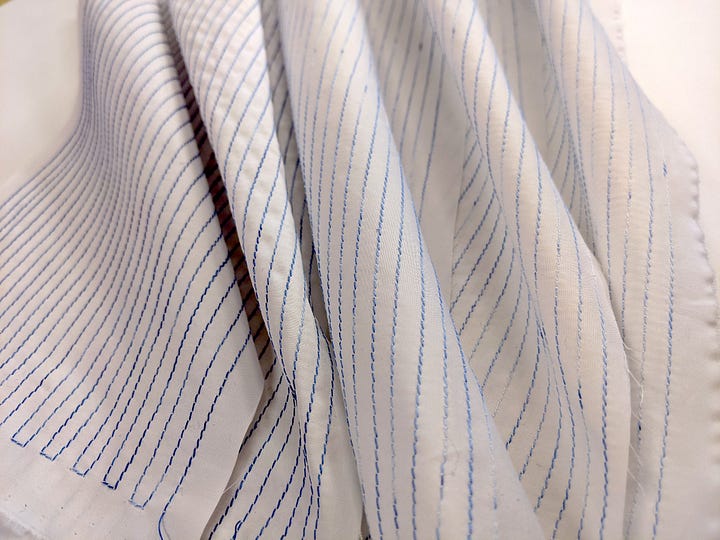
I get a lot of questions around my selection of threads.A frequent comment is on the durability/longevity of cotton not being strong enough to hold a garment together as compared to a polyester or cotton wrapped poly. The below are the threads I use and favor. Just to note - Coats and A&E require a bit of digging through resellers to find what you’re looking for. I recommend reaching out to the team to order samples.
Coats:
- Tre Cerchi (My personal favorite) - 100% mercerised long-staple cotton with a lustrous appearance. The mercerisation process increases the tensile strength of the cotton fibers and dyes consistently.
Tex 21- 120
OEKO-TEX Class I certification
https://coats.com/en-us/products/threads/tre-cerchi/tre-cerchi/
Pro: High quality, widely available, excellent performance on industrial and home machines.
Product link: https://itsastitchup.co.uk/shop/500m-spool-coats-tre-cerchi-40-100-cotton-sewing-thread-black/
- Tre Cerchi Vie - Similar to above but made from 100% sustainable cotton and environmentally compliant dyes and chemicals.
Tex 30- 270
https://www.coats.com/fr/products/threads/tre-cerchi/coats-tre-cerchi-vie/
- EcoRegen (Lyocell thread) - Coats’ 100% lyocell threads made from sustainably sourced wood pulp- a great alternative for lyocell/Tencel garments or when you want a cellulosic thread with a slightly different hand.
Tex 30-105
The cellulose fibre is carbon neutral and is made from 100% controlled wood with a closed-loop manufacturing process.
https://coats.com/en/products/threads/ecoregen/ecoregen/
Pro: Lyocell is closed-loop produced, biodegradable, and compostable with cellulosic fabrics. Great for next to skin use.
- Cotton Dymax - Coats’ high-tenacity cotton thread for industrial applications.
Tex 30-105
OEKO-TEX Class I certification
https://coats.com/en/products/threads/dymax/dymax/
Pro: Strong performance for high-stress seams; still natural fiber.
Con: Overkill for many garment applications; more relevant for bags, outerwear, and heavy-duty construction.
A&E (American & Efird)
- A&E Chroma SPC - 100% Cotton mercerized thread designed for abrasion resistance
Tex 40-180
C2C (Cradle to Cradle) certified dyes and chemical compliance
https://www.amefird.com/blog/2023/09/chroma-spc/
Pre: Engineered for abrasion resistance
- A&E Anecot Plus - 100% long staple spun cotton thread with increased strength resistance, ideal for overdying
Tex 21-400
C2C (Cradle to Cradle) certified dyes and chemical compliance
https://www.amefird.com/blog/2023/09/anecot-plus-spc/
Pro: Engineered for abrasion resistance & excellent for overdying
Güterman
- Güterman 100% Cotton - 100% Mercerized Egyptian Cotton
Tex 20-45
https://consumer.guetermann.com/en/products/natural-cotton-c-ne-50/
Pros: Available nearly everywhere, easy to find in sewing shops
Cons - smaller spools & more home sewing focused
Product link: https://www.wawak.com/thread/thread-by-brand/gutermann/
Organic cotton/rubber elastic:
Pro: True mono-material for cellulosic garments: organic cotton + natural rubber, both biodegradable. Natural rubber is FSC-certifiable and non-petroleum-based.
Con: Natural rubber does have latex content - flag for anyone with latex sensitivity. It also has a narrower width range than synthetic elastic and can be more challenging to find.
Product links: https://merchantandmills.com/us/organic-cotton-elastic
https://sustainbykat.com/products/organic-cotton-natural-rubber-elastic
Alternative - knitted/woven cotton drawstring: A cotton twill tape or tubular knit drawstring threaded through a casing can replace elastic entirely and is easier to recycle/compost/remove.
A note on synthetic elastic: Most commercial elastic is polyester + rubber. Even “recycled” elastic is still synthetic. If your goal is compostability, it needs to come out of the garment. If you’re designing for longevity rather than composting, recycled elastic is the lesser evil, but it remains a mixed material. If you must, be sure to make the elastic easily removable/replaceable (Don’t top stitch through elastic, focus on using channels)
-Corozo (tagua nut / “vegetable ivory”) - The gold standard for natural, biodegradable buttons. Corozo is harvested from tagua palm nuts that fall naturally to the forest floor, and harvesting them supports rainforest conservation since it gives local communities an economic incentive to protect the trees rather than clear-cut them
Pro: 100% biodegradable, OEKO-TEX certifiable, excellent durability and scratch resistance. Accepts dye well, unique natural grain on each button. Truly circular: it decomposes without microplastic residue.
Con: Not ideal for garments requiring frequent industrial washing above 60°C - extended exposure to high heat can cause cracking
Product link:
https://corozobuttons.com/
-Coconut shell buttons - Agricultural byproduct, biodegradable, good durability.
Pro: Lower cost than corozo, truly zero-waste sourcing.
Con: Less consistent surface quality and harder to dye to precise color.
Product link: https://organiccottonplus.com/collections/notions-buttons/products/decorative-coco-shell-buttons
-Mother of pearl (MOP) - An iconic menswear staple, used in fine shirting and tailoring for centuries. Sourced from oyster shells, ideally as a byproduct of responsible pearl aquaculture where it would have been labelled as waste. Overfishing, wild harvesting and depleted mollusk populations make this a controversial addition to this list, but I stand by my vintage MOP buttons!
Pro: Amazing aesthetically with longevity in mind and will biodegrade over time.
Con: Supply chain transparency is patchy. Without verified provenance, wild fishery pressure to over fish is a real risk.
Product link: https://organiccottonplus.com/collections/notions-buttons
- Self-fabric interfacing (zero-waste preferred method) - Pre-washed, then ironed lightweight fabric works great as reinforcement for plackets, collars, and cuffs as a non-fusible sew-in interfacing. Hand baste, then catch in seam allowances.
Pro: Use your own cut scraps, truly zero additional materials.
Con: Less precise than commercial fusible + takes more skill to apply without shifting.
- Silk organza/gazar - Lightweight silk organza makes excellent interfacing and underlining for fabrics that need added body, since it is crisp without being bulky. Its crispness is due to the natural sericin gum left on fibers during processing and gives support while resisting wrinkles.
Pro: 100% natural protein fiber, no adhesives, no synthetics. Breathable. Compostable with silk or wool garments.
Con: Cost. Silk gazar especially is not cheap and can be hard to source outside of specialty fabric districts (Mood in NYC carries it periodically). Sew-in only, so more labor-intensive than fusible. Stiffness reduces with washing on organza; gazar holds better.
Product link: https://www.moodfabrics.com/collections/silk-organza-fashion-fabrics
- Pellon SF101 Shape-Flex - 100% woven cotton fusible interfacing, made in the USA. No manufactured fibers. Available in white and black.
Pro: Best widely-available 100% cotton fusible option. Behaves like a proper fusible, it won’t shift. Compatible with cotton’s wash/care requirements. Con: The fusible adhesive is still a separate chemistry - if strict compostability is your goal, treat it as “better, not perfect.
Product link: https://www.wawak.com/bag-making/bag-interfacing/pellon-sf101-shape-flex-fusible-woven-cotton-interfacing/
Zippers are one of the hardest trims to solve for mono-material logic because teeth are typically metal or molded plastic and tape is typically synthetic. Best current options by ascending preference:
- YKK organic cotton tape zippers - YKK offers zippers with organic cotton fibers for the woven tape, which provides a fiber match for your cellulosic garments. Teeth are still metal (brass or aluminum), which is recyclable but not compostable.
Pro: Best widely-available option. The tape is the largest material volume in a zipper; organic cotton tape is a big improvement. Metal teeth are recyclable.
Con: Still a mixed material at end of life; cannot compost with the garment. https://ykkamericas.com/what-is-a-sustainable-zipper/
Product links: https://sewingsupplydepot.com/products/ykk-4-5-metal-zippers-cotton-tape-by-the-yard https://zipperandthread.com/collections/dyeable-organic-cotton-tape
- Removing the zipper before composting - If you’re designing for true end-of-life composting, design the zipper to be removable and communicate this to the wearer.
- Design away from zippers entirely Perhaps the most zero waste answer! Tie closures, button loops, drawstring casings, or stretch openings eliminate the zipper problem at the design stage.
That’s it for now! Let me know what other notions or pieces of garments you have questions on sustainable options or sourcing.
<3 Danielle
No posts
Comments
Nothing yet. Say the first thing.
Sign in to join the conversation.