
Hello, friends-
Last week, I wrote about the intense criticism of Nicole Kidman’s face and the larger conversation unfolding around facelifts, Botox, fillers, and the complexities of what we feel we “should” do, or not do, with our changing faces and bodies.
The responses here and on Instagram revealed just how quickly we are pulled toward the binary. We want to decide whether we are for or against these choices. We want to know whether a woman is aging “naturally,” resisting ageism, or participating in it.
In that essay, I returned to one of the principles at the center of my work:
Soft on people. Hard on systems.
But I’m not sure what I mean by the word "systems" is well understood. So let’s get into it.
Because if we don’t understand the systems, we will keep focusing on individuals. We will scrutinize faces, bodies, and choices. We will continue to judge women for trying too hard, not trying hard enough, “letting themselves go,” or failing to age in whatever way we have decided is the right way.
And of course, we will likely turn that same harsh scrutiny against ourselves.
So, this week, I want to take you one layer deeper to the body hierarchy and the systemic oppression underneath so much of the shame we experience as we grow older.
I write extensively about the body hierarchy in my book Unapologetic Aging because I believe understanding it is essential to mending our relationship with our bodies. When we cannot see the system, we are much more likely to feel body shame and try to fix our bodies
It’s normal and natural for our bodies to change as we grow older. And that’s okay.
But the world’s response to our changing bodies doesn’t feel so normal and natural. It is learned, culturally constructed, and shaped by systems that assign greater value to some bodies than to others.
Those are not the same thing.
Since our bodies change and the world’s response to them changing happens at the same time, they can be very difficult to separate. We may feel shame about our changing bodies without clearly seeing how the culture has shamed us for changing. Understandably, we internalize that shame and turn it against ourselves.
We notice that our faces look different, our bodies are softer, our hair is grayer or thinner, or we move differently than we once did. At the same time, we may notice that we are looked at less, listened to less, represented less, or treated as though we are less relevant.
We may automatically conclude that our changing body is the problem, and body fixing is the answer.
We turn our attention toward our wrinkles. Our weight. Our shape. Our mobility. Our changing capacity. Our age.
Body shame so easily becomes body fixing when we have been taught that changing our bodies is the way to restore our value.
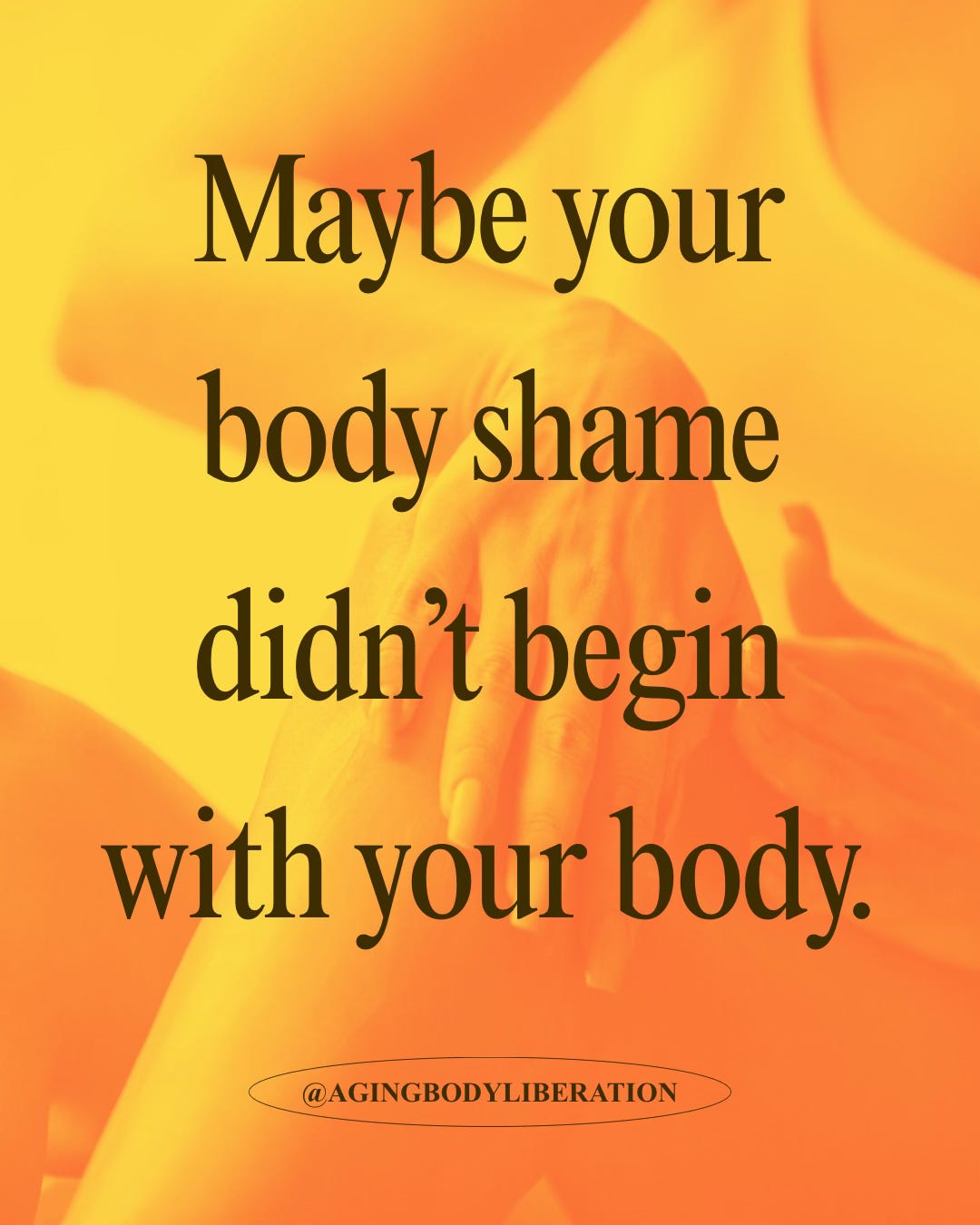
What feels like a problem with your body is actually the pain, struggle, and confusion of living within a culture that has changed the value it assigns to your body. What mind-fuckery!
A social wound can feel remarkably like a problem with your body.
Understanding the body hierarchy helps us recognize the difference.
This month marks one year since I began writing here on Substack and creating this community with you. To celebrate, I’m offering 20% off an annual paid subscription through August 31.
If my writing has helped you feel less alone in your changing body or given you a more compassionate way to think about aging, food, beauty, and belonging, this is a great time to become a paid subscriber. Your support makes it possible for me to continue creating this space away from the noise of anti-aging, wellness and longevity fads, and diet culture.
Before I get into this, I want to acknowledge Sonya Renee Taylor’s work and her book, The Body Is Not An Apology. Their writing and work have been among my greatest teachers on this topic and so much more. I highly recommend the book; it's literally always on my desk or by my bed.
Simply put, the body hierarchy is the system through which our culture assigns greater value to certain bodies than to others.
It teaches us which bodies we see as beautiful, healthy, disciplined, desirable, respectable, credible, capable, and worthy of love, power, belonging, and care. It also influences which bodies are accommodated, seen and heard, protected, believed, valued and invited.
In our culture, bodies tend to be valued more when they are young, thin, fit, neurotypical, white, able-bodied, conventionally attractive, gender conforming, and visibly monied. The closer you are to these ideals, the more likely you are to hold social currency and access, although you are not permanently safe within a hierarchy built on a conditional sense of social value.
This hierarchy is reinforced consistently and constantly: in advertising and entertainment, in medicine and wellness culture, in workplace policies, in beauty and fashion, and in our conversations and thoughts about our own and other people’s bodies.
Likely, you absorbed these rules long before you had language for them. Maybe you’re just now becoming aware of your entanglement with body hierarchy.
You learned stories about which bodies should be admired and which need fixing. Which bodies look like success and which were treated as evidence of failure.
You learned that maintaining your position within this hierarchy was part of your life’s work.
I always say, if you don’t recognize how you’ve internalized body hierarchy, have you ever said or thought, “Am I bigger than her? Do I look as old as she does?” We all do it. When we enter a room of strangers, start a new job, or join a new group, we may instinctively size up the people around us to determine where we stand in our internalized body hierarchy.
You’ve probably noticed more changes and complications in your social standing as you've grown older.
For women in particular, and for those socialized as female, the approval we receive for our appearance comes with a baffling number of conditions. You are rewarded for being attractive, but not too attractive, and certainly not too confident about it. Sexual, but lord knows you can’t be too sexy. Thin, but only within some Goldilocks version of “just right.” Youthful, but somehow with no visible effort whatsoever.
Nothing exposes just how conditional social approval has always been more than getting older along with a change in body size, but let’s take these one at a time.
Gray hair, wrinkles, softening that accompanies body composition, disability, chronic illness, menopause, and any visible signs of growing older move us toward the margins, and away from the cultural ideal. Qualities associated with youth, like smoothness, firmness, agility, fertility, and productivity, are treated as virtues and accomplishments, while the changes of growing older are framed as decline.
This is why growing older feels like more than adapting to your changing body. It also feels like losing social currency, relevance, and the ability to be seen and heard. Because the body hierarchy makes it so.
You likely know what it’s like to feel less visible, dismissed in a medical appointment, underestimated professionally, or underrepresented in stories and images in media and entertainment. It shows up as straight-up ageism or the assumption that older people are less interesting, less sexual, less flexible, less capable of growth or trying new things, or somehow less vital and alive.
These experiences are real. But they do not prove that your body is less worthy or a problem to fix. They reveal the harmful and distorted values of the culture looking at your body.
You do not become less valuable as you grow older. You move through a distorted culture that assigns greater value to some bodies than to others.
That distinction matters. That distinction helps you become more critical of your culture and how you experience it rather than being critical of your body.
There is no single experience of growing older in a body.
Ageism does not operate separately from racism, anti-fatness, ableism, classism, sexism, homophobia, or transphobia. These systems overlap and compound one another, shaping who is allowed to grow older visibly, who receives respectful healthcare, whose pain is believed, who has access to care and support, and whose older bodies are portrayed as elegant rather than shameful.
Some of us, especially those of us who are white, straight-sized, cisgender, financially resourced, or able-bodied, may have spent much of our lives closer to the culture’s preferred body. Growing older may be the first time you’ve become acutely aware of losing some of the privilege or approval attached to that proximity.
People in larger or fat bodies, disabled bodies, Black and brown bodies, LGBTQIA+ bodies, and neurodivergent bodies likely have navigated body-based marginalization throughout their lives. For them, ageism is not an entirely new experience but another layer added to navigating our culture’s body hierarchy. For these folx, ageism is not an entirely new experience but another layer added to navigating our culture’s body hierarchy.
In naming this difference, I am not trying to create a competition over who has suffered most. I simply refuse to flatten our experiences into a universal story centering those who once benefited most from the hierarchy. As a white, straight-sized woman who benefits from unearned privilege, I believe it is important to acknowledge this.
This awareness also gives us an opportunity to recognize not only how the body hierarchy harms us, but how we may have learned to reinforce it or participate in it.
This is why understanding the systemic roots of our body hierarchy matters so much.
When we cannot see the body hierarchy, we are left to experience and navigate our struggles with how we see our bodies, or body image, individually.
I write extensively about the body hierarchy in Unapologetic Aging because I believe understanding it is essential to mending our relationship with our bodies. We cannot fully heal a wound we keep mistaking for a personal failure. When we recognize the systems shaping how we see and experience our bodies, we can begin to separate our inherent worth from the value the culture has assigned to our bodies.
You interpret the loss of social collateral or relevance as evidence that your body is a problem. You interpret inaccessible spaces as evidence that your body needs to be fixed so you fit in. You interpret medical bias as evidence that you have failed to take care of yourself. You interpret a culture’s discomfort with your changing body as evidence that you are not aging well.
And then you turn toward the body as the obvious project of evaluation and correction, thinking you need to “get with the program.” You start to have thoughts like-
Maybe it’s time to lose weight.
Perhaps I need to work on looking younger.
Maybe I need to work harder on building muscle mass and staying fit.
Perhaps I need to show how chic I am and prove I haven’t let myself go like those other ‘old people.’
This is how a social wound becomes a body project.
The beauty, diet, fitness, wellness, anti-aging, and longevity industries are ready to meet you there. They offer seemingly infinite products, plans, procedures, supplements, and protocols promising not only to change how you look or feel, but also to restore the safety and belonging you fear you’re losing.
And of course, your desire for relevance, belonging, and safety makes sense.
We are relational creatures. We need to feel we belong in order to feel safe. We want to be seen, valued, desired, included, and relevant. There is nothing vain or shallow about feeling the threat of losing what is essential to our wellbeing.
But no individual body can be optimized enough to dismantle the system that created the oppressive ideals. In the wise and brilliant words of Audre Lorde:
"The master’s tools will never dismantle the master’s house.”
Seeing the world through the lens of the body hierarchy does not mean you will magically become immune to it.
And coming to this understanding does not require you to love your changing body. It does not mean you will stop coloring your hair, buying skin care, wanting to be attractive, or grieving a capacity you’ve lost.
Clearly seeing the body hierarchy does not give us permission to judge other women for the choices they make while trying to live within the same system. Applying yet another set of oppressive standards to ourselves and others does not move any of us toward liberation.
The point is to create more space and freedom, more autonomy around our body choices.
When we begin to understand the systemic and oppressive forces pressing in on us, we can meet ourselves with compassion instead of body shame. We can become curious about what we are experiencing and longing for in this chapter of our lives. We can check in and consider whether a choice feels like care, pleasure, expression, relief, fear, conformity, or likely some mish-mash of all of the above.
You can hold the paradox that your choices are shaped by both your unique preferences and your cultural conditioning.
This is what I mean when I say we can be soft on people and hard on systems.
We can have radical compassion for ourselves and one another while becoming more discerning about the hierarchy we have been taught to uphold.
Learning to see the body hierarchy does not make it vanish. But it does loosen its grip on your life and your relationship with your body.
When I recognize that my fear of losing relevance in this culture did not originate in my body, I no longer feel pulled to make my body fit in.
I can seek relationships in which I am deeply seen just as I am. I can support the work of women in diverse bodies. I can question whose bodies are missing from the images and stories I consume. I can notice and discern if I want to speak up about ageist, anti-fat, and ableist language, even when it appears as a joke or a compliment. I can invite and make space for bodies being pushed to the margins. I can challenge the assumption that health, beauty, and worth have a look.
And I can notice when I am using the body hierarchy against myself.
I can consider my favorite liberating question:
Who says? Who taught me that my body’s value expires at a certain age, size, or level of ability?
Your changing body is not evidence that you are failing at aging. Your heartache and struggle may be telling you something important, but not necessarily about your body.
They may be telling you about a world that does not know how to honor bodies across the fullness of a human life, and that benefits from keeping you entangled in striving for the body ideal.
Your challenge is to stop mistaking the body hierarchy for the truth and to help create a world in which no body has to earn its dignity or value.
If this essay gives you language for something you’ve experienced, I hope you’ll tap the heart or share it with someone who might need it. These moves help this work reach more people who are ready for a different conversation about our changing bodies.
The next time you feel distress about your changing body, pause and give yourself a moment before you get pulled into asking what you need to fix.
If it feels supportive, place a hand somewhere on your body and take a few unhurried breaths or check in with your senses if that feels more comfortable. Then gently ask:
What happened just before I began to feel this way?
Am I responding to a sensation or change in my body, to the way my body is being treated, or to a message about what this change supposedly means?
What was I taught to believe about bodies, especially bodies like mine?
What belonging, safety, visibility, or care am I truly longing for? Or am I longing for something else?
What would it be like to direct my attention toward the shame or social wound I’m experiencing instead of making my body “the problem?”
You do not need to arrive at some perfect answer. The intention is simply to create a little breathing room between your body and the meanings this culture has attached to it.
Sometimes that space is where your heart can soften, your mind can quiet, and compassion begins.
Here’s last week’s essay that stirred up this conversation about being soft on people and hard on systems:
And a very popular piece breaking down the pressure to stay thin from every direction:
Once you recognize that what you’ve believed as a personal body problem, or a body story you carry, may actually be a social wound, it may bring up feelings like grief, anger, relief, or some complicated combination of all three. Or this may not be the best time to consider this question. If that’s your instinct, maybe save this for later. So please take good care of yourself as you ask yourself this question.
When did you realize that something you believe to be a personal body problem was rooted in a social wound or body-shaming experience?
Share what feels comfortable to you. Whether you comment or simply hold the question for yourself to consider over time, I’m grateful we can bring these tender and complicated truths to the surface.
If this essay gave you language for something you’ve experienced, please consider tapping the heart or sharing it with someone who might need it. And if you’d like to help sustain this work, my first-anniversary offer of 20% off an annual paid subscription is available until August 31.
Thanks for reading Unapologetic Aging! This post is public so feel free to share it.
I wrote Unapologetic Aging: How to Mend and Nourish Your Relationship with Your Body with you in mind.
Part guide, part workbook, and part storytelling, the book is designed to help you recognize and navigate the pressures of anti-aging and diet culture targeting women in midlife and beyond—and cultivate a more compassionate, trusting relationship with your changing body.
You can order your book at Bookshop, Barnes and Noble, and Amazon
As always, I’m so glad you’re here.
Much love,
Deb
Comments
Nothing yet. Say the first thing.
Sign in to join the conversation.