
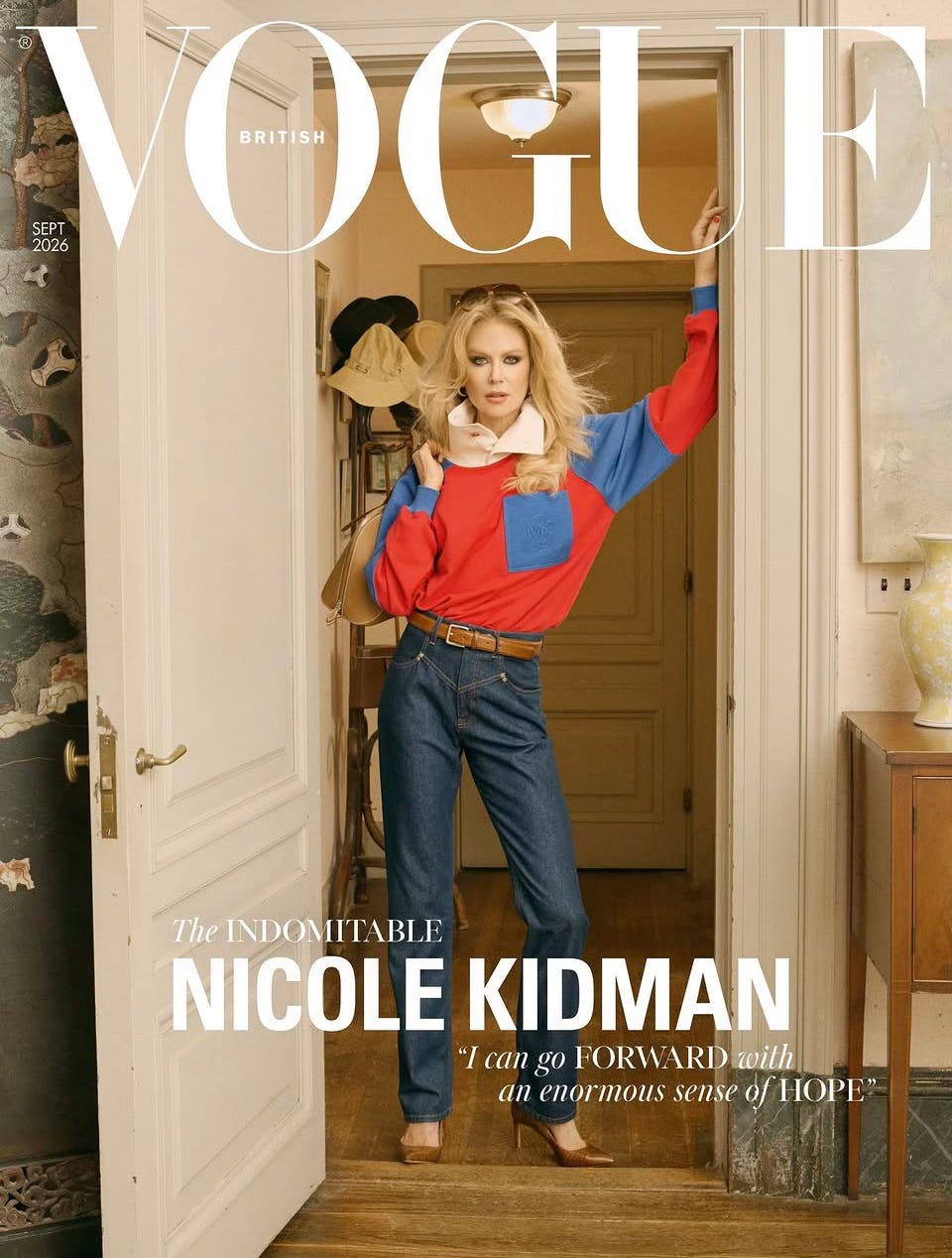
I imagine you’ve seen Nicole Kidman on the cover of British Vogue by now. The cover highlights her story as a woman celebrating her next chapter at age59.
I found her quotes to be rather thrilling. She talks about a relatable experience: a life she didn’t see coming after divorce. She talks about the vulnerability and uncertainty those of us who have been through divorce know well. About the fullness of her life with her children and her career and being open to love in this chapter of her life. And I must say, my favorite part is her talking about dancing in Ibiza in a wig, disappearing into a crowd. Lord knows, we all need more dancing.
It’s a lovely story about a big life transition and beginning again at 59. I’m not one to really care that much about celebrity culture, but there is so much here that interests me. This is another cultural moment and conversation about women in midlife and beyond. So I'm tuned in.
And so terribly predictably, it took a nanosecond for the conversation to become about her face:
What happened to her face?
Is that really her? Why are they making her look 30?
Is it Botox? Fillers? Surgery? Photoshop? AI?
One headline asks why this “midlife role model” can’t simply look her age. Another describes the cover as evidence of our obsession with hyper-perfection. The internet is full of people scrutinizing her features and speculating about what procedures she may or may not have had.
I’m taking in the spectacle, the media circus, andtrying not to lose my entire day reading about this. I wrote a response to a post on Instagram post-
Is there anything more complicated than being an aging woman in this culture?
The whole thing is just so bananas. What exactly are women in midlife and beyond to do?
Grow older, but not look like it? Don’t allow yourself to change?
Hold onto your beauty or “your looks” while not appearing to work so hard or have work done?
Don’t create the suspicion that you’ve used all the tricks and hacks and procedures because we’ll study and dissect your face like we’re looking for the cure of some fatal illness.
“Age gracefully,” a phrase that sends me, but don’t forget you must maintain smooth skin, a clearly defined jawline, lustrous long hair, perfect white teeth, always bright eyes, and just enough visible aging to reassure us that you haven’t become desperate and done something drastic.
What an absolutely impossible assignment we’ve been given.
And I don’t want to participate; I really don’t.
I’m not interested in learning what Nicole Kidman, or anyone else, has or hasn’t done to their faces. I don’t care. My usual hunch is that what we’re seeing is a mix of professional lighting, makeup, styling, photography, editing, cosmetic procedures, and genetics. Most likely a combination of all of the above.
And by the way, I don’t think she owes us an explanation. It’s up to her. Her choice and her choice alone. Fly, be free, Nicole.
What I’m much more interested in is what the noisy, big reaction to this cover tells us about us: how deeply invested we are in what women choose to do with the visible evidence of growing older, maybe especially for the beauty icons.
Even when we’re talking about something else. Weren’t we talking about something else? Wasn’t the article about something that’s actually far more interesting and valuable for us to talk about:
Her actual experience. Her hopes and dreams. How she is choosing to live her next chapter, which is actually a worthwhile conversation we can all relate to.
With all the excitement and noise about Nicole Kidman’s face, I’ve heard zippo about her body. So I’m wondering-
Are we whispering about her body in the shadows now?
In the era of extreme thinness in Hollywood and the weight loss accompanying GLP-1 use becoming a common, daily observation (or experience) now, alongside the debate about if it's cool to talk about extremely thin bodies, are we afraid to talk about Nicole Kidman’s body now?
She inhabits a very particular kind of body, the kind that appears to remain unchanged at 59 years of age. A body that represents the beauty ideal our culture rewards in women of all ages. And somehow, that is not mentioned.
What’s that about?
I’m not sure at all, and don’t know if there is any benefit to pondering this, but I don’t think I can help myself at this point. Are we simply more comfortable talking about the pressure we feel to erase evidence of growing older on our faces than with the pressure we feel to prevent our bodies from changing? Are our bodies far more vulnerable and tender for this discussion? Have we learned our lesson after making other celebrity bodies topics of conversation?
The think pieces about Nicole Kidman’s appearance are focusing on her potential, if not likely, use of Botox, fillers, and surgical procedures.
And I’m leaving Nicole Kidman’s body out of it.
But I can’t help but notice that we seem to find it easy to talk about other aspects of growing older, like choosing to let your hair gray.
We talk about the celebrities who seem comfortable allowing their faces to “age naturally”, a phrase I have complicated feelings about too.
But what about the body changes that are normal for midlife and older? What about our bellies changing? The changes we experience in our breasts? The redistribution of our body fat? The softening of our bodies as we lose muscle? The way our skin on our bodies gets much more interesting with spider veins, dimples, spots, and yes, the skin on our body has wrinkles too?
The way our bodies become rounder, smaller in some ways, larger in other ways, simply shifting and changing, being less predictable over time?
What about the enormous cultural pressure on women in midlife and beyond not simply to be healthy and strong, but to make sure our bodies don’t look like they’re aging either?
We’re not calling that anti-aging; we’re calling it wellness, longevity, healthy aging, protecting your metabolism, getting in shape, and optimizing. Sure, sometimes these things are about our wellbeing and caring for our bodies.
But come on, mostly it's the same old fear of the female body changing and growing older.
Don’t get it twisted, I am not interested in equally scrutinizing Nicole Kidman’s face AND her body. Nope, not at all.
I genuinely do not care about her cosmetic procedures, definitely do not care what she eats or about her workout routine, or anything she does to control and maintain her appearance.
I want something entirely different.
I want us to stop caring so much about what women are doing to “work on” their appearance. Make it stop!
That includes women who put effort into conforming to conventional beauty standards and women who don’t seem to give a shit and everything in between, because most of us are somewhere in the middle.
I do want to say that I find the way beauty standards and procedures are creating homogeneous faces and bodies terribly boring. My eyes, mind, and heart are much more interested in unique women and diverse bodies.
At the same time, I don’t want to add another moral measure for women to feel they “should” compare themselves to. The moment we turn “aging naturally” into another way to be “good”, we haven’t escaped the system at all, have we?.
We’ve simply created another way to get aging right.
Interestingly, Molly Jong-Fast has recently been talking publicly about her facelift. I absolutely love that she is asking for more honesty and transparency about having work done. And I especially appreciate that she is also clearly saying this alongside a request for more compassion for all of us trying to navigate these impossible expectations. Maybe we could talk about our aging with more honesty if people didn’t feel they needed to brace for the wrath of so much judgment.
My favorite part of what she is saying is what she calls the big question: Does having a facelift make you a bad feminist?
I don’t have an answer. I’m not sure we need one. And I certainly don't want another litmus test for whether we’re growing older the “right way” or being a good feminist or a good anything.
I am interested in more compassion and understanding, and I wonder if those might make more honesty and transparency possible. My commitment is finding our way toward untangling ourselves from what we’ve been socialized to believe about our appearance and our bodies, especially in midlife and beyond
I keep wondering if radical transparency might come with even more radical compassion. So much compassion. We aren’t making our choices about our appearance as we age in a vacuum, right? We’ve been conditioned to believe that allowing ourselves to appear older means losing things. So it becomes challenging to know you'll likely lose your social collateral, relevance, desirability, and even value if you don’t work to look younger.
Maybe an even more transformative question is-
How do we make choices about our changing bodies and faces while staying awake to the culture shaping those choices—without turning on one another for the choices we make?
Because beneath all the talk about Nicole Kidman’s appearance, this woman is saying something far more interesting for us to talk about. And I can relate to my own version of her story, and I’ll bet you can too.
Our lives take a turn, and don't go the way we planned. We didn’t expect to find ourselves here. The transition creates a vulnerability, an uncertainty to navigate while we continue to care for our loved ones, show up for our careers, and ponder what new love might look like.
I remember that time and place in my own life. I remember feeling unmoored, excited, and many times afraid. The not knowingness. The desire to try new things, take risks, and keep going. Remaining open and curious and DANCING.
That sounds a lot like what I love about growing older.
It's not about controlling and freezing our faces so we keep looking like we’re still in our 30s. Or containing our bodies at 59.
Can we please talk about what it would look like to arrive at an age you once imagined would look so different and find yourself crossing a threshold you never imagined? That’s a much more interesting conversation, and the one I wish we were having.
Not:
How does Nicole Kidman look at 59?
Instead of only talking about her face, can we take this opportunity to imagine starting a new chapter in our lives?
What do women entering their 6th decade under new terms-
Find delightful? What might we be grieving? What do we consider our biggest lessons at this point? What are we still wondering about? Are we considering creating something new? What does dancing do for us these days?
I’m longing for a different conversation. For Nicole Kidman and for you and me.
One of the most liberating things we can do in midlife and beyond is to be more interested in our experiences than our changing faces and bodies.
And liberation doesn’t require pretending we never struggle with our changing bodies and faces. Both can be true.
The next time you notice yourself evaluating a woman’s appearance, or your own, see if you can pause, zoom out, and then get curious about the fact that you’re evaluating appearance. No shame, we all do it.
Ask:
What have I been told a woman in midlife plus is supposed to look like anyway?
And what do I assume about her based on her appearance?
And then try asking a different question:
What happens if I get more interested in who she is and her experiences than how “well she is aging”?
Then ask yourself what it might be like if you offered yourself that same freedom from prioritizing your appearance?
If this conversation resonates, you might also enjoy revisiting
I wrote about learning to meet our changing faces with a desire for connection rather than evaluation and judgment.
And
An essay about what becomes possible when effort to control our changing bodies doesn’t preoccupy our lives.
I’m genuinely curious about this:
When you saw Nicole Kidman’s Vogue cover, what did you check first? And what have you been taught to look for?
Because I’m so interested in this potentially enormous conversation hiding underneath all this noise about Nicole Kidman’s cover shoot.
I think it’s time we stopped whispering about it.
My book, Unapologetic Aging: How to Mend and Nourish Your Relationship with Your Body, is out now. I wrote it with you in mind. The book is part workbook, part guide, part storytelling to help you navigate the pressures from anti-aging and diet culture targeting women in midlife and beyond.
You can order your book at Bookshop, Barnes and Noble, and Amazon
Comments
Nothing yet. Say the first thing.
Sign in to join the conversation.