
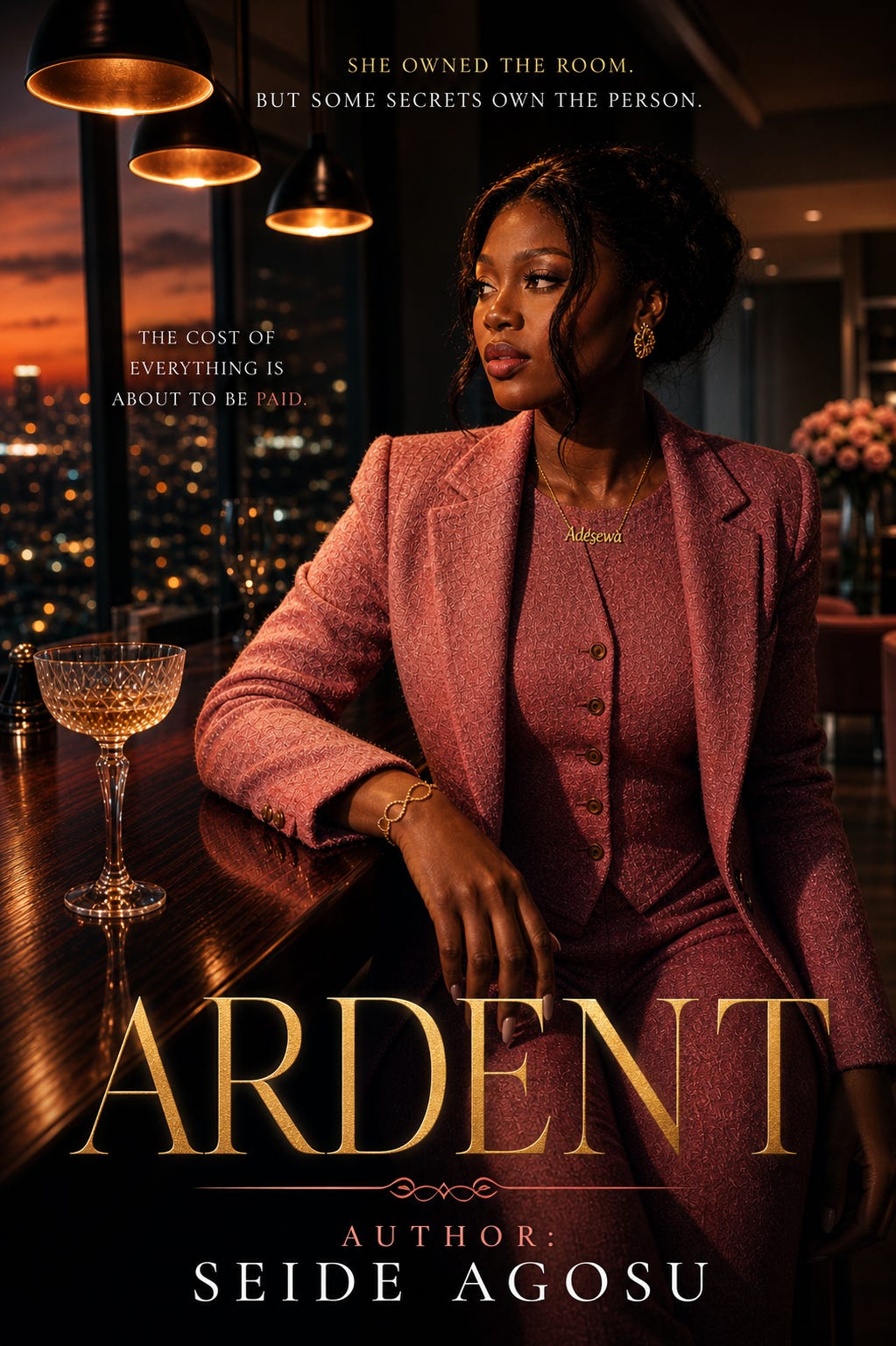
The shortlet is in Maitama.
Of course it is Maitama. Ọrọ booked it in October. A three-bedroom luxury apartment on the seventh floor with a view of the city that she described in the group chat as fit for a queen who is about to become a wife and which Adanna responded to with seventeen fire emojis and which Roli responded to with: I need the full address and the check-in procedure and can someone confirm the parking situation.
Roli.
Always Roli.
I arrive at 2 p.m. on a Saturday.
The door opens before I knock.
Ọrọ.
She screams.
This is the only possible beginning.
She grabs me with both arms and holds on with the specific quality of a woman who has been planning this day for months and is now living it and the living of it is bigger than the planning of it, which is always how the important things go.
“ADESEWA COKER”, she says into my shoulder.
“ỌRỌOLUWA HUNDEYIN”, I say back.
We hold on.
Then she pulls back and holds me at arm’s length and looks at my face the way she always looks at my face — the full assessment, the thirteen-years-of-friendship reading that takes less than three seconds and sees everything.
“You are glowing gaan”, she says.
“I shower regularly”, I say.
“This girl.”
“It is called skincare, Ọrọ.”
“It is called being loved correctly”, she says. “I know the difference.”
I shake my head.
But I am smiling.
She pulls me inside.
The room.
Twelve women.
Ọrọ.
Adanna.
Roli.
Dara — Ọrọ’s younger sister, who I have known since she was a child and who is now twenty-four and has my energy energy in a smaller body.
Chisom from the Ministry. My Thursday lunch partner for two years.
Tolani, my best buddy back in the university.
Ngozi from Celeb Teens, who has become a proper friend in the months of Imani building.
Amara — Fewa’s Amara who has become mine too in the way that good people become yours when you stop being careful about who you let close.
Temi, who I went to UNILAG with and who has been present for every version of my life since we were nineteen.
Funke, who I met through the content creator community and who has been one of the genuinely good ones in a space that is not always genuinely good.
And Juliet. Romeo’s twin. Juliet Emmanuella Kehinde Olusiji-Onoja.
She flew in from Lagos yesterday. She left Jacqueline with her father.
She walked in this morning looked around the room and said: right, I am on Sewa’s side today, anybody who disagrees can argue with the door, and sat down next to Amara, who she had met at the wedding and already texts regularly, and the room rearranged itself around her the way rooms always rearrange themselves around Juliet.
I look at the room.
Twelve women.
The people who have been in the rooms of my becoming.
Inside: this is what chosen family looks like.
Nobody voted for Roli.
She simply stood up when everyone arrived, cleared her throat, and said:
Alright, I have the schedule.
And produced a printed document from her bag with a confidence that suggested the emcee question had been settled in her mind long before it was settled in anyone else’s.
She is, it turns out, extraordinary at this.
Not the lawyer version — the Roli version. Which means precise transitions, zero filter, occasional legal metaphors that make everyone laugh, and the warmth of someone who is doing something she loves and has not yet admitted to herself that she loves it.
Adanna leans over to me at one point and whispers:
“She should do this for money.”
“I know right”, I whisper back.
“Has anyone told her?”
“Watch”, I say.
Roli opens proceedings.
“We are here—”, she says,
Standing at the front of the room with her printed schedule held in one hand like a barrister’s brief.
“—for one reason. Adesewa Coker is getting married in sixteen days. And before she goes—”
She pauses for effect,
“—we are going to pray for her, embarrass her, celebrate her, and eat entirely too much food. In that order.”
The room cheers.
“Opening prayer: Ọrọ.”
Ọrọ does not stand immediately.
She sits for a moment.
Then she stands.
And the room, which has been warm and noisy, becomes something else.
Because when Ọrọ prays the thing that happened to her — the encounter, the faith that arrived slowly and then completely, the woman who became more herself while I watched — is present in the room with her. It is not performance. It is simply real.
“Abba”, she says. “We are here for our sister. Your daughter”
She prays.
For Sewa the individual. Sewa who has been becoming herself in You for two years and deserves to be sent into the next season with intention.
For the marriage. Not the event. The marriage. The daily decision to be with each other. The ordinary days. The hard seasons and the abundant ones. The communication that requires courage. The forgiveness that requires grace. The specific love that God designed when He decided these two people should find each other on a Tuesday.
For the children. She does not avoid this. She names it directly, with the boldness of a woman who believes prayer is not a whisper but a declaration. The PMOS is known in this room — I told Ọrọ, Ọrọ told the inner circle, the inner circle received it and has been praying about it for months. Ọrọ names it. She asks for the fruit of the womb. She asks for God’s will in His timing. She asks that whatever the path looks like, Sewa would know that she is not walking it alone.
I cry during the children prayer.
I am not managing it.
Ngozi’s hand finds mine on my left.
Juliet’s on my right.
I hold both.
For Imani. For the children coming through those doors. For the cases Roli is fighting. For the donors and the partners and the building on the Kuchigoro land that is almost ready.
For the missions and the ministry. For the platform. The voice God gave her, the position of a woman who has access to a generation and is learning to steward it well.
For money. Practical, unashamed. For financial wisdom and generosity and the grace of people who build wealth and do not let wealth build them.
“And Father”, Ọrọ says.
Her voice doing the thing it does when she is arriving at the thing she most needs to say,
“thank you. For this woman. For what You have done in her. For the version of her that is standing here today — unafraid, full, chosen, whole.”
A pause.
“She stopped running. You know what that cost her. We know what it cost her. Thank You for the grace to stop. And for the man You sent to her and sent her to.”
The room laughs softly.
“Amen”, Ọrọ says.
“Amen”, the room says.
I look at the ceiling.
Then at the room.
Twelve women looking back.
It's been over an hour of praying.
“Okay”, Roli says.
Clearing her throat because she is also crying and does not intend to acknowledge it.
“First game.”
Game One: Who Said It — Romeo or a Romance Novel?
Roli reads quotes. The room decides: Romeo Olusiji or a fictional character.
The problem — immediately apparent — is that Romeo is consistently indistinguishable from the romance novel option.
“You are not a problem to be solved. You are the person I am building a life with.”
“ROMANCE NOVEL”, the room shouts.
“Romeo”, I say.
Screaming.
“I was not going anywhere. I just needed to think.”
“Romeo”, they all say immediately.
“Yes”, I confirm.
“The caregiver also needs to be given care.”
Dead silence.
Then Juliet, quietly:
“That is definitely brother.”
The room dissolves.
“I am going to need six weeks” — said the day after the proposal, in response to my birthday being in August.
“Wait”, Adanna says. “Romeo said that?”
“Yes”, I say.
“The day after he proposed.”
“Yes.”
“While you were still on the rooftop.”
“Technically I had gone home by then—”
“SEWA.”
Game Two: Sewa Bingo
Each person has a card with things Sewa is known for doing. The first to cross off five in a row wins.
Squares include:
Arrives on Thursday when she said Friday.
Gives unsolicited advice that is exactly right.
Stress-cooks.
Stress-cleans.
Sends really long albumish voice notes.
Buys too many candles.
Makes everything an aesthetic.
Knows everyone’s birthday.
Shows up with food you didn’t know you needed.
Quotes a verse and then immediately says something chaotic.
The game is supposed to be played by elimination.
It takes approximately three minutes before everyone has full cards because they are all immediately confirmed by someone in the room sharing a story.
“The food one”, Chisom says. “One time like that I had that terrible week in February last year and she showed up at my house with a full pot of pepper soup at 10 p.m. on a Monday evening. This woman actually got home late from work oh.”
“I did not know you were having a terrible week”, I say.
“I know”, Chisom says. “That is the point. She just knew.”
“The voice notes”, Funke says. “Seventeen minutes. I counted.”
“The message was complex”, I say.
“It was a restaurant recommendation”, Funke says.
The room falls apart.
Game Three: What I Wish I Could Unsee
Each person names one Sewa moment they wish they could unsee — not out of malice but out of love, the love that accumulates the embarrassing details of a person and keeps them tenderly.
Ọrọ goes first.
“NYSC camp”, she says. “Week two. You tried to teach the group a line dance. You had invented the line dance. Nobody else knew the steps. You continued for six minutes before noticing.”
“I thought they were following”, I say.
“You were facing the wall”, Ọrọ says.
Game Four: Act Like Children
Roli announces this one with the energy of someone who has been waiting for it.
“We are going to play Telephone”, she says. “Except every person must act out the message with sound effects before passing it.”
The message starts with Ọrọ:
Sewa found her person on a random Tuesday and now she’s getting married in sixteen days.
By the time it reaches the end of the room — through twelve women’s interpretations, sound effects, and escalating dramatic license — it has become:
Sewa punched a man on a Tuesday and now she owns his house.
We play four more rounds.
None of them reach the end with any resemblance to their beginning.
We also play a version of musical chairs using cushions from the shortlet’s perfectly arranged living room, which Adanna feels briefly guilty about and then immediately stops feeling guilty about because the game is too good.
And a relay race that involves carrying a wrapped gift from one end of the apartment to the other using only your elbows because Juliet proposed it and nobody was going to tell Juliet no.
Roli calls them up one by one.
Not formally. Just the okay who wants to go first energy that somehow becomes, under her management, the most organised informal thing I have ever witnessed.
Chisom talks about the corridor. The day I walked out of the meeting to take Romeo’s call and came back and sat down and picked up my pen and nobody who was not paying attention would have known anything had happened.
“But I was paying attention”, she says. “And I watched you come back into that room and something was different. Something had — changed. And I thought: whatever is happening in that woman’s life, something is going right.”
Temi talks about UNILAG. About the nineteen-year-old Sewa who walked into their hostel block like she owned it and proceeded, over four years, to become the person everyone called when anything happened.
“You have always been this”, she says. “The person who shows up. The person who remembers. The person who arrives and the room is better for it. You have always been this. You are just more yourself now.”
Amara speaks quietly.
She is not loud by nature. Normal normal she is the woman who asks the right questions without giving the answers, who loved Fewa into therapy through precision rather than volume. When she stands the room gives her the attention it gives people whose words are earned by their consistency.
“I came into this group of friends through Fewa”, she says. “Which means I came in from the outside. And sometimes the outside sees things the inside misses.”
She looks at me.
“What I saw from the outside is a woman who loves people so specifically and so consistently that the people she loves become more of themselves around her. I watched it happen to Fewa. I have watched it happen in this room today.”
She pauses.
“You are a gift, Sewa. Not because of what you do. Because of who you are when you are just — being.”
I look at Amara.
I think about the twelve-year-old girl from Gwagwalada. The fourteen-year-old from Karu. The children coming through the Imani doors who need someone to look at them and say: you are worth something, not because of what you produce but because of who you are when you are just being.
Inside: give them what Amara just gave you.
Juliet goes last.
She stands up and she looks at me.
“I have known about you”, she says, “since before you knew me yourself. My brother does not talk about people. He talks about books, God, Aurora, and occasionally basketball. He has talked about you since the day you guys met.”
She pauses.
“Not obsessively. Romeo does nothing obsessively. But consistently. The way he does everything that matters — quietly, specifically, over time.”
She looks at me.
“Welcome to the Olusijis. We are quieter than you. More like all of us, but meeeee. You are louder than us. It has already made us better.”
The room.
The twelve women.
The December Abuja afternoon outside the seventh-floor windows.
I look at all of them.
Inside: this is what it feels like to be seen.
Not performed-at. Seen.
Between the games and the tributes, during the food portion of the afternoon — intercontinental spread, because if Sewa Coker is having a bridal shower the food will be an event — Adanna turns to Roli.
“Roli”, she says.
“Yes”, Roli says, reaching for the jollof rice.
“You know you could do this for a living”, Adanna says.
Roli puts the jollof rice down.
“Do what for a living?” she says.
“This”, Adanna says.
She gestures at the room.
“Emceeing. The programme. The way you ran events today.”
“I am a lawyer”, Roli says.
“You are a lawyer who just emceed the best bridal shower I have attended in four years”, Adanna says. “And trust me, I've attended a lot.”
“It is the same skills”, Roli says. “Reading a room. Controlling a narrative. Managing timing.”
“Yes”, Adanna says. “Which you are extraordinary at. In both contexts.”
Roli is quiet.
“I have thought about it”, she says.
Very quietly. The first time she has said this out loud to anyone in this room, I suspect, possibly ever.
“And?” I say.
She looks at her plate.
“Events by Roli”, Ọrọ says.
The same energy she uses when she has decided something.
“I can see the logo.”
“Nobody is starting a business today and that's such a crappy name”, Roli says as she laughs.
“Nobody said today”, Ọrọ says. “But I am putting it in the universe.”
“The universe has been notified”, Adanna says.
Roli shakes her head.
But she is smiling.
Like someone who has been told a truth about themselves they were not ready to claim but cannot entirely reject.
After the games and the food and the tributes, the afternoon settles into the specific warmth of twelve women who have stopped performing and are simply present with each other.
Dara says:
“Can we talk about the journey? Like — properly. Where she was and where she is.”
The room agrees.
“The talking stages”, Adanna says.
She says it the way you name a thing that has become historical — not with mockery, with the affection of someone who was present for it.
“Machine gun style.Three to five a week.”
“I was optimising”, I say.
“You were running”, Ọrọ says.
Gently. The truth without sting.
“Yes and that. I was running”, I confirm.
“The AS complication”, Roli says.
The man I actually mourned.
“Yes”, I say.
“The Seven-Year Settler”, Adanna says. “The one who reminded you of—”
“Pleaseeee, let's not even go there”, I say.
Chisom, who did not know most of this history, is listening with the expression of someone receiving context that explains many things.
“The thing about that season”, Ọrọ says carefully, “is that it was not wasted. Every one of those situations was — preparation. Data. Educating a woman who needed to know exactly what she did not want before she could recognise what she did.”
“Ishmael”, Dara says. “Before Isaac.”
The room receives this with scattered “hmmmmm” sounds.
“The Ishmaels were not punishment. They were the syllabus”, Ọrọ says.
I look at the city outside the window.
“The difference”, I say slowly, “between then and now — it is not that I found a better person. It is that I became a person who could recognise a good one and stay.”
I pause.
“The therapy. Forgiveness. Faith. All of it. Not because Romeo required it — because I required it. Because you cannot receive what you are not ready to receive.”
I look at the room.
“I was not ready. And then I was.”
“Coming into Christ first reminds me of Matthew 6:33 that says we should seek first the Kingdom of God and everything else will be added. When I did that, everything else fell into place. Romeo and I found each other properly.”
Ngozi says:
“And now you are sixteen days from marrying him.”
“Sixteen days”, I confirm.
“And the PMOS”, Juliet says.
Quietly. The way you name the real thing without drama because the real thing deserves honest naming.
“How are you sitting with it now?”
I think about it.
The proper answer.
“With more peace than I had in March”, I say. “Dr. Amaka. The sessions with Pastor Dami. Romeo’s Aunt Francesca. The prayer — this room, all of you, for months.”
I pause.
“I do not have certainty but I have peace.”
“Faith for the fruit of the womb”, Ngozi says. Simply.
“Faith for the fruit of the womb”, I confirm.
Ọrọ prays again.
Short. Specific. The way she prays when she is not opening a meeting but closing a moment.
“Abba. Sewa's body and womb is Yours. The timing is Yours. The path is Yours. We ask for the fruit. We ask for the fullness. And we trust You with the pace. In Jesus name.”
“Amen”, the room says.
Quietly.
The quiet of twelve women who have just placed something real into real hands.
At 8 p.m. Roli stands up.
“Final item”, she says.
She produces a small journal.
“We all wrote something”, she says.
“Everyone in this room. Something for Sewa to read on the mornings that are hard. The ordinary Tuesdays that nobody writes vows about.”
She puts it on the table in front of me.
“When the path is longer than expected. When the building is slow. When the communication is hard. When you need to remember who you are and who loves you and what you are made of.”
I look at the journal.
My name on the cover.
Twelve sets of handwriting inside.
“Roliiiiiii”, I say.
“You are not allowed to open it tonight”, she says. “It is for the marriage, not the bridal shower.”
“Okayyyyyyyyyyyyyy”, I say.
“Sewa.”
“Yes.”
“We love you”, she says.
“All of us. Loudly and without reservation.”
She pauses.
“You are our person. And you are going to be an extraordinary wife. Not because you are perfect. But because you have done the work and will keep doing the work.”
This room.
I look around. The twelve women.
“Thank you”, I say.
It is not enough.
It is the only word.
“Thank you”, I say again.
Ọrọ starts singing.
Softly.
See How Far by Victoria Orenze.
I sit in the middle of it.
The love.
The costly, attentive, unglamorous, extraordinary love of women who have been present for the becoming.
I receive it.
Without managing it.
Without performing anything.
Just — receiving.
Inside: this is enough.
Inside: this is more than enough.
Inside: this is everything.
At 8:47 p.m., just as the singing is settling into the warmth of a room that has worshipped together and is not quite ready to leave, I stand up.
Everyone looks at me.
“I have something”, I say.
I go to the main bedroom.
The boxes have been there since Friday evening. Twelve boxes, identical in size, different in everything else. I have been planning these since September. The personalisation started in August, actually, in the notes app where I keep the things, in a list titled simply: them.
I carry the first one out.
Then the second.
Then Ọrọ, who has seen the bedroom and said nothing, which is an act of restraint so extraordinary it deserves its own acknowledgment, starts helping me carry the rest.
Twelve boxes.
On the living room floor.
Each one wrapped in the recipient’s favourite colour. I know everyone’s favourite colour because I pay attention and this is what paying attention produces. Gold ribbon on each. A tag with a name in my handwriting.
The room is very still.
“Before I explain”, I say, “I want to say something.”
I look at the room.
At Ọrọ who has been my person since JSS1.
At Adanna who was at the first talking stage debrief and every one after.
At Roli who argued my cases before she knew she was arguing them.
At Juliet who welcomed me into the Olusiji family before Romeo had the language for what I was to him.
At Amara who saw me from the outside and told me the truth about what she saw.
At all of them.
“You are not just my bridal shower guests”, I say.
“You are my tribe. And in three weeks when I stand to make the most important decision of my life — I want you beside me.”
I hear a lot of “Awwwwwn awwwwn”.
“You are my bridal train”, I say. “All of you. Every person in this room.”
A sound from Adanna that is not quite a scream and not quite a word.
“And I have two things to say before you open the boxes.”
I look at Roli first.
“Roli. You anchored today like you were born to do it. You hold rooms the way you hold briefs — with precision and warmth and exactly the right timing.”
I pause.
“You are my maid of honour.”
Roli opens her mouth.
Closes it.
“Roli”, Ọrọ says.
“Yes”, Roli says. Quietly. The word landing differently from all the other words she has said today.
Then I look at Adanna.
“Adanna.”
She is already crying. She has been crying since I said bridal train and has not stopped.
“You have been present for every version of me. The chaotic version, the figuring-it-out version, the ministry version, the Imani version, the Romeo version.” I hold her gaze.
“You are my chief bridesmaid.”
Adanna cries harder.
“I need you to be able to see on the day”, I say.
“I WILL BE ABLE TO SEE”, she says, through the crying.
“I know they are the same but I want Adanna to fully handle the bridesmaids while Roli will be my special human handbag for the day, sorryyy, PA”.
Everyone laughs.
“Open the boxes”, I say.
The boxes.
Each one is a customised argument for the person receiving it.
Inside each.
The asoebi fabric. Pastel pink, chosen by Romeo and me together over two evenings in October. Six yards of the finest lace, already cut and tagged with each person’s measurements because I collected them in November under the pretence of needing them for something else. The fabric will become their outfits for December 23rd.
The gele. Pre-tied. Personalised. I found a woman in Lagos — a gele artist named Mrs. Comfort who has been tying gele for thirty years — and I described each person to her. Their face shape. Their energy. The version of themselves they are when they are most themselves. She made twelve geles. Each one different. Each one, when I saw them, was exactly right. Adanna’s is wide and high — bold, declarative, the gele equivalent of her entrance into a room. Roli’s is structured and precise — elegant, composed, the gele equivalent of a barrister’s brief. Ọrọ’s is soft and full — warm, present, the gele equivalent of the way she prays. Juliet’s is — I can only describe it as unapologetically itself, which is the only description Juliet has ever required.
The wig. This was the most complex coordination. Eight months ago I started noticing — the way I notice everything, which is specifically and with full attention — what each person’s hair does on the days they feel most like themselves. I brought this information to a wig artist named Mercy, who operates out of a studio in Wuse 2 and whose work I have been wearing for two years and whose skill I trust completely. Each wig is customised. Length, texture, colour, parting — all specific. All right. When Mercy showed me the finished pieces in November I stood in her studio and cried because she had taken my descriptions and produced twelve versions of each person at their most beautiful.
The handbag. Structured. Quality. The kind that lasts. Each one chosen for the person — not the same bag in different colours but genuinely different bags for genuinely different women. Ọrọ’s is soft leather, the specific black of something that has been chosen for longevity rather than trend. Roli’s is structured and dark — professional, excellent, the bag equivalent of who she is in a courtroom. Adanna’s is the colour she has been wanting for two years, which I know because she mentioned it in a group chat in February and I screenshotted it immediately. Juliet’s is — the most extra one, which she will love completely and deny is extra.
The skincare set. Personalised to each person’s skin type — I know everyone’s skin the way I know everything about the people I love, which is from paying attention over years of proximity. Not the same set for all twelve. The specific products for the specific skin. A note inside each with the routine, written in my handwriting, because I am Sewa Coker and a personalised skincare routine is a love language.
The mini electric fan. Because December 23rd in Abuja is not cold. Because asoebi and lace and gold gele in December requires personal climate management. Because I am a practical woman who plans for the actual conditions of the actual day.
The perfume. All from AYINKE REGAL. One bottle for each person. A different scent for each. Not random, chosen. The scent that I associate with them. The one that, when I encounter it in the world, reminds me of them specifically. Funke’s is fresh and green — the scent equivalent of her energy. Temi’s is warm and amber — the scent of nineteen years of friendship. Ngozi’s is clean and floral — the scent of someone who moves through the world with specific grace. Each bottle has a small tag with one line: you smell like yourself, which is the best thing anyone can smell like.
The journal. Small. Personal. Their name on the cover in gold. One line inside the front from me: for the true things.
The letter. At the bottom of each box, sealed. Personal. Written by hand. The things I have wanted to say to each of these women that the group chat could not hold and the ordinary occasions never quite created space for. True. The kind of letter that takes a long time to write because the right words require the right silence to find them.
The chocolate. Because it is December. Because it is a celebration. Because Ọrọ and Mautin love chocolate and this is a nod, however small, to the wedding where this story turned.
And at the very top of each box, sitting wrapped like it was placed there by someone who knew exactly what it was doing:
One peony.
Cream. Fresh. From Sapphaster Ltd.. My Friday subscription, the small consistent beautiful thing I have given myself every week for four years. The flower that has been present at every important moment. The rooftop proposal. The dining table conversations.
One peony for each woman who has been present for the becoming.
The room opens the boxes.
It takes twenty-seven minutes.
I know because Roli times it. Not officially, but she is Roli, so she clocks everything.
Twenty-seven minutes of tissue paper and discovery and the specific sounds a room makes when it is receiving something it was not expecting at the depth it arrives. The wigs produce the loudest response. Adanna holds hers up and puts it on immediately, over her current hair, and the room’s response is immediate and unanimous and entirely correct: it is the most Adanna wig that has ever been made.
Juliet puts on her gele over the wig she is already wearing.
The result is extraordinary.
She looks at me.
“Sewa”, she says.
“Yes.”
“You are a menace”, she says. “And I mean that with my whole chest.”
Ọrọ finds her letter at the bottom of her box.
She reads the first line.
She closes it.
She puts it against her chest.
“I am not reading this here”, she says. “This is for when I am alone and prepared to feel everything.”
“Yes”, I say.
Roli opens her box in the order a barrister opens evidence. Systematically. Each item examined before the next is revealed. When she reaches the letter she reads the first line, the way Ọrọ does, and then she folds it.
But her face does something.
The exact something that Roli’s face does when she is not performing anything for anyone.
“Sewa”, she says.
“Yes.”
“This is — a lot”, she says.
“You are a lot”, I say. “I was matching the energy.”
She shakes her head.
The room is warm.
The boxes open everywhere.
The chocolate unwrapped.
The perfumes tested.
The fans assembled immediately by three people simultaneously because it is, in fact, warm in a Maitama shortlet in December with twelve women in it.
And over all of it. Underneath the noise and the unwrapping and the gele and the wigs and the fans — the quality of a room that has just received something made with full attention and is reckoning, quietly, with what it means to be loved that specifically.
I look at all of them.
Twelve women. Eleven opened boxes. Mine is the twelfth and I'll inbox mine later.
My tribe.
My bridal train.
My people.
Inside: I made it.
Not to the wedding. Not yet.
To this.
To the room full of people who know me.
To the receiving without managing.
To the woman who stood in a JSS1 classroom and refused to lend a pencil and has been beside me since.
To the man who was not supposed to be walking on a Tuesday.
To the life that is sixteen days from beginning properly.
Inside: I made it. Thank You, Jesus.
Narrator's Nook:
The bridal shower is not a party. It is a sending forth. Twelve women who love Sewa Coker gathering not to celebrate a date on a calendar but to pray, witness, and release her into the next season with intention. The difference between a celebration and a consecration is what happens in the room — and what happened in this room was consecration.
Roli’s emcee gift is the chapter’s grace note. The woman who holds things like briefs and files them at the right moment, who coordinates prayer and games and tributes with the precision of a barrister and the warmth of a friend, who says Events by Roli is still in the universe even after she shakes her head. This is ARDENT doing what it does best — showing a person to themselves through the eyes of the people who love them. Roli does not know yet what she is. The room knows. It has been placed in the universe. It will arrive.
And the Ishmael/Isaac framework — named by Dara, received by the room — is the series’ most complete retrospective on Sewa’s journey. Not that the wrong ones were punishment. That they were the syllabus. The education of a woman who needed to know exactly what she did not want before she could recognise what she did. The curriculum was always leading here.
Twelve women singing in a room.
A woman receiving love without managing it.
Sixteen days.
Comments
Nothing yet. Say the first thing.
Sign in to join the conversation.