
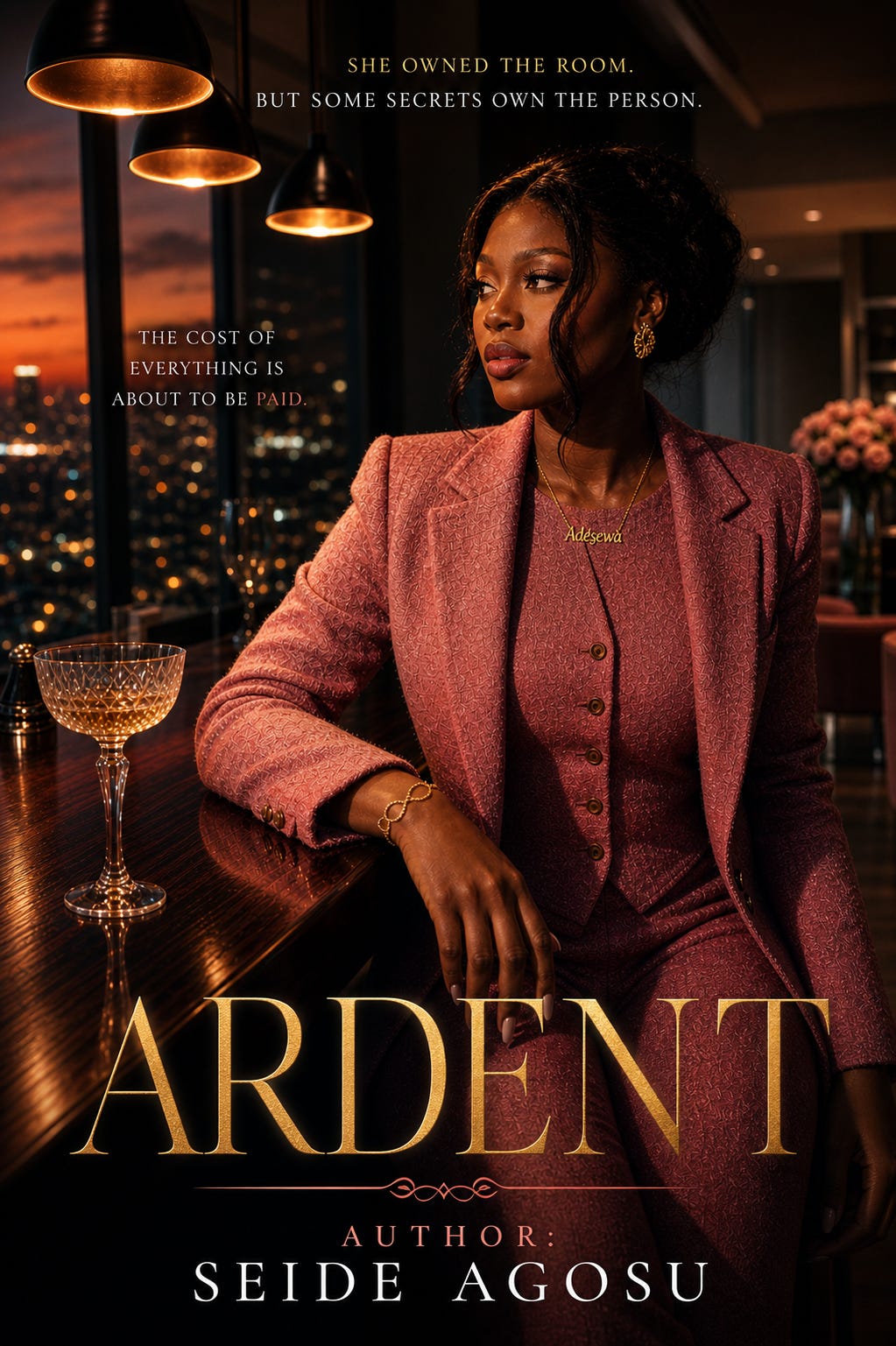
November arrives and I am already in a purple fitting.
The Introduction outfit has been in progress since September. The brocade fabric chosen by my mother, who has an eye for cloth that I have inherited and which manifests differently in each of us.
Hers is precise and restrained. Mine is precise and maximalist.
Together we stood in a fabric store in Lagos in September and disagreed productively for forty-five minutes before arriving at the purple and gold that is somehow both of us simultaneously.
Deep purple. The kind that does not apologise for itself. The colour of something ancient and intentional. Gold. Not the brash one. The quiet one. It is threaded through the brocade like light finding its way through a thing that was designed to hold it.
Romeo’s agbada is the same colour.
This was my suggestion. He received it the way he receives things that are new to him — with a moment of stillness and then a complete yes.
I have not seen it yet.
This is deliberate.
Some things are better as surprises.
That reminds me of my Comments' Sections.
My channel has been a new kind of alive since the engagement post in January and has become more alive with every month as December 23rd approaches. One million and three hundred thousand subscribers and followers now.
The face reveal still pending. I'll reserve it for boxing day. Three days after my wedding. I unbox my gift and taadaaa my husband. And the anticipation of it has become its own content, which I did not plan but have learnt to find funny.
The comments are everything.
The good ones:
She found her person and I have been crying since.
The way she talks about him without showing him??? Love itttt .
I am a believerrrrr. In this government. Sewa has been glowing differently since the engagement.
This is what being loved correctly looks like.
The less good ones:
She’s been with this man for almost two years and we still haven’t seen his face. What is she hiding. He’s probably not as fine as she’s making him sound.
Rich girl finds rich man? It's is not a real love story. Na ordinary money finding money.
And the category that makes Romeo laugh every time I read them to him:
I don’t trust a man who has no social media. Abi why isn't he in her comment section. What is he hiding? No trace at all.
“He is hiding himself”, Romeo said, when I read him that one. “Which is not hiding. It is simply living.”
“I kuku told them oh”, I said.
“What did you say?”
“I said: some people are so whole they don’t need an audience to confirm it. he is those people.”
He was quiet for a moment.
“That is very kind”, he said.
“It is accurate”, I said.
He shook his head.
We laughed about it for a long time.
I've been building a tough skin since the channel began. Years of it. The comments do not land the way they used to. Not because I have stopped caring about people but because I have learnt the difference between the voice that is worth receiving and the voice that is projection wearing an opinion’s clothes.
I receive the ones that are real.
The rest I let pass.
Romeo finds the whole thing mildly baffling and entirely amusing. He does not understand the instinct to perform one’s life for an audience — he never has — but he has come to understand that for me it is not performance, it is connection. A community built across screens. He respects it. He just does not share it.
This is one of the ways we are entirely different people who have chosen each other anyway.
I am back at the bookshop in Wuse.
Not the Aurora Library. I want to be alone. Somewhere I can just be a human being. Not Boss. Not “sir”. Not CEO. Just Romeo.
Mr. Bello has the door open before I reach it.
“Mr. Romeo”, he says.
“Good evening, Mr. Bello”, I say. “How are you?”
“Well”, he says. “The new consignment came in on Monday. I kept something for you.”
This is the system. He knows what I read. He has been keeping things for me since I found this shop and made it part of my Thursday routine.
He hands me a book.
A collection of essays by a Nigerian philosopher I have been looking for since July. Out of print. The spine worn in the specific way of a book that has been read by someone who meant it.
“Where did you find this?” I say.
“A retired professor”, he says. “was clearing his library. He asked me to find it a good home.”
I hold it.
The weight of it.
The weight of a book that has been carried by someone else and is now in your hands.
“Thank you, Sir”, I say.
I pay for it.
I find my usual corner.
I sit.
I read.
Two hours.
This is the thing about solo Thursdays that I have never been able to explain adequately to anyone who has not done it. It has this quality of time spent entirely in your own company, pursuing the thing you love for no reason except that you love it, with nobody requiring anything of you. It is not loneliness. It is the opposite of loneliness. It is fullness that does not need to be witnessed to be real.
In five weeks I will be married.
The Solo Thursdays will continue. Sewa and I talked about this in July. We spoke about what we each need to remain whole inside the marriage. Her solo dates. My Thursdays. Our individual lives that feed the shared one. Two whole people. She said it and I agreed and we have both been living it.
I read the philosopher’s essays.
At one point I find a sentence that stops me.
The self is not diminished by commitment. It is clarified by it. The person who knows who they are brings that knowing into a union. The person who does not, has nothing to bring.
I write it in the margin of my journal.
Then I sit with it for a long time.
In five weeks, I am bringing everything I know myself to be into the union with Sewa Coker.
And she is bringing everything she has spent the last two years becoming.
Two whole people. Not two halves.
Two whole individuals.
This is the only mathematics that works.
I go to the art gallery.
The one in Maitama that I have been visiting since I moved to Abuja. A small gallery that does not advertise itself because it does not need to. It changes its exhibition every six weeks, and has given me three of the pieces now hanging in the Maitama house.
November’s exhibition is a young sculptor from Katsina. His work is in terracotta — the deep brown of the earth, shaped into forms that are simultaneously ancient and entirely contemporary. Hands. Faces half-emerged from clay. A figure mid-motion, caught between one thing and another, and the between-ness rendered with such precision that you can feel the transition in your own body.
I stand in front of the mid-motion piece for a long time.
The figure between one thing and another.
I think about the woman I was when I arrived in Abuja five years ago. The apartment. The talking stages. The dates. The Paris trips. The performing of a life that was real and also not fully inhabited.
I think about the woman standing in this gallery in November, four weeks from her wedding.
The between-ness.
I am on the other side of it now.
Not finished. Nobody is finished. But no longer mid-motion in the anxious way. Mid-motion in the direction of something. With both hands. With full knowledge of the cost.
I take a photograph of the piece.
Not for my channel - Sewalicious Chronicles.
For myself.
The way I have been taking photographs for myself all year. The collection of images that are not content, that have no caption, that live only on my camera roll as evidence of moments I wanted to keep.
I send it to Romeo.
Below, I type.
“The between-ness I used to live un. I wanted you to see what it looks like from the outside.”
Three dots.
Then:
“See beauty nah. You are such a beauty goddess. Can our wedding day come already?”
In response to the text.
“And now?”
I look at the piece.
The figure mid-motion.
“Now I know where I am going. And who I am going with.”
“The day is almost here.”
A pause.
“Yes and I can't wait”, he types.
“I have something planned for November 30th”.
“I am taking you somewhere for our solo date together. Pretty please mark your calendar.”
“A solo date together is a contradiction in terms, Sir”, I type.
“It is a Romeo special”, he types. “Different category.”
I shake my head at my phone in the middle of the art gallery.
The sculptor’s terracotta figures witness this.
I am smiling.
More like grinning from ear to ear.
Five outfit changes.
I am not ashamed of this.
This is Sewa Coker’s Pre-wedding Photoshoot and Sewa Coker has been thinking about outfits since she was old enough to understand that clothes are a language.
Outfit One: The Introduction set.
Purple and gold brocade. The buba and iro are floor-length, the gold detailing catching the Jos afternoon light in a way that is not accidental. The gele — tied by my mother’s hands, which is the detail I will remember when I am old.
Romeo in his agbada.
We stand together for the photographer and the height difference is everything. His six three and my five five, the purple and gold of both of us, the compound behind us and the families seated around us. The photographer — a woman named Ife who does not tell people to smile because she says the real ones arrive without instructions — captures the moment Romeo leans down slightly to say something in my ear and my face does the thing it does when he says anything that undoes me.
I do not know what the photograph looks like yet.
I know exactly what it looks like.
Outfit Two: Traditional editorial.
His agbada changes to a creole chocolate version. The same brocade but structured differently, more formal, the Omoluabi aesthetic at full power. Mine becomes a full brocade dress — not iro and buba but a gown. I understand that brocade in the right silhouette is a complete argument for itself. Blinding. Modest. Elegant. The kind of dress that people will be referencing in years when they talk about this day.
Him in the deep chocolate agbada.
Me in the chocolate gown.
His hand in mine.
Ife takes one shot.
She says: that is the cover.
Outfit Three: Italian heritage.
This one is Lady Aurora’s gift.
She arrived with a garment bag she brought from Milan. Inside is a tailored suit for Romeo in the finest Italian wool . Charcoal, precie and giving the elegance of old money in its European form. Slim cut. The watch he always wears — inherited, his grandfather’s, the one that does not announce itself.
For me: a dress that Lady Aurora commissioned from the same Milan atelier that makes her own pieces. Emerald green. Column silhouette. The cut doing the work of something made for myyyy body by someone who was given the measurements and the mandate and trusted to do something extraordinary with both.
We stand together in Italian elegance.
The height difference is, again, everything.
He looks at me in the dress.
The look.
The full one.
The photographer takes shots in rapid succession because she says she cannot stop.
Outfit Four: Formal casual.
Juliet and I’s idea — me in a dusty pink dress, fitted, the kind that is both dressed up and entirely wearable, with small gold jewellery and my hair down. Him in a white two-piece lounge set, the kind of white that only works on a man who carries himself correctly, which he does.
The contrast of us.
My pink and his white.
My five five and his six three height.
The photographer positions us facing each other, his hands on my face, my hands on his chest, foreheads nearly touching.
I hear the shutter.
I feel his hands.
Inside: in a few weeks this is forever.
Outfit Five: The simplest.
White shirts.
Jeans.
Barefoot.
Both of us.
This is Romeo’s suggestion. His one contribution to the outfit planning delivered at the end of the shoot brief in July in his usual calm. He had thought about it carefully and was placing it as a request rather than a requirement.
“One set where we are just ourselves”, he said. “No fabric. No heritage. Just us.”
The photographer takes us to a patch of grass.
We stand barefoot.
White shirts.
Jeans.
Him and me.
Six feet three and five feet five.
His hand in mine.
Looking at each other like the camera is not present because by the fifth outfit change the camera has genuinely ceased to be present.
There is only Me and My Man.
Ife does not direct this one at all.
She just shoots.
The family compound in Jos.
I have not been in this compound since I was a teenager. The Coker family property, the one that predates my father’s money, that has been in the family since before the money arrived and which has a quality that no amount of renovation has erased: the specific quality of a place that has held generations of people who belonged to each other.
It is the Saturday before the second week of November.
The compound has been transforming since Thursday.
A large event tent. Chairs in the Coker colours — the family chose purple and gold for the day, which my mother noted with the composure of a woman who did not coordinate this with the Introduction outfits and is privately satisfied that the universe did it for her. Caterers. Drinks. The infrastructure of a Yoruba family party being assembled by people who have been assembling Yoruba parties their entire lives and do not need to be told anything twice.
My mother moves through it all with the focused energy of a woman in her element.
This is Mrs. Bimbo Cole-Coker at full power — not the composed silence of the house, not the careful rebuilding of a marriage, but the authority of a woman in her own compound organising an occasion that matters. She has many many opinions about the flower arrangement. She has corrected the caterer thrice. She has sent my father to retrieve something from the main house many times that I've lost count and he has gone each time without comment because he understands that this is her domain and he is wisely staying in his lane.
They are good together now.
Not performed good.
Actually good.
The kind of good that has been built over eighteen months of counselling and choosing and the daily effort of two people who decided to try again. My father tending the vegetable patch. My mother accepting the pot from his hands. The ordinary days accumulating into something that looks, from a distance, like a different marriage.
It is the same marriage.
Renewed.
I am still learning to see it that way.
Dr. Yetunde would say I am getting better at it.
She would be right.
The Olusijis arrive at 10 a.m.
I watch from the window of the main house as the cars pull in.
Mr. Adedamola first. The only son of his parents, which means he carries the Olusiji name with the weight of someone for whom lineage is not abstract. He gets out of the car and he looks at the compound and I watch him receive it like a man who understands what a family compound means, what it holds, and what it communicates about the people who built it.
Lady Aurora beside him.
In lace fabric. She has made this choice deliberately, the courtesy of a woman who is entering someone else’s cultural space and has dressed to honour it rather than to stand apart from it. The fabric is blue and silver, wrapped and styled by a woman in Lagos whose name she got from Juliet, and she wears it with the ease of someone who has been navigating cultural crossings her entire adult life.
Juliet. Tony. Jacqueline — two and half now, in a miniature version of her mother’s fabric, with opinions about the compound that she is expressing immediately to anyone within range.
And then Romeo.
He gets out of the car last.
The agbada.
Purple and gold getzner brocade. On him it is — I do not have a word. I am speechless watching this man who carries himself with quiet intention dressed in a thing that asks him to take up space and he does it without performing. The agbada is not wearing him. He is wearing it. His height — six feet three inches, a fact I am aware of every time we stand together, my five feet five against his six three, the geometry of us — is remarkable in it.
He looks up.
He finds me in the window.
He smiles.
I go downstairs.
Chief Kunle Coker in his element.
I have seen my father in many rooms. Business rooms. Political adjacency rooms. The quiet Jos evening rooms of a man who is trying to be better than he was.
But the Olori Ebi room is the room he was born for. The family elder. The man who speaks for the Cokers. He sits at the centre of the compound in his agbada — deep green, the family colour. The colour that has been present at every Coker occasion for three generations. And he receives the Olusiji family with the dignity of a man who knows exactly what this moment means and intends to conduct it accordingly.
Mr. Adedamola across from him.
The only son of his parents.
Two fathers who love their children with everything they have — in different ways, from different backgrounds, across different failures and rebuildings — looking at each other across a Jos compound and understanding each other without needing to.
The elder speak first on both sides.
Then Chief Coker.
He speaks in Yoruba. Proper Yoruba, the unadulterated version. The language that carries more than its words. He speaks about the Coker family. About what they bring. About his daughter. About what he has watched her become. About what he is asking the Olusiji family to receive.
His voice is steady.
Until it is not.
There is a moment — brief, managed quickly, but present — where his voice does the thing that my father’s voice has never done in public before. Where the weight of the moment reaches through the Olori Ebi composure and finds the father underneath.
My mother’s hand finds his on the arm of the chair.
He steadies.
He continues.
I look at my father.
At the man who stayed for the wrong reasons for too long and is now, eighteen months into the right reasons, standing in the compound of his family saying the true thing about his daughter in front of two assembled families.
I see the grace of a man changing in the direction of love.
Inside: I see you, Daddy.
Her father speaks and I listen.
I catch enough Yoruba to follow the shape of it. I have been speaking the language my whole life, my father’s insistence, the gift of a Nigerian man who went to England and came back and made sure his children came back with him in every way that mattered.
Chief Coker speaks about his daughter.
About the fire in her.
About the way she walks into rooms.
About the thing he did not give her — the model of love that was stable and real and chosen daily — and the grief he carries for that, stated plainly, in front of both families, without managing it into something easier.
He says:
“I failed her in some ways. And she has been generous enough to let me try again. I am asking your family to love her the way she deserved to be loved from the beginning.”
The compound is very still.
I look at Sewa across the space.
She is looking at her father.
Something moving through her face that is not grief and is not quite joy. Looks to me like an expression of someone receiving something long-delayed and finding it still has the power to reach them.
She looks at me.
I hold her gaze.
Inside: this is the family you are marrying into. Imperfect. Healing. Honest about the healing. These are your people.
Inside: yes. They are.
My father speaks next.
The Olusiji response.
He speaks in English. The choice is deliberate, the courtesy of a man who wants every person in this compound to receive his words without mediation. He speaks about what family means. About what he is bringing. About Romeo.
He says:
“This boy — my son — has been waiting for her since before he knew her name. He has been patient the way only a man who trusts God can be patient. And I have watched him choose her every day since he found her. Not because choosing is easy. Because she is worth it.”
He looks at Sewa directly when he says the last part.
She looks back.
The compound.
The Jos afternoon.
Both families.
Two whole people in the middle of all of it, choosing each other in front of everyone who made them.
The party.
A Yoruba party in full expression is a phenomenon and I say this as a man who grew up attending Yoruba occasions and thought he knew what to expect.
I did not fully know what to expect.
The music starts at 4 p.m. and does not stop.
The food. I have eaten four meals already and someone is bringing a fifth. The food is every version of excellence simultaneously. The abundance of a Coker table, which is the abundance of a woman who grew up in a family that expressed love through provision and has never stopped.
Chief Coker dances.
This is information I did not have before today.
Chief Kunle Coker, Olori Ebi, gets up from his seat and he dances and he dances well, which is the most hilarious event of the entire day.
My father watches him and then my father gets up.
Mr. Adedamola Nathaniel Olusiji, business tycoon, publisher, stands up and dances.
Mum joins him.
Mum, in her lace fabric, dances with her husband and her daughter-in-law’s family.
Juliet is already dancing. She has been since the music started.
I look at Sewa.
She is looking at our parents dancing.
She's smiling and teary at the same time. She breaks into soft laughters and the tears drop too.
I extend my hand.
She takes it.
We join them.
Both families.
The music and the food and the abundance of a people who take every chance to celebrate because they understand, in the bones, that the good days must be marked.
I hold Sewa’s hand on the dance floor of her family’s compound.
She looks up at me.
“Reo”, she says.
“Yes, Evie.”
“Welcome to the family”, she says.
I look at her.
At the compound.
At the families dancing around us.
At the woman who rearranged my life without losing herself or me losing myself.
“Thank you”, I say.
“For what?” she says.
“For not going to Paris”, I say.
She looks at me.
Then she laughs.
The full laugh.
It rearranges the whole compound.
Narrator's Nook
The Introduction is not just a ceremony. It is a reckoning. Two families in a compound, speaking the true thing about their children and themselves in front of witnesses. Chief Coker naming his failures in public — not managing them into something easier, not softening them for the occasion — is the series’ most complete portrait of a man who has chosen to be honest even when honesty costs him the performance he was comfortable with. That is the healing made visible.
Five outfits are not vanity. They are a woman who has spent her whole life understanding that environments communicate and clothes are a language, using that language to say something complete. The brocade says: I am my mother’s daughter and my father’s daughter and I carry all of it. The Italian wool says: I am choosing a family whose heritage is different from mine and I am honouring it. The white shirt and bare feet says: underneath everything I am just this. A woman. Standing next to a man. Choosing.
And the dancing. Both families. On a Jos compound. The specific, unrepeatable, entirely Nigerian grace of people who know that joy must be marked, that the good days must be witnessed, that celebration is not frivolous but faithful — it is the act of saying: we were here, and it was good, and we chose to mark it.
Two whole people.
God math.
December 23rd is coming.
Comments
Nothing yet. Say the first thing.
Sign in to join the conversation.