
There are tens of millions of people working remotely across borders right now. Digital nomads, Web3 folks, remote employees who left their home country and never looked back. Many of them do not have a coherent legal structure.
They haven’t formally exited their home tax system. They run revenue through a US LLC they don’t fully understand. They bank somewhere without knowing how CRS reporting works — or that their accounts are being automatically reported to a jurisdiction they no longer live in. They have a tourist visa and a prayer.
It’s a knowledge problem. And governments are not helping with their slow law-making processes that fail to adapt to new trends basically in any sector, whether it is crypto or global mobility. The information needed to structure a multi-jurisdictional life is dispersed across thousands of pages of legislation in dozens of countries. No single lawyer, no single jurisdiction, no single human possesses it all. The consulting industry survives on this information asymmetry. No platform ties residency, corporate structure, banking, and tax intelligence together. The attempts I have seen, I did not like for various reasons. So I have decided to build it. The operating system for global citizens.
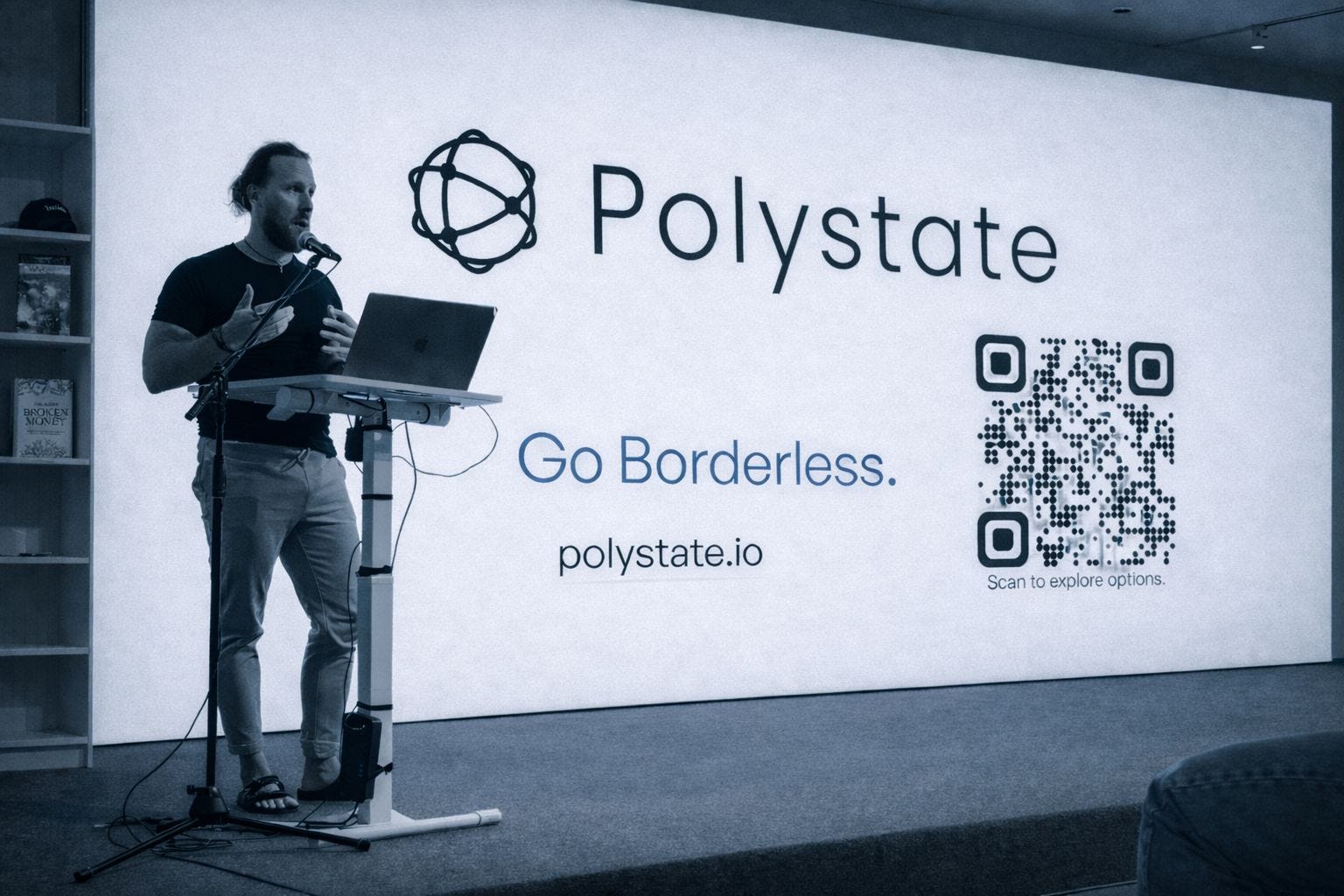
That’s what Polystate is. Last week I presented it publicly for the first time, on stage at Network School in Malaysia. And now I am looking for the first 1000 users that will test the app, give us feedback and help us make it even. better! We have perks for the users with registration number under 1000. So make sure you become one!
I’ve spent the last 12 years in crypto — initially researching and then building infrastructure for financial freedom. Building in crypto made me learn a bit about international laws, taxes, and regulation. A failed crypto startup first, then successful Fumbi, now the market leader for crypto investing in Czech and Slovak Republic, and later Cork Protocol, backed by a16z. Along the way I advised dozens of startups and corporations along the way including some government bodies or the National Bank of Slovakia. Same thread through all of it: how do individuals get more freedom and sovereignty over their own lives?
Crypto was the financial layer. Network states are the physical layer. Polystate is the intelligence and service layer that connects people to both.
A few years ago I started to be concerned about the EU’s direction. Rising taxation. Expanding regulation. Occasionally outright authoritarian moves on individual finances (Cyprus and Greece in 2009). I realized that having my entire life — residency, banking, company, tax obligations — anchored to a single jurisdiction was a concentrated risk. Not theoretical. Structural.
Enter Flag Theory. The framework coined by Harry Schultz in the 1960s, grounded in Austrian economics. The core insight: states claim monopoly on force within their territories, but mobile individuals can shop between those monopolies. Tiebout formalized it in 1956 — competing jurisdictions, mobile citizen-consumers. Hirschman named the mechanism in 1970 — exit vs. voice. The ability to leave is what gives your complaints teeth.
Plant your residency in one country, your company in another, your banking somewhere else. Your passport gives you options, not obligations.
But most people get paralyzed. By the complexity, choices, and the bill. It can get expensive, confusing, and long. And the hardest part was verifying anything.
I worked with lawyers and accountants across multiple jurisdictions. Read immigration law. Talked to people who’d done it. Some advice was solid. A lot of it was contradictory, outdated, or wrong. The information asymmetry was massive — the people who knew the answers were charging $500/hour for them, and even they disagreed with each other.
Eventually I got my setup working. Residency, corporate structure, banking — the whole stack across borders. The process of discovery was demanding. It took years.
Then the questions started. Friends. Fellow Web3 builders. People in the Network State community. All asking the same things:
”How did you set things up?”
”Where should I get residency?”
”How many days I need to spend in Paraguay?”
”Do I have to move there, or can I have it as PlanB?”
”What’s the actual deal with US LLCs?”
The same questions, over and over, from every circle I was in. And the answers were either locked behind expensive gatekeepers or scattered across the internet in unreliable fragments.

I saw this as a systems problem. With the right technology, you can collapse the information asymmetry and automate 80% of what consultants charge for.
I wasn’t the first to face this. The Austrian economists who developed these ideas were also their most urgent practitioners. Menger shifted wealth into gold and Swedish securities before WWI. Somary converted client assets to gold in Switzerland the day Franz Ferdinand was shot. Mises left Austria for Geneva in 1934 — six years before his apartment was ransacked by the Gestapo. Even Hayek relocated to Arkansas to exploit its divorce laws. These weren’t theorists. They were foot voters — proving that the ability to exit a jurisdiction is the ultimate form of sovereignty.
Three things are converging that make sovereign mobility a real market, not just a lifestyle blog topic:
Remote work went permanent. COVID didn’t create remote work — it removed the last excuse to deny it. Tens of millions of people now have location-independent income. Their governments haven’t caught up. Tax systems still assume you live where you’re from. That gap is the market.
Jurisdictional competition is a discovery procedure. Paraguay offers territorial taxation. Prospera runs a $5,000/year lump-sum tax. Dubai charges zero. Panama has one of the most accessible residency programs on Earth. These aren’t random policy choices — they’re experiments. Each jurisdiction is a hypothesis about what governance mobile talent will pay for. The ones competing on sovereignty-to-friction ratio are generating real-time data about what the market actually wants. This is Hayek’s insight applied to governance: no central planner designed the optimal tax policy. Competition is revealing it.
Network states are becoming physical. Balaji Srinivasan’s thesis — that digital communities united by shared values would eventually condense into physical infrastructure — is materializing. I’m writing this from Network School in Forest City, Malaysia. There are 150+ long-term residents here, and every month a new batch of roughly 100 come for at least a month. Last month, Ethereum Foundation brought here 100 of their builders. Vitalik comes once in a while. Base and Solana are building here their outposts. The community is real. And these communities need sovereignty infrastructure the way early internet communities needed email providers.
These three forces create a market that didn’t exist five years ago. Mobile people need tools. Competing jurisdictions need distribution. And network state communities need a service layer that doesn’t exist yet.
I’ve been following Balaji for years. He gave me a small grant for my newsletter about six years ago, from which my book Coinstory later came to life. When he published The Network State, it articulated something I’d been feeling — that cloud-first communities would eventually condense into atoms. That alignment would matter more than geography.
Over a year ago, while I was in Prospera, Balaji announced Network School V2. I immediately booked flights.
Network School is in Forest City, Malaysia, near Singapore. I came for two months. I’m still here. What keeps me is the community — people dealing with the exact same problems I spent years solving for myself, sharing the same values and mindset. It’s the best place to learn and the best place to build.
But these communities like Network School, Prospera, Arc, Ipe City, Frontier Tower, and the broader network state movement — they need more than ideology. They need infrastructure. Where do network state citizens get residency? Where do they bank? How do they structure companies across borders? How do they navigate a world that still assumes everyone lives in one place?

Polystate is a global mobility platform. We help people get residency permits in LATAM, set up US companies, and open bank accounts in Asia — with free intelligence tools and automation that replace what consultants charge thousands for.
The commodity cost of jurisdictional information is near zero. Legislation is public. Tax treaties are public. Residency requirements are public. The markup is 100x because the information is scattered, contradictory, and expensive to verify. That’s not a moat — it’s a bug. Polystate aims to fix this in the way any first-principles operator would: collapse the information cost to zero, then charge for execution, and rever tto consulting only if really necessary.
The obvious objection: “You still need real lawyers for this.” Yes, for complex individual cases. But 80% of what people pay $500/hour for is standardized information that should be free. We keep building a network of partners — lawyers, accountants, immigration experts across the world — for the cases that genuinely need human judgment. For everything else, we build technology. Our focus: the jurisdictions that are actually competing for digital nomads.
I want Polystate to be the interface for regulatory arbitrage — where the requirements, costs, timelines, and process are transparent.
When a founder needs a US LLC, we handle formation and simplified accounting for non-residents. When someone needs a bank account that doesn’t auto-report to a country they haven’t lived in for three years, we know which jurisdictions and institutions work.
We also build an AI assistant trained on mobility and international structures, a legal monitoring pipeline that tracks legislation changes across jurisdictions automatically, and free databases comparing passports, residencies, and tax regimes.
Everything with transparent pricing. The goal is to automate consulting with technology. Not to bill by the hour.
One of the things we also built is the Sovereign Stack Audit. You can take it at polystate.io to assess your tax situation.
Most people don’t know what their actual situation is. They left their home country but never formally exited the tax system. They have a US LLC but don’t understand what it does and doesn’t protect them from. They bank somewhere without knowing how CRS reporting exposes them. Some others do know what their situation is, but do not know it could be much better.
The audit takes 5 minutes. You answer questions about your citizenship, residency history, income sources, banking, and corporate structure. We calculate an Exposure Index across five dimensions and assign you an archetype — Perpetual Traveller, Borderless Founder, Anchored Professional.
You learn where your gaps are. We learn what solutions are relevant to you. Educate first, sell later.
Last week I was on stage at Network School, presenting Polystate publicly for the first time. This is where I’m building and this community is exactly who I’m building for.
I’m running a workshop series here — four events covering the full sovereign mobility stack: fiscal exit and territorial taxation, LATAM residencies like Paraguay, Panama or Uruguay, US LLCs and non-CRS banking, and crypto tools for sovereign mobility. All very useful tools for EU-based remote workers.
We have been shipping features and onboarding users for months. Now its time to go public! DM me if you have ideas, comments or request for features!
Crypto gave people financial sovereignty. Network states are giving them community sovereignty — alignment over geography. Polystate gives them structural sovereignty — the tools to actually execute a multi-jurisdictional life without a law degree and $20K in consulting fees.
The future is polystate. Not as a brand, but as a condition. Multiple flags, multiple jurisdictions, multiple options. A life that isn’t dependent on any single government’s decisions.
Jurisdictions are becoming infrastructure products. The ones that compete on sovereignty-to-friction ratio will win the next generation of mobile talent. The ones that don’t will watch their tax base walk out the door — not in protest, but in silence. Exit over voice.
I’m building the platform that makes exit viable for everyone. We ship fast, and we have a lot of things in the pipeline. If you don’t wanna miss out what we build register for free.
If you want to go deeper on any of this, here’s where I’ll be and what I’m working on:
I sat down with Samantha to talk about this on her podcast.
Friends of mine organize - BREW Berlin. A three-month privacy-focused builder program starting March 23, with a conference June 20 during Berlin Blockchain Week. From zero-knowledge proofs to confidential compute — researchers, engineers, and founders building real privacy-preserving systems across decentralized and open-source ecosystems. If you’re building in privacy, this is where to be.
Other friends are crowdfunding a new hackerspace in Prague called Bordel. You can lend them a loan to fund the project. Paralelna Polis showed what these spaces can do. Bordel is the next one.
I will be speaking at ETH Prague, where I also help to bring together some cool speakers from the Network State community to discuss the future of governance. This is one of the best communities in Europe to have that conversation. Also another cool event that overlaps with ETh Prague is Fintech Week CEE. Make sure to get the tickets before the price goes up.
I am a heavy Claude Code addict, and when tweaking up my workflow while building Polystate, I came up with a framework that helps me massively to boost my productivity and make Claude really useful. This was done in collab with my goof friend Šimon who is an AI mastermind. If you are curious check more info here. I am pretty confident this this will 10x your productivity. Will be curious to hear your feedback!
Links for your convenience:Polystate Web: polystate.io
My web: davidstancel.com
My book: Coinstory
Twitter | LinkedIn
No posts
Comments
Nothing yet. Say the first thing.
Sign in to join the conversation.