

Stock Idea: STLLR GOLD (Sponsored Post)
U.S. Bails Out Japan From Crisis; What It Means For Markets
‘Major Meltdown’ Coming: Trader Warns Markets Are Ignoring The Biggest Risk
Investor Reveals The ‘Best Shorts In History’ And The Next ‘Homerun’
Shocking Bubble Top Sign You’ve Never Thought Of
Worst Ever Consumer Sentiment: Signal For Economic Collapse?
Next Asset To ‘Come Down Hard’; Brace For Major Moves Warns Investor
MARKET RECAP: Aug 3, 2026 - Aug 7, 2026
The U.S. economy lost 23,000 jobs in July, the Bureau of Labor Statistics said Friday, against a Dow Jones consensus forecast for a gain of 83,000.
The unemployment rate slipped to 4.1% from 4.2%, and May and June payrolls were revised down by a combined 103,000. Traders removed bets on a September rate hike, and Treasury yields fell across the board as the dollar weakened. Stocks rallied.
The S&P 500 rose 0.62% Friday to a record close of 7,757.64 and gained 3.6% for the week, its best week since April.
The Nasdaq Composite climbed 1.3% to 26,690.62 and advanced 5.2% on the week as semiconductor stocks rebounded, with the iShares Semiconductor ETF up more than 7%. The Dow Jones Industrial Average added 0.28% to 54,036.93 and gained nearly 3%.
Diplomacy whipsawed commodities. WTI crude plunged more than 5% Monday and nearly 6% Tuesday on signs of progress toward reopening the Strait of Hormuz, then stabilized near $77 per barrel as the talks stalled, leaving the benchmark down roughly 10% for the week.
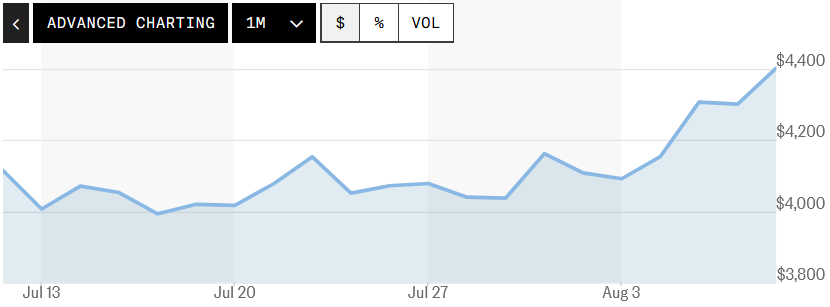
Gold climbed above $4,300 per oz and gained more than 5% for the week, its largest weekly advance since January.
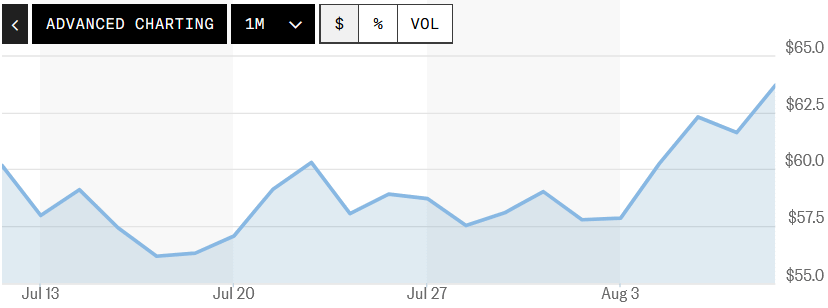
Silver surged 5% Friday to a six-week high of $64.57 per oz, its best week since February.
AMD reported record revenue of $11.5 billion, though shares fell on heavy AI capital spending. SpaceX posted its first results as a public company and rallied sharply into Friday.
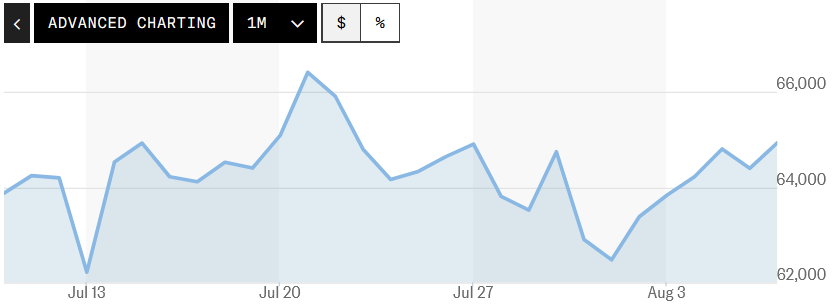
Bitcoin held a range between $62,000 and $66,000, trading near $65,000 Friday.
Market Movements
The following assets experienced dramatic swings in price this past week. Data are up-to-date as of Aug 7 at approximately 4pm EST.
(Data from StockAnalysis.com)
UP
Palantir - up 40.04%
SpaceX - up 22.83%
NVidia - up 11.56%
DOWN
Western Digital - down 20.29%
Chevron - down 5.22%
AbbVie - down 4.60%
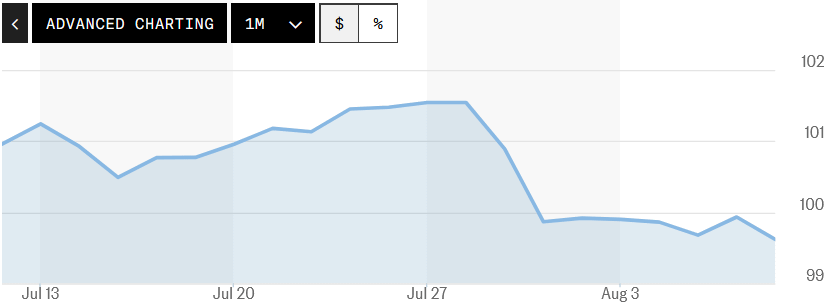
DXY - down .24%
Bitcoin - up 2.24%
Gold - up 6.76%
Silver - up 8.94%
Platinum - up 5.77%
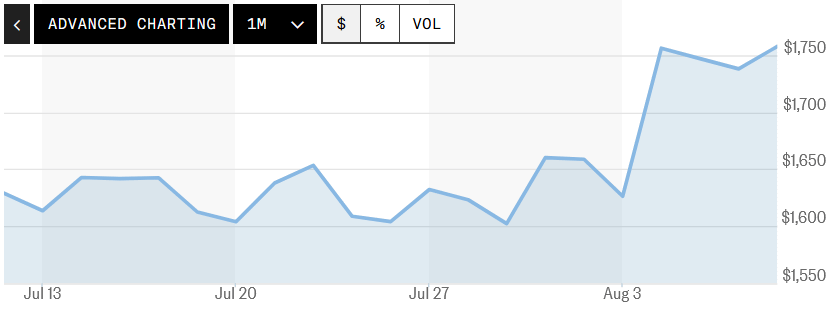
10-year Treasury Yield - down by 5 basis points
(10-year data from https://www.cnbc.com)
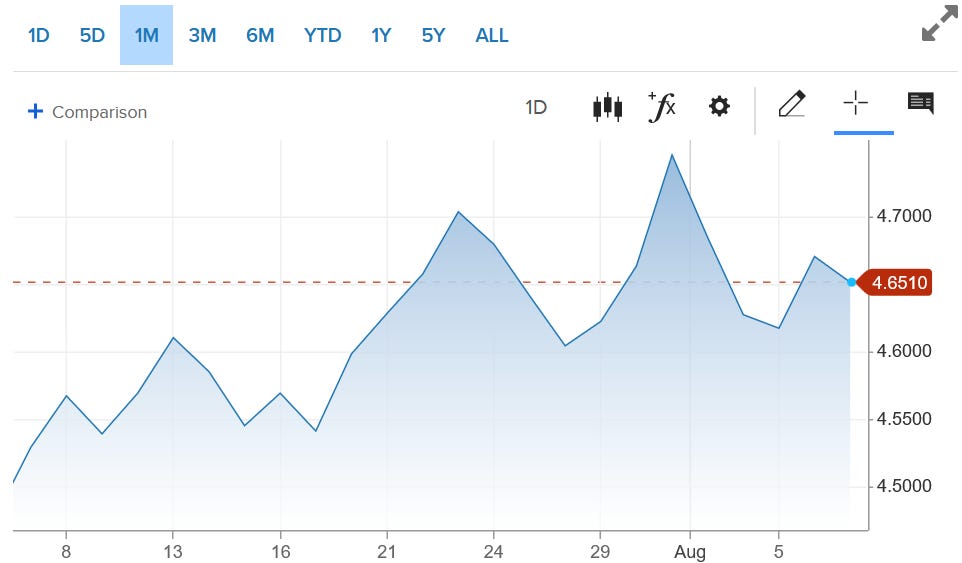
S&P 500 - up 3.37%
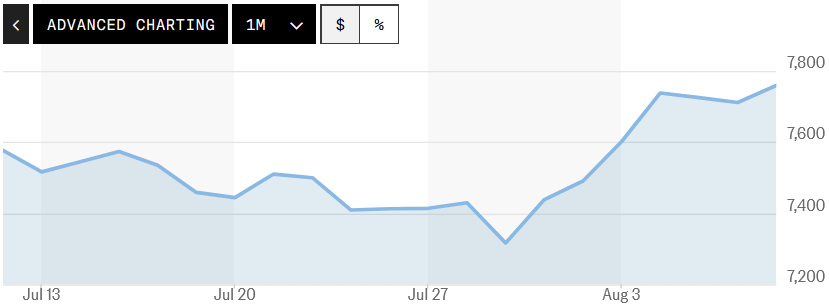
Russell 2000 - up 3.38%
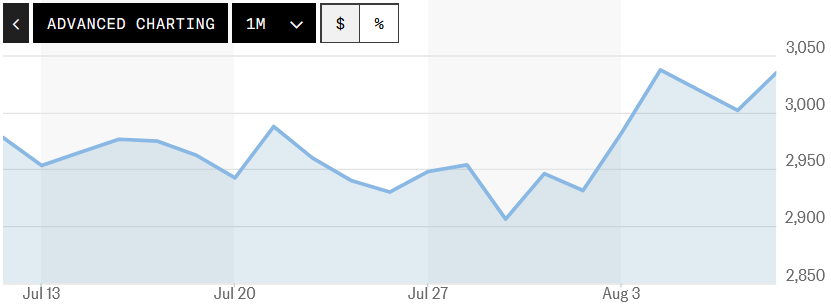
Chris Vermeulen, Chief Market Strategist at The Technical Traders, joined David Lin to review stocks, gold, oil, and interest rates. He framed the discussion around what he calls inner market analysis, a method blending price, time, and sentiment to place each asset within a stage of a recurring cycle.
Stocks, he said, had just completed a cycle low and, with bull flag patterns on the S&P 500 and Nasdaq, were entering the market’s last euphoric push. He set his S&P 500 target at 8,555, up roughly 10% from 7,724, with Nasdaq upside near 20% and semiconductors capable of rallying 30 to 50%. Once that blow-off top forms, he warned, latecomers could sit underwater for a decade or longer.
On oil, Vermeulen read the WTI pullback to about $77/barrel as an ABC correction, a three-wave pattern he treats as a bullish cleansing event, with Fibonacci extensions pointing to $100/barrel. He had stepped back from active oil trades given the volatility of the Iran war, but expects prices to stay elevated while the conflict runs.
His bigger warning centered on bonds. Charts for the 10-year and 30-year Treasury yields pointed toward 8%, a level he argued could trigger a global financial reset by crushing overleveraged borrowers. The 30-year had already spent 40 to 50 days above 5% this year, echoing a 2007 stretch that preceded the financial crisis, and 8% yields would roughly halve the TLT bond ETF from its recent price near $82.
Gold, near $4,300/oz, was bouncing off major support at $4,000/oz, a level that happens to match Bank of America’s revised year-end forecast. Vermeulen still called precious metals technically in a bear market, noting silver’s roughly 50% drop from its highs, and likened the bounce to Bitcoin’s history of false green bars that lure buyers before another leg down. A resurgent dollar, in his reading, had entered its own bull market.
Longer term, he remains very bullish on metals and would not rule out gold eventually reaching $12,000/oz, even while expecting another 20 to 40% correction first.
For a true reversal, he waits for gold and silver to break two prior swing highs and for the 20-day moving average to cross back above the 50-day, confirmation of an uptrend rather than another bear market trap.
STLLR Gold owns three significant Canadian assets with multi-billion-dollar upside: Tower, Colomac, and Hollinger Tailings. Tower and Colomac are among the largest undeveloped gold projects in the country, while Hollinger is a clean-up site with potential for near-term cash flow.
Check out David’s interview with STLLR President and CEO Keyvan Salehi in the video above.
Across these projects, STLLR has delineated 16.6 million ounces in estimated mineral resources, representing over $2 billion in replacement cost. Tower alone could deliver $2.5 billion in after-tax NPV if gold reaches $3,200, and Colomac spans 1,000 square kilometers of greenstone with considerable district-scale potential.
Backed by a seasoned management team and strong leverage to rising gold prices, STLLR Gold is positioned to unlock long-term value. Learn more at stllrgold.com/davidlin. Please review their cautionary statements and risk disclosures on their website and on www.sedarplus.ca .
Steve Hanke, Professor of Applied Economics at Johns Hopkins University, returned to the program to discuss a historic currency intervention in the yen and a selloff in the US bond market. He read both through his standing framework that monetary policy is about money supply growth, not interest rates.
The yen touched a 40-year low near 164 to the dollar before the United States and Japan intervened together, the first US purchase of yen at scale since 1998. Treasury Secretary Scott Bessent authorized the buying, speculated at $5 billion to $10 billion, and the yen rebounded to about 157.5, a gain of roughly 4%. Japan itself spent an estimated $52 billion, while the US funded its side by selling euros rather than dollars, a choice Hanke read as avoiding any show of dollar weakness.
Hanke attributed the yen’s slide to Japan’s money supply, growing just 2.2% year-over-year against the roughly 6% he calculates Japan needs to sustain 2% inflation. Japanese inflation runs at 1.6%, below target, a gap he said explains the country’s low rates, weak growth, and weak currency better than any rate differential with the US.
He called the intervention market manipulation, describing Bessent as a discretionary big player unconstrained by fundamentals, and sided with former Treasury official Mark Sobel’s judgment that the move was unwise. The bounce, he expects, will prove temporary as Japan’s fundamentals reassert themselves, especially with the new prime minister’s military spending and tax cuts set to widen the deficit.
Turning to Treasuries, Hanke noted the 30-year yield had spent 27 straight sessions above 5%, standing at 5.18%, with the 10-year at 4.637%, already past the 4.5% level Bessent wants to defend. Fed Chair Kevin Warsh had said at last week’s FOMC meeting that bond yields were doing the tightening the Fed had not.
His money-supply reading has hardened since late July. Where he then cited Divisia M4 growth of 6.7% year-over-year, he now points to an accelerating quarterly pattern, annualized growth running 4.6%, 5.6%, 7.5%, and 8.5% across the last four quarters, confirmation in his framework that inflation pressure is building rather than easing.
Hanke expects long-term yields to keep climbing, pressured by Trump’s conflict with Iran and an uncontrolled fiscal deficit, a combination he called a deadly cocktail. The affordability squeeze, visible to him in a Democratic Socialist primary win in Michigan, remains the central midterm liability, and a September rate hike would change little, since in his framework policy is the quantity of money, not its price.
Gary Wagner, Editor of TheGoldForecast.com, joined David Lin to review gold’s breakout and update his technical targets on the metal.
On July 14, Wagner had called a tentative double bottom in gold at $4,000/oz, saying a close above roughly $4,190 would confirm the correction was over, with targets of $4,300 to $4,400/oz. That call held up. Gold gapped higher in a single session, gaining roughly 4% to 5%, about $178, to trade near $4,300/oz, with a session high around $4,360/oz.
Wagner described the move as the resolution of a triangle pattern with a descending top and a flat bottom near $4,000/oz. He set new near-term support just below $4,200/oz, at roughly $4,174, and pegged resistance at $4,400/oz, the level he wants gold to clear before calling the rally sustainable.
He called $4,000/oz the line in the sand for the uptrend. A close back below it would mean the rally had failed and gold would enter a multi-year correction, not a multi-month one, echoing the aftermath of the 2011 top, when the metal fell nearly 50% from about $1,900/oz to roughly $1,000/oz by early 2016.
Wagner attributed the breakout mainly to a shift in sentiment rather than a specific catalyst, arguing traders had come to see $4,000/oz as an attractive entry after a year of exaggerated gains. He remained puzzled that gold fell rather than rallied when the United States took military action against Iran, a break from its usual response to geopolitical uncertainty.
The macro backdrop leaned hawkish. The CME FedWatch tool showed a high probability of a quarter-point rate hike in September, with Chair Kevin Warsh committed to returning inflation to 2%, and Bank of America had already cut its year-end gold forecast to about $4,300/oz on rate expectations, a level gold had since matched.
Silver mirrored the move, gaining about 4.19% to test resistance near $63.30/oz, with a second ceiling at $68/oz and support near $60.30 to $61/oz. Wagner also noted that gold’s usually weak correlation with crude oil, trading near $78/barrel, had tightened this year.
Asked directly whether he was bullish or bearish, Wagner said he had to be bullish for now. He was watching $4,400/oz as the next upside target, with $4,200/oz and then $4,000/oz as the floors gold must hold to keep the bullish case intact.
David Nicoski, CIO of Vermilion Research, discussed market rotation, the weekend US intervention in the Japanese yen, and his sector outlook. The interview taped Monday, August 3, hours after oil fell 6.5% on reports that President Trump called off a strike on Iran, and after the US bought yen for the first time since 1998.
Nicoski began with what is breaking down. Technology, now about 42% of the S&P 500’s weighting, looked parabolically extended to him, and the semiconductor ETF SMH had fallen roughly 22% to 23% from its June peak.
Korea’s KOSPI fell 33% in July, its worst month on record, worse than the 1998 Asian crisis, 2008, or the dot-com bust. Roughly 1.2 million accounts were margin called, about 3% of the population, though the index later rebounded sharply.
Consumer discretionary looked weak too. The sector traded at a 14-year relative-strength low against the S&P 500, with Home Depot, Lowe’s, and Lululemon among what he called the disasters, McDonald’s at a 14- to 16-year low, and RV and boat sellers Thor Industries, Winnebago, and Camping World lagging as buyers backed away from big financed purchases. Precious metals miners and rare earths also ranked among his weakest groups by relative strength.
Against that, financials, insurance, and healthcare have improved sharply since late June as money leaving the tech trade rotates in. European banks UBS and Deutsche Bank have outperformed for nearly five years, and healthcare names Medtronic, Abbott, and Baxter are turning up.
Movie theaters ranked among his strongest groups, and Target was beating Walmart and Costco. Energy, through the XLE, has quietly outpaced tech since the 2020 lows despite a market weight near 3%, meaning modest inflows could move it sharply.
On Japan, Nicoski said the Treasury’s intervention aimed to head off a disorderly unwind of the yen carry trade. However, Japanese yields and the yen have both risen since, an unusual pairing. The dollar broke uptrend support near the 100 to 101 level, a break he compared to April 2002, when a similar failure preceded a 25% decline in the S&P 500 over two years.
He expects bond yields to keep climbing and doubts oil revisits $40/barrel. He was watching gold’s support near $4,100/oz, with less confidence below $4,000/oz. While he stayed overweight technology for now, he called the rotation into financials, insurance, and healthcare the most investable move on the board.
Todd Horwitz, Founder of BubbaTrading.com, and a veteran pit trader, returned to the show on Monday, August 3, a day of whipsaw trading. A post-Fed rally pushed the S&P 500 up about 1.5% and the Nasdaq up 2%, while South Korea’s KOSPI had just closed its worst month on record, down roughly 33% to 35%, and the US had intervened to prop up the yen.
Horwitz kept his long-term bearish call intact, saying a major meltdown is still coming. Volume ran near half normal, and the VIX sat flat despite the rally, signs he read as buying nearly exhausted, though he expects light volume to keep drifting markets higher near term.
His oil position was largely unchanged. He remained a seller near $85/barrel, would consider shorting again near $80, and now targets the mid-$50s by year-end. Monday’s 6.5% single-day drop, tied to a called-off strike on Iran, showed him fear premium rather than fundamentals driving the swings.
He kept his call for a Fed rate hike, though he now frames it as a year-end move rather than pinning it to September, with markets pricing roughly a 90% chance of a hike by then. He credited Fed Chair Kevin Warsh, and said the Fed would skip only if oil fell back into the $50s and inflation cooled.
He kept buying dips in the metals. Gold had been based between $4,000/oz and $4,200/oz since late June, touching $4,000 ten times in 35 days by his chart, and he expects a breakout north of $4,800/oz by year-end once bearish traders capitulate into a short squeeze. Silver’s base at $55/oz to $60/oz remained his entry zone.
The yen was the newest wrinkle. He would have bought it near the chart’s bottom, but after the intervention-fueled spike, he expects a substantial near-term pullback, while staying constructive on the currency longer term.
On stocks, he reiterated that he stays permanently long and hedged, adding on dips and using back-ratio option spreads rather than naked puts.
His bond trade shifted the most. Having sold 10-year note futures near 114 previously, he now looks to reload that short around 110, implying a yield near 4.4%, and to sell 30-year futures near 112, betting the 10-year yield approaches 6% by year-end.
George Noble, Managing Partner of Noble Capital Advisors and Author of “The Noble Update," returned for his third appearance in recent months to revisit his short calls and lay out a new long idea.
SpaceX, his short since $145 a share, traded down to a fresh low near $111 during the interview even after reporting quarterly revenue up 92% to $7.8 billion. He kept his valuation near $30 a share and said the stock could still be cut in half, possibly by year-end, flagging a share unlock the next day that would lift the float from 5% to 25%, freeing roughly 911 million shares against the 85 million issued in the IPO.
He grouped Tesla, shorted since $475, alongside SpaceX as two of the best shorts in the history of capital markets, arguing both trade more on artificial intelligence narrative than fundamentals. SpaceX’s quarterly revenue set against a market capitalization near $1.4 trillion illustrated, he said, the size of the gap.
Noble used the collapse of Leopold Aschenbrenner’s roughly $45 billion fund, absorbed by Citadel after a forced sale, as a case study in excess leverage. The fund had been up 439% before four times leverage erased 67% of its value in a single month, and Noble said that stripping out its Anthropic stake left Aschenbrenner near zero on his publicly traded positions.
He called semiconductor stocks a fabulous short, comparing them to shipping stocks that should be sold when order books are full and profits peak rather than bought. Record options activity, more than 4 million S&P 500 call options traded in a single day by his account, struck him as a blow-off top, and he repeated his view that AI-related capital misallocation ranks among the worst in history.
For his next idea, Noble named energy as a likely home run trade over the next 5 to 10 years, alongside copper and gold. Energy is up 30% this year yet still represents only 3% of the S&P 500, less than half the weight of Apple or Nvidia alone. He also favors bulk shipping and remains short bonds.
Asked whether rising interest rates and a steepening yield curve threatened his gold and commodity positions, Noble agreed that they did. He offered no hedge against that risk beyond his broader view that reflation, defined widely, remains intact.
Mark Thornton, Senior Fellow at the Ludwig Von Mises Institute, talked with David for the first time on Tuesday, August 4th, the day the S&P 500 and Dow Jones closed at record highs. AI infrastructure spending guidance for 2026 stood at $725 billion, up 77% from last year, while the 30-year Treasury yield held above 5% for weeks running, a combination Thornton called a danger zone.
His framework is Austrian business cycle theory: artificially cheap credit pushes businesses into malinvestment, funding projects that would not pay off at true market rates. His signature illustration, the skyscraper curse, holds that record towers, the Chrysler Building in 1931 and the Burj Khalifa in 2010 among them, tend to open just as the boom that financed them turns to bust.
He applied that lens to AI data centers, the modern skyscraper in his view, financed by the same cheap credit but rising in rural counties rather than city skylines. The pace of that spending struck him as irrational, and its scale suggested motives beyond ordinary business productivity.
Thornton treated tariffs the same way, as a political tool that taxes domestic consumers rather than foreign exporters. He compared today’s duties to the 1860s, when Northern tariffs on European goods burdened Southern agriculture and helped push the country toward civil war. Twenty-five Democratic-led states have sued the administration over new tariffs covering most US imports, and Amazon’s $600 million in refunds, he noted, mostly returned duties Amazon itself paid as an importer.
He tied the Persian Gulf conflict to a decades-long decline in fossil fuel and nuclear investment, warning that falling output from aging oil fields will push diesel prices higher and strain fertilizer supply enough to risk an agricultural crisis within two crop cycles. Copper, he added, was trading at an all-time high on AI demand and China’s shift away from silver in solar panels.
On the Fed, Thornton said Kevin Warsh’s nomination, the most hawkish of the finalists, coincided with a sharp drop in precious metals that deepened after the US strike on Iran’s leadership. He expects financial repression from here: bond purchases at the long end of the curve rather than rate cuts, plus an inflation target pursued partly by redefining how prices are measured.
The malinvestment lens produces a forecast outside consensus. Thornton expects stocks, bonds, and real estate to deliver roughly zero or negative real returns over the next decade even as food and energy prices keep rising, a split most Wall Street forecasts do not anticipate.
Joanne Hsu, Director of the Surveys of Consumers and Research Associate Professor at the University of Michigan, discussed her index’s latest reading and the trends beneath the headline number.
The index bottomed in May at a level comparable to the prior historic low of June 2022. Sentiment then rose more than 10% in both June and July, with July’s final print at 55.2, up from June’s 49.5, though still 11% below its year-earlier level and, she said, part of a longer downward trend.
Consumers were not reacting to geopolitical headlines directly, Hsu said, but to gas prices. Those had risen again in recent weeks amid continued disruption at the Strait of Hormuz, which would make the improvement hard to sustain without lasting relief on energy costs.
Inflation remained the top factor on consumers’ minds, with the economy now five years above the Federal Reserve’s inflation target. Expectations eased somewhat after the Iran conflict began but stayed above February levels for both the short and long run, which she said works against the Fed’s goal of anchoring them.
Sentiment split sharply by wealth. Consumers who own stock felt far better about the economy than those who do not, tracking record highs in equities, while low-wealth consumers barely moved, holding no personal stake in the rally. The overall index, she noted, shows essentially no correlation with the S&P 500.
Consumer mentions of artificial intelligence have risen over the past year and roughly flatlined since March. Comments split between those crediting AI with lifting stocks and productivity and others citing layoffs and data center side effects such as higher local electricity prices. On balance, the commentary skewed negative.
Hsu also tracks what she calls inflationary psychology, the share of consumers who say now is a good time to buy big-ticket items because prices will only rise later. A sustained surge in that measure has historically been a strong leading indicator of higher inflation, and one followed the 2024 election as consumers rushed purchases ahead of expected tariffs.
Sustained disinflation, not a month or two of improvement, is what consumers need before confidence returns, Hsu said, distinguishing that from deflation, which people claim to want but would not welcome. She could not yet call a sustained uptrend for sentiment without more stability in energy prices, pointing back to the unresolved tension at the Strait of Hormuz.
Florian Grummes, Managing Director of Midas Touch Consulting, joined David on July 30, a day after the Federal Open Market Committee held rates steady, to discuss the Fed, inflation, and the outlook for gold, silver, and Bitcoin.
Grummes attributed the recent CPI rise mainly to oil prices tied to the Iran war and to years of expanding global money supply, a pattern he likened to Ludwig von Mises’s crack-up boom, in which trust in fiat currency erodes even as stock prices keep setting records.
Near term, markets rebounded that day from the prior session’s 1,000-point Dow drop, with the S&P 500 up 1.3%, the Nasdaq up 2.5%, and gold up almost 2% to $4,170/oz. Gold had otherwise churned sideways near $4,000/oz since mid-June with $100 daily swings, and Grummes preferred to stay cautious until the Jackson Hole meeting in late August.
Within one to three months, he expected gold to finish bottoming and rally toward its 50-day moving average near $4,250 to $4,300/oz, with the 200-day average near $4,500/oz as a stretch target and worst-case downside of another 10 to 15%. Silver will likely lag gold near term, while a Bitcoin cycle turn could arrive by mid-October.
He also faulted the European Central Bank for raising rates into mass layoffs and steep profit declines across Germany’s auto sector, a mix he warned risks stagflation.
Longer term, Grummes said gold remained in a secular bull market roughly 25 years old, with a retest of $5,000/oz possible by year-end or into next year. Silver was repeating the pattern of its 1980 and 2011 tops near $50/oz, having broken above $50 again and peaked near $121/oz; he saw support at $45 to $55/oz and an eventual return to $100/oz.
On Bitcoin, Grummes had exited crypto entirely last autumn but was regaining interest now that sentiment had gone quiet, with prices, by his account, near $58,000 to $60,000. If the four-year cycle holds, a turning point could arrive by mid-October and a run toward $300,000 within three years, though he flagged Michael Saylor’s leveraged strategy as an ongoing risk.
Across horizons, Grummes paired near-term caution with longer-term conviction, most clearly on gold. The 30% correction since January was, to him, a healthy reset of an overbought market, not evidence of a lost safe-haven role, and his strongest belief remained that gold’s multi-year bull trend would continue.
Thanks for reading! This post is public so feel free to share it.
Monday, Aug 10 -
No economic data
Barrick Mining earnings
Tuesday, Aug 11 -
NFIB Index of Small Business Optimism (July)
Existing Home Sales (July)
Federal Reserve Bank of New York Q2 Household Debt and Credit Report published (4Q)
Sea Limited earnings
CoreWeave earnings
Wednesday, Aug 12 -
CPI (July)
Core CPI, M/M% (July)
CPI, Y/Y% (July)
CPI Core, Y/Y% (July)
Monthly Treasury Balance (July)
Cisco earnings
Thursday, Aug 13 -
Weekly Jobless Claims (Aug 8)
PPI (July)
Ex-Food & Energy PPI, M/M% (July)
Applied Materials earnings
Friday, Aug 14 -
Retail Sales (July)
Manufacturing & Trade: Inventories (June)
U. Michigan Prelim Consumer Survey (Aug)
No posts
Comments
Nothing yet. Say the first thing.
Sign in to join the conversation.