
SPONSORED POST: Augusta Precious Metals
Stocks ‘Can Collapse At Any Time’ If The Fed Does This Warns Analyst
$14,000 Gold, $500 Silver; Investor Warns A ‘Big Reset’ Is Coming
$5,000 Gold Return: This Is When And How The Next Breakout Starts
‘Edge Of A Precipice’: Entire Financial System At Risk
Tech Sell-Off Deepens: Investor Reveals Major Market Warning Signs
Major Market Repricing Alert: Global Economy Changed Forever
MARKET RECAP: July 27, 2026 - July 31, 2026
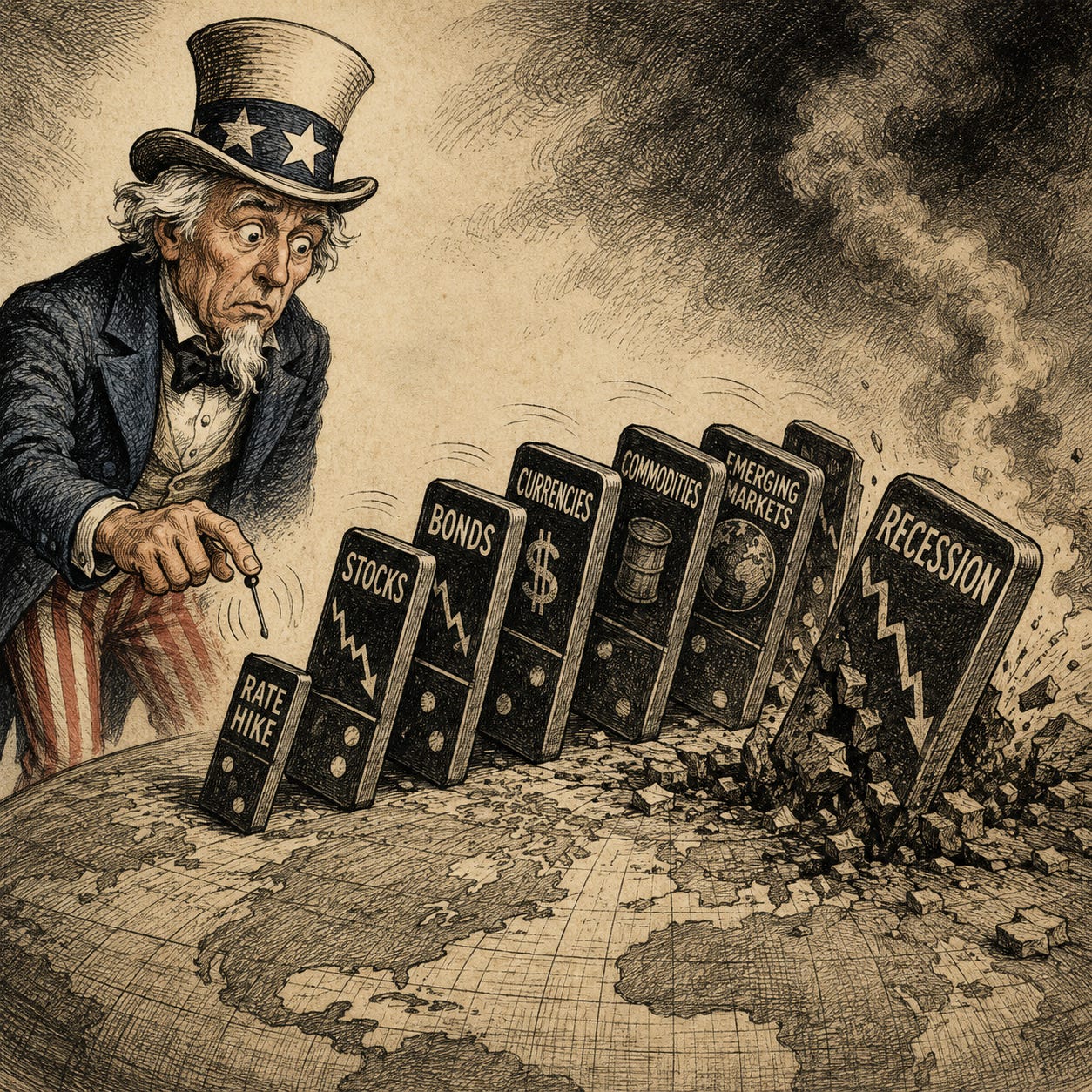
The Federal Reserve held its benchmark rate at 3.5% to 3.75% on Wednesday, a fifth consecutive pause. Three officials dissented in favor of a quarter-point increase: Beth Hammack of Cleveland, Neel Kashkari of Minneapolis, and Lorie Logan of Dallas. The 9-3 vote produced the most dissents in one direction since September 2016.
The decision was Chair Kevin Warsh’s second, and he again withheld forward guidance and released a statement far shorter than the Fed’s recent norm. The statement said economic activity was expanding at a solid pace despite elevated uncertainty tied in part to the Middle East conflict.
Equities sold off sharply on the decision. The Dow Jones Industrial Average fell 1,153.18 points, or 2.19%, to 51,594.14, its worst session since April 2025. The S&P 500 lost 1.52% to 7,316.15, and the Nasdaq Composite dropped 1.74% to 24,442.94.
Long-dated Treasuries drove the reaction, as investors judged the Fed to be falling behind on inflation. The 30-year yield rose more than 9 basis points to 5.193% and later reached its highest level since 2007. The two-year yield slipped 4 basis points to 4.236%, a split that signaled concern about prices rather than growth.
Megacap earnings reversed the mood on Thursday. Microsoft jumped about 15% after Azure revenue topped $100 billion for the first time, its largest one-day gain since 2008. Meta sank 8%, while the Nasdaq climbed 2.8% to 25,122.18 and ended a six-day losing streak.
Amazon rose about 15% on Friday after strong cloud results, while Apple fell on a soft outlook and rising component costs. The S&P 500 added 0.7% to 7,489.72, the Nasdaq gained 1% to 25,373.85, and the Dow rose 0.53% to 52,485.03. All three gained for the week, and the four largest hyperscalers guided to combined 2026 capital spending of $720 billion to $745 billion.
Crude whipsawed on shifting war headlines. Brent fell 8.7% Monday to $88.36 per barrel after Iran signaled it would suspend attacks, then settled at $90.12 Friday after Tehran said it struck two tankers transiting the Strait of Hormuz. WTI closed at $84.67, leaving both benchmarks down more than 5% for the week but up about 20% for July.
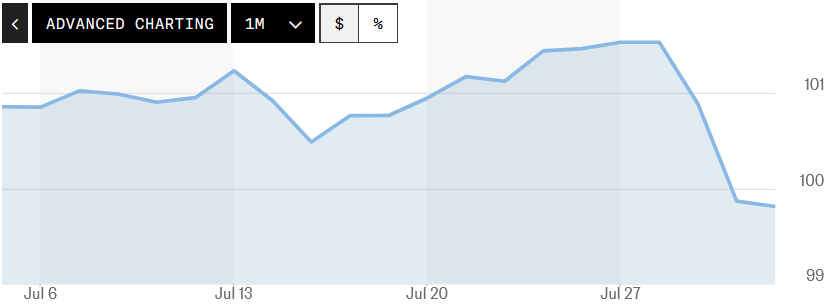
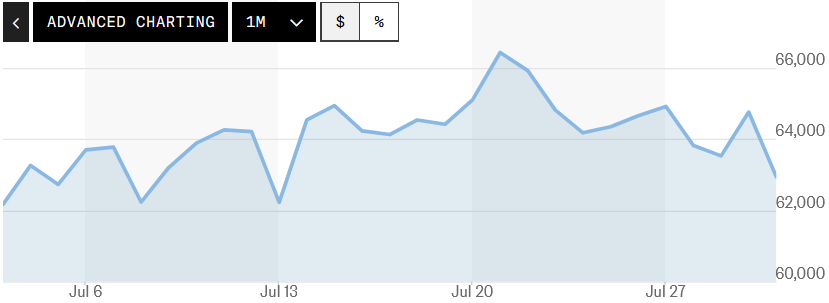
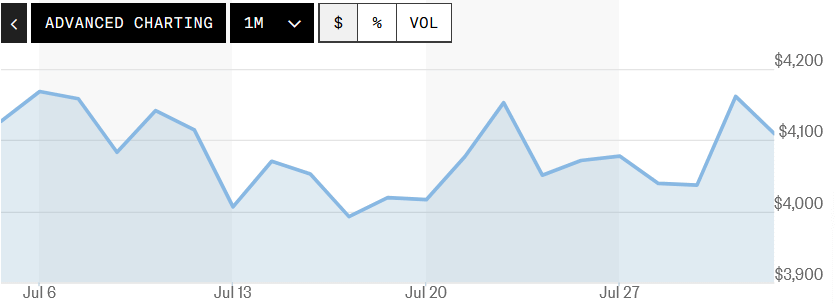
Growth data softened while inflation held firm, with GDP up 1.5% in the second quarter against a 1.8% forecast and core PCE steady at 3.3%. Gold traded near $4,100 per oz and silver near $58 per oz as suspected Japanese intervention pushed the dollar down 3.3% against the yen. Bitcoin slipped toward $64,000.
Market Movements
The following assets experienced dramatic swings in price this past week. Data are up-to-date as of July 31 at approximately 4pm EST.
(Data from StockAnalysis.com)
UP
Microsoft - up 21.21%
Amazon - up 16.31%
Alphabet - up 11.78%
DOWN
Sandisk - down 22.39%
META - down 9.06%
Caterpillar - down 8.35%
DXY - down 1.56%
Bitcoin - down 3.70%
Gold - down 1.10%
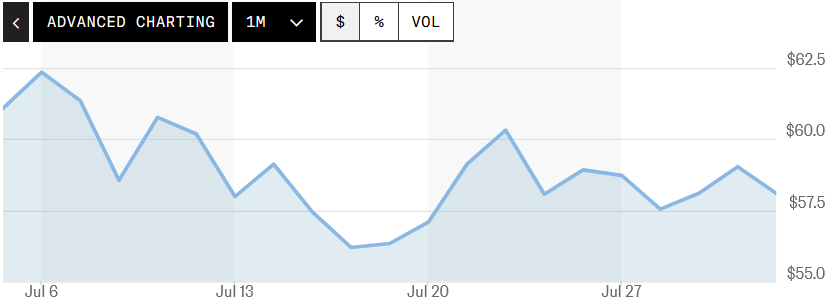
Silver - down 2.54%
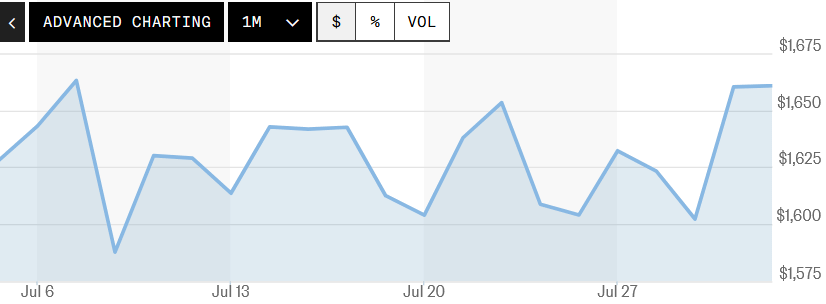
Platinum - up 2.00%
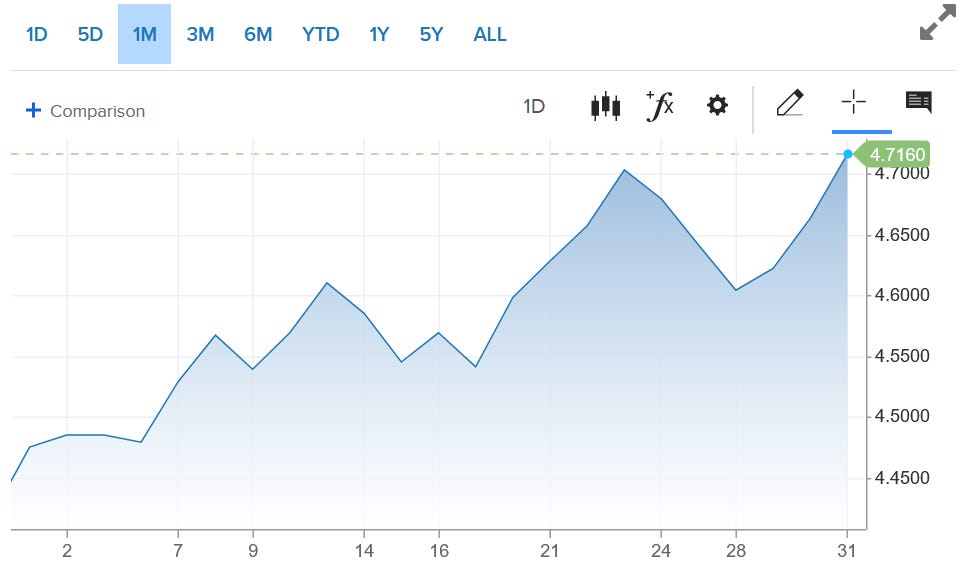
10-year Treasury Yield - up by 6.1 basis points
(10-year data from https://www.cnbc.com)
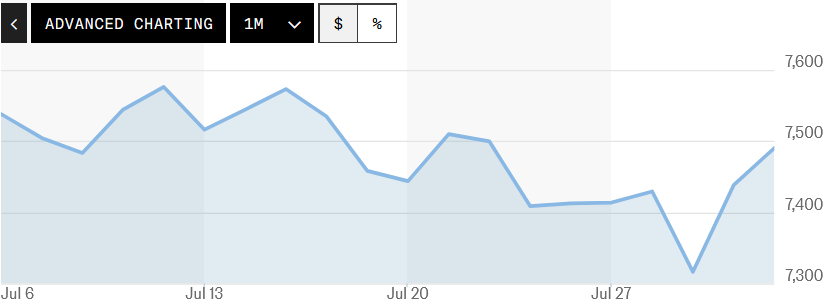
S&P 500 - up .34%
Russell 2000 - down .45%
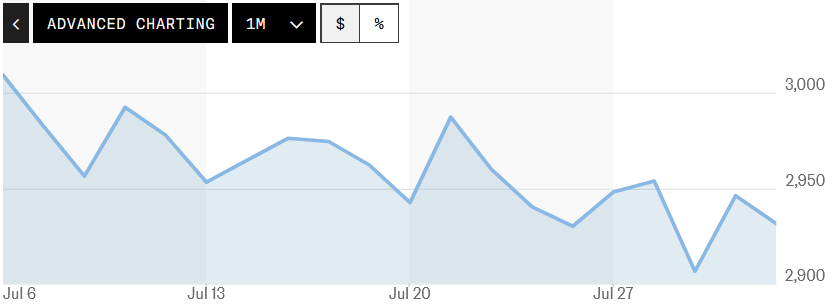
Mike McGlone, Senior Commodity Strategist at Bloomberg Intelligence, discussed the Federal Reserve, inflation, and his long-running deflation thesis. A rising stock market, not energy, was his primary read as the driver of inflation, and Fed chair Kevin Warsh had little reason to hike since the bond market was already tightening on its own.
McGlone reads markets through ratios more than levels. The Treasury bond price measured against gold had fallen to its lowest since 1985, and he called the 30-year yield, near 5.2% and the highest in 19 years, this year’s momentum trade, the role gold played last year. That yield has become steep competition for non-income assets like gold and Bitcoin.
Gold itself had reached its highest correlation on record to the S&P 500, even as its volatility ran twice the index, a combination unseen in about 20 years. He called last year’s rally the sharpest since 1979 despite a disinflationary backdrop and said gold, near $4,000/oz, needs stocks to keep rising to hold its gains. He expected a reversion toward $3,000/oz, with $5,000/oz requiring something far more dramatic.
Copper traded as a near-total mirror of the S&P 500 rather than on its own fundamentals, he said. Hedge funds held roughly 30% net long positions in CME copper futures against a historical average near 5%, a crowded setup he read as a warning. A 10% drop in the S&P 500 would likely send copper down 10% to 20% or more.
Asked which of gold, copper, or crude oil would revalue first, McGlone chose crude, expecting a reversion toward its long-term average near $70/barrel and potentially $40/barrel, with average US production costs near $55/barrel as a rough floor. Copper was the more telling signal, since a decline there would point to a broader global slowdown.
Bitcoin, trading near $64,000 to $65,000, drew a harsher read than gold. McGlone considers it high-beta speculation in an oversupplied field of tokens rather than digital gold, and he kept his standing call for an eventual bottom near $10,000, noting Bitcoin had already fallen even as stocks rose, a divergence he called a failed leading-indicator test.
The ratio he returned to most often was copper against the S&P 500. A break in that link, copper falling while equities held firm or the reverse, would be the clearest early signal that the deflationary reset he expects across gold, bonds, and crude had begun.

Retirement keeps getting more expensive. Fidelity now estimates the average couple will spend around $345,000 on healthcare alone over the course of retirement, before a single mortgage payment or grocery bill. Add long-term care and the figure climbs higher.
For most people, that money sits in a 401(k) or IRA, tied to a stock market that swings and a dollar that loses purchasing power over time. That is why a growing number of investors are choosing to hold part of their retirement in physical gold.
Gold sits outside the traditional paper system. It carries no counter-party risk, answers to no central bank, and has held its value through past financial crises, which is why many use it to diversify when markets get volatile.
Federal tax law lets you move an existing 401(k) or IRA into physical gold, held in a gold IRA, without triggering taxes or penalties.
Learn more and get your free 2026 Gold IRA Guide at LinTrustsGold.
Komal Sri-Kumar, President of Sri Kumar Global Strategies, discussed the market turmoil that followed the Federal Reserve’s decision to hold interest rates steady. The Federal Open Market Committee voted 9 to 3 to keep the federal funds rate at a range of 3.50% to 3.75%, with three regional bank presidents dissenting in favor of a hike.
The vote alone barely moved markets, Sri-Kumar said. The damage came during Fed Chair Kevin Warsh’s press conference, when he declined to explain the Fed’s inaction: the Dow fell 1,000 points, and the gap between 2-year and 10-year Treasury yields widened 11 basis points, a 35% single-day jump he attributed to eroding Fed credibility rather than growth optimism.
Sri-Kumar disagreed with Warsh’s framing that rising long-term yields meant markets were doing the Fed’s job for it. The Fed should lead the bond market, not follow it, he argued, and Warsh’s refusal to offer forward guidance, unlike prior chairs, left investors operating in a vacuum.
He also tied the inaction to politics. President Trump opposes a rate hike and has previously insulted and threatened to fire Fed officials, a history Sri-Kumar believes is nudging Warsh toward delay.
That delay carries a cost. Inflation has run above the Fed’s target for 63 straight months, and Sri-Kumar likened Warsh’s reliance on task forces to Jerome Powell’s pandemic-era insistence that inflation was transitory. Further delay, he warned, will make the inflation picture significantly worse by early 2027.
He was equally skeptical of two workarounds to a hike. Yield curve control, which the Fed last practiced until 1951, in an era when the central bank was effectively subservient to the Treasury, would only postpone a reckoning. Aggressive quantitative tightening, meanwhile, risks a funding accident like the 2023 Silicon Valley Bank failure or the 2019 repo crunch, forcing a reversal into easing.
He predicted the Fed will raise rates 25 basis points in September, short of the 50 basis points he believes is warranted, with the first signal likely at the Jackson Hole symposium in late August. Until Warsh offers clearer guidance, Sri-Kumar expects continued volatility, with NASDAQ shares and long-dated bonds most exposed.
The consequence he flagged as most overlooked was structural. The traditional 60/40 portfolio no longer offers protection, since an opaque Fed leaves stocks and bonds vulnerable together. Delay does not erase the eventual adjustment so much as store it up for a sharper, less orderly one later.
Peter Grandich, Founder of Peter Grandich and Company, which manages close to $2 billion for clients, discussed the risks he sees building across markets, the dollar, and global politics.
Grandich said the wealthiest 1% of Americans now hold more assets than the entire middle class. His own clients, many in New Jersey, told him business has never felt harder. The Fed was due to meet that Wednesday, and market odds of a rate hike had jumped to 38%.
He doubted anything would stop the Fed from tightening, citing tariff-driven strength in producer prices. Not raising rates, he argued, could hurt bonds more than raising them, with the 10-year yield nearing 5%. Refinancing the nearly $10 trillion in debt coming due would likely require a 10-year at 5% or higher.
Japan concerned him more. The yen had fallen to its weakest level in almost four decades even as the Bank of Japan kept raising rates, and Tokyo’s shift toward repatriating capital mattered more to him than the Fed’s next move. He also flagged cracks in Korean and Chinese equities, AI-related vendor lending reminiscent of the dot-com era, and the recent exit of two senior Blackstone executives.
His gravest concern was the dollar itself. He called this the beginning of the end of its dominance, with Gulf states and the BRICS bloc drifting from Washington while China led central bank gold buying. The prolonged, unresolved conflict with Iran, worsened by a drained Strategic Petroleum Reserve, would prove a net negative for the United States, he argued, and would accelerate that loss of standing.
Grandich admitted his own timing had not been perfect. He held metals aggressively from 2016 through this past January, then sold almost everything as prices rose too fast. He returned only in recent weeks, after gold briefly traded below $4,000/oz, the level he had been waiting for.
He pushed back on the idea that higher rates threaten gold, noting its two strongest rallies in his 42-year career came as rates rose. His favorite holding remained copper, which has climbed steadily for years.
Citing estimates that the world needs six new tier-1 copper deposits annually through 2050, with almost none in development, he said he would rather own copper stocks than any technology stock today.
Milton Berg, Founder of MB Advisors and a longtime Wall Street technician formerly with Oppenheimer, joined David on July 29, just ahead of that day’s FOMC meeting, with the Nasdaq down 1.4% intraday.
Berg expected Fed Chair Kevin Warsh to act despite consensus forecasts of no change, arguing the central bank historically follows the 2-year Treasury yield, then near multi-year highs. He put the odds of an outright rate hike above 50% and called some tightening action, possibly balance sheet reduction, close to certain.
His first exhibit was a rare divergence: 54 S&P 500 stocks hit new one-year highs on a day the Nasdaq had fallen in 8 of the prior 9 sessions. That pattern had occurred only twice before, in 1985, when the market fell another 4.5% before bottoming, and in January 2022, at what proved to be the S&P’s bull market peak ahead of a 24% decline.
His second exhibit was margin debt. Net credit balances relative to cash sat at the lowest level on record, a condition he associated with the tops of 2000 and 2007 to 2008. Rising rates make that debt costlier to carry and could eventually force selling.
Against those warnings stood a cluster of buy signals his models generated between March 31 and April 14. Historically, such signals produced 12-month S&P gains of 19.7% in the minimum case and about 26% at the median, implying index targets between roughly 8,286 and 8,958. About two-thirds of the April signals remained on track, which is why he stopped short of calling a bear market.
On the charts, he cited the Philadelphia Semiconductor Index down 26.31% from its June peak and South Korea’s Kospi falling to a fresh low, both tracing island-top reversal patterns he reads as exhaustion. He called that kind of cycle work highly speculative even as it led him to add a 1% tactical long position in the Kospi.
Berg also revisited his January 29 call to sell his own and clients’ gold, made after gold’s ratio to CPI reached roughly twice its 1980 level and its ratio to crude oil hit a record. Gold has historically outpaced inflation by only about 1.5% a year, he noted, though he has since taken tactical 5% positions in gold, silver, and the miners’ ETF GDX.
His institutional accounts stayed short semiconductors, the Nasdaq 100, and the S&P 100 since June, while his retail model remained fully long the S&P 500. He will abandon that stance only once a majority of the April signals start underperforming their historical medians.
Willem Middelkoop, Founder of the Commodity Discovery Fund, discussed the monetary transition he believes is accelerating. He first laid out the thesis in his 2013 book, subtitled The War on Gold and the Financial Endgame, and said this year’s headlines confirm it.
He pointed to the escalating US-Iran conflict, including threats from President Trump to strike Iranian infrastructure over Strait of Hormuz attacks, as evidence the petrodollar arrangement struck with Saudi Arabia in the early 1970s is breaking down. Saudi Arabia has increasingly sold oil in yuan rather than dollars, he said, and Gulf states are learning that hosting US bases is a liability, not a guarantee.
China, leading the BRICS bloc, is the quiet beneficiary of American missteps, expanding non-dollar trade while avoiding confrontation. Central banks have bought roughly 1,000 tons of gold annually for five straight years, about a third of global mine output, which he reads as hedging against dollar decline, not speculation.
He cited a Deutsche Bank report, which he said echoed his own book, showing central bank gold holdings have surpassed their Treasury holdings and now make up about 30% of reserves, against a historical norm above 40%. The bank projected gold could reach $12,000/oz to $14,000/oz on that reversion, a target Middelkoop called credible.
He warned that US national debt is nearing $40 trillion, with about $8 trillion in Treasuries rolling over annually, dangerous as yields resume climbing after decades of decline. A sovereign debt crisis, potentially a third and larger wave after the 2000 tech bust and the 2008 financial crisis, ranks among the biggest risks ahead.
On prices, Middelkoop said gold could retest levels below $4,000/oz before resuming its advance, having pulled back from an early-year peak near $5,500/oz. He expects silver, which he bought more of near its $55/oz breakout level, to reach $100/oz within months and $500/oz within a few years, on his view that the gold-to-silver ratio will eventually revert toward 10 to 1.
He favored gold and silver mining equities, noting major producers trade at price-to-earnings ratios near 10 to 11 with free cash flow exceeding many tech companies, and said producers could double within 12 to 18 months. Copper offers the strongest setup among industrial metals, he added, given AI and electric vehicle demand alongside falling output at BHP, Rio Tinto, and Codelco.
The signpost he watches for the next phase is continued central bank selling of Treasuries in favor of gold, alongside stress in sovereign bond markets.
Joe Cavatoni, Senior Markets Strategist at the World Gold Council, discussed why gold’s rally stalled and which flows could restart it. Gold was consolidating near $4,000/oz, at $4,000.88/oz on July 21, after correcting from a peak near $5,500/oz.
Cavatoni called that peak stretched, the product of roughly 162% price appreciation over about 18 months amid a fever pitch of geopolitical rhetoric touching Greenland, Cuba, Venezuela, and Iran. Physically backed gold ETFs shed $8.9 billion in June, World Gold Council data showed, with every region posting outflows and North America losing the most. He tied the selling to Western investors rotating into higher-yielding short-term instruments.
That selling was offset by central banks, which kept buying, and by steady bar and coin accumulation in the first half of the year. Asian investors proved stickier through the downturn, a pattern he tied to regional diversification needs rather than US rate expectations. China, India, and Japan posted record ETF and investment flows last year.
Flows have recently turned, Cavatoni said, with US ETF demand going positive, Asian flows holding, and European buying picking up after a quiet stretch. He cautioned that ETFs make up only 6% to 7% of the global gold market, a sentiment gauge rather than the full picture. Central bank purchases, jewelry demand, and the roughly 10% of demand from technology matter just as much.
Looking ahead, he expected rates to dominate headlines, with a new Fed chair still shaping policy and Beige Book commentary describing a steady, unspectacular economy. He flagged the FOMC meeting at month’s end and the coming Jackson Hole gathering as likely to clarify the Fed’s direction. Absent that clarity, gold should hold near $4,000/oz, with a return toward $5,000/oz possible if rates fall or Middle East tensions ease.
Cavatoni also cited a structural case: mammoth sovereign debt with no clear resolution, and no dollar-based alternative liquid enough to rival gold as a reserve asset. Central banks have built reserves for nearly 15 years since the financial crisis, a trend he expects to keep gold appreciating over five years rather than repeating the multiyear consolidations of the 1980s and 2012 to 2019.
The flow he expects to matter most from here is Asian demand: new gold ownership instruments in China, and Hong Kong’s bid to become a physical trading hub alongside London’s OTC market. That shift, he said, is likely to shape gold demand more than any single Western data point.
Doug Casey, best-selling author of "Crisis Investing" and the Crisis Investing Newsletter, discussed the Israel-Iran war, the US debt, and the outlook for gold, silver, and oil.
Casey argued the US resembles a dying empire, a giant dinosaur in its death throes, headed toward what he called a greater depression building since the 1960s. He called the US and Israeli strikes on Iran a Pearl Harbor-style attack launched during peace talks and a war crime, and said he hoped Trump would be prosecuted for it. None of the roughly 800 US military bases abroad are defensive, he argued, citing Henry Kissinger’s line that being an American ally is worse than being an enemy.
From that framing, Casey turned to markets, putting Iran’s damage at $300 billion and arguing the conflict is not going away. Cheap Houthi drones had outmatched costly American missiles, kept US carriers off Iranian shores, and pushed tanker tolls through the region’s chokepoints to $1 million to $2 million a ship, trivial against oil near $80/barrel. He remains bullish on oil through stocks rather than futures, avoiding Middle East operators.
Casey extended his distrust of state power to fiscal policy. The federal government carries $40 trillion in debt, he said, with $15 trillion due to roll over within a year, financed increasingly by the Fed creating money, which he called the root of inflation. Fed chair Kevin Warsh is trapped between hikes risking defaults and cuts risking more inflation, and the debt will eventually be defaulted on outright or inflated away.
That distrust underpins his metals stance. He has bought gold since 1971, when it traded at $35/oz against roughly $4,000/oz now, a gain of roughly 120 times, and said gold and silver, near $60/oz, are no longer as underpriced relative to other goods as they once were.
Mining stocks remained attractive to him, since industrywide costs run near $1,700/oz against a $4,000/oz sale price. He is heavily overweight gold, silver, and energy stocks.
He owns no artificial intelligence companies, calling the sector a bubble even as he credited computing power with advancing fast enough that machines could eventually become sentient. AI is improving geological analysis and could lift metals output, but most data center spending, in his telling, gathers information on people, and much of that capital will be lost.
Despite the pullbacks in gold and silver, Casey said monetary conditions are more dangerous than at any point in the last 50 years, calling himself an unrepentant bull on the metals and energy stocks he holds.
E.B. Tucker, Editor of The Tucker Letter, discusses markets, discussed the tech selloff, the outlook for gold, silver, and Bitcoin, and this week’s Federal Reserve rate decision.
He addressed the near-term picture first, noting Intel had fallen 40%, South Korea’s SK Hynix more than 50%, and SanDisk another 12% in a single session, while Nvidia and OpenAI were reportedly discussing a backstop of up to $250 billion to help finance a 10-gigawatt data center campus in Pike County, Ohio. The arrangement, in which AI firms increasingly finance one another rather than tapping banks or equity markets, meant to him that the buildout still had room to run. However, weaker segments would face trouble as more efficient chips arrive. On the Fed’s Wednesday decision, he said the outcome mattered less than assumed, since a 25- to 50-basis-point move would ultimately be absorbed by consumers, not companies.
Tucker revisited a call from earlier this year that had drawn reader criticism: selling about 15% of his silver position above $100/oz, near what he called a premature peak around $121/oz. He wished he had sold 30%, since the price later pulled back, and he stood by the trim despite the backlash.
He also flagged a gold trade, saying he sold his gold ETF holdings in the first quarter and booked gains while keeping physical bullion. Gold’s move from roughly $4,100/oz to $4,500/oz was not meaningful to his thesis, he argued, attributing the price mainly to leverage ratios in the futures market rather than rate expectations and dismissing a recent Bank of America forecast cut as unreliable.
On mining stocks, Tucker said he exited his positions in April, a call he now views as about a month late. If gold’s rally failed to lift mining stock prices meaningfully, he reasoned, investors had little reason to keep holding them.
Looking further out, Tucker put gold’s total market value at about $32 trillion and called a rise to $100 trillion highly unlikely even across a 30-year horizon. Gold should stay a modest share of a portfolio, he said, and he rejected using it to prepare for societal collapse as unrealistic.
His farthest-out call centered on Bitcoin. He recommended holding Bitcoin equal to roughly half one’s gold allocation, called the price near $65,000 an attractive entry point, and dismissed other cryptocurrencies. As daily life becomes fully digitized, he predicted, demand for Bitcoin’s fixed supply of about 21 million coins will keep growing.
John Butler, author of The Amphora Report, discussed chokepoint geopolitics, stagflation, and precious metals.
Butler said repeated American strikes had badly weakened Iran’s military, yet the Strait of Hormuz, which carries roughly 20% of the world’s oil, petrochemicals, and fertilizer, remained closed off and on. Iran needed no first-rate navy to keep it that way, only enough of a threat to make shipping insurers unwilling to write policies. He called the result stagflationary, prices rising as growth slows, with China, the United States, and India drawing down stockpiles to buy time.
Butler measured the moment against the 1970s. Major stock indices moved roughly sideways that decade while inflation ran in high single or double digits, so that by the early 1980s price-to-earnings ratios on major indices had collapsed into the single digits.
Today’s market, he argued, has not absorbed that lesson. US indices still trade near 20 times earnings even as chokepoint disruption feeds a comparable shock, a gap he likened to Wile E. Coyote still running after leaving the cliff edge, suspended only until gravity is noticed.
An IMF forecast cited in the interview projected global headline inflation rising from 4.1% in 2025 to 4.7% in 2026 before easing to 3.9% in 2027. Butler tied that path to the Gulf crisis and to Milton Friedman’s view that inflation is ultimately monetary. He predicted incoming Fed chair Kevin Warsh, the first nominee since Alan Greenspan to have openly criticized the Fed beforehand, will abandon a hawkish path once hikes threaten recession.
Only one thing, Butler said, could end the gold and silver bull market: a genuine reversal of the inflationary policy approach governments have followed since the late 1980s. He saw no sign of it. Central banks kept buying gold steadily even after a two-year rally unwound in a momentum-driven selloff when war broke out in February, with gold near $4,000/oz at the time of the interview.
Extending his 1970s parallel forward, Butler said stock indices could sink to low double-digit earnings multiples within a couple of years, potentially near early 1980s levels, while earnings for basic industries with pricing power rise alongside inflation.
He recommended holding 15 to 20% of a portfolio in precious metals plus energy, citing his multi-year pick of Argentina’s state oil company, tied to offshore reserves near the Falkland Islands and Patagonia. The 1970s playbook, in his reading, has already begun repeating.
Monday, Aug 3 -
US Manufacturing PMI (July)
ISM Report On Business Manufacturing PMI (July)
Construction Spending (June)
Palantir earnings
Tuesday, Aug 4 -
Trade (June)
Job Openings & Labor Turnover Survey (June)
Factory Orders (June)
SpaceX earnings
AMD earnings
Caterpillar earnings
Toyota earnings
Merck earnings
McDonald’s earnings
Wednesday, Aug 5 -
ADP National Employment Report (July)
US Services PMI (July)
ISM Report On Business Services PMI (July)
Eli Lilly earnings
Novo Nordisk earnings
Sandisk earnings
Shopify earnings
Uber earnings
Thursday, Aug 6 -
Preliminary Productivity and Costs (2Q)
Weekly Jobless Claims (Aug 1)
Monthly Wholesale Trade (June)
ConocoPhillips earnings
Friday, Aug 7 -
Employment Report (July)
Unemployment Rate (July)
Avg Hourly Earnings, M/M% (July)
Avg Hourly Earnings, Y/Y% (July)
Consumer Credit (July)
No posts
Comments
Nothing yet. Say the first thing.
Sign in to join the conversation.