
SPONSORED POST: Augusta Precious Metals
Fund Manager Called Tech Wipeout, Now Reveals Next Great Rotation
Massive Money Printing Alert: Next Asset To ‘Vertical Moonshot’
Stocks, Gold, About To Double: The Debasement Trade Is About To Explode
Biggest Market Shift Now: ‘You’re Making A Mistake’ Ignoring These Assets
How High Will Interest Rates Go? Bond Market Sends Fed A Major Warning
‘Japan’s Entire Market Is Insolvent’: Michael Gayed Called Yen Crash, Warns ‘Real Panic’ Next
Investor Called Chips Crash, Now Warns ‘We’re Nearing The End’ Of Stock Rally
MARKET RECAP: Aug 10, 2026 - Aug 14, 2026
Cooling inflation set the week’s tone and carried the S&P 500 to a record. July CPI rose 0.1% for the month and 3.4% from a year earlier, down from 3.5% in June.
Core CPI gained 0.2% and 2.5% annually.
Producer prices were unchanged in July against forecasts for a 0.2% rise.
Traders cut the odds of a September rate hike to 30.6% on the CME FedWatch tool, down from 50% a month ago, with the federal funds target holding at 3.50% to 3.75%.
The S&P 500 closed Thursday at a record 7,798.99 after clearing 7,800 intraday for the first time. Friday reversed part of the advance.
Retail sales fell 0.6% in July, the steepest drop since May 2025, and University of Michigan consumer sentiment slid to a preliminary 51.0 from 55.2.
The S&P 500 settled at 7,785.76, up 0.4% for the week and higher for a third straight week.
The Nasdaq Composite ended at 26,729.16, up 0.1%. The Dow finished at 53,732.41, down 0.6%.
Oil delivered the largest move. WTI settled Friday at $82.40 per barrel and Brent at $88.52, both up more than 5% on the week.
Treasury Secretary Scott Bessent said Washington would move to isolate Iran economically, and Defense Secretary Pete Hegseth said U.S. forces could blockade Iranian ports indefinitely.
Attacks on shipping near the Strait of Hormuz continued.
The International Energy Agency predicted the widest global supply deficit in five years.
Energy led all 11 S&P 500 sectors and headed for its best week since October 2022.
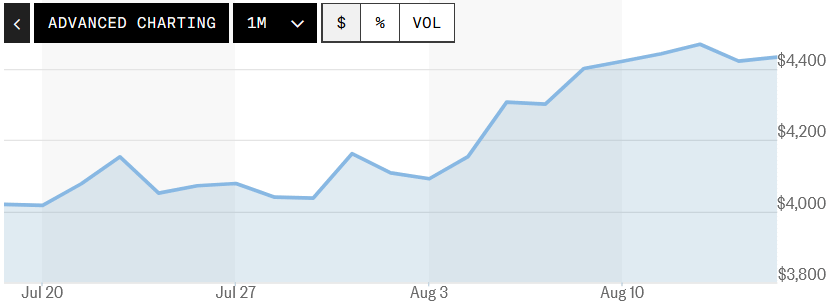
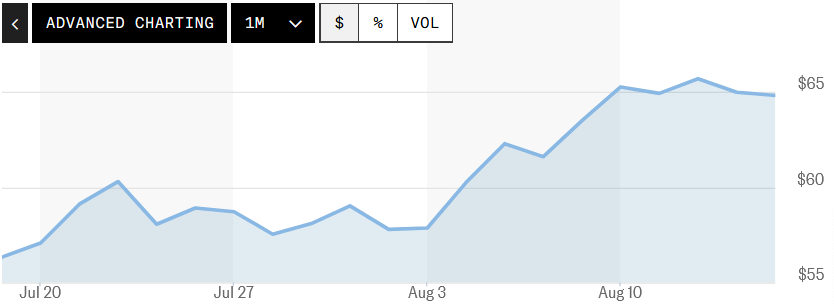
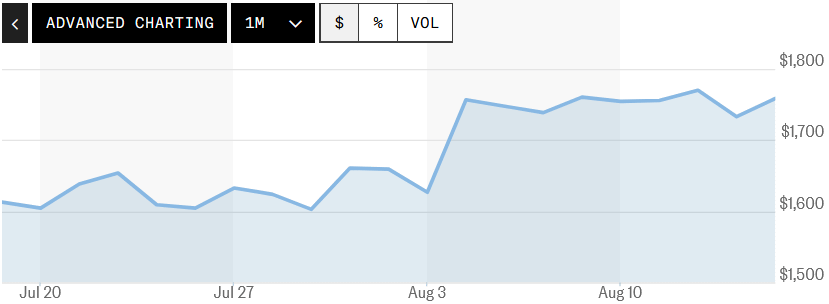
Gold closed near $4,380/oz, a weekly gain of $39.70/oz, and silver near $65/oz, up $1.66/oz.
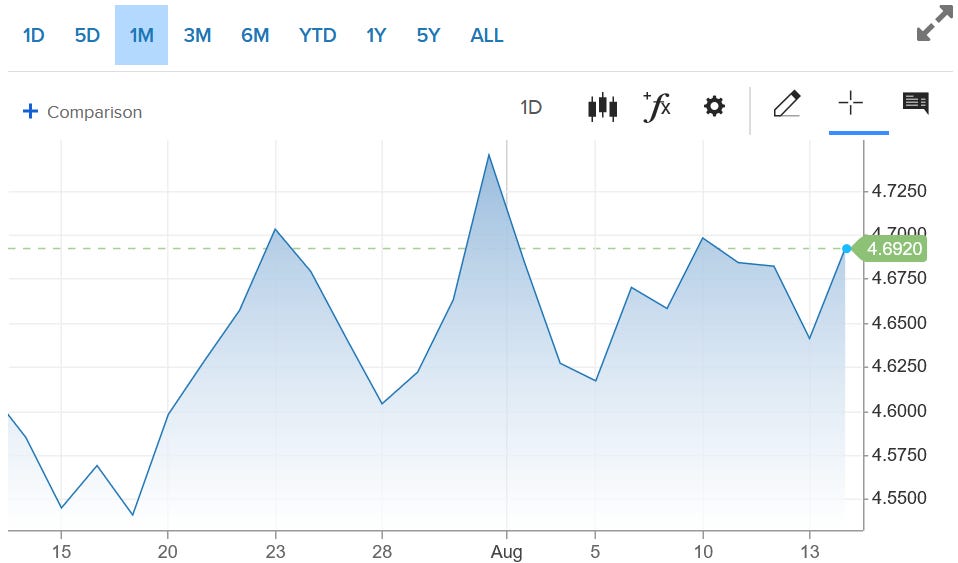
The 10-year Treasury yield rose above 4.69% on Friday after easing to 4.65% Thursday, having touched a 19-month high of 4.75% on Tuesday.
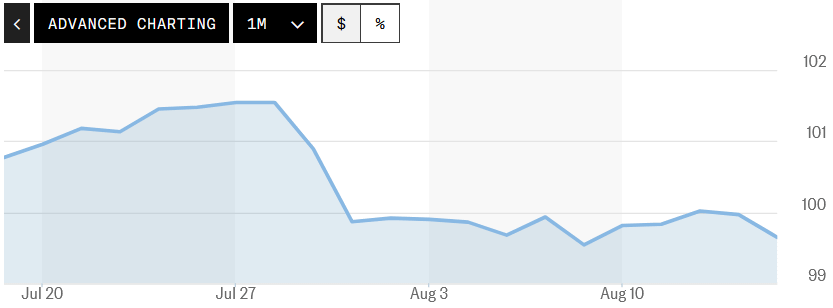
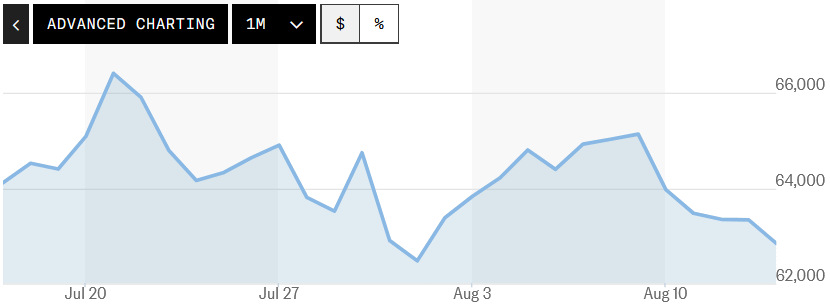
The dollar index slipped toward 99.6. Bitcoin fell to about $62,800, its lowest since August 3.
Reddit surged 12.6% to $177.98 and will replace AvalonBay Communities in the S&P 500 on August 18.
Investors will turn to retailer earnings and the July FOMC minutes on August 19.
Market Movements
The following assets experienced dramatic swings in price this past week. Data are up-to-date as of Aug 14 at approximately 4pm EST.
(Data from StockAnalysis.com)
UP
Sandisk - up 35.34%
Dell - up 8.18%
ConocoPhillips - up 7.80%
DOWN
Broadcom - down 8.11%
Cisco - down 8.03%
Applied Materials - down 5.93%
DXY - down .16%
Bitcoin - down 3.07%
Gold - up 1.01%
Silver - up 1.61%
Platinum - down .33%
10-year Treasury Yield - up by 4.4 basis points
(10-year data from https://www.cnbc.com)
S&P 500 - up .44%
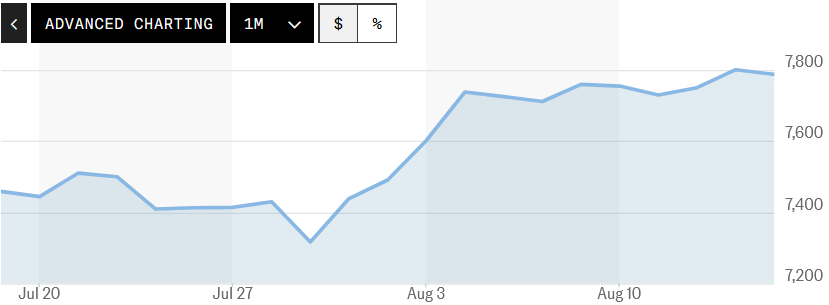
Russell 2000 - up 1.39%
Gareth Soloway, president of Verified Investing, returned to the show to revisit the market calls he made in July. Risk assets have rallied together since July 31, a move he tied to weakening retail sales, a softening jobs picture, and inflation holding near 3.4%. That shift pushed the FedWatch tool to roughly 70% odds of no September hike, a full reversal from late July, when similar odds favored one.
His July line in the sand at 7,300 on the S&P 500 held, and the index pushed to fresh highs after that old ceiling flipped into support. Soloway raised his sights to a parallel-channel target of 8,100 to 8,200 by year-end, a zone he still expects to mark a near-term top.
He credited part of the advance to politics. President Trump, he believes, wants markets near record highs heading into November and will avoid renewed strikes on Iran until after the midterms. Soloway reiterated that Kevin Warsh will not raise rates this year, a view he has held since Warsh took the chairmanship, and he now expects rate cuts in 2027 as the labor market continues to soften.
He agreed that heavy capital spending from megacap technology companies was masking consumer weakness, though markets tend to price in a spending rollover 6 to 12 months before it happens. The debt buildup looked unsustainable to him long term, a path that could culminate in a severe depression, and he cited a 30-year Treasury auction that priced at the highest yield in 25 years as the national debt passed $40 trillion.
Gold’s pullback bottomed near $3,900/oz rather than the $3,500/oz flush he had floated in July. He still expects to buy dips within a longer uptrend that could eventually carry gold toward $13,000/oz by 2029 to 2031.
On semiconductors, he is watching Micron and SanDisk for a 61.8% Fibonacci retracement of their roughly 40% declines before adding fresh short positions, consistent with his July bounce-then-breakdown thesis.
Bitcoin lagged badly, producing one of the weakest breakouts he has charted. He remained near-term bullish for a run into the mid-$70,000s and possibly $80,000, above his July target of $71,000 to $72,000, contingent on Congress advancing crypto legislation before the midterms.
His most actionable level remained the S&P’s 8,100-8,200 zone, the point where he expects the current rally to stall.

After interviewing investors, economists and market analysts for years, one pattern stands out. The good ones rarely open with what to buy. They open with why they would own it.
That question is worth asking about gold right now. Prices have been in the headlines all year, and more people are wondering where physical metals actually fit in a long-term retirement plan.
Augusta Precious Metals built its business around answering it. Their education team runs one-on-one web conferences that walk through the different ways people own physical gold and silver, how buying metals directly differs from holding them in a Gold IRA, and the trade-offs on each side. Whether precious metals turn out to be right for you stays entirely your decision.
Learn more or request Augusta's free 2026 Gold IRA guide at LinTrustsGold.com, or text LIN to 35052.
Trita Parsi, Executive Vice President of The Quincy Institute, returned to the show for his first appearance since the Iran war began.
Parsi disputed Trump’s Truth Social claim that the United States controlled the Strait of Hormuz. Iran still decided who passed through it, he said, while a separate US blockade targeted some Iranian vessels and overall traffic remained sharply reduced. The 13-day US bombing campaign, in his assessment, left America weaker than before it began.
Iran suffered a naval defeat, air force setbacks, and decapitated IRGC leadership, compounded by steep inflation. Yet the war, in his view, had strengthened rather than weakened the Islamic Republic, much as Saddam Hussein’s 1980 invasion let Khomeini consolidate power. Large protests in January had faded into a rally-around-the-flag effect, for now.
The memorandum of understanding signed roughly two months earlier collapsed within weeks, Parsi said, after the US fortified a shipping corridor through Omani waters outside the MOU’s terms and Iran retaliated, in what he called an exaggerated reaction, against ships hiding their identity. The strike campaign that followed achieved nothing before it stopped. Unlike the earlier nuclear deal, the MOU had no arbiter comparable to the IAEA to enforce it.
Iran now demands that Trump leave office before renewed talks, plus war reparations exceeding $300 billion and full US military withdrawal. Parsi doubted reparations would be paid as such, though he expected Washington to abandon many regional bases anyway for economic reasons.
On oil, Parsi said the strait carried roughly 40% of world flows two decades or more ago, down to about 21 to 22% now as Brazil, pumping 5 million barrels a day, and the United States expanded output. Forcing the strait open militarily would require invading and holding southern Iran with 500,000 troops, an option with no domestic political support, leaving negotiation the only viable path.
China took no side in the conflict and drew down its strategic reserves, and the spike in oil prices to $150-$200 that some had predicted never came. Parsi expected China to reduce its long-term reliance on the Gulf, even as it imported more Iranian oil to rebuild those reserves.
He expects the conflict to stay active at least through the US midterms, with resolution coming, eventually and with certainty in his phrase, through negotiation. The signpost to watch once the strait is settled is Lebanon, which he called the likely next flashpoint.
Thomas Hayes, Managing Member of Great Hill Capital, called the rally off July’s lows in tech and semiconductor stocks a dead-cat bounce. He said he was rotating out of artificial intelligence exposure into defensive and consumer names.
His top defensive pick was Diageo, the spirits and Guinness maker, down 50% from its 2021 highs while still generating about $3 billion in free cash flow. The company posted a 13.4% return on invested capital for fiscal 2026, with revenue about 1.4 times its nearest competitor. Hayes credited new chief executive Dave Lewis, formerly of Tesco and Unilever, with cutting costs and fixing a weak US tequila business.
His offensive consumer pick was Disney. He pointed to a new chief executive drawn from the experiences division, which has historically been Disney’s highest-return business. This streaming segment had turned free cash flow positive, and an ESPN unit now seen as valuable. Disney’s earnings beat expectations while rival Universal’s parks disappointed, and he had witnessed the strong park attendance firsthand in France.
Both calls rested on his view that institutional money was leaving an overcrowded AI trade. Exposure to leveraged AI ETFs had jumped from 26% to 58% over two years, and July’s casualties included Whale Rock, down 21.7%; Lone Pine, down 27%; Altimeter, down 11%; and Situational Awareness, down 67%. Those funds, he argued, will sell into the bounce to fund redemptions, leaving semiconductors weaker for another two to three months before a real buying opportunity.
He extended the caution to Nvidia’s newly announced push with Apollo, BlackRock, Blackstone, Brookfield, Goldman Sachs, and KKR to mobilize more than $500 billion in third-party capital for AI infrastructure. Securitizing that spending reminded him of pre-2008 mortgage finance, and he questioned whether GPUs hold collateral value over five to seven years.
The macro backdrop helped his consumer thesis. August 12 inflation data came in cooler, with headline CPI at 3.4% and core at 2.5%, and markets priced a 62% chance of a hold against 38% for a hike. The case for tightening under Fed chair Kevin Warsh had faded, he argued, with a cut growing likelier in coming months, 4% unemployment, and consumer confidence recovering from multi-decade lows.
Diageo remained the conviction pick. The stated risk was a secular decline in drinking, including his cited figure that 85% of people who start weight loss drugs quit within two years. However, the world’s largest premium spirits maker offered, in his judgment, a sufficient margin of safety.
Clem Chambers, founder of ANewFN, discussed gold, copper, and the standoff between the United States and Iran.
Chambers said a fresh liquidity injection was fueling the rally in stocks and metals, moving first into speculative equities before settling into calmer names. The money, he argued, was coming from the Treasury rather than the Federal Reserve, reasoning that the previous such injection had arrived. At the same time, the Fed chair of the day sat under threat of prosecution, leaving Treasury the only plausible source. He stayed heavily long the market.
On Iran, Washington’s only realistic option was a siege, cutting off trade rather than invading or withdrawing. He called President Xi Jinping’s planned Washington visit in late September the most significant underreported story in markets, with asset prices set to react sharply to its outcome.
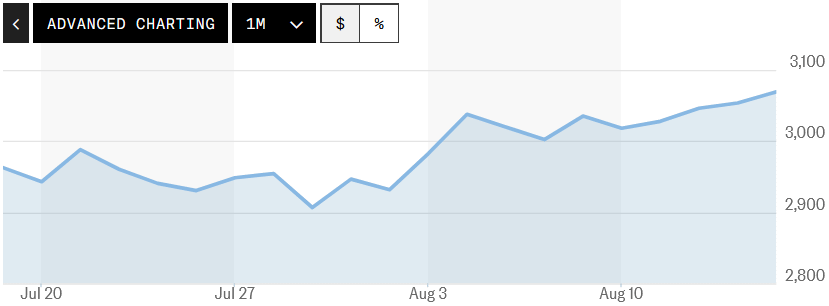
Gold traded near $4,480/oz on the day of the interview, up more than 11% since early August. Chambers said his past bullish call had played out, and he now held no investment gold, preferring platinum instead. He doubted gold reaches $6,500/oz by Christmas, consistent with the war-barometer logic of his last appearance.
He repeated his view that the AI trade is really about hardware and electricity, not software, describing it as energy plus hardware producing intelligence and heat. The West still needs roughly 250% more electricity, pylons, transformers, and cables to match China, and he noted five nuclear reactors recently switched on in the United States.
Copper was his top pick. Chambers forecast the metal will roughly double within a year as AI data center demand outruns supply that takes a decade or more to expand, with prices spiking toward $30,000/ton before easing back to $15,000 to $20,000/ton. He tied the buildout to inflation he put at roughly 5% to 7% ahead.
Bitcoin, which he had called a coin flip last time, now drew an openly bearish read. The coin had gone nowhere for weeks, repeated large thefts had left him unwilling to trust holding it, and a technical breakdown could send it below $40,000.
The newest idea he raised was a Wall Street financing consortium. Nvidia had partnered with Apollo, BlackRock, Blackstone, Brookfield, Goldman Sachs, and KKR to arrange $500 billion in third-party capital for AI infrastructure, with underwriters collecting roughly 7%, about $35 billion combined. The banks, in his phrase, will make out like bandits, and his advice was to follow the AI money down the trunk of the tree, starting with a name like Goldman Sachs.
Jim Thorne, Chief Market Strategist at Wellington-Altus Private Wealth, argued that most of Wall Street is still reading this cycle through an outdated, demand-driven playbook. He used that claim to defend price targets well above consensus.
On inflation, the prevailing debate centers on whether persistent deficits and tariff-driven price pressure force the Federal Reserve to keep rates elevated. Thorne countered that supply shocks, tariffs, and wages are not inflationary, citing break-even inflation rates and real-time Truflation data as evidence the current spike is a one-off. The Fed, in his view, should cut its policy rate to a neutral 2.75%, with Canada roughly a percentage point lower.
While many investors expect the rally to give way to a four-year-cycle correction, Thorne said that setback already occurred last year amid tariff turmoil, noting that the United States has never recorded two consecutive 20% drawdown years outside a recession or financial crisis. Using an earnings estimate near $440 per share for the S&P 500 and a 22- to 23-times multiple, he reached 10,000 on the index, extending to 14,000 or 15,000 by the 2028 election on continued double-digit earnings growth from AI-driven capital spending.
He credited Treasury Secretary Scott Bessent, a veteran of the Soros fund’s London office in the 1990s, with the intervention that lifted the yen back to 157 to the dollar. Bessent and Kevin Warsh, he argued, understand bond market mechanics well enough to cap long-term Treasury yields, an approach he likened to Mario Draghi’s pledge to do whatever it takes.
His chief worry sat in Japan. Losses on Japanese government bond holdings, he warned, could force insurers and banks to sell assets large enough to trigger a steepening crisis in the United States.
Canada drew his sharpest break from consensus. The country is repeating the secular stagnation the United States faced in 2008 and 2009, he argued, its housing market frozen even after rate cuts, while bank shares trade at 3.5 to 4 times tangible book value, the most expensive they have ever been.
Bitcoin, near $63,000 and down about 30% this year, looked to him like gold before its own run, held back mainly by regulatory uncertainty tied to Senator Elizabeth Warren’s opposition to digital asset legislation.
His most contrarian call remained gold. He forecast a rise to $9,000/oz as the long end of the Treasury curve stays capped by policy rather than market forces, a dynamic he said investors are still underpricing.
Ted Oakley, CFA, Founder and Managing Partner of Oxbow Advisors, detailed how he is positioning client portfolios into year-end. Oxbow holds roughly 45% cash, raised last year by selling silver, part of its gold, and most of its miners.
Over the past six weeks, the firm redeployed much of that cash into precious-metals miners, which had corrected by 35% to 40%. He named Hecla Mining, repurchased near $15 a share after selling above $30 last year, plus Franco-Nevada, Alamos Gold, and Equinox Gold, the last near 5.5 times 2027 earnings. He also added silver directly and gold near $4,000/oz, which he called still buyable around $4,300/oz.
On energy, Oakley still favors oil producers with West Texas Intermediate near $83/barrel, arguing they remain cheap at 7 to 8 times earnings. Oxbow owns companies across the spectrum, including Chevron, Matador Resources, midstream pipelines, and service names such as Schlumberger and Transocean. He also noted market-wide oil short interest near 480 million barrels, positioning that could reverse sharply if sentiment shifts.
Oxbow sold nearly all of its Microsoft stake this year, ending a roughly 14- to 15-year holding, because Oakley doubts megacap technology will continue to perform at its recent pace. Large semiconductor stocks were his least favored group, an industry he called feast or famine after following it for four decades.
The firm avoids the 30-year Treasury because, in his reading, bond investors no longer trust US fiscal policy. The 30-year yield, above 5% for more than 30 sessions and near 5.24%, could crimp stock valuations if it climbs toward 5.5%, lifting mortgage and floating-rate borrowing costs. Fed Chair Kevin Warsh had recently pointed to rising yields as evidence markets were doing the Fed’s tightening for it.
Oakley also flagged the S&P 500’s cyclically adjusted price-to-earnings ratio near 42, up a fourth straight month, noting that readings above 35 have historically preceded weak five-year returns. He preferred regional banks to money-center banks, the latter of which were expensive at roughly three times book value, with US Bancorp his only holding in the group.
Above all, Oakley told investors not to ignore commodities, arguing the next decade will favor hard assets over the crowded technology trade. He urged clients to take profits and pay the taxes on gains rather than hold indefinitely, a lesson he said many learn only after cycles turn.
Ed Yardeni, President of Yardeni Research, discussed rising bond yields, second-quarter earnings, and AI spending.
Yardeni said the economy remains in what he calls the Roaring 2020s, a scenario he has tracked for seven years, with GDP and the stock market both at record highs and no recession in sight. He set a year-end target of 8,250 for the S&P 500 and 10,000 by the end of the decade, tying the case to AI-driven productivity gains as baby boomers retire. He has even coined a term for the moment, FIMO, fabulous earnings momentum, with the forward price-to-earnings ratio near 20.
Asked whether the bond vigilantes have returned, Yardeni cited a 10-year yield near 4.6% to 4.7% and a 2-year around 4.25%, roughly 75 basis points above the fed funds rate, both signaling that markets expect a hike. He answered that 4% to 5% marks a return to normal, the range that prevailed before the 2008 financial crisis, and one the economy can absorb.
On inflation, he put the core rate near 3.3% and said last year’s three rate cuts were unnecessary and worsened the underlying problem. He expects Fed Chair Kevin Warsh, hawkish since arriving in June, to raise rates in September to defend credibility, despite the approach of the midterms and against President Trump’s wishes.
On deficits, Yardeni contrasted today’s $1.5 trillion to $2 trillion shortfalls with the $250 billion deficits that worried him when he coined the term bond vigilantes in 1983. He credited Treasury Secretary Scott Bessent with keeping auctions calm through short-term bill issuance and stablecoin demand for Treasury bills, plus a coordinated intervention in which, by his account, Japan bought $58 billion of yen rather than selling its Treasuries.
On AI, he conceded volatility, citing SpaceX’s stronger-than-expected revenue offset by heavier-than-expected capex, including an AI venture unrelated to its rocket business. Still, hyperscalers post strong profits and margins alongside their negative free cash flow, and companies report demand backlogs rather than idle capacity. He favors established, dividend-paying firms over speculative AI plays, with overweights in financials, industrials, and healthcare.
The one scenario that would concern him is a repeat of 2023, when the 10-year yield jumped from 4% to 5% in three months amid weak Treasury auctions. Short of that pairing, a rapid yield spike with soft demand, the Roaring 2020s outlook stays intact.
Michael Gayed, Founder of the Lead-Lag Report and portfolio manager of the Free Markets ETF, explained the yen warning he first raised in 2023. Washington’s decision to buy yen, the first such intervention since the 1998 Asian financial crisis, signaled real trouble to him, and he predicted the rescue would fail.
Japan wants a firmer yen, he explained, so it does not have to sell US Treasuries to raise dollars, which would push yields higher. The yen carry trade, borrowing cheap yen to fund higher-returning dollar assets, remains profitable even after the bounce, so money will keep flowing into it.
August 2024 offered a preview. The Nikkei fell roughly 7% to 8% in a single session by his account, and the S&P 500 dropped 3% when the carry trade briefly unwound. A larger panic, he warned, will follow once the yen retraces its gains.
He linked the intervention’s timing to Fed chair Kevin Warsh signaling no rate hike, a pairing he found telling. The 30-year Treasury yield had held above 5% for more than a month and a half, evidence the bond market was tightening on its own.
Gayed flagged rising credit default swap spreads on AI-linked companies including Oracle, warning of a broader repricing of default risk across debt-heavy data center plays. His lumber-to-gold ratio, which normally signals small-cap strength when lumber outperforms gold, had stopped working this cycle because housing, its usual driver, no longer moves markets.
He also cited a gap between prediction markets, where recession odds had fallen to about 7% from 35% at the onset of the Iran conflict, and the University of Michigan sentiment index, still near record lows. That pricing looked overconfident to him, and the S&P 500’s 59% rally since its mid-April 2025 low said little, since the Nasdaq also hit new highs heading into the 2000 recession.
On oil, he was bullish, citing asymmetric upside risk, including the remote possibility that Iran strikes its own oil fields to hurt the United States. He also expects artificial intelligence to face heavy regulation within about six months following a damaging AI headline, a view that keeps tech underweight in his fund.
Above all, currency markets remain his most trusted early warning, since every equity crisis in his research shows up first in currency moves. A second, delayed phase of the reverse carry trade, he expects, will eventually pull yields down and revive Treasuries as the safe-haven trade.
Jim Welsh, Founder and Author of Macro Tides, returned to update his market roadmap, tracing a chain from Treasury yields through the dollar to stocks and gold.
Treasury yields, he said, are in a long-term uptrend that will eventually push the 10-year above 5%, a level last touched in October 2023. The 30-year has already cleared its 2023 high of 5.15%, trading as high as 5.26%-5.28%. He expects Fed Chair Kevin Warsh to raise rates once, in September or October, citing nine of 18 FOMC members who favored a hike in June and the three governors who dissented in favor of one last meeting.
He downplayed July’s surprise loss of 23,000 jobs, tying it to seasonal cuts in government education staffing and hospitality layoffs, with unemployment claims under 200,000. The economy looked sound to him overall, since the top 10% of earners drive close to 50% of consumer spending.
From yields, Welsh turned to the dollar, whose index had completed its correction and sat close to a rebound. He trusts the dollar’s inverse link to gold more than gold’s tie to yields, citing the dollar’s September 2022 peak of 114.77 against gold’s bottom near $1,660/oz.
That combination points to a stock pullback. The S&P 500 rose from its March low through a choppy triangle capped at 7,620 in June, then thrust to a recent high of 7,793. Still, thin breadth on that leg signals a 4% to 7% pullback in coming weeks. Semiconductors, which he correctly flagged in June ahead of July’s crash, should roll over again from near 590 on the SMH toward its recent low of 503 before resuming higher.
Gold, in what he calls a wave four retracement rather than the start of a run above $6,000/oz, reached a cash price of $4,371/oz and looked due for a near-term high before a later move toward roughly $4,575 to $4,825/oz. He favors buying gold, silver, and miners on dips over the next 1 to 2 weeks. GDX, recommended near $72.80 and lately at $90.80, can reach $102 and eventually new highs above $117.
Welsh flagged one checkpoint: a crossover in his 5- and 13-day exponential moving averages within the next several days would confirm the S&P is topping. He was low on confidence that the Strait of Hormuz standoff would resolve peacefully before the midterms, the risk he sees as triggering the decline.
Monday, Aug 17 -
Empire State Manufacturing Survey (August)
NAHB Housing Market Index (August)
Tuesday, Aug 18 -
Housing Starts (July)
Import Prices (July)
Industrial Production, M/M% (July)
Capacity Utilization % (July)
Pending Home Sales Idx, M/M% (July)
Home Depot earnings
Wednesday, Aug 19 -
Federal Open Market Committee meeting minutes published
TJX earnings
Lowe’s earnings
Target earnings
Estee Lauder earnings
Thursday, Aug 20 -
Philadelphia Fed Business Outlook Survey (August)
Weekly Jobless Claims (Aug 15)
Leading Indicators (July)
Walmart earnings
Alibaba earnings
Friday, Aug 21 -
US Flash Manufacturing PMI (August)
US Flash Services PMI (August)
No posts
Comments
Nothing yet. Say the first thing.
Sign in to join the conversation.