
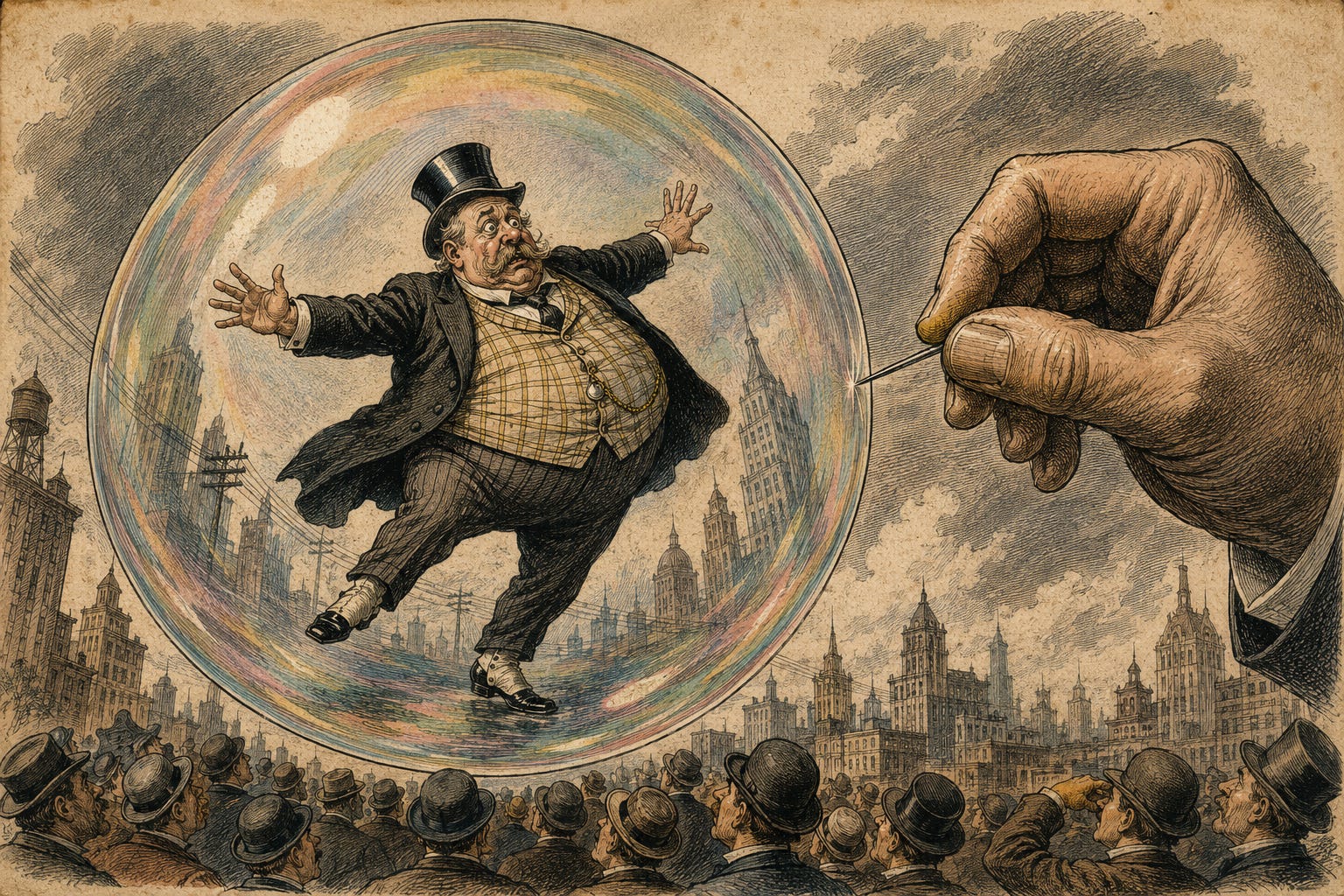
Stock Idea: PALISADES GOLDCORP
Why Tech Stocks Are Blowing Up Now: Expert Reveals Bottom
Why Are Markets Crashing Now? Trader Reveals Major Signals For Stocks, Bitcoin, Gold
You Don’t ‘Own Enough Cash’ For What’s About To Happen
Markets Repeating 2008: Trader Reveals Best Places To Hide
One Asset To Triple As Global Supply Squeeze Hits Markets
Are Interest Rates About To Explode? ‘Greatest Financial Bubble In History’
2026 Top Gold Stock Picks: Expert Reveals Most Undervalued Plays
MARKET RECAP: July 20, 2026 - July 24, 2026
Oil dominated markets this week as the conflict between the United States and Iran escalated. Brent crude topped $100 per barrel on Wednesday for the first time since May, after Houthi militants struck two Saudi oil tankers in the Red Sea and U.S. forces pressed a nearly two-week bombing campaign.
Prices eased Friday, with Brent near $97 per barrel and WTI near $88, but Brent still rose more than 10% on the week and WTI about 8%.
Disappointing megacap earnings drove the week’s sharpest declines. Alphabet fell 7.1% on Thursday, and Tesla plunged 14.52%, its worst earnings-reaction day on record, as investors fixed on soaring artificial intelligence spending.
Alphabet lifted its capital-spending plan to as much as $205 billion even as cloud revenue grew 82%.
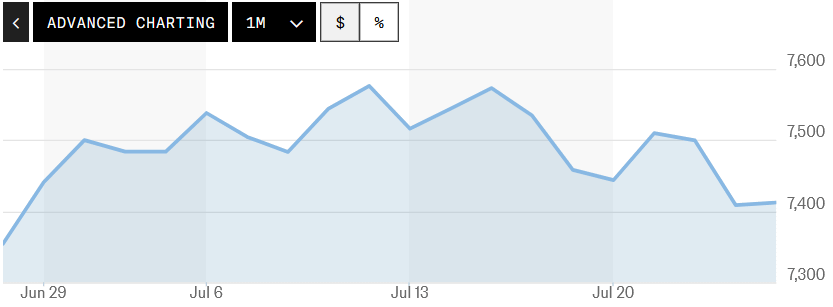
U.S. equities fell for a second straight week. The S&P 500 closed Friday at 7,411.98, up 0.05% on the day but down about 0.6% for the week, while the Nasdaq Composite ended at 24,975.82, off roughly 2.1%. The Dow rose 0.46% to 51,947.25, lifted by a 3.5% gain in Apple, yet slipped about 0.4% for a third straight weekly decline.
Chip stocks stayed weak as concern over heavy hyperscaler spending persisted. Intel fell Friday even after it beat estimates and raised its outlook, and the Philadelphia Semiconductor Index dropped again. SpaceX shares closed at a record low ahead of a planned Starship launch.
The White House added a fresh source of uncertainty on Thursday. The Trump administration announced tariffs of 10% to 12.5% on roughly 60 trading partners, replacing temporary 10% global duties set to expire Friday. Officials said the new levies rested on forced-labor grounds, a legal basis seen as more likely to survive court challenges.
Rising oil prices lifted inflation worries and pushed rate expectations higher. Two-year Treasury yields reached a 17-month high, the dollar firmed, and traders priced roughly a 34% chance of a Fed rate increase at next week’s meeting and better than 78% odds by September.
Initial jobless claims fell to 187,000, their lowest level since 1969, which weakened the case for near-term cuts.
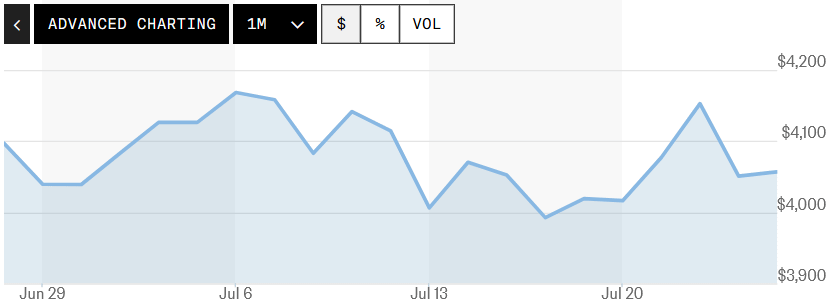
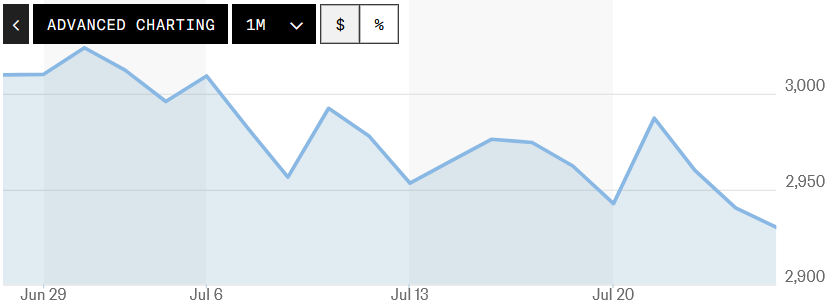
Gold recovered as buyers stepped into the pullback. The metal reclaimed the $4,000 mark and traded near $4,055 per oz on Friday, holding a modest weekly gain after touching a two-week high midweek. Higher oil prices and firmer yields capped the advance.
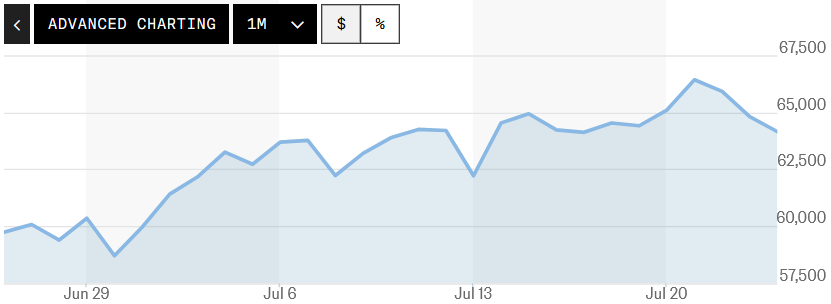
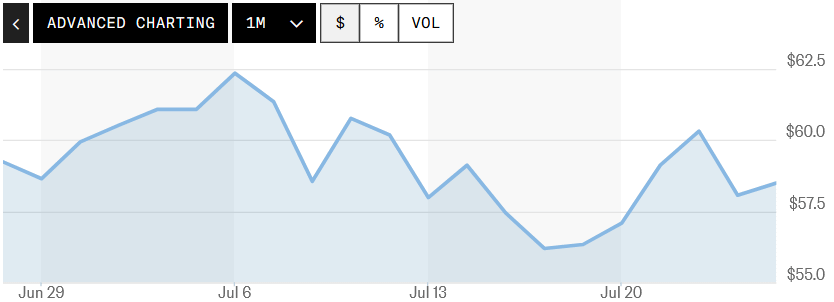
Silver rebounded harder than gold. It traded near $58.40 per oz on Friday and gained several percent on the week, recovering the ground it lost the week before. Bitcoin, by contrast, retreated toward $64,000 and ether toward $1,860 as higher yields drew money away from risk assets.
Market Movements
The following assets experienced dramatic swings in price this past week. Data are up-to-date as of July 24 at approximately 4pm EST.
(Data from StockAnalysis.com)
UP
Lockheed Martin Corporation - up 14.51%
Dell Technologies - 11.57%
ExxonMobil - 7.13%
DOWN
Tesla - down 17.81%
American Express - down 10.06%
Uber - down 8.99%
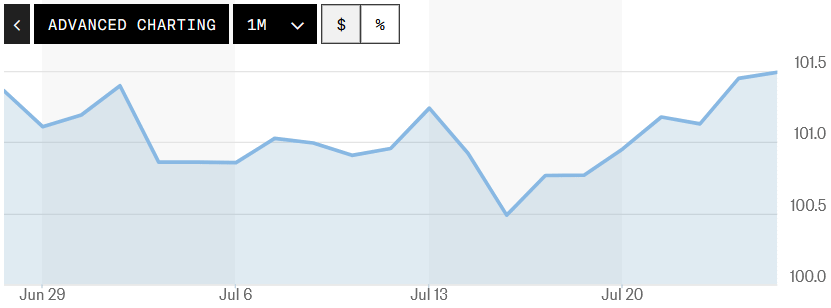
DXY - up .76%
Bitcoin - down .85%
Gold - up .69%
Silver - up 2.04%
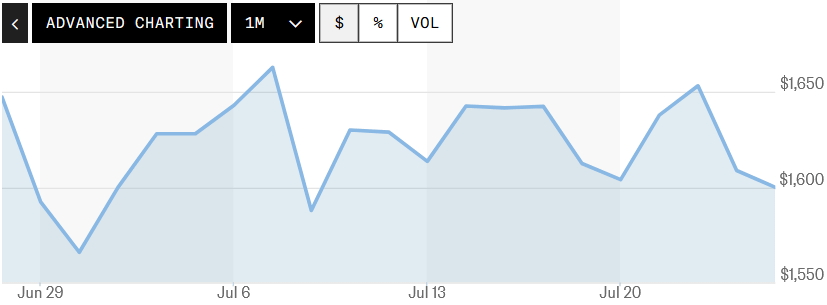
Platinum - down .49%
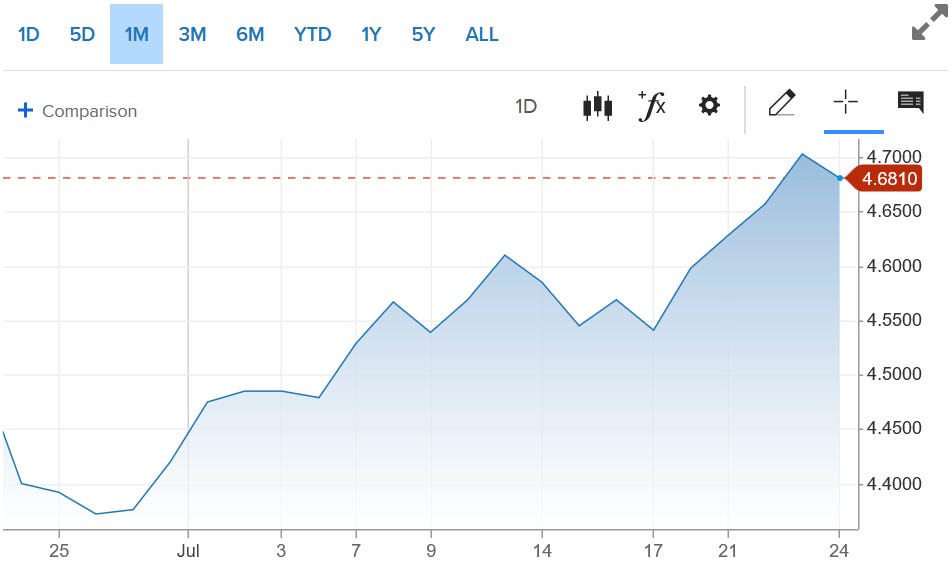
10-year Treasury Yield - up by 13.2 basis points
(10-year data from https://www.cnbc.com)
S&P 500 - down 1.03%
Russell 2000 - down 1.28%
George Noble, Managing Partner of Noble Capital Advisors and Author of “The Noble Update,” argued that the AI and semiconductor trade is unwinding into one of the worst bubbles in market history, one carrying 17 times the malinvestment of the dot-com crash, and he went so far as to say both Oracle and OpenAI could go bankrupt.
He pointed to the chip sector’s collapse as confirmation. AMD, Qualcomm, Nvidia, and Intel all peaked between May and early July; SK Hynix, by his account, fell roughly 70% within weeks, and about 1.2 million South Korean trading accounts, close to 10% of the country’s total, were hit with margin calls.
Positioning, he said, had not caught up with falling prices. Despite the selloff, about $25 billion flowed into the three leading semiconductor ETFs since the June 22 peak, which he read as stale bulls refusing to capitulate. Intel had fallen about 33% in a single month.
David pressed him on whether this truly resembled 2000 and, if it did not, whether the drop was a buying opportunity ahead of a rebound. Noble answered no on both counts, citing strategist Julien Garran’s estimate of the malinvestment gap and arguing this boom was far more asset-intensive so that the economic fallout would run deeper.
He extended the short case beyond chips. He valued SpaceX near $30 a share against a price that had already slid from a $225 peak to about $125, a decline he attributed partly to forced index buying he called improper, and he put fair value for Tesla in the same $30 to $50 range despite a share price near $380.
On gold, he partly reversed course, admitting his earlier bullish call had been wrong given dollar strength and rising yields. He expected that strength to fade and argued, citing Luke Gromen, that rising rates in a country that cannot afford them are ultimately bullish for gold, even as Bank of America trimmed its forecast 14% to $4,316/oz against a $4,000/oz spot price.
David’s sharpest challenge came last: traditional metrics such as price to book, price to earnings, and price to free cash flow would have kept an investor out of this entire rally. Noble conceded the point and answered only with historical parallel, recalling that managers like Julian Robertson and Chuck Clough were pushed out during the 1999 to 2000 mania before events proved them right, an answer that left open whether he was early or simply wrong.
Palisades Goldcorp (TSX-V: PALI) is a publicly listed investment company built to give investors unparalleled leverage to junior resource equities.
At its core, Palisades is an active company builder. It founded New Found Gold Corp. (NYSE: NFGC / TSX-V: NFG) in 2015 — a company that reached a $2 billion market valuation at its peak, and in which Palisades retains an 8% ownership stake.
Check out our interview with Collin Kettell, Founder & CEO of Palisades, above.
Palisades also holds a 90% interest in Made in America Gold (private), the largest junior landholder in the United States, strategically positioned along Nevada’s prolific Battle Mountain trend, and a 100% interest in Radio Fuels Resources (private), owner of the Eco Ridge project, one of the largest underdeveloped uranium and rare earth projects in North America. Most recently, the Company formed Palisades Royalty, which holds a growing book of royalties across North America.
Beyond these cornerstone holdings, Palisades owns a portfolio of 1.7 billion warrants across 330 companies in the junior resource sector, spanning gold, silver, copper, critical minerals, lithium, uranium, and more — a diversified, one-stop entry point to the space. Built through participation in unit offerings and the deliberate accumulation of long-dated warrants, the portfolio carries an average of 27 months to expiry, ample runway for a mining bull market to unfold.
As rising gold and silver prices draw capital back into junior mining, equities follow, competition among check writers intensifies, and attractive warrant terms become harder to find. Palisades’ deep industry knowledge, access to deal flow, and disciplined timing secured early-stage positions in high-quality companies — a “time machine” into the sector’s up-and-coming developers and producers, and a portfolio positioned to benefit from a strengthening market.
For investors seeking leveraged, diversified exposure to the junior resource sector, Palisades is a stock worth watching.
Learn more at https://palisades.ca/
Steve Hanke, professor of applied economics at Johns Hopkins University, rests his argument on one number: the growth rate of the money supply. His preferred measure, Divisia M4, weights money by how spendable it is, counting cash and checking deposits more heavily than savings. It grew 6.7% over the past year, above the roughly 6% pace he considers consistent with the Fed’s 2% inflation target.
From that gap he derived his inflation call. Money supply changes, he argued, feed through to prices with a long lag, so the price level months out was already set by growth roughly a year earlier. The latest CPI eased to 3.5%, below consensus and down from 4.2%, yet Hanke expected inflation to stay volatile and remain above target.
He faulted the Fed for targeting the fed funds rate rather than the money supply. Futures markets priced only a 13% chance of unchanged rates through December, implying further hikes. He noted that the Fed’s July 10 report, for the first time in years, cited the money supply, a nod he read as vindication.
The same logic explained Japan, he argued: decades of near-zero money growth, not loose policy, produced low rates, low inflation, and weak nominal growth, a case he made with co-author John Greenwood in a Fortune piece. He expected the yen, already at a 40-year low, to keep weakening, sustaining a carry trade of borrowing cheap yen to invest abroad.
Oil supplied the period’s relative price shock, layered atop the monetary story. Brent rose 20% between July 7 and 21 as WTI traded near $83/barrel, and crude backwardation widened from 3% to 8.2%. Hanke traced this to Trump’s renewed strikes on Iran, which closed the Strait of Hormuz and, via Houthi attacks, the Red Sea route.
On gold, trading just above $4,000/oz, Hanke kept his $6,000/oz target, noting prices had already peaked near $5,500/oz. Rate risk and a strong dollar were headwinds, he said, but central bank buying, led by Chinese purchases a Goldman Sachs analysis found underreported, gave prices a floor. He dismissed a viewer’s idea of revaluing US gold to $20,000/oz to ease the debt as bookkeeping fiction, since the Treasury’s gold was worth roughly $1 trillion against $39.6 trillion in debt.
Hanke’s insistence on the quantity of money over its price places him in a monetarist lineage running from Irving Fisher through Milton Friedman. This school spent much of the past half century losing ground to interest-rate targeting, ground that, in his telling, one footnote in a Fed report has just begun to reclaim.
At 6:30 in the morning, from his desk in Monaco, a longtime trader pulled up a stock chart so ugly he assumed the company was finished. He asked an AI model why, got a confident but wrong answer, then had it find comparable names, bought when they turned, and came out 15% better off four days later.
Clem Chambers, founder of ANewFN, told the story to make his central point: the AI trade is not really about the large language models that get the headlines. It is about the hardware underneath them, chips, hard drives, air conditioning, and cabling, where he noted firms such as Hewlett Packard and Cisco had already risen tenfold.
The broader tape gave him plenty to react to. The Nasdaq fell 1.2%, and the S&P 500 fell 1% on Friday, and the SMH semiconductor ETF has dropped 20% since mid-June. Gold held near $4,000/oz, Bitcoin traded around $64,000, roughly 50% off its highs, and Treasury yields climbed.
Chambers framed gold as a barometer of war rather than peace, bought beforehand and sold once fighting starts and currency is needed for supplies. He named Russia and Iran as sellers under that theory. Oil at $81/barrel, despite at least nine tanker strikes near the Strait of Hormuz since July, suggested to him a market shrugging off a slow siege rather than pricing a war.
He kept returning to one statistic. China, he said, generates roughly 250% more electricity than the United States, and in what he called an electricity race, that gap forces America to build aggressively or cede ground. The buildout will be inflationary and eventually good for precious metals, though not in a straight line.
A CNBC survey finding 61% of Americans pessimistic about the economy drew a blunt dismissal. No pessimist, in his telling, has ever gotten rich, and the bull run since 2008 rewarded investors who ignored years of crash predictions.
On crypto, he was ambivalent, calling its future a coin flip. Wall Street had absorbed the anarchist vision of money outside the banking system, though stablecoins will endure. He cited a reported plan by Trump Media to charge traders $100,000 a month for faster access to the president’s Truth Social posts as evidence that little online can be taken at face value.
Chambers, by his own account no longer young, noted that AI now lets a barely technical 65-year-old write working software once left to hired programmers. He offered no plans to test that claim himself before his next visit.
Jason Shapiro, founder of the Crowded Market Report and a trader profiled in Jack Schwager’s Unknown Market Wizards, returned to map where the crowd stood across stocks, currencies, energy, and metals. His method: find trades that have grown one-sided, then wait for the market to stop reacting to the narrative behind them. Four years of bubble callers, he argued, had the sentiment backward.
Retail bears dominated chip-stock commentary, he said, even though the sector had pulled back only about 17% after a far larger run. The real excess, in his telling, showed up in South Korea, where SK Hynix fell 30% to 40% and roughly 1.2 million margin-called accounts were wiped out within weeks. That washout likely cleared some excess, though it does not mean stocks must rally straight back.
He likened the mood to 1999, when he called stocks a bubble himself and watched the Nasdaq climb another 60% before topping in 2000. Doubters then got laughed out of the room, while today’s bears get applauded, evidence that participation differed this time. A crowd that agrees with the bear case, in his framework, is a crowd worth fading.
Consensus has quietly abandoned crypto, he said, pointing to thin retail turnout at Miami’s Consensus conference in May, where institutions like JPMorgan outnumbered individual traders. Once nobody cared anymore, Bitcoin, gold, and silver stopped making new lows even as yields climbed. Waning interest, not price, was his signal that the short side had grown crowded.
He named the long dollar and short Canadian and New Zealand dollar as the most overcrowded currency bets left standing. Crude drew similar scrutiny: The Economist ran a piece on July 1 conceding it had been wrong about rising oil, a date that marked crude’s exact low before it climbed from the mid-$60s to $87 to $88/barrel. Few traders chased oil higher after getting burned earlier in the year, so the rally, he argued, had further to run.
Gold’s slump since January persisted even as miners struggled to raise capital near $4,000/oz, a level that had drawn easy financing months earlier. Gold turned, he said, once it stopped falling on the higher-rate narrative that had driven it down, even with yields across the curve near new highs. He risks about 70 basis points of his portfolio per trade, entering only once the market confirms his thesis.
Whether crude’s climb toward $90 reflects a market still under-owned, or an early crowd re-forming, is a question his positioning data has not yet answered.
Tavi Costa, Co-Founder and CEO, Azuria Capital LLC., has argued before on this program that Washington’s path of least resistance is to inflate away its debt rather than tighten into it. He opened this appearance restating that claim, warning a genuine tightening cycle would leave nobody holding enough cash, with the alternative closer to systemic collapse.
Federal Reserve Chair Kevin Warsh told Congress that long-term inflation is a monetary phenomenon, and Costa agreed. However, he doubted Warsh’s appetite for spending discipline given how little came of similar DOGE promises two years ago. Cooling CPI and a deflationary producer price report, he argued, still understated real-world inflation and might reflect changes in how the data gets measured.
On rates, he held his ground: with the federal funds rate at 3.75% and roughly a third of federal debt rolling over within a year, he doubted the system could absorb a hike even though markets had priced one as likely, and he expected the Fed to hold, with at most one hike in the next 12 months.
That backdrop framed his read on gold. Gold had fallen from above $5,000/oz earlier in the year to just under $4,000/oz by the interview; Bank of America had just lowered its forecast by 14% to $4,316/oz, and GDX, the miners’ ETF, was down 35% for the year, with well-run miners off 45 to 50%. Costa called the selloff sentiment-driven by the Iran war rather than thesis-breaking, and said he was adding aggressively to Agnico Eagle, down 44% from its March peak and now one of his largest gold positions.
He extended the logic to copper, which had broken its historic correlation with gold since April and begun tracking equities instead. He tied the shift to structural demand from data centers, onshoring, and grid buildout outrunning constrained supply, and endorsed financier Robert Friedland’s description of copper as a new safe haven alongside gold and silver.
Geographically, he favored Latin America, noting Peruvian, Mexican, and Brazilian currencies had outperformed developed-market peers over five years, a trend he tied to a political shift toward capitalism across the region. On energy, he had reversed course twice, turning bullish on this program roughly eight months earlier, selling once crude cleared $100/barrel, and buying again with crude near $80/barrel.
He closed where he began: the real risk, in his view, was not another leg down in metals but a Fed forced to choose between tightening into an unpayable debt load and inflating around it. He still expected the latter, the same call he had made on this program before.
Todd “Bubba” Horwitz, founder of BubbaTrading.com, argued markets were setting up for a repeat of 2008, citing mortgage defaults at their highest level since 2009. He said he remained short.
Oil anchored the conversation. He held his short from the low $80s a barrel, having sold some near $85. He expected crude to fall to the high $50s or low $60s by year-end, dismissing the reignited Iran conflict as a lasting driver.
He turned skeptical on official inflation data. Gas near $4 a gallon and elevated beef prices, he said, were squeezing a consumer already deep in debt, with many credit card holders at least 90 days past due. He expected the Federal Reserve to hike rates in September regardless, though prediction markets put the odds of a hike by the end of 2026 at just 60%.
Tech supplied his sharpest levels: Nvidia had more downside, and Palantir’s slide from the 200s to 120 previewed other AI names. SpaceX, down to about $130 from what he put at a $250 offering, was the one he wanted to buy on firmer support. Oracle, off nearly 70% amid bankruptcy chatter, looked good only for a short-term bounce, near 90% odds given how oversold it was.
South Korea’s leveraged-ETF blowup drew his attention. He cited Goldman Sachs data showing 1.2 million retail accounts there had triggered margin calls, with 320,000 to 360,000 fully liquidated. A leveraged SK Hynix fund had fallen about 70% while the underlying stock held up far better, much as leveraged gold miner funds fell 70% against gold’s 30% drop from its record.
On metals, he named his levels. He has been buying gold dips at $4,000/oz, with support he expects near $3,500 to $3,600/oz. He has bought silver around $55/oz and platinum around $1,600/oz, and noted grains had rallied 15% off their lows.
Rates and the dollar closed out his view. He sold 10-year notes near 114, now 108 to 109, and expected further declines, since the 10-year, not the fed funds rate, sets mortgage rates, still above 6%. He pegged dollar support near parity, with room toward 102 or 103 as global capital sought safety.
He ended on stocks. The S&P 500 was up 11% for the year, he noted, but he expected it to finish flat or lower, having spent the morning selling short into the rally. His larger target for the broader market: a 40% to 60% haircut, still to come.
Gold traded near $4,000/oz in early July, down from a peak above $5,600/oz reached earlier this year. Kai Hoffmann, Founder and Managing Director for Soar Financial Partners, blamed the retreat on inflation worries and fear of a Fed rate hike, not weaker physical demand. Copper, by contrast, held above $6/lb, which he called fundamentally, not sentiment-driven.
Hoffmann argued the two metals had decoupled: copper tracks electrification and data center demand, gold reacts to Middle East headlines. Traders seemed to be growing numb to that conflict, he said; an attack on a Qatari ship drew less reaction than a Samsung earnings warning the same week.
The usual link between a rising gold-to-oil ratio and recession broke down too, in his view. Oil traded below $70/barrel in the US even as fighting continued, a supply story, not a demand one. Sri Lanka paid $240/barrel at the crisis peak, other regions saw prices go negative amid a glut, and OPEC weighed pumping more.
Hoffmann’s long-only mining equity fund, launched last year, treated the GDX miners index’s roughly 35% drawdown as an opportunity, adding to positions the prior week. It is built like a pyramid: majors and streamers at the base, small-cap developers, his favorite for gold-price torque, layered above.
Junior financing tracked by his Oreninc index showed the sector raising about $4.5 billion by July 1, already ahead of the $6.8 billion raised in all of last year. Activity slowed in March on geopolitical headlines but normalized since, with flows tracking Fed policy: hikes in 2022 shut the window, and cuts in September 2024 reopened it.
He rejected the idea the sector had topped, calling the pause a result of investors rotating out of expensive tech stocks, not exhaustion in mining. Hoffmann said he could live with gold at $4,000/oz for five years, arguing $3,000/oz margins were unusually rich next to a typical $1,000 to $1,700/oz range.
The dollar index, he noted, sat just above 100, and the petrodollar remained dominant despite years of dedollarization talk, with Turkey selling gold to buy dollars and defend its currency. The euro had briefly touched $1.17 to $1.18 before the war sent capital back toward the dollar.
Hoffmann expected copper to reach $12 to $18/lb in a short window, citing a mine-supply shortfall and the 12 to 15 years needed to bring new production online. He was less bullish on gold, doubting it would double within a year, leaving the metals’ divergence as the story to watch into 2027.
Are interest rates about to explode? Peter Boockvar, CIO at OnePoint BFG Wealth Partners and author of The Boock Report, argued that a bond bear market he has flagged for years has reached its most consequential stage, the flip side of an earlier extreme in which the world held $18 trillion in negative-yielding bonds, what he called possibly the greatest financial bubble in history. Today’s climb in yields, in his view, is that bubble unwinding.
His evidence centered on real rates, not inflation fear. TIPS break-evens stayed subdued even as long-term yields rose, which he read as investors pricing debts and deficits, not inflation. The effective fed funds rate stood at 3.62%, which he called accommodative rather than restrictive given inflation expectations of 3.8% for June, barely below the prior month’s 4.2% CPI reading.
Markets that Monday showed the rotation underway. The NASDAQ fell 1.5% while the S&P 500 slipped 80 basis points, as chipmakers and other AI spenders gave back prior-year gains. Semiconductors made up 18% to 19% of the S&P 500, Boockvar noted, so their weakness carried outsized weight as bank stocks worldwide outperformed.
So what happens if the AI trade stalls? Boockvar warned that data center construction has become such a large share of economic activity that any slowdown would carry real economic consequences beyond markets. He cited the dot-com bust, when the NASDAQ eventually fell 82%, cautioning that other sectors might not absorb the blow.
Oil supplied a second front. Prices jumped more than $6 that day on renewed tensions with Iran after Trump discussed guarding the Strait of Hormuz. Boockvar expected crude to settle in the 80s and 90s rather than the 70s, since gasoline near $3.80 had fallen only modestly as refining bottlenecks kept prices sticky.
Japan added a complication. The Bank of Japan raised its policy rate to 1% last month, the highest since 1995, and Boockvar watched for repatriation of Japanese capital, as Japan is the largest foreign holder of Treasuries at $1.2 trillion. He expected the 10-year yield to retest 5%, last touched in 2023.
He doubted a Magnificent Seven leadership revival: three of the seven, including Microsoft, traded down on the year, and Micron’s 10 times sales valuation reflected fragile optimism. He still favored energy, agriculture, and uranium, expecting gold and silver, disappointing since last year’s run, to resume a bull market later this year.
For investors, his framework argued for trimming concentration in AI infrastructure spenders toward the technology’s eventual users instead. Whether that rotation persists depends on whether inflation data lets the Fed keep holding rates steady, or forces a response neither stocks nor bonds have priced in.
Talon Metals holds a deposit that stretches from a purchased property in Michigan to a newer strike across the border in Minnesota, rich in nickel, copper, and platinum group metals, with processing already mapped out in North Dakota. The stock has fallen markedly from its highs even as the discovery itself has grown, according to Brent Cook, Founder of Exploration Insights, the economic geologist who co-founded Exploration Insights and now serves as its senior adviser.
Cook, a returning guest, surveyed the mining sector with gold near $4,000/oz, down from a peak above $5,000/oz earlier in the year. He argued sentiment had turned dismal even though the price sat roughly where it did a year ago, a swing he attributed to investors chasing momentum in both directions.
Financing told a more encouraging story. Junior miners raised roughly $10 billion this year, double the prior year’s total, though the number of companies receiving funding fell 13%, meaning capital concentrated in fewer, stronger names. Major miners’ price-to-net-asset-value multiple slid to about 0.7 times from roughly 1.6 times a year earlier, a compression Cook read as opportunity rather than warning.
His own strategy centers on juniors worth $20 million to $100 million holding projects capable of growing into billion-dollar assets a major would want. Four companies from his portfolio were acquired last year, and he pointed to Agnico Eagle’s purchase of Rupert Resources in Finland and Hudbay’s purchase of Arizona Sonoran as disciplined deals, made by acquirers already operating in those jurisdictions.
The broader tape has been rougher. The GDX gold miners index dropped about 35% from its top even as gold itself gave back roughly 25%, a decline he called painful for sentiment but not for producer cash flow at current prices.
Talon remained his single favorite name, a larger stock than his usual hunting ground, with infrastructure in place, permitting largely secured, and a processing plan already drawn. Its share price, in his reading, had overshot to the downside.
He expects gold to trade within $500 of its current level over the next year, citing a standoff between inflation pressure and pressure to cut rates. Copper above $6/lb looked frothy to him near term but cheap two years out, its price now tracking the stock market’s AI-driven buildout more closely than gold.
Cook, characteristically, offered no grand call on a bottom. He kept pointing back to the rocks.
Monday, July 27 -
Durable Goods (June)
U.S. Federal Open Market Committee meeting
Tuesday, July 28 -
Advance Economic Indicators Report (June)
Wholesale Inventories (June)
Retail Inventories (June)
S&P Cotality Case-Shiller Home Px Index (May)
Conference Bd - Consumer Confidence (July)
Wednesday, July 29 -
FOMC U.S. interest rate decision
Thursday, July 30 -
Advance estimate GDP (2Q)
Weekly Jobless Claims (July 25)
Personal Income, M/M% (June)
Consumer Spending, M/M% (June)
PCE Price Idx, M/M% (June)
PCE Price Idx, Y/Y% (June)
PCE Core Price Idx, M/M% (June)
PCE Core Price Idx, Y/Y% (June)
Friday, July 31 -
Employment Cost Index (2Q)
Chicago Business Barometer - ISM-Chicago Business Survey - Chicago PMI (July)
U. Michigan Final Consumer Survey (July)
No posts
Comments
Nothing yet. Say the first thing.
Sign in to join the conversation.