
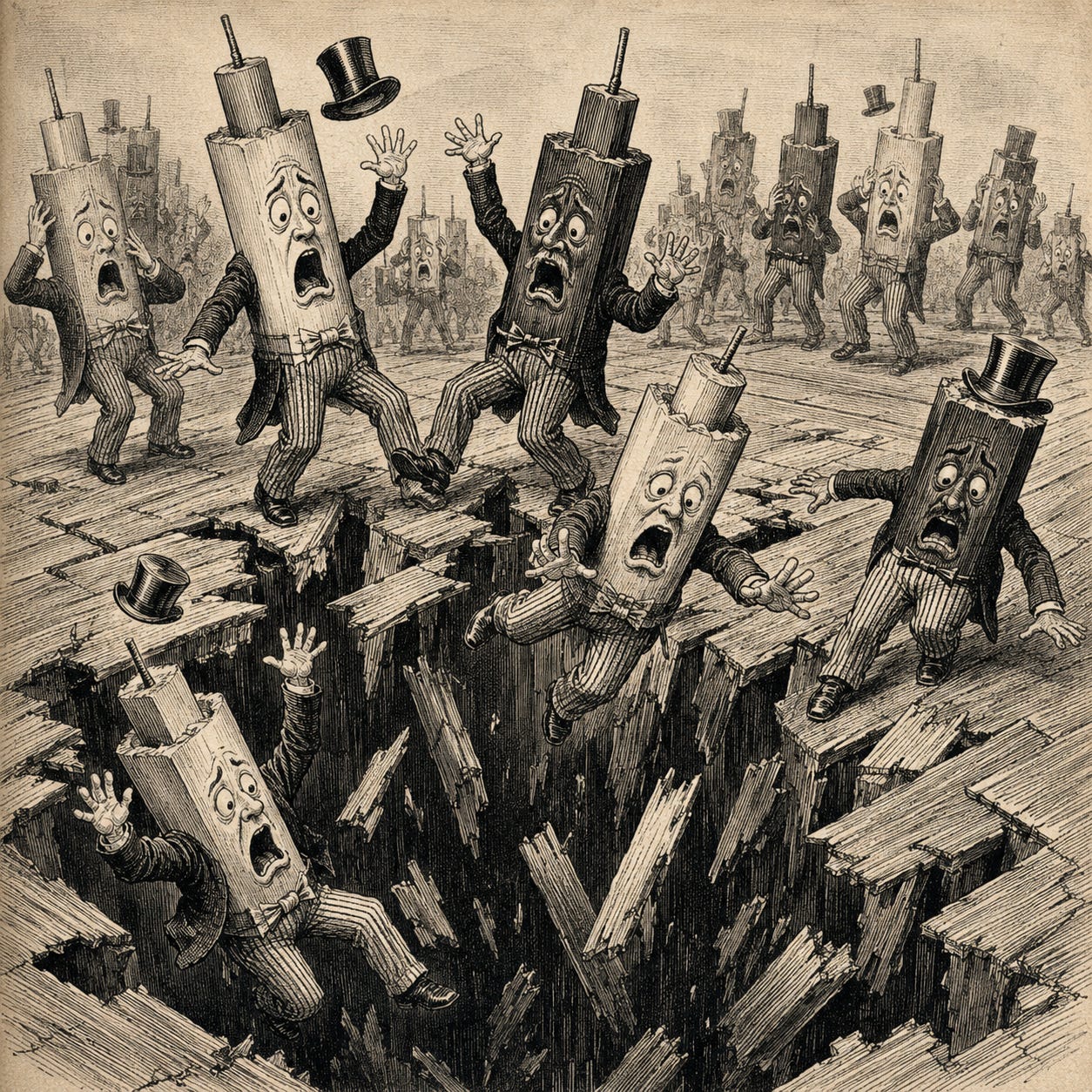
Ultimate Sell Signal? Why Tech Billionaires Are Quietly Dumping Their AI Stocks
40% ‘Deeper Correction’ Ahead? Fund Manager On Best And Worst Assets
The Biggest Market Rotation In Years Has Already Started
Gold’s ‘Stupid Cheap’ Price Level Revealed; Lobo Tiggre On Next Buy Signal
MARKET RECAP: July 13, 2026 - July 17, 2026
Escalating conflict between the United States and Iran drove markets this week and pushed crude sharply higher. U.S. forces struck Iranian targets for a seventh straight night, and Washington reimposed a naval blockade on Iranian ports near the Strait of Hormuz, which handles roughly 20% of the world’s seaborne oil. WTI crude settled at $82.49 per barrel on Friday, up about 4.5% on the day and more than 10% on the week, while Brent settled at $88.10.
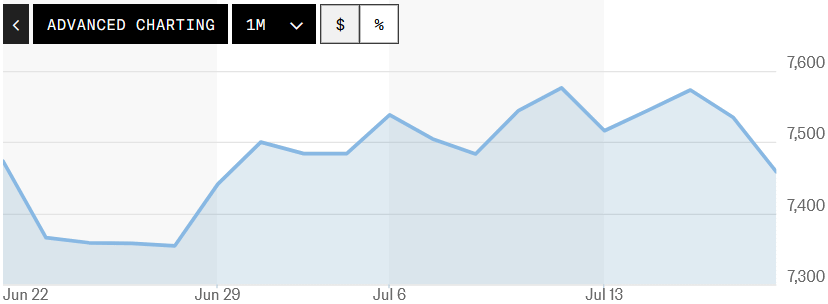
U.S. equities fell as the rout in semiconductors deepened. The S&P 500 closed Friday at 7,457.69, down 1.01%, and lost about 1.6% on the week. The Nasdaq Composite dropped 1.40% to 25,520.24 and shed 2.9% across the week, and the Philadelphia Semiconductor Index entered a bear market.
Chinese startup Moonshot AI released a new model on Friday that it said rivals leading U.S. systems, which deepened worries over stretched valuations and heavy spending. Taiwan Semiconductor topped second-quarter estimates on Thursday but raised its capital-spending outlook, and its shares fell anyway. The VanEck Semiconductor ETF lost about 9% on the week.
Netflix issued weaker-than-expected guidance after Thursday’s close, and its shares dropped Friday. UnitedHealth beat estimates and raised its outlook, which supported the blue chips. The Dow Jones Industrial Average closed Friday at 52,146.42, down 0.77%, and fell about 0.9% on the week.
June inflation cooled on Tuesday and offered brief relief. The Consumer Price Index fell 0.4% for the month, its largest decline since April 2020, and rose 3.5% from a year earlier, below the 3.8% consensus. The soft print eased pressure for a July rate increase, though Fed Chair Kevin Warsh said he remained focused on restoring price stability, and traders stayed divided over a September move.
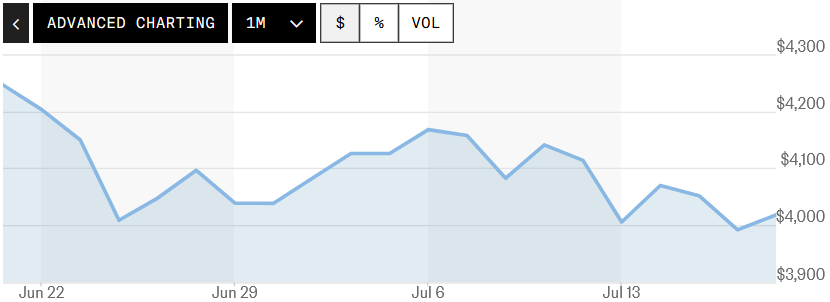
Gold fell despite the turmoil, pressured by a firm dollar and expectations that rates will stay higher for longer. The metal traded near $3,990 per oz on Friday and lost more than 3% on the week, its steepest weekly decline since early June. Prices approached their lowest level since November 2025.
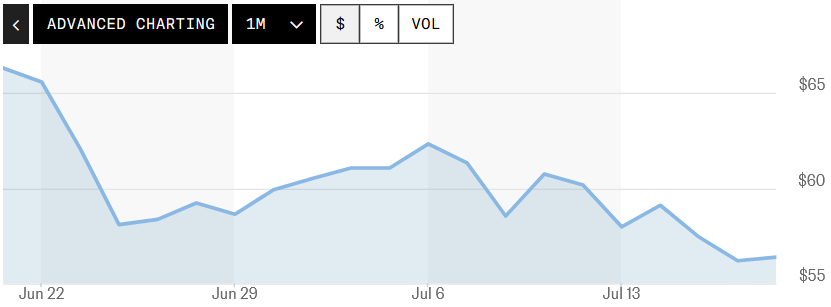
Silver dropped harder, sliding below $56 per oz and marking an eight-month low on a weekly loss of more than 7%. It traded well below the highs it set earlier in 2026. Higher real yields weighed on both metals.
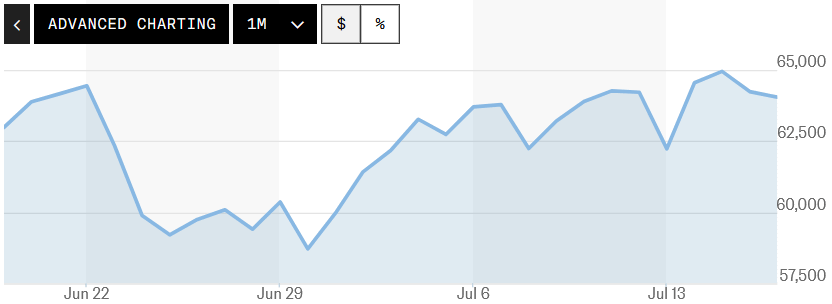
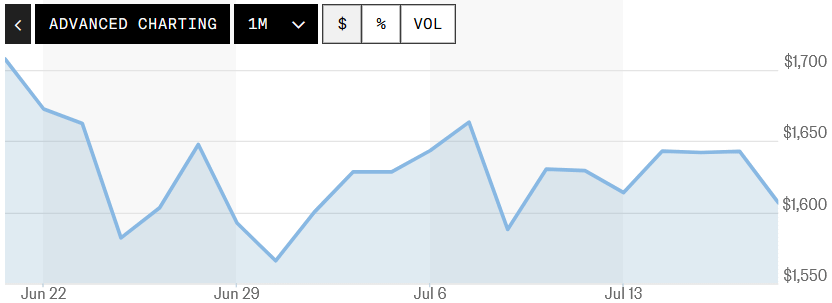
The dollar held firm, with the U.S. Dollar Index near 101. Bitcoin fell below $63,000 as the risk-off mood spread from equities to crypto, and ether traded near $1,850. The total crypto market value stood at around $2.2 trillion.
Market Movements
The following assets experienced dramatic swings in price this past week. Data are up-to-date as of July 17 at approximately 4pm EST.
(Data from StockAnalysis.com)
UP
BP - up 8.43%
T-Mobile - up 6.14%
Philip Morris - up 5.86%
DOWN
Sandisk - down 27.05%
IBM - down 26.08%
SpaceX - down 18.74%
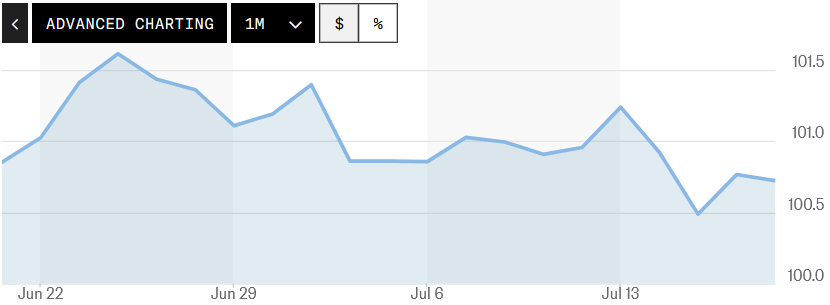
DXY - down .09%
Bitcoin - up .35%
Gold - down 1.24%
Silver - down 3.76%
Platinum - up .04%
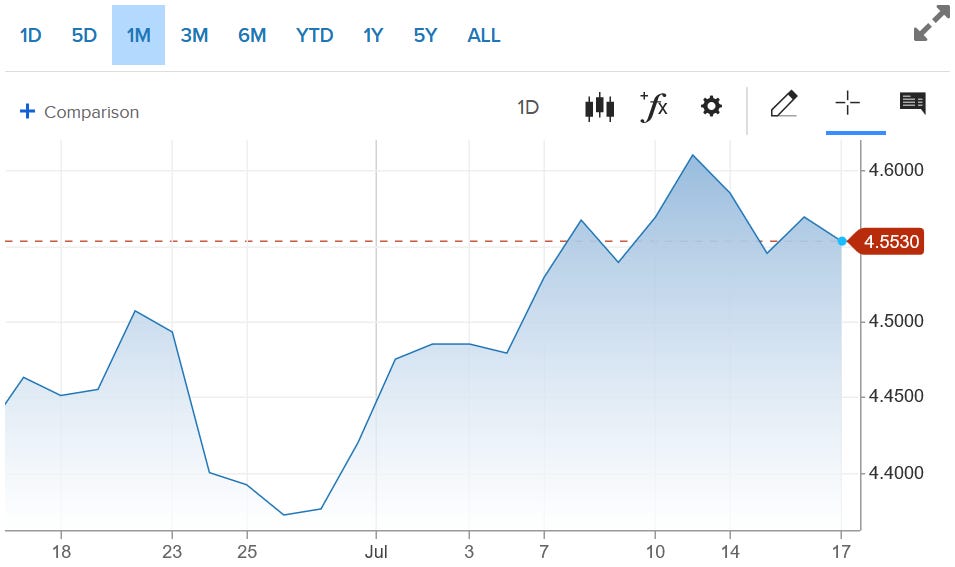
10-year Treasury Yield - down by 1.6 basis points
(10-year data from https://www.cnbc.com)
S&P 500 - down 1.19%
Russell 2000 - down .41%
Gareth Soloway, president of Verified Investing, talked with David on Friday amid a tech-led selloff. The S&P 500 and NASDAQ each fell about 1% intraday, while gold rose and bond yields eased. He framed the action as a rotation of capital, not a market exit.
The chip trade was cracking. Soloway tied the drop to markets looking 12 months ahead, as new memory factories loom and buyers ration expensive supply. Micron had fallen 36% from its earnings-day high.
He still bought the dip for a bounce. Soloway went long semiconductors on the day and flipped Seagate for a 10%+ gain the same morning. Longer term, he warned the sector could fall by as much as 75%, echoing past technology busts.
The broader indexes held up better. Mega caps like Apple, Microsoft, and Meta cushioned the NASDAQ as money rotated out of the chip sector. Apple, near $5 trillion, sat at major resistance, and Soloway expected it to roll over next.
On the Fed, he doubted the hawkish talk. Soloway expected at most one hike this year, and possibly cuts by 2027, arguing Warsh will resist raising rates under a Trump appointment. Economic weakness, he said, should surface by year-end.
He flagged froth as a warning. Analyst price targets of $2,700 to $3,500 on SanDisk and lofty Micron upgrades marked a top, as did the SpaceX hype. SpaceX had since fallen to $124, below its $135 insider price.
Oil had climbed from the high $60s to $81/barrel. Soloway planned to short near $87 and doubted oil would hold above $100 this year, expecting a return to the $60s by the midterms. Higher oil, he cautioned, is the real recession risk through inflation.
On metals, Soloway had been bearish since gold traded above $5,000/oz, targeting a move below $4,000, a level that has now been hit. He saw a possible final flush to $3,500/oz before turning a long-term mega bull and noted that Bank of America cut its 2026 average forecast by 14% to $4,316/oz. Bitcoin, near $63,000, formed a bullish near-term pattern pointing to $71,000.
Today’s sponsor is Algo Grande Copper Corp., ticker ALGR (TSXV), advancing a high-grade copper discovery in Sonora, Mexico, one of the world’s most established copper-producing regions.
Watch David’s interview with the Algo Grande team above.
Their flagship project, Adelita, sits within a six-kilometre mineralized corridor where maiden drilling has already returned standout results: including 18.2 m at 1.8% copper equivalent (1.2% Cu, 28.2 g/t Ag, 0.7 g/t Au), and 3.5 m at 3.9% copper equivalent with meaningful gold and silver credits (2.4% Cu, 61.1 g/t Ag, 1.8 g/t Au)..
The company has mapped multiple high-grade systems along the corridor, with geological work pointing to potential large-scale copper at depth. Phase II drill targets are already defined. The technical team includes Peter Megaw of MAG Silver and Raymond Jannas of ATEX Resources -- both with proven discovery and M&A track records in this geology.
In a market where quality copper assets are genuinely scarce, Adelita’s grade and scale are worth watching.
Ticker is ALGR. Learn more at vrify.com/decks/21900. Please review their risk disclosures on SEDAR+.
Danielle DiMartino Booth, CEO of QI Research, was interviewed by David after a surprising inflation report early this week. Headline inflation fell 0.4%, from 4.2% to 3.5%, its biggest monthly drop since April 2020.
The core reading was the real shock. Core CPI held flat, easing to 2.6% year-over-year, and core goods fell 0.1% for a second month. About 90% of Wall Street had positioned for a hotter print.
Fed chair Kevin Warsh, testifying to the House Finance Committee, called it premature to declare the inflation fight won. Booth read his tone as constructive rather than hawkish. Markets pulled bets on a July hike, pushing the question to September.
She argued restrictive policy was biting on a lag. Some 372 bankruptcies were filed in the first half of 2026, the most since 2010. Lending Tree reported personal bankruptcies up 50% year-over-year.
The labor market showed strain. More than a quarter of the unemployed had been jobless for six months or longer, and 720,000 people left the workforce in a month. Participation fell to 61.5%, the lowest outside COVID since 1976.
Booth highlighted a margin squeeze. Firms struggled to pass higher input costs to consumers, forcing cost cuts that fall on headcount. Renewed tension over the Strait of Hormuz, with oil back near $78/barrel, threatened to lift prices again.
The mega banks posted about $49 billion in second-quarter profit. JPMorgan set a record $21 billion in profit, up 41%, and Goldman Sachs’ profit jumped 78%. But the gains came from investment banking and lending to private credit and shadow banks, not consumers.
Booth would not own financials as they took commercial real estate losses and tightened lending. She saw multifamily, retail, and lodging as the next distress after office. On gold, she said the consolidation looked finished, with tourists washed out near $4,000/oz.
Josef Schachter, President of Schachter Energy Research Services, gave David a cautious but bullish oil outlook. He warned that oil prices above $140- $ 150 per barrel would trigger a severe global recession. Such a spike would destroy 5 to 8 million barrels of demand per day.
Prediction market Kalshi priced a 30% chance of oil above $115 by year-end and better than 20% above $140. Schachter did not share the most extreme calls. He expected WTI, near $71.50, to slip back to the mid-$60s, presenting a buying opportunity.
Energy stocks already looked cheap, trading under three times cash flow. He forecast an average of $80 in the fourth quarter and $90 for 2027, within a $70 to $110 range. A prior action-buy call in April 2025, he noted, saw the TSX energy index double.
The Strait of Hormuz remained the swing factor. Roughly 10 to 15 ships were exiting daily, down from 40, and vessels were loading but not returning. Global inventories showed a shortage of 4 to 5 million barrels heading into winter demand.
Schachter stressed US isolation from the strait. The US produced about 23.8 million barrels a day and imported most of its crude from Canada, Venezuela, Mexico, and Colombia. Any pinch, he said, would raise the price, not threaten availability.
China was tapping record reserves as imports hit a decade low. Sophisticated buyers, the Chinese, back away when prices are high and load up when they are cheap. Iran and Saudi Arabia were discounting cargoes to clear oil off the water.
Governments would also compete for barrels. Schachter modeled a 500,000-barrel-a-day strategic reserve refill, below a Reuters estimate of 664,000, since buyers turn cautious above $75-$80. Draining reserves too far, he warned, creates engineering as well as economic limits.
He favored undervalued Canadian producers. Canada ranked fourth globally at nearly 6.1 million barrels a day, and the Carney government had reversed Trudeau’s pipeline stance. The IMF, meanwhile, projected global growth easing from 3.5% to 3% in 2026 before recovering to 3.4%.
Gary Wagner, editor of TheGoldForecast.com, talked with David Lin on Tuesday after a cooler inflation print. Headline CPI came in at 3.5%, below the 3.8% expected and down from 4.2%. Wagner believed gold had formed at least a tentative bottom near $4,000/oz.
Markets welcomed the data. The S&P 500 and NASDAQ rose, gold jumped 1.4% intraday, and Bitcoin gained 3.5%. A softer inflation trend, Wagner noted, points to fewer rate hikes later this year.
He read the chart as a developing base. Gold made matching lows on June 23 and again on July 13, a double-bottom pattern near $4,000/oz. The metal opened above that level and recovered quickly from an intraday dip.
Wagner viewed $4,000 as more psychological than technical. Century marks like $2,000, $3,000, and $4,000 tend to act as magnets. A former support level near $4,080, once broken, had become resistance.
Confirmation would take more work. Gold needed a close above roughly $4,190/oz to signal the correction had ended. Beyond that, he flagged targets at $4,300 and $4,400.
The decline had been steep. From above $5,600/oz, gold fell about $1,600 in a textbook downtrend of lower highs and lower lows. The $4,300 target marked just a 23.6% retracement of that drop.
Oil worried him. Prices had ticked up after bottoming about a week earlier, and any reignition of the Iran conflict could lift inflation and rates. That risk, he said, sits in the back of every gold trader’s mind.
Wagner drew on history for scale. After peaking near $1,900/oz in 2011, gold eventually bottomed around $1,044 in early 2016 as buyers such as George Soros accumulated. For now, he saw no reason to stay bearish and expected gold to track higher near-term, with support near $3,920/oz if selling resumed.
Ron Butler, principal broker at Butler Mortgage and host of the Angry Mortgage Podcast, gave David Lin a bleak housing outlook. He warned that buyers waiting for a rebound may wait 18 months or longer.
US mortgage rates crept higher. The 30-year fixed rose to 6.58% from 6.57%, and prediction market Kalshi priced a 64% chance it ends the year above 6.7%. Butler said the market began to wilt once rates cleared 6%.
He argued that rates track supply and demand more than central bank policy, and he saw them rising further. Incoming Fed chair Kevin Warsh had not signaled dovishness. WTI above $80 to $90/barrel, he added, would keep inflation elevated.
Canada and the US diverged sharply. The US economy looked firm, if K-shaped, while Canada’s stayed weak. Bank of Canada Governor Tiff Macklem did not want to raise rates, and Butler expected no change for the rest of the year.
The bigger story was a government bailout. Prime Minister Mark Carney announced up to $1.4 billion in funding to buy roughly 2,200 vacant British Columbia condos and convert them into affordable housing. Butler, who once bet such a rescue would never happen, admitted he lost.
He panned the plan as a developer bailout that will not create jobs. Distressed condos were already selling to family offices and vulture funds at 50% off in Toronto. An auction, he argued, not government purchases, sets a true floor.
Canada’s population was shrinking for a second straight year. After the Trudeau government admitted 3.2 million people in three years, many were now leaving due to a lack of work. Thirty years ago, the average first-time buyer was 27; today, that buyer is 40.
Butler advised sellers to act now and buyers to turn serious by the fall. Foreclosures and power sales had climbed from record lows in a hockey-stick pattern. He called lower home prices unambiguously good for Canada and described the economy as suffering from a profound malaise masked by heavy rearmament spending.
Adam Taggart, host of Thoughtful Money, spoke with David Lin from the Rule Symposium. He urged caution after markets pushed higher for a fourth year, following three years of roughly 20%+ gains. Investors sitting on profits, he said, should take some off the table and consider hedges.
Taggart, a Stanford MBA who watched the dot-com boom firsthand, saw a clear AI bubble. The open question was whether the market sat closer to 1998 or to 2000. Nobody, he noted, finds the top until it is behind them.
His most striking signal came from a July 4th gathering of tech elites near Lake Tahoe. Attendees who made fortunes in technology were de-risking hard, with one already 65% in Treasury bills. The people most exposed to AI, he said, were quietly selling.
Taggart argued that the constraint on AI was no longer capital but physical limits. Land, permits, water, memory chips, and capacitors could all bend the buildout curve. Reno had passed a moratorium on new data centers, and Blackstone pulled out of what would have been the largest US site.
The stakes were broad. AI and AI-adjacent companies accounted for about 45% of the S&P 500’s market cap so that a cooling sector would drag the index down. Three of the Mag 7 were already down year to date.
He flagged a hidden cost in the infrastructure. Unlike railroad tracks or dark fiber, AI chips grow obsolete in about three years. Upgrading a data center costs nearly two-thirds as much as building one.
Taggart cited peers turning cautious. Darius Dale, a longtime bull, expected a 1998-style correction of roughly 15% between summer and October. Jeremy Grantham, bearish on tech, was roasted on CNBC for early calls.
Even so, Taggart doubted a near-term recession while AI capex ran near $800 billion this year and deficit spending flowed. He described a K-shaped economy in which wage growth is decisive, and tied rising political support for socialism to strain at the bottom. He closed constructively on hard assets, suggesting precious metals may have bottomed and copper looks strong long-term.
Chance Finucane, CIO of Oxbow Advisors, said his firm was rotating back into energy and precious metals. Both had sold off in the second quarter, and he viewed the pullback as a good entry point.
Oxbow had trimmed metals in January, when gold spiked near $5,500/oz and silver near $116/oz. It grew interested again as gold fell toward $4,000/oz and silver toward $60/oz. A metals allocation cut to mid-single digits was rebuilt toward its 10% average.
The firm kept 60% in stocks and 40% in short-term treasuries, viewing the market as fully valued. It avoided the AI trade. Roughly 50 to 60 companies accounted for nearly half of the market capitalization as AI beneficiaries.
Finucane saw steep downside in that group. High-quality semiconductors experienced about a 40% downside in a typical bear market, far beyond the 20% limit Oxbow accepts for new positions. AI IPOs priced at 20 to 70 times revenue, against Google’s 8.5 times at its debut.
SpaceX, one such listing, had already fallen 16% from its first-day close. OpenAI and Anthropic were expected to follow. Finucane preferred to wait, noting that first-year IPOs are usually cheap.
Energy positions were trimmed when the Iran war sent Brent above $120/barrel overnight. With oil back near $80, Oxbow rebuilt exposure through pipelines, integrated firms, producers, and oil-service names. Geopolitical risk, Finucane said, now raises the floor under oil.
He expected long-term Treasury yields to keep rising, a structural shift since 2020 that hurts bond prices. Oxbow held maturities of three years or less and locked in more at the 2-year yield above 4%. Roughly 60% of market trading, he added, is driven by momentum players.
As those players rotated out of semiconductors, money moved into financials, healthcare, utilities, and staples, where Oxbow had been buying. Looking to 2027, Finucane saw the potential for a deeper decline as strong 2026 growth and inflation figures cycle off. Midterm election years, he noted, tend to be volatile.
Adrian Day, president of Adrian Day Asset Management, joined David from the floor of the Rule Symposium. He described gold sentiment as bullish but realistic. Long-term holders were unfazed by the pullback from roughly $5,500/oz.
Day flagged a tough near-term backdrop. A stronger dollar, a higher CPI, and rising bond yields formed a negative trifecta for gold. The bond market had already done what the Fed had not, yet real interest rates remained negative.
Fed expectations had swung hard. In January, more than 80% of futures traders priced rate cuts; by April, more than 80% priced hikes. Incoming governor Kevin Warsh set a hawkish tone, though the latest payrolls came in weak with downward revisions.
Oil had round-tripped below pre-war levels. Day expected that to soften gasoline prices and the CPI, if only temporarily. He argued US oil self-sufficiency now blunts the recession risk that oil spikes carried in 1974 and 1990.
The economy proved resilient. Q1 GDP was revised up to 2.1% from 0.5% in the prior quarter. That cushion, he said, will let it withstand higher oil prices.
Mining stocks told a bleaker story. The GDX had fallen 35% from January, valuations sat in the lowest 20th percentile historically, and bullish sentiment hovered near 7%. On one recent day, the sample showed zero bulls, a mix of weak prices, valuations, and sentiment that Day called a setup for a strong move.
His firm trimmed its silver holdings in January and April but has since stopped selling. Day tied gold’s long-term case to central banks and Tether, both of which are price-insensitive buyers. Central banks have cut dollar exposure for 15 years, a trend that accelerated after Russia’s reserves were frozen.
Day expected the AI bubble and private credit to unwind next. Nvidia, Microsoft, and Amazon had each fallen 15% to 20% over the prior month while the broad market stayed flat. He also warned that private credit firms mark their own loans, masking risk, and he viewed Warsh more favorably than recent Fed chairs given his market experience.
Lobo Tiggre, Founder of the Independent Speculator also spoke with David from the Rule Symposium. His base case held that gold would consolidate before its next major move higher. He was in no rush to buy.
A sharp drop would change that. If gold retreated 50% from its peak, into the high $2,000s/oz, Tiggre said he would buy without watching charts. He had not sold an oz of his bullion, reserving trades for mining stocks.
Outside metals, he favored oil. Many oil stocks traded below pre-war levels, and some analysts were calling a bottom. Still, he expected the glut narrative and a draining US strategic reserve to pressure the shares lower first.
Tiggre saw the second half of 2026 shifting from war headlines to Fed headlines. He cautioned that Warsh’s hawkishness was tone, not hard data. A renewed war, he added, would prove inflationary, driven by money printing as much as by oil.
He also weighed an AI unwind. If data-center spending pulled back, copper could be wrongly sold off as an AI play. Tiggre, who named copper his top 2026 pick, said he would gladly buy that dip.
Uranium remained a favored long-term thesis. Prices sat near the incentive level around $80/lb, and spot traded below long-term contracts. He expected a snapback but already owned heavily.
His pair trade set oil against copper. War lifts oil and hurts copper through economic destruction, while peace does the reverse. The immediate geopolitics, he noted, push the two energy-linked metals in opposite directions.
Tiggre said old knocks on gold were fading, helped by a crypto crowd that taught younger investors about fiat debasement. At $4,000/oz, miner sentiment was bearish, even though producers earned the same margins that had drawn champagne on the way up. That gap, he said, is where disciplined speculators find opportunity.
Monday, July 20 -
Leading Indicators (June)
Tuesday, July 21 -
No economic data
Charles Schwab Corp. earnings
Capital One earnings
Danaher earnings
Wednesday, July 22 -
No economic data
Alphabet earnings
Tesla earnings
Philip Morris earnings
Texas Instruments earnings
IBM earnings
Thursday, July 23 -
Weekly Jobless Claims (July 18)
Kansas City Fed Survey (July)
Intel earnings
Friday, July 24 -
US Flash Manufacturing PMI (July)
US Flash Services PMI (July)
New Home Sales (June)
American Express earnings
NextEra Energy earnings
No posts
Comments
Nothing yet. Say the first thing.
Sign in to join the conversation.