
The David Lin Report To Attend The 2026 Rule Symposium
Peter Schiff: The Next Meltdown Has Quietly Started
Lyn Alden: Did Another Great Depression Just Trigger?
Massive Liquidity Shock Coming; Brace For ‘Wrecking Ball’
‘I’m Mostly In Cash’; Trader Calls Next Drop For Stocks, Bitcoin, Gold
Market ‘Smackdown’ Ahead: Investor Reveals Your Ultimate Defense
‘The Entire Planet Has 1930s Depression’ Once Interest Rates Hit This Level
Fund Manager Reveals #1 AI Trades Now
MARKET RECAP: June 22, 2026 - June 26, 2026
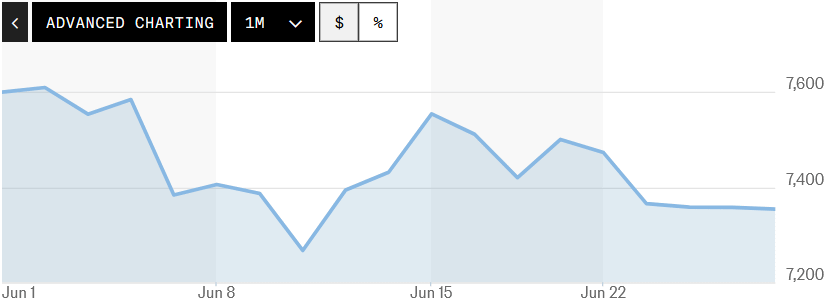
Technology stocks led a broad retreat. The Nasdaq Composite fell 4.6% on the week and posted a fifth straight losing session Friday, closing at 25,297.62, while the S&P 500 slid nearly 2% to 7,354.02 and the Dow Jones Industrial Average rose 0.6% to 51,876.11. Investors rotated out of high-valuation technology names and into more defensive areas of the market.
Several catalysts fed the decline. The New York Times reported that OpenAI had weighed delaying its public offering until next year, and chip stocks slid alongside SpaceX, which extended losses following its June 12 debut. Micron posted record quarterly revenue of $41.46 billion on Wednesday, yet technology shares remained under pressure amid rising memory and data-center costs. Alphabet had dropped 5% Monday on concerns over AI talent departures.
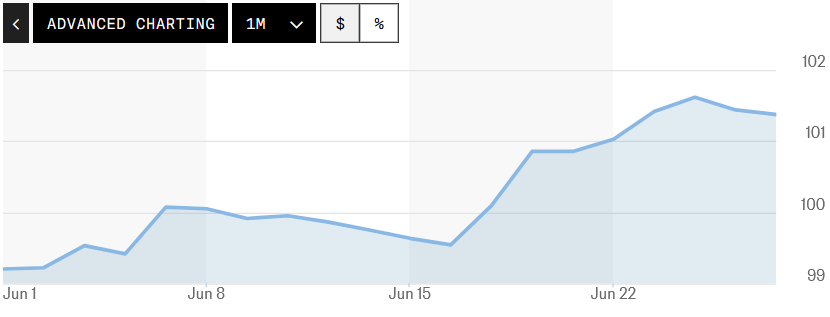
The Federal Reserve set the macro tone. Under new Chair Kevin Warsh, the central bank held its policy rate at 3.50%-3.75% on June 17 and sharply raised its inflation forecasts. Traders priced in three rate hikes this year, with roughly a 62% chance of the first move in September. The dollar index climbed toward a 13-month high near 102 before easing Friday, ending higher for a second straight week.
Inflation data offered some relief. Thursday’s report showed headline PCE at 4.1% for May, with personal income and spending each up 0.7% on the month. The print eased fears of a sharper acceleration and led investors to scale back some tightening bets.
Crude oil collapsed. West Texas Intermediate fell nearly 4% Friday toward $69 per barrel, its lowest since February 27, and recorded a weekly drop of more than 10%. Tanker traffic through the Strait of Hormuz accelerated as US-Iran peace talks advanced and Saudi Arabia resumed loadings at Ras Tanura, restoring Persian Gulf exports toward prewar levels. Trump said Friday that Iran had violated the ceasefire by firing drones at ships in the strait.
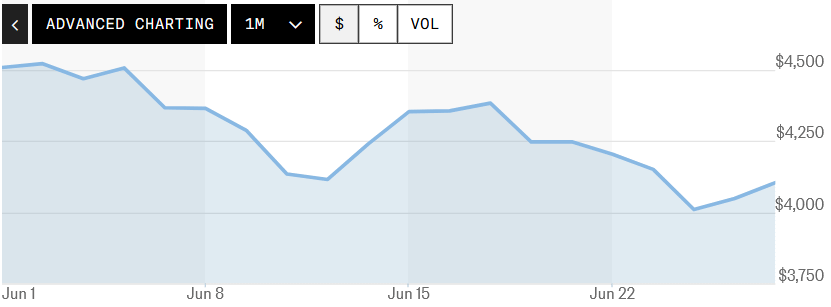
Gold had a volatile week. Spot prices reached a high near $4,221 per oz on Monday, then set a weekly low near $3,959 on Wednesday as a firmer dollar and rate-hike bets drove selling, marking the first move below $4,000 since November. A Friday rebound lifted gold back to about $4,090 per oz, though the metal still logged a fourth straight weekly decline.
Silver fell harder. The metal dropped from around $65 per oz early in the week to a close near $57.83 on Tuesday, its weakest since December 2025, before recovering to about $59.50 per oz on Friday amid a softer dollar and ceasefire headlines. Silver traded at roughly half its January record near $121.62 per oz.
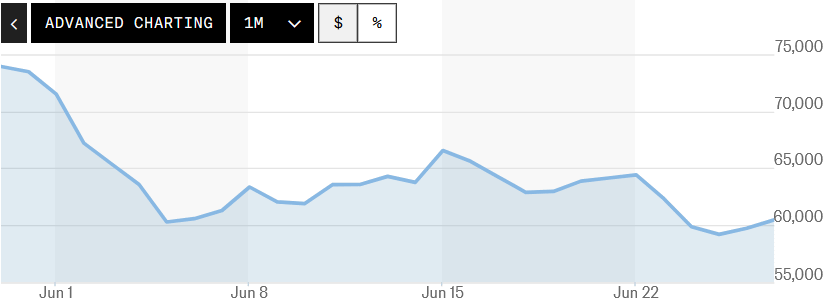
Bitcoin tracked the risk-off mood. It traded near $59,000 on Friday, down big again on the week and roughly 20% for the month, with sentiment gauges at extreme fear levels. Abroad, UK Prime Minister Keir Starmer resigned Monday, and South Korea’s Kospi triggered a circuit breaker Friday before closing down 5.8%
Market Movements
The following assets experienced dramatic swings in price this past week. Data are up-to-date as of June 26 at approximately 4pm EST.
(Data from StockAnalysis.com)
UP
Merck & Co. - 12.47%
Johnson & Johnson - 10.10%
AbbVie - up 9.39%
DOWN
Western Digital Corporation - down 21.61%
Oracle - down 15.13%
Palantir - down 12.25%
DXY - up .49%
Bitcoin - down 5.93%
Gold - down 2.44%
Silver - down 10.50%
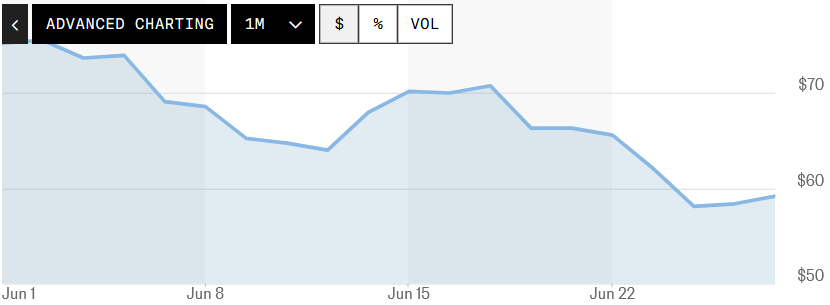
Platinum - down 2.42%
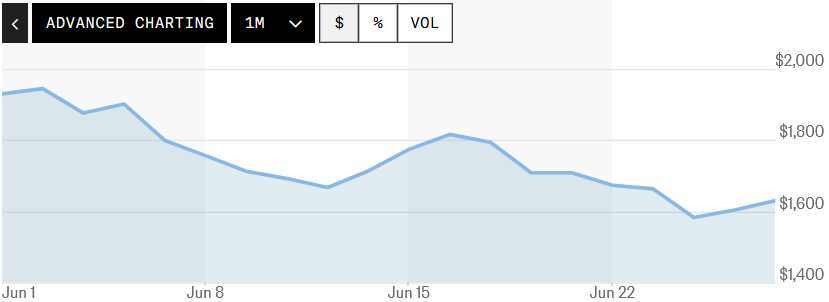
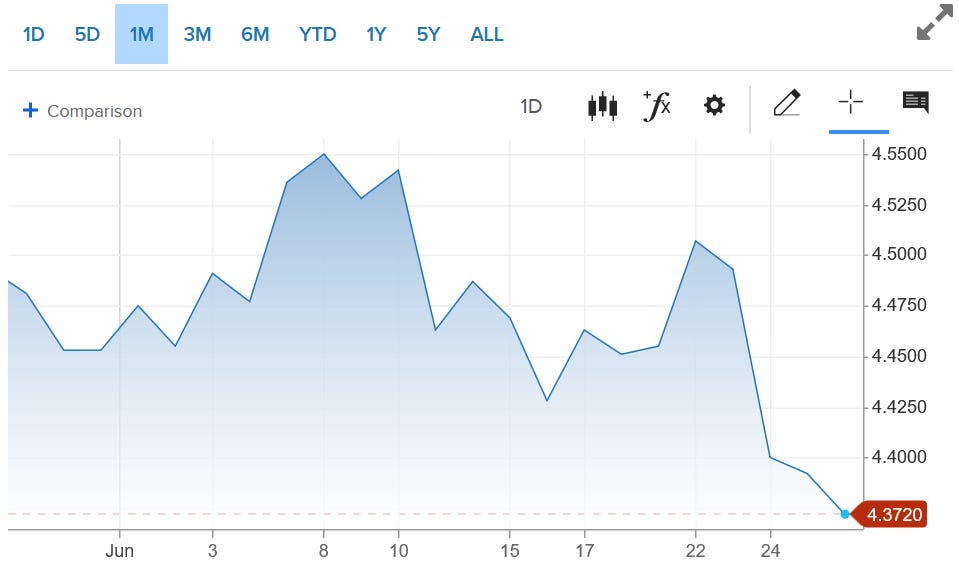
10-year Treasury Yield - down 14 basis points
(10-year data from https://www.cnbc.com)
S&P 500 - down 1.95%
Russell 2000 - up .59%
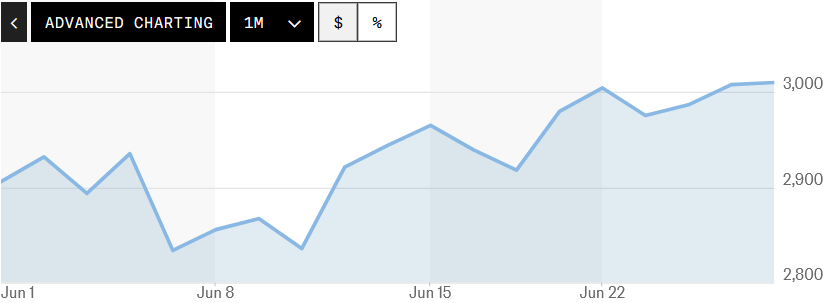
Chris Vermeulen, chief market strategist at The Technical Traders, said the rallies in stocks, gold, and Bitcoin had all rolled over. The S&P 500 topped in early June. Gold peaked in late January, and Bitcoin peaked late last year. The question now, he argued, was whether to be in markets at all.
Market internals had turned. Vermeulen explained that money-flow signals on the S&P 500 had shifted from buying to a search for safety. Utilities had started outperforming, a red flag he reads as a warning that money is leaving stocks. The dollar had also begun to break out.
He had trimmed accordingly. Vermeulen said he closed his QQQ position near the high and held only a sliver of S&P 500 exposure. His system, he explained, lightens up when a trend stalls rather than betting on a coin toss.
On the downside, he was specific. The S&P 500 could fall 18% to 24% on the monthly chart, toward 5,500-6,000. Gold faced a pullback toward $3,300-$3,600, roughly 17%. Bitcoin looked weakest of all.
Vermeulen predicted Bitcoin would drop toward $44,000 next, with the monthly chart pointing to $16,000, a level he had flagged years earlier. He said crypto had fallen completely out of favor as money rotated first into precious metals and then into AI and technology names.
He took a longer view on gold. Vermeulen argued the metal was in a shakeout phase, echoing the long consolidations after the 1980 and 2011 peaks. He predicted a sharp correction, then possible stability, then a potential surge toward $8,500/oz if something in the economy broke. He cautioned that such a move would mean real pain elsewhere.
For now, Vermeulen favored only the dollar. He noted the dollar index had built a base before prior 20% legs higher. He said the currency tends to rally during economic stress, as it did in 2022, and that a dollar breakout would likely coincide with a stock selloff. He framed cash at 4% as a smart temporary hold while waiting for metals to bottom.

David Lin will be attending The 2026 Rule Symposium on Natural Resource Investing from July 6–10 in Boca Raton, Florida, as a media partner with coverage sponsored by Palisades Goldcorp Ltd; a publicly listed resource investment company and merchant bank focused on financing junior companies in the mining and resource sector (TSX-V:PALI).
The 2026 Rule Symposium is founded by legendary investor Rick Rule and delivers actionable insights, dynamic discussions, and unmatched networking.
Through its extensive investment portfolio across multiple commodities, Palisades provides investors with significant leverage to upside potential in junior resource equities.
Doomberg, head writer of the Doomberg Substack, said the oil market stayed calm through the Iran war because traders read it correctly. WTI traded near $72- $ 73 per barrel, barely above prewar levels. That price, he explained, signaled to the market that the Strait of Hormuz was effectively open.
Three forces kept the supply flowing. China stockpiled heavily under the radar. China also leaned on hydrocarbon fungibility, switching toward coal, ethane, and other feedstocks at a scale few expected. And more oil slipped out of the strait than anyone admitted. The true disruption ran near 5 to 6 million barrels a day, Doomberg said, not the 15 million the market first feared. China absorbed roughly four million barrels, and reserves covered the rest.
On the fear of empty tanks, he was blunt. North America was never at risk. Canada produces 5.5 million barrels a day that can only flow to the US, he explained, and the combined region runs a vast surplus of crude and refined products. He dismissed forecasts of US shortages by July 4. Parts of California and the Northeast faced strain, but the Jones Act could be suspended to ease it, which the administration did early.
Doomberg argued Trump’s claim that reserves would run dry in four weeks was narrative management around the Iran memorandum, not a reading of physical inventory. He said the real leverage Iran held was never Hormuz. It was the proven ability to destroy Saudi oil infrastructure with missiles and drones, a threat he likened to an economic nuclear weapon.
He saw oil drifting lower into year-end, with Lebanon the milestone to watch. A major escalation could spike prices. Absent that, his base case is prices easing back toward prewar levels. He noted European gas traded near 42 euros per megawatt-hour, with Asian buyers outbidding European buyers for cargoes.
Doomberg closed on China. He said coal supplies more than half its primary energy, and its all-of-the-above buildout across coal, nuclear, solar, batteries, and the largest EV fleet ever assembled gave it flex no rival could easily copy.
Peter Schiff, host of The Peter Schiff Show, argued the market had melted up and would eventually melt down. He said valuations had reached extremes never seen before. He pointed to the SpaceX listing, a company he said traded at more than 100 times revenue after selling only about 4% of its shares.
Schiff argued crypto offered the clearest signal. He said Bitcoin had fallen from a peak near $126,000 to around $64,000, a drop of about 50%, leaving it lower than in April 2021.
He took particular aim at Strategy and Michael Saylor. Schiff explained that the firm had sold common stock for three consecutive weeks to buy Bitcoin, even as its shares traded at a 25% to 30% discount relative to its Bitcoin holdings. He argued that the move destroyed Bitcoin per share and would eventually cause the company to collapse.
On the dollar, Schiff said recent strength reflected yen weakness rather than confidence in the currency. He noted the yen had broken down near 162. He explained Japan held over $1 trillion in Treasuries and could become a forced seller, pushing US yields higher.
Schiff said Japan faced its own debt strain, with a deficit near 4.5% of GDP and debt at 250% of GDP. He argued the US could not safely reach that level, since it was the world’s largest debtor, ran a trillion-dollar trade deficit, and depended on services rather than manufacturing.
He predicted the Federal Reserve under Kevin Warsh would keep expanding its balance sheet and monetizing debt. He argued real interest rates had already collapsed as inflation accelerated. Schiff said inflation was a policy choice that every chair since Alan Greenspan, who died that day, had made.
On energy, Schiff said oil companies would benefit from higher prices tied to the conflict in Iran, though most Americans would pay more. He argued that the US lost that war by granting Iran sanctions relief and the return of frozen assets.
Schiff predicted gold would climb once the Fed began raising rates, as markets judged the moves insufficient. He said weak data could pull hikes off the table and send gold sharply higher. He argued that tokenized gold, not Bitcoin, represented the future of blockchain.
Lyn Alden, founder of Lyn Alden Investment Strategy, pointed to two developments shaping the rest of the year: the partial resolution with Iran and the new Fed chair’s hawkish signaling. She cautioned that the Iran deal was only a memorandum of understanding, so headlines would keep coming.
Her central theme was fiscal dominance. Alden explained that once federal debt passes 100% of GDP, interest rate policy loses its punch. Raising rates curbs bank lending, but it also widens the deficit by lifting interest expense, which now exceeds defense spending. The Fed’s tools, she argued, were built for an era of monetary dominance that no longer applies.
This produces a two-speed economy. A young family seeking a first mortgage faces near-impossible affordability, while deficit spending flows to Social Security, Medicare, and defense, and wealthy asset holders prosper.
On inflation, Alden was measured. She said energy had been the largest driver of the recent spike. If the ceasefire holds and oil stops climbing, year-over-year readings should cool in the back half of the year. She added that there were no signs of a 2021-style breakaway, since M2 growth had returned to normal rather than the 40% surges of that period.
Markets had priced a 90% chance of at least one rate hike by December. Alden found that aggressive, leaning closer to neutral herself. For most investors, she argued, 25 basis points hardly matter in the larger picture.
She walked through her allocation asset by asset. High-quality equities form the core, favoring companies outside bubble territory. Gold she treats as a permanent strategic holding, but after a powerful two-year run, she wants to build a base before adding. Bitcoin sits in low-sentiment territory, weighed down by a stagnating broader crypto space and by capital rotating into AI.
On AI, Alden drew the same parallel as gold: real technology that arrived too fast for comfort. She predicted parts of the trade would crack from a high base, then recover. SpaceX at 100 times revenue struck her as excessive, and she favored chip stocks over free-cash-flow-negative hyperscalers.
Michael Howell, founder and managing director of GL Indexes and author of Capital Wars, traced the year’s weakness to liquidity, which he said peaked in late 2025 and has been slowing ever since.
He stressed it was not falling in absolute terms but decelerating, and that the cause was not the Fed stamping on the brake but a real economy so strong it crowds money out of financial markets. Even absent the Iran war, he argued, stocks, gold, and Bitcoin would have fallen as much as they did.
On Warsh, Howell approved of the trimming of the Fed’s remit and questioned whether the funds rate means much anymore. With AI firms earning gross margins above 50% and a government paying a large interest bill to the private sector, he argued that a 25-basis-point change changes little, and a rate rise can even act as stimulus. Warsh, he said, is standing back and letting the markets tighten for him through a stronger dollar and rising yields.
He walked through his liquidity machinery. A disguised QE program he called the RMP had refilled markets after repo tensions threatened a coronary at the end of 2025, while the Treasury suppressed bond volatility through buybacks, swapping illiquid off-the-run bonds for fresh ones. Either you trust these authorities are guarding your back, he said, or you worry the cracks are widening. He ruled out near-term balance-sheet shrinkage, noting the last attempt in late 2025 broke the repo market.
Howell explained the dollar’s strength through buoyant capital flows, post-GFC bank and insurance regulation, and enthusiasm for US tech, all of which are reinforced by the coming Fed tightening.
The yield curve, expected to steepen this year, had instead flattened, signaling tighter liquidity, and he matched nominal GDP growth of 6%-7% against a 10-year target near 6%. The danger above 4.5%, he argued, falls on the leveraged financial sector rather than the economy, which he thought could endure until roughly 5.5%.
On gold, Howell offered a contrarian read centered on China. The People’s Bank had been internally devaluing the yuan since early 2023 to escape its debt problem, and gold priced in yuan tracks PBOC liquidity nearly one-for-one, making Shanghai the marginal pricer.
China abruptly turned off the tap around March 2nd, he said, probably to cool the economy and curb oil demand amid tensions with Iran. Still, the latest data showed relief had resumed. This was a selective debasement, he argued, with the great Western debasement still to come.
Bitcoin, he called a clean barometer of Fed liquidity, suffering as that liquidity slows. He warned Wall Street would not remain immune, recalling that the 2021-22 tightening cut stocks by 25% and Bitcoin by 75%, though he expected a range-bound 2026, with tightening intensifying into year-end or 2027.
On oil, Howell leaned on the gold-oil ratio, historically near 20 and now around 45. With gold elevated at a minimum of $4,000, simple arithmetic implies $200 oil, though he framed it as triangulation rather than a forecast.
The ratio tracks the liquidity cycle, falling late as the real economy’s appetite for commodities crowds out finance, so he would not discount higher oil and commodity prices in the medium term, especially given deglobalization and duplicated supply chains.
His closing themes were structural. Deficits are exploding worldwide, he said, because aging demographics drive welfare costs above mainstream inflation while neither party will cut spending or raise taxes.
Governments increasingly fund themselves at the front end through bills bought by banks, a form of monetization that Milton Friedman would lament. He urged defensive positioning, commodity protection, and shorter-duration government debt or TIPS, and he summarized his worldview simply: economics is downstream of liquidity, and geopolitics is downstream of economics.
Kevin Steuer, managing partner at StockTA.com, said his algorithm was flashing deflation signals even as the rest of the world braced for higher inflation. The strongest readings pointed to the US dollar and a deflation ETF. The weakest were crypto, oil, and agricultural commodities, the very inputs that drive inflation.
That left him doubting the case for aggressive Fed action. Steuer said the inflation inputs looked tamed before Kevin Warsh even started. He wondered aloud whether Warsh would raise rates to follow the data or to prove he was tough.
On oil, Steuer was clear. He predicted crude had peaked for this cycle unless boots hit the ground in Iran. He doubted Iran would keep the Strait of Hormuz closed, since the regime would want to push oil through and capture revenue after sanctions relief.
Steuer stayed mostly in cash. He set his SPY downside level at 693, roughly 6% below current prices, and warned July could turn choppy. He was not outright bearish, but he would not buy here either.
Gold drew the same caution. Steuer noted that the metal had broken below its $4,000 support, erasing its year-to-date gains. His key Fibonacci level had been 4719, and once it broke, he expected a faster selloff. He said the metal would lead the miners, so he wanted gold to stabilize first.
He drew a historical parallel that worried him. Gold peaked in 1980 and collapsed by 1981, then peaked in 2011 and collapsed in 2012. Steuer questioned whether this rally had staying power.
On Bitcoin, trading below $60,000 at its lowest since September 2024, Steuer predicted a bounce toward $63,000 given an oversold RSI near 29. He wanted three or four days of higher highs before committing. He flagged quantum computing and a possible Strategy blowup as his main fears.
Steuer turned to politics through the lens of markets. He argued Republicans needed oil under $85 and strong jobs data to hold the House. A divided Congress, he predicted, could stall spending bills and ease pressure on long-end yields.
John Feneck, CEO of Feneck Consulting, argued the precious metals trade was not dead but resting. Gold traded just above $4,200/oz, down about 25% from its highs, and silver had fallen roughly 40%. Both still sat more than triple-digit percentages above year-ago levels. Weak sentiment, he said, traced back to the war.
He pointed to two rug pulls earlier in the year. Silver lost 34% in a single session on January 30, a move he attributed to orchestrated short selling led by JPMorgan. A second wave of liquidation began on March 3, fueled by margin calls that fed on themselves.
Feneck rejected comparisons to 2011 and 2012. The paradigm had changed, he argued, with billionaires and central banks buying hand over fist. Silver had also become a designated critical mineral, with persistent shortages and growing industrial use.
His own positioning reflected patience. Feneck said his silver cost basis sat under $20/oz, so he held through the panic. He had sold above $100/oz eight or nine times on the way up and planned to reload in the high $40s to low $50s.
The big banks stayed bullish. Feneck cited year-end gold targets of $6,000 from Bank of America, $5,400 from Goldman Sachs, and $5,050 from JP Morgan, with only Citi pulling back. Against $4,185 gold, he saw real upside into year-end.
On copper, trading near $6.36/lb at record highs, Feneck explained the divergence from gold as the split between an industrial metal and a precious one. Copper, he said, was riding the AI and infrastructure trade alongside the S&P 500.
He warned that the set-it-and-forget-it equity crowd faced a reckoning. Feneck predicted a smackdown within nine months, into the first quarter, driven by the Fed, Trump, or war. He flagged real estate and energy stocks as poor trades, the latter because oil itself rose while XLE went nowhere.
His conviction had shifted toward critical minerals. Feneck favored tungsten, 86% of which is produced by Russia, North Korea, and China. He noted spot tungsten had climbed from $920 to around $3,000 this year and named Guardian Metal and Western Star as holdings.
Grant Cardone, founder and CEO of Cardone Capital, said a 10-year Treasury yield of 6% would push the global economy into a depression on the scale of the 1930s. He argued mortgage rates would then climb to 8% or 9%. HSBC had flagged 4.5% as a danger zone, with yields already near that level.
Cardone said the US housing market faced a mortgage crisis rather than an affordability crisis. Cement, labor, and permit costs could not fall quickly, he explained, while interest rates could change overnight. He put the average US home at $416,000.
Housing had been in recession for three years, Cardone said. He explained that 60% of US mortgage debt carried rates of 4% or lower, which gave owners little reason to sell into a 7% market.
For his own capital, Cardone favored a mix of real estate and Bitcoin. Cardone Capital planned to add about 2,000 apartment units to its 15,000-unit portfolio, an increase of nearly 18%, buying at roughly 30% below replacement cost. He said the firm would reach $6 billion of real estate this year and had raised more than $2 billion online without missing a distribution.
The firm intended to pair those purchases with 1,000 BTC and Fannie Mae financing. Cardone said the market marked the largest real estate correction since 2008, with Bitcoin down about 50% from its peak.
He predicted Bitcoin would reach at least $1 million within a decade. On a Boca Raton complex bought for $235 million out of a Blackstone-financed bankruptcy, he had added $100 million of Bitcoin. He predicted monthly rents would rise from $4,500 to $13,000 and the property would be worth $1 billion in 10 years.
On the macro picture, Cardone said WTI crude traded near $75/barrel after spiking around the conflict with Iran. He predicted the incoming Fed leadership under Kevin Warsh would move toward lower rates, citing President Trump’s pressure for cheaper money. He said yields had been falling toward 3.6% before the Iran strikes reversed that path.
Cardone also said the SpaceX listing created 4,800 employee millionaires and lifted Elon Musk to trillionaire status. He said he bought and sold the stock within 28 minutes. He predicted a pullback once early investors could exit.
Matthew Tuttle, founder and CIO of Tuttle Capital Management, said the AI trade remained strong heading into 2027. He rejected comparisons to March 2000. The recent dip across tech, he argued, was profit-taking after names ran up too far, too fast, and he would buy it.
Memory had become the hottest corner of the market. Tuttle explained that DRAM contract prices jumped roughly 60% in a single quarter, with prices skyrocketing due to AI’s demand for it. Micron rose more than 12% the day of the interview after the results, and he said the stock had climbed around 275% from its bottom.
He framed his approach around three bottlenecks: memory, photonics, and space. Memory ranked as the most powerful right now. Tuttle said he keeps individual positions small, near 1% to 2%, so a 50% correction would not sink the portfolio.
On software, Tuttle was wary. He argued that AI would crush many legacy software companies while sparing others. He avoided the IGV index for lumping everything together, and named Microsoft, Palantir, cybersecurity, ServiceNow, and Salesforce as likely survivors.
Tuttle addressed the Broadcom selloff directly. He said a 14% drop in fine print showed expectations had moved from strong to perfect, not that the AI trade was breaking. He did not own it, preferring bottleneck plays.
On new listings, he drew one lesson: do not become exit liquidity for IPO insiders. Tuttle said he avoided SpaceX on day one, then added exposure to it across several of his ETFs. His favorite upcoming IPO was not OpenAI or Anthropic but Anduril, a pick tied to what he called the convergence of traditional defense with drones, lasers, robots, and AI.
Tuttle named the risks that could end the party. A pullback in hyperscaler spending would be the big one, he said, though he saw no sign of it in the near term. He predicted Fed rate hikes would crush companies without earnings, as the inverse ARK ETF he launched in late 2021 had anticipated. He also flagged stress building in Korean memory names.
Monday, June 29 -
No economic data
Tuesday, June 30 -
S&P Cotality Case-Shiller Home Px Index (Apr)
Chicago Business Barometer - ISM-Chicago Business Survey - Chicago PMI (June)
Conference Bd - Consumer Confidence (June)
Job Openings & Labor Turnover Survey (May)
Wednesday, July 1 -
ADP National Employment Report (June)
US Manufacturing PMI (June)
ISM Report On Business Manufacturing PMI (June)
Construction Spending (May)
Thursday, July 2 -
Weekly Jobless Claims (June 27)
Employment Report (June)
Unemployment Rate (June)
Avg Hourly Earnings, M/M% (June)
Avg Hourly Earnings, Y/Y% (June)
Factory Orders (May)
Friday, July 3 -
No economic data
No posts
Comments
Nothing yet. Say the first thing.
Sign in to join the conversation.