
Rick Rule Called Gold Price Crash; Reveals Shocking Move After The Storm
Will Fed Crash Markets? Economist Reveals New Chair’s Gameplan
Will Gold Price Still Collapse? Don’t Ignore These Hidden Risks
Fed’s Next Pivot: Which Assets Collapse First And When?
MARKET RECAP: June 15, 2026 - June 19, 2026
The U.S.-Iran war kept crude oil near multi-year highs as President Trump escalated his rhetoric before abruptly pulling back. Trump warned Iran early in the week that time was running short and threatened to leave little of the country standing if it did not move quickly toward a deal. Oil climbed on the threats.
Brent crude settled 2.6% higher Monday at $112.10 per barrel, and West Texas Intermediate rose 3.1% to $108.66, with both benchmarks up more than 50% since the war began February 28.
Prices eased in extended trading after Trump said he had called off a strike planned for Tuesday, citing requests from the leaders of Qatar, Saudi Arabia, and the United Arab Emirates, who told him serious negotiations with Iran were underway.
Those talks centered on a Pakistan-mediated memorandum of understanding that would extend the ceasefire for 60 days, reopen the Strait of Hormuz, and reframe negotiations over Iran’s nuclear program.
Crude ticked lower Tuesday as traders weighed conflicting signals over whether Washington would resume the war. Some tanker traffic resumed through the Strait of Hormuz, including several crude cargoes and a Vietnamese-bound Iraqi shipment, though flows remained well below normal.
Goldman Sachs predicted that each additional month of closure would add $10 to oil prices by year-end. U.S. diesel held above $5 per gallon, and roughly one-third of the global seaborne fertilizer trade remained constrained by the disruption.
U.S. equity markets fell for a third straight session as a sharp selloff in long-dated Treasuries revived fears that inflation was reigniting.
The S&P 500 dropped 0.67% Tuesday to 7,353.61, while the Nasdaq Composite lost 0.84% to 25,870.71 and the Dow Jones Industrial Average shed 322.24 points, or 0.65%, to 49,363.88.
The decline followed a steep Friday selloff, when the S&P 500 fell 1.24% to 7,408.50. The bond market drove the action.
The 30-year Treasury yield briefly touched 5.197% Tuesday, its highest level since July 2007, while the 10-year yield reached 4.687%, its highest since January 2025. A Bank of America survey found that 62% of global fund managers expected the 30-year yield to reach 6%. Ian Lyngen, head of U.S. rates at BMO, argued that a move to 5.25% on the 30-year would trigger a more durable pullback in equity valuations.
Home Depot beat first-quarter earnings estimates, and investors awaited results from Nvidia and Target on Wednesday. Gold stayed under pressure from rising real yields and a firmer dollar, trading near $4,550 USD per oz after sliding alongside a 7% drop in silver the prior Friday, which left silver near $70 USD per oz.
Bitcoin slipped to its lowest level of the month, opening Monday near $77,400 before easing toward $76,800 as higher yields and weekend drone strikes in the Gulf sapped risk appetite.
The bond market now stands as the key near-term catalyst, with traders watching whether the 30-year yield breaches the 5.25% threshold and whether the Pakistan-mediated memorandum of understanding can be finalized into a durable end to the war.
Market Movements
The following assets experienced dramatic swings in price this past week. Data are up-to-date as of June 18 at approximately 4pm EST.
(Data from StockAnalysis.com)
UP
Western Digital Corp. - up 40.99%
Sandisk Corp. - up 16.12%
Caterpillar - up 9.83%
DOWN
IBM - down 9.37%
Salesforce - down 8.81%
Shell - down 8.20%
DXY - up 1.09%
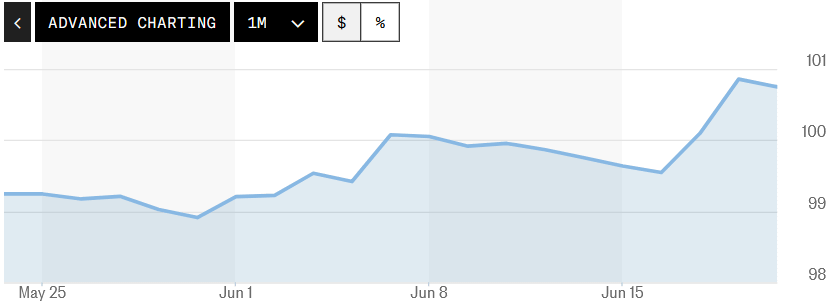
Bitcoin - down 3.95%
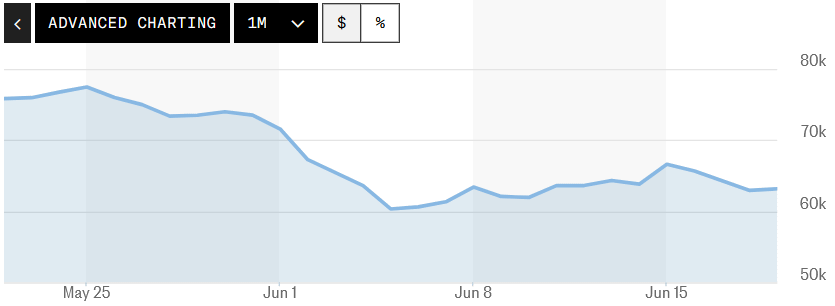
Gold - down 2.40%
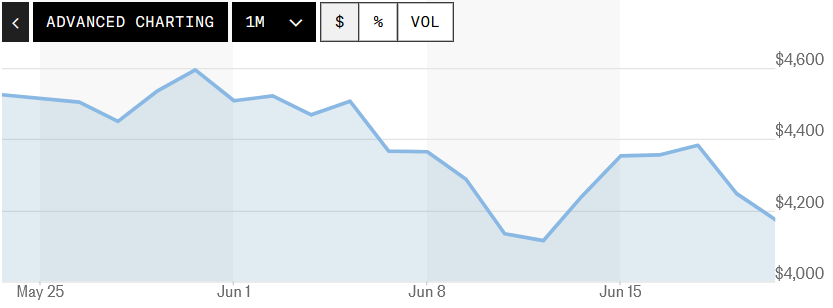
Silver - down 4.36%
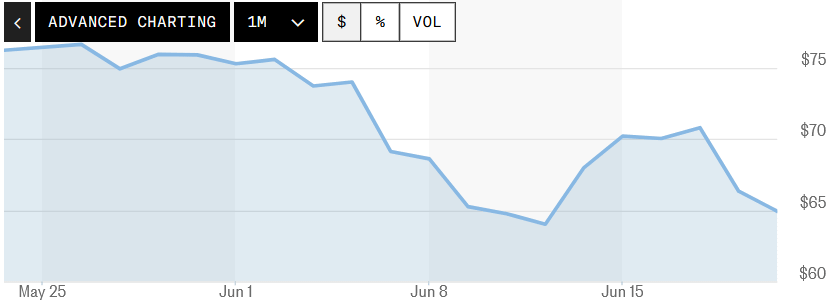
Platinum - down 2.58%
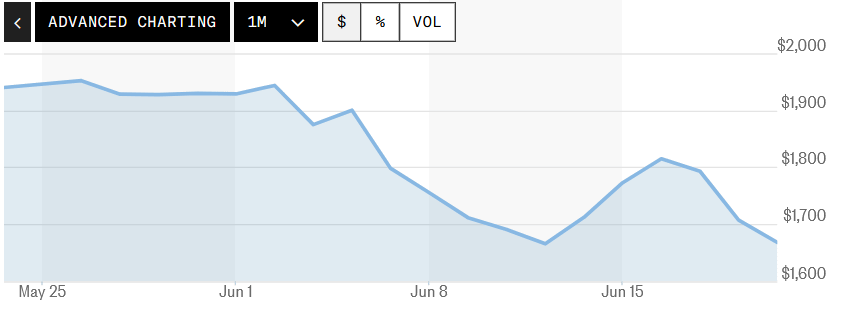
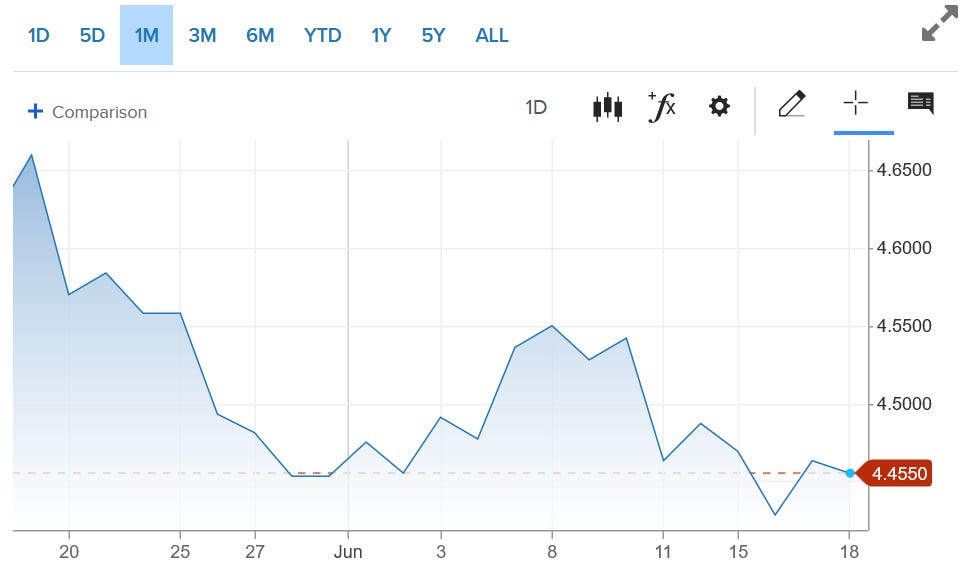
10-year Treasury Yield - down 2.9 basis points
(10-year data from https://www.cnbc.com)
S&P 500 - up 1.44%
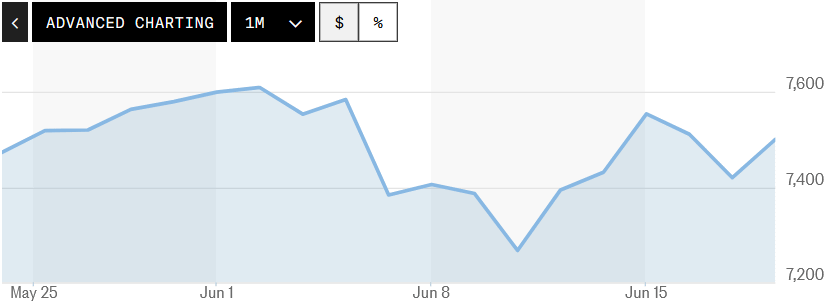
Russell 2000 - up 2.01%
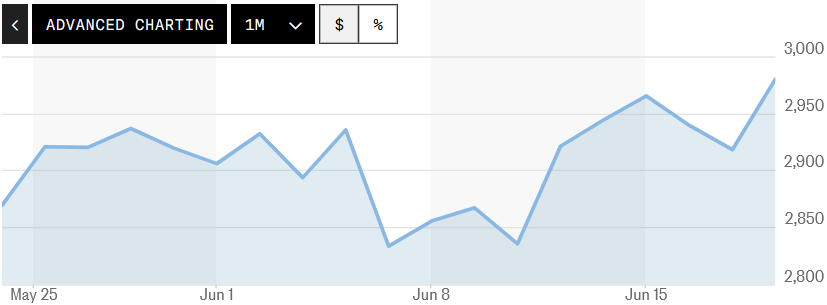
Todd Horwitz, founder of BubbaTrading.com, stayed long the indices but hunted for a place to short. Stocks rallied hard on the Iran deal, the Nasdaq up 3% intraday, yet he saw a market overdue for a 5% to 10% pullback. Thin holiday volume and triple witching, he said, made it no time to act.
His broader read was grim. Credit card delinquencies past 90 days topped 13%, car loan defaults ran near 6%, and he pegged true U6 unemployment around 8.5%. The K-shaped economy, with its narrowing top, did not bode well.
Oil remained his standing short, held since $110 to $115. He pointed to a domestic glut, weak demand, and empty tankers arriving for crude, and predicted oil in the $60s before year-end. Every Iran deal, he said, had produced a lower high and lower low.
On metals he turned bullish. Gold and silver had moved too far too fast and paid the price, with silver halved from its high, but he believed the bottoms were in near $4,056. He saw gold returning toward $5,500, possibly $6,000.
The SpaceX IPO drew his classic warning. The stock ran straight up from its $135 price toward $185, and when grandmothers and old friends start asking what to buy, that is a screaming sell signal. He cited Beyond Meat and Tilray as cautionary parabolas, though he expected SpaceX itself to survive.
His method leaned on Bollinger bands set to three standard deviations, a roughly 90% probability of a retracement, plus the patience he learned at the poker table. The market, he insisted, is never wrong; the trader in the mirror is. Every trade needs a planned exit.
Looking ahead, Horwitz predicted the 10-year yield would reach 6%, dragging the S&P toward 5,500. He compared no-money-down Vegas homes to 2008. Still, he stayed long, citing the market’s 8.5% historical annual gain and the cost of missing its best days.
Steve Hanke, professor of applied economics at Johns Hopkins University, judged the Fed’s decision to hold rates a wise piece of orchestration by Kevin Warsh. The market had priced a 99.6% chance of no change beforehand, he noted, and a split first vote would have left the new chair without unanimity.
Warsh, he said, is the maestro leading the orchestra, but had he raised rates the orchestra would have played out of tune.
Hanke expected the Fed would ultimately be forced to tighten. With CPI at 4.2%, more than double the 2% target, he argued it was hard to resist the urge to squeeze.
The CME tool showed roughly 30% odds of a hike by July rising to 85% by December, and the post-conference jump in those probabilities was, in his view, the main event of the meeting.
His real focus lay where the Fed does not look. Hanke argued the money supply had been accelerating for 18 months, driven mostly by commercial bank lending, which he put at about 80% of money creation.
Drawing on his book with Matt Sekerke, Making Money Work, he stressed that bank regulations, not the funds rate, are the first-order condition. Warsh warned that loosening those rules could expand lending and keep the inflation genie out of the bottle, leaving the Fed cornered.
On the new chair’s leanings, Hanke called Warsh a monetarist light. Unlike Jerome Powell, who explicitly rejected the quantity theory of money, Warsh has not, and his old skepticism of QE and balance-sheet expansion hinted at some eye on the money supply. To prove himself a monetarist, Hanke said, Warsh would have to embrace MV equals PY outright, as Volcker did. He lamented that macroeconomics had been hollowed out over 30 years by post-Keynesian models that omit money entirely.
Hanke praised Warsh’s push for clarity, shorter statements, dropped forward guidance, skepticism toward dot plots, comparing it to telling a student he would read only the first thousand words. The Fed’s statements, he said, had long served mainly to confuse. He found the new task forces too inward-looking, staffed entirely by Fed insiders with no hardcore monetarists among them.
He reserved his sharpest words for the Iran deal. Hanke called the US-Israeli war one of the greatest strategic catastrophes in American history, citing depleted weapons stockpiles, reputational loss, a $300 billion fund he read as war reparations, and a failure to achieve the real objective of regime change.
The Strait of Hormuz, free and open before the war at 130 ships a day, would now be controlled de facto by Iran, open in quotes and subject to a toll. Iran, he argued, had adopted a disproportionate counterattack posture, making it more dangerous, not less.
Looking ahead, he predicted oil would rise again as depleted inventories required refilling, and that the accelerating money supply would keep real growth merely okay while pumping considerable inflation into the system.
The FOMC held rates at 3.5%-3.75% on Kevin Warsh’s first day as chair, and Komal Sri-Kumar, president of Sri-Kumar Global Strategies, read the meeting as a hawkish turn. Nine of the 19 members favored a hike before year-end, some more than once, and Warsh alone declined to register a rate view.
Markets took fright. The 2-year yield jumped about 15 basis points while the 10-year barely moved, flattening the curve. Sri-Kumar explained two triggers: that bloc of nine, and Warsh’s insistence that the 2% target still held rather than drifting to 3%.
He agreed with market pricing of further hikes. He had argued even before the Iran war that the Fed should raise rates, and with the conflict now past 100 days, he doubted the recent oil decline was sustainable or would filter through quickly.
Sri-Kumar drew a sharp contrast between Warsh’s record and his likely conduct. The chair was a noted inflation hawk from 2006 to 2011 who opposed QE, yet, as a candidate for the job, wrote in late 2025 that rates should be cut.
Campaigning makes strange bedfellows, Sri-Kumar said. He predicted no resumption of quantitative tightening soon, since the Fed feared a cash crunch like September 2019 or the March 2023 regional bank stress, and noted the balance sheet had been expanding again with no mention of tightening it.
He criticized the 2024 rate cuts as politically motivated and unjustified, arguing they pumped money into consumers’ pockets and worsened the inflation that followed. Trump’s preference for lower rates, he said, traced to a real estate background, echoing Nixon’s pressure on Arthur Burns.
On inflation, Sri-Kumar warned of no escape. Higher oil had already passed into fertilizer and gasoline, so the relief from a reopened Strait of Hormuz and $75 oil would lag by months.
He flagged a risk in Warsh’s interest in trimmed-mean inflation, which strips out extreme movers and could report 2.3% to 2.5% rather than the 4.2% headline, potentially flattering a Fed that was failing on CPI.
Three hikes by December, he predicted, would seed stagflation in 2027, pairing sticky inflation with slowing growth.
He rejected the Phillips curve, expecting higher inflation and higher unemployment together, and noted Warsh omitted any employment reference, signaling a single-minded focus on prices that he welcomed.
He cautioned that dropping forward guidance and favoring trends over data points would breed volatility. For positioning, he favored shorter-duration fixed income, energy, and value sectors over stretched tech.
Gold sat near $4,300, down about 20% from its high above $5,500, and the chart drew an uncomfortable comparison. Gary Wagner, editor of TheGoldForecast.com, acknowledged the technical damage: gold had broken below its 200-day simple moving average and held there, confirming at least a short-term bearish posture.
The market found a bottom near $4,045 last week and bounced sharply. Wagner walked through the parallel that worried viewers, the 2011-2015 collapse that halved gold from roughly $1,900 to about $1,020, a drawdown exceeding 40%.
To repeat that scale now, he explained, gold would need to fall from $5,500 toward just under $3,000. He doubted it would. The correction so far looked far shallower, and he expected $4,000 to act as a floor based on last week’s low.
His conviction rested less on chart levels than on who was buying. Wagner cited a World Gold Council survey finding that 57% of central bank respondents planned to actively accumulate gold over the coming year, thereby repositioning their reserves away from fiat currencies.
That kind of demand, he argued, was different in character from retail or hedge fund flows and signaled eroding faith in currencies from the euro to the yuan. It was, in his view, the single most significant factor capable of pushing gold back above $4,000.
He recalled that George Soros buying gold in early 2012 had marked a durable bottom, and he saw central banks playing a similar floor-setting role now.
Wagner traced the year’s selloff to interest rates rather than geopolitics. The prospect of a Fed hike, with CME odds near 60% for one this year, made the non-yielding metal less attractive and pulled money toward fixed income.
He found it striking that gold fell as the Iran conflict deepened, a break from the usual safe-haven response, and attributed it partly to markets reading the war as contained, unlike the open-ended Russia-Ukraine conflict.
Inflation at 4.2%, driven roughly 60% by energy, would ease as crude retreated toward $80 if the Strait of Hormuz truce held, though the pass-through would lag. On positioning, Wagner kept the long-standing 10%-15% portfolio allocation to physical gold or silver, advising existing holders to continue accumulating at a slower pace and newcomers to start at around 5% and average down.
He favored silver over gold for fresh purchases, noting it had reclaimed its 200-day moving average while gold had not, a relatively more bullish signal even after silver fell from $120/oz to near $70/oz.
Peter Boettke, distinguished university professor of economics and philosophy at George Mason University, opened with the Gallup finding that capitalism’s favorability had slipped to 54%. In comparison, socialism held near 39%, with the divide sharpest among the young.
He offered two explanations. The first was presentism: anyone under 40 had no lived memory of communism’s collapse, only a string of seismic crises like 9/11, the financial crisis, COVID, etc., each met by turning to government. The second was the rise of cronyism, government putting its thumb on the scale for favored businesses, which makes the system feel rigged and breeds zero-sum thinking among the young.
He defined cronyism as politicians concentrating benefits on organized interest groups while dispersing costs across uninformed voters. That, he argued, is capital accumulated through political enterprise rather than commercial enterprise, and it deserves criticism without indicting markets themselves.
On the dictatorship-versus-prosperity debate, Boettke pointed to property rights as the common thread. South Korea and Singapore opened to trade and respected property and individual autonomy. China, he considered overblown, noting US per capita income still runs 20 times higher, and he pointed to Poland, now richer than the UK, as the more impressive miracle.
The deeper driver, he said, is a regime of property, contract, and consent that shifts the norm from raiding to trading. He cited the collapse of extreme global poverty from 40% in the early 1980s to under 10% by 2015.
Explaining Hayek, Boettke reframed the knowledge problem. It is not about the volume of data or computing optimal conditions, he argued, but about where the data comes from. Prices guide future activity, profits lure, and losses redirect, making the market a discovery procedure that no central planner can replicate.
On the widening wealth gap, he tied the decline in social mobility to cronyism, citing Raj Chetty’s work and the declining share of children who out-earn their parents. The goal, he said, is an opportunity economy where ordinary people can do extraordinary things, not one where privilege lets only the extraordinary succeed.
Boettke called himself an AI optimist precisely because he is an AGI skeptic. Knowledge must be generated, not computed, and human judgment exercised in its use. He drew the contrast between chess, a kind learning environment of fixed rules where Deep Blue excelled, and soccer, a wicked environment demanding constant adaptation. Entrepreneurship, the engine of growth, always inhabits the wicked kind.
He dismissed the lump-of-labor fallacy behind Jamie Dimon’s 40% unemployment warning. Telephone operators and elevator operators vanished; app developers appeared.
He ran through famous expert misfires, from heavier-than-air flight to the iPhone, to argue the future is unknowable but imaginable, and that predicting fixed job destruction is a failure of imagination.
Boettke worried more about declining population growth and the inverted Christmas tree of fewer workers supporting more retirees, and saw AI as a way to boost human productivity. He critiqued the proposals of Bernie Sanders, Daron Acemoglu, and Dani Rodrik alike, noting each ignores the incentives and knowledge required at every decision node.
Real income, he insisted, rises only through real productivity, which rests on the rules of the game: property, contract, and consent.
His closing advice for students concerned curiosity. The skill that machines cannot replace, he argued, is asking the right question, the hypothesis generator behind every aha moment. He suggested grading students on their prompts rather than their output, encouraging boredom and imagination over TikTok. He noted that such curiosity flourishes under freedom rather than under a state that hands you everything.
Rick Rule, proprietor of Rule Investment Media and co-founder of Battle Bank, applied for the SpaceX IPO and received exactly none of the stock he requested. He declined to call it overvalued or undervalued, explaining that he makes money on the delta between price and value and that he had no idea what SpaceX was worth.
He treats the market as a facility, not a subject. A broad-based decline, he said, delights him, since it puts businesses he understands on sale, and at 73 he still harbors a wish to grow wealthier.
On Iran, Rule predicted a rosier near-term market but a worse hangover. The conflict had cost roughly half a trillion dollars, pushing the US deficit from $2 trillion to $2.5 trillion, and the bill would need financing on top of a large refinancing over the next 18 months. High long-term rates, he argued, reveal private capital’s skepticism toward the dollar.
Canada’s recession, he called an own goal. Rich in resources, educated, and energy-capable, the country instead exported its intellectual capital through perverse incentives, and its political class blamed Trump rather than itself.
Rule challenged the notion that deficits help investors. Measured in gold rather than dollars, he argued, the S&P’s gains since 2000 look far less impressive once purchasing power is subtracted. He saves in gold to preserve purchasing power and invests separately to grow his money.
He keeps adding to gold systematically, indifferent to price, selling only when more compelling opportunities appear, as when he sold 80% of his physical silver after January’s hyperbolic move and rotated a quarter of the proceeds into bullion.
The current softness, he explained, stemmed from higher US nominal interest rates, recession fears, and worries that a credit collapse could derail inflation. The setup reminded him most of 1975, when rising rates cratered gold from $200 to $100 before a loss of political nerve sent it toward $850. Gold’s share of savings sits near half of 1%, down from a four-decade mean of 2%, and he expects reversion.
He held his oil stocks despite elevated prices, citing global underinvestment in sustaining capital exceeding a billion dollars a day, which he believes locks in higher prices toward 2029 and 2030. Canadian natural gas, he called, is still very cheap, and select large gold deposits near infrastructure genuinely cheap by historical metrics.
On productivity, Rule drew his sharpest line: businesses must convince customers their goods are worth the price, while governments coerce through the threat of violence. Prosperity, he concluded, requires a larger private sector and a smaller public one.
David Rosenberg, president of Rosenberg Research and Associates, dismissed the market euphoria over the Iran deal. There was no deal, he said, only a memorandum of understanding, a deal to do a deal, with 60 days of negotiations still ahead. Oil fell a total of $4, which he judged an appropriate, cautiously optimistic response.
The inflation story, in his telling, did not hold up. Core CPI in May came in at 0.2%, below consensus, and Warsh’s preferred trimmed-mean PCE ran near 2.3%.
Strip out the items adjacent to the oil price, such as airfares, delivery services, and utilities, and Rosenberg’s own core measure ran at 1.8%. Cure the energy shock and those components deflate.
He argued the move in yields was real-rate-driven, not inflation-expectations-driven. Ten-year breakevens held at 2.3% and 5-year-5-year forwards at 2.2%, flat through every shock. Analysts, he said, fit the narrative to the price action.
The labor market looked far weaker than the headlines. Year-over-year payroll growth sat at 0.3%, the household survey ran negative, and real wages had contracted three months running. A tight market with decelerating wages, he insisted, was mutually inconsistent.
He doubted the 172,000 May jobs would survive revision, noting figures had been cut lower roughly 85% of the time over the past year.
The consumer told the same story underneath. Real disposable income declined 1% year-over-year, and only a collapse in the savings rate, from 5% to 3%, kept spending positive. By the income side of the ledger, he said, the US consumer was already in recession. He predicted a spending vacuum in the second half once tax refunds and the World Cup stimulus faded.
Rosenberg called the ECB hike a policy mistake, echoing its 2008 blunder. He expected the Fed’s next move to be a cut, taking the other side of the market’s hike bets, and saw yields peaking and the curve steepening. He liked the bond markets of Canada, the US, and Australia, and had bought the 5% US long bond precisely because nobody wanted it.
Equities he called exciting and exuberant, but with a flat-to-negative equity risk premium, not rational, and he was not ready to throw out the CAPM model just yet.
Adrian Day, president of Adrian Day Asset Management, took a glass-half-empty view of the jobs data that knocked gold lower. The May payrolls beat expectations, but he noted nearly all the gains came from local government and healthcare, a pseudo-government sector. Counting the 4.8 million working part-time involuntarily and the 6.2 million who want work but left the labor force, he counted 11 million underemployed or jobless.
At oil near $83, he argued the economy could adjust, since the price sat at the lowest 20th percentile, inflation-adjusted, over 20 years. The strain fell on the lower-income half of the population, for whom higher gas means cutting somewhere else.
Day predicted oil would grind higher over the next few years. The Hormuz closure had shifted the focus from price to supply security, he explained, pushing Asian importers such as Japan, Indonesia, and Malaysia toward coal. China’s cut from 11.7 million to 9 million barrels a day, he suspected, partly reflected oil it simply could not get rather than a deliberate easing.
He warned that every oil price spike over the past 80 years had preceded a recession, from the 1974 Arab embargo to the 1990 Kuwaiti invasion. North America’s energy independence insulated it, he said, but he expected Europe and parts of Asia to slip into recession if the conflict dragged on.
Day doubted the Fed would hike rates during Warsh’s first meetings, though a majority of voting members now leaned toward fighting inflation rather than supporting growth. A sustained higher oil price, he cautioned, would eventually feed core CPI, since transport costs touch every good. Warsh might pursue balance-sheet reduction instead, though Day was skeptical it would happen meaningfully.
On gold, he was unworried by the 21% drop. The selloff came from a rising dollar and rising 10-year yields during wartime, a pattern he traced across 50 years: gold rises ahead of anticipated conflict and falls once it arrives, as it did before the Ukraine invasion. The dollar’s safe-haven bid does the rest.
He rejected the 2011 comparison, since that top followed rampant retail speculation, the barista offering gold tips. This time, ETFs saw outflows, with GLD losing $8.2 billion over three months even as central banks and Tether kept buying. Net central bank purchases hit their highest level in a quarter since late 2024.
For positioning, Day defined risk as exposure to an event rather than its outcome and called big-cap AI tech grossly overvalued. He favored rotating into undervalued global markets, naming Britain, Hong Kong, Singapore, and Brazil, where valuations sat at 50-year relative lows to the US. Rather than dumping gold stocks ahead of an uncertain correction, he urged holding cash and staying defensive, noting miners fall faster but recover sooner, as they did in 2008.
Jim Bianco, president of Bianco Research, expected the Fed to raise rates at least once, probably in October, joining a global hiking cycle already underway from Japan, Australia, and the ECB. He predicted the 10-year yield would drift from 442 toward 5% by year-end.
The driver was inflation: 63 consecutive months above 2%, headline above 4%, and core PCE at 3.4% against a roughly 3.6% funds rate, leaving real rates near zero.
He invoked his adage that bond investors can stop panicking when the Fed starts panicking, recalling that 9% inflation in 2022 never pushed the 10-year above 4.23% precisely because the Fed hiked rates by 75 basis points at each meeting.
Had Warsh acted like the sock puppet in his confirmation hearings and cut, Bianco said, the bond market would have collapsed, and yields would have soared.
Higher rates need not kill stocks, he argued. Trump had taught everyone to think like a real estate guy, where lower is always better, but rates have a fair-value range that was moving up with inflation.
He flagged the AI war he calls the Strait of Hormuz war, noting oil fell from $95 to $75 in a week and a half, and mocked the White House for signing its memorandum at Versailles, where nations go to surrender. He defended the case for hiking, contrasting the single-mandate ECB’s 2008 misstep with a genuine core inflation problem now.
On the September 2024 cut, Bianco noted that the Fed rarely changes course after Labor Day in an election year, doing so only in 2008 and 1980, which lent weight to political-timing arguments. The double cut also responded to an unemployment scare that promptly vanished, the kind of model-driven error Warsh wants to end by scrapping forward guidance and stale data.
He pushed back on entitled return expectations. Investors had come to believe any random pick owes them 20% a year, but he framed a four-five-six world: cash returns 4%, bonds 5%, non-AI stocks 6% on average.
The S&P had effectively split into two markets, with AI stocks at 48% of the index, a concentration unseen since the railroad era. During the early-June selloff, the index fell 4.5% while over 400 non-AI companies rose.
On the Gartner hype cycle, Bianco placed AI closer to 1997 or 1998 than to the 2000 peak, bullish on the sector but warning of eventual overbuild and an 83% NASDAQ-style bust before the technology proves transformative.
The current constraint was too little compute, not too much, evidenced by huge token bills and enormous capital raises from Alphabet, SpaceX, and Nvidia.
He saw AI’s real use case in replacing the $300 billion to $400 billion annual SaaS market with a single context window. Crypto he placed near the trough of disillusionment, 15 years old yet still mostly a speculative instrument, redeemable only if developers build genuine utility like stablecoins, already the dominant electronic dollar in dollarized Venezuela.
Monday, June 22 -
No economic data releases
Tuesday, June 23 -
US Flash Manufacturing PMI (June)
US Flash Services PMI (June)
FedEx earnings
Cerebras Systems earnings
Wednesday, June 24 -
New Home Sales (May)
Federal Reserve Board releases annual bank stress test results
Micron earnings
Carnival earnings
Trip.com earnings
Thursday, June 25 -
Durable Goods (May)
3rd estimate GDP (1Q)
Weekly Jobless Claims (June 20)
Personal Income, M/M% (May)
Consumer Spending, M/M% (May)
PCE Price Idx, M/M% (May)
PCE Price Idx, Y/Y% (May)
PCE Core Price Idx, M/M% (May)
PCE Core Price Idx, Y/Y% (May)
Kansas City Fed Survey (June)
Friday, June 26 -
Advance Economic Indicators Report (May)
Wholesale Inventories (May)
Retail Inventories (May)
U. Michigan Final Consumer Survey (June)
No posts
Comments
Nothing yet. Say the first thing.
Sign in to join the conversation.