
SPONSORED POST: MONETARY METALS
Investor Called Meltdown In Bitcoin, Gold, Stocks; Here’s His Shocking Forecast
Housing ‘Repeat Of 2008’: Trader Warns Banks Will Need Bailouts
End Of Cycle: Analyst Called Bitcoin Top, Warns Market Breaking Point Nears
Gold Crash Not Over Says Analyst Who Called Drop, Here’s How Low It Gets
Economy Flashing 1930s Warning Signs Warns Economist
Binance CEO Reveals Bitcoin’s Next Big Move, Future Of Trading
Iran War Escalates: Global Economy Just Changed Forever
MARKET RECAP: June 29, 2026 - July 3, 2026
A weak June jobs report set the tone. Nonfarm payrolls rose just 57,000, well below forecasts near 110,000 and the smallest gain in four months. The unemployment rate slipped to 4.2%, though the drop reflected a fall in labor force participation to 61.5%, the lowest since March 2021.
The report cooled expectations for further Fed tightening. Fed funds futures moved to roughly a 50% chance of a September rate hike, down from 67% before the data. New Chair Kevin Warsh argued this week that inflation expectations had eased, while reaffirming the central bank’s focus on price stability. April and May payrolls were revised down by a combined 74,000.
Equities split on Thursday. The Dow closed at a record 52,900.07, up 1.14%, led by Apple’s 4.8% gain, while the S&P 500 finished flat at 7,483.24 and the Nasdaq Composite fell 0.8% to 25,832.67 as chipmakers sold off. Markets closed Friday for the Independence Day holiday.
The AI trade drove the tech weakness. Micron dropped about 7%, Applied Materials about 7.4%, and AMD about 4.3%. Reports said OpenAI had opened talks to sell a 5% stake to the US government, while Meta said it might monetize excess computing capacity, feeding valuation concerns.
The pullback capped a strong quarter. The major indexes wrapped their best quarter since 2020 on June 30, with the Dow finishing at 52,319.20, up about 8.85% year to date.
Two single names stood out. Tesla fell about 7.5% despite strong quarterly deliveries. SpaceX rose about 7.2% Monday after Nasdaq said it would add the company to the Nasdaq-100 before the July 7 open, an inclusion JPMorgan said could draw about $4.3 billion in passive inflows.
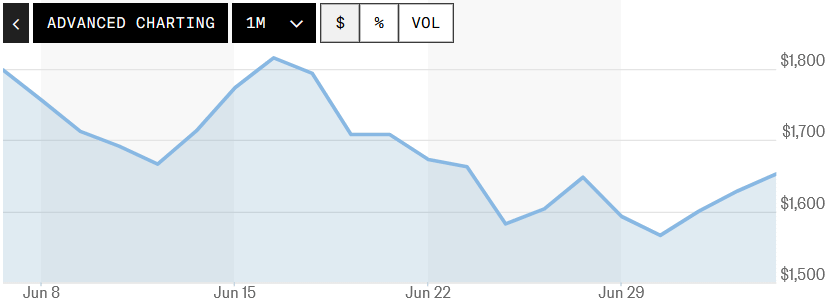
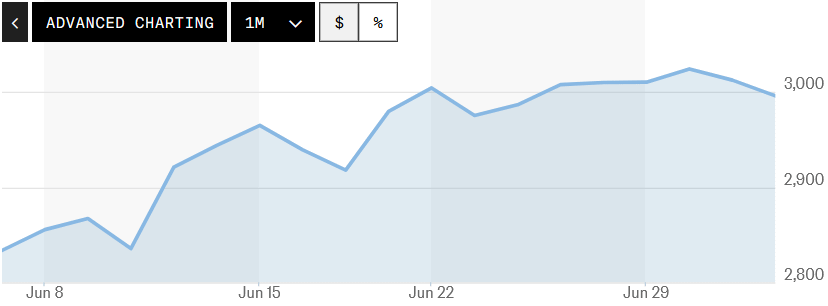
Precious metals rebounded. Gold traded near $4,123/oz Thursday, up about 2.5% on the week, after a second quarter that erased about 16% in its steepest quarterly loss since 2013. Silver climbed above $61/oz, up more than 5% on the week, recovering from seven-month lows.
Oil extended its slide. WTI crude traded near $68/barrel, its lowest since late February and a third straight session lower, as recovering shipping through the Strait of Hormuz and progress in US-Iran talks eased supply fears. The US Dollar Index eased toward 101 amid soft jobs data, and bitcoin climbed back above $61,000, though it remained down roughly 18% for the month.
Market Movements
The following assets experienced dramatic swings in price this past week. Data are up-to-date as of July 3 at approximately 4pm EST.
(Data from StockAnalysis.com)
UP
Robinhood Markets - up 20.61%
Palantir Technologies - up 20.54%
CrowdStrike Holdings - up 14.33%
DOWN
Sandisk Corporation - down 25.27%
Caterpillar Inc. - down 8.84%
Oracle Corporation - down 8.00%
DXY - down .49%
Bitcoin - up 4.56%
Gold - up 4.16%
Silver - up 10.08%
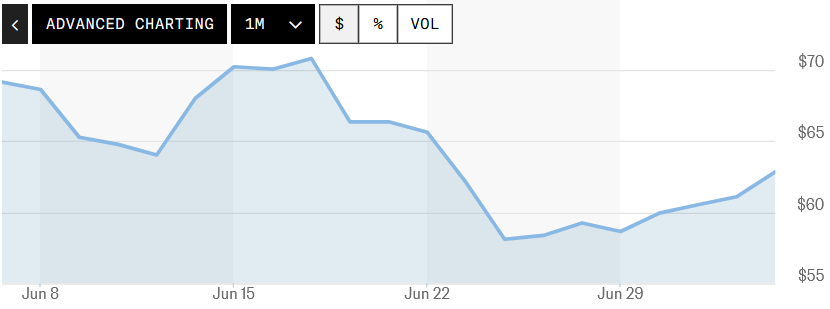
Platinum - up 4.09%
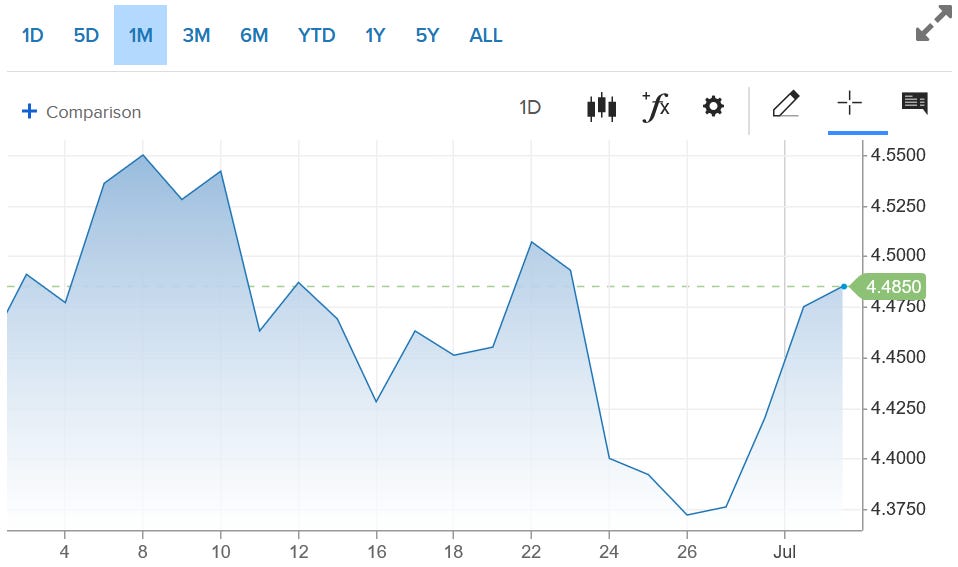
10-year Treasury Yield - up 11 basis points
(10-year data from https://www.cnbc.com)
S&P 500 - up 2.33%
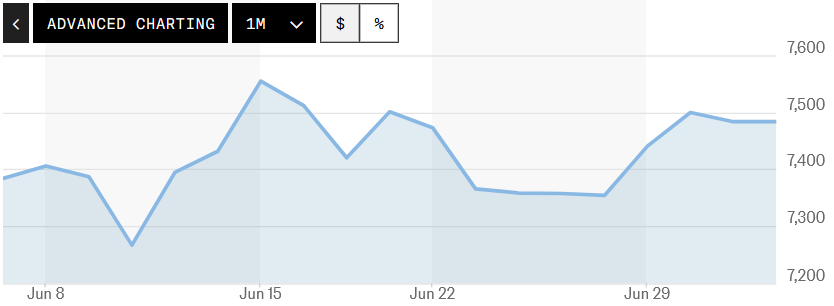
Russell 2000 - up .20%
Lawrence Lepard, managing partner of Equity Management Associates, argued that the monetary debasement trade remained intact despite sharp pullbacks.
Governments kept running large deficits and printing money to service the debt, he said, and until that changed, he saw no reason to abandon hard assets. Lepard placed the current cycle in the third or fourth inning.
He noted that US debt was projected to reach 120% of GDP by 2036, with the annual interest bill near $1.3 trillion.
Bitcoin had fallen more than 50% from its high, yet he predicted a bottom near current levels and a next run toward 150,000 to 180,000.
Gold corrected into the low $4,000s/oz after peaking around $5,400/oz, and he forecast $6,000 to $7,000/oz next year.
Silver, down from $120/oz to near $60/oz, could reach $150 to $200/oz in his view.
Lepard argued the market had misread the Fed. Traders expected higher rates to tame a 4.2% CPI, which strengthened the dollar and pressured metals. He predicted the opposite.
Kevin Warsh, the new Fed chair, had created task forces to review inflation measures, and Lepard expected those bodies to conclude that inflation ran lower than reported, clearing the way for cuts.
When the market grasped that shift, he said, hard assets would move sharply higher. He was buying Strategy and silver miners, calling the miners deeply underpriced.
On the SpaceX IPO, he saw echoes of the 2000 tech bubble and named Starlink a strong business at too high a price.
China’s record gold imports, he argued, signaled a smart bet on gold’s monetary future.
Steve Hanke, professor of applied economics at Johns Hopkins University, traced the oil story back to a single event. The US and Israeli strikes on Iran shut the Strait of Hormuz, he said, and the world pulled roughly 1.2 billion barrels forward from future supply into the present.
That borrowed oil now had to be replenished. Restocking would lift demand, and Hanke predicted crude would climb toward $85- $ 90 per barrel. He called the recent drop to $70/barrel an overshoot, disconnected from fundamentals. Trump, he argued, caused the price spike and then blamed refiners, jawboning retailers toward $2.50/gallon gasoline he considered fanciful.
Markets, Hanke explained, had entered an era of big players. Figures like Trump, Musk, and Xi could move prices and expectations regardless of profit and loss, and their pronouncements were largely arbitrary.
Traders then abandoned fundamentals and chased rumors, a pattern he called noise trading. The result was more volatility and a greater risk of bubbles, and he said US equities sat clearly in one.
Everything now ran through Washington, which he likened to a centralized voice rather than a free market. On the Fed, Hanke saw little room for cuts, with inflation at 4.2%, real GDP growth of 2.1%, and low unemployment.
He tied widening inequality to loose money. Billionaire wealth had jumped from 13.7% of GDP before Covid to 26.3%, he said, because Fed money creation lifted asset prices unevenly. He argued that neither minimum wage hikes nor wage growth drove inflation, since money supply set the trend.
Gold has long been viewed as a store of value. However, unlike many other assets, it typically does not generate income. Monetary Metals offers a different approach by allowing investors to earn a yield on their gold, paid in physical gold.
Check out David’s interview with CEO Keith Weiner in the video above.
Through its leasing platform, investors can earn up to around 4% annually, with yield paid monthly in ounces rather than dollars. This means returns are measured in gold itself, which may appeal to investors focused on growing their holdings in physical metal.
The gold remains your asset throughout the process and can be redeemed at any time.
Thousands of investors are already earning monthly yield in gold through Monetary Metals.
Learn more at Monetary-Metals.com/Lin
Clem Chambers, founder of ANewFN, predicted a deeper decline for Bitcoin. He forecast a fall from roughly 60,000 toward 40,000, with an outside chance of a break below 30,000.
Chambers explained that Bitcoin’s four-year cycle was fading. Retail buyers had left the market. Institutions now dominated, and he argued that the shift stripped the asset of its founding purpose.
He pointed to mounting pressure across the crypto space. Chambers described Asian forced-labor scam operations that laundered proceeds through Bitcoin. He added that Iran, which he said produced 25% of Bitcoin, might retreat from mining if regional tensions eased.
Wall Street posed a further threat, Chambers argued. He said large institutions eyed a roughly $1 trillion prize in liquidating Bitcoin holdings.
On gold, Chambers predicted a settling point near $3,500/oz. He said he would dollar-cost average into the metal rather than buy in a single move.
Gold was for war, Chambers argued. He tied its path to a potential China-Taiwan conflict, which he said had been postponed for two to three years.
Chambers framed AI as the decisive economic contest. He said electricity would determine the winner and cited a large Chinese power advantage over the United States.
His market outlook hinged on one question. If the current sell-off marked a mid-bubble pullback, a boom would follow. If it marked the top, he warned the fallout for the West would be severe.
Todd Horwitz, founder of BubbaTrading.com, argued the stock market was overvalued and delusional. He was short the S&P and predicted a 30% to 40% decline before the sell-off was over. He said equities kept making lower highs and lower lows, a sign the top was in.
He explained that gold had already discounted higher interest rates after its 30% haircut, so he went long at $4,000/oz and expected a run toward $4,500. He predicted rate hikes were coming, at least one and maybe two before year-end, and welcomed them as a return to normal after years of easy money that favored the wealthy.
Horwitz flagged trouble in housing, comparing conditions in Las Vegas to those in 2008 and warning that failing banks would again seek taxpayer bailouts.
On oil, Horwitz stayed short and predicted a move toward the mid-$50s. He said a glut, weak demand, and steady production outweighed concerns over the Strait of Hormuz, and he noted that the closures affected Brent rather than WTI. He argued the initial spike to $120 was panic that trapped short sellers.
He explained that the dollar had climbed because nations buy it as a safe haven during periods of global stress, which pressures gold.
Horwitz described gold’s earlier surge to $5,500 and silver’s move to $120 as fear-driven excess, followed by margin-call selling that overshot to the downside.
He said the Dow-to-gold ratio, near 10 against a historical mean of around 5, supported his long gold, short Dow position. He set downside support for gold near $3,800.
Richard Smith, chairman and executive director of the Foundation for the Study of Cycles, predicted further downside for Bitcoin. He tied the move to a tightening liquidity cycle that Michael Howell has mapped over roughly 65 months.
Smith explained that money was rotating out of financial assets and into the real economy, including energy and oil.
He said Bitcoin acted as a canary in the coal mine, first to gain and first to suffer as liquidity shifted. Typical corrections ran 75% to 80%, he said, which pointed toward a level near 30,000 to 35,000. Smith predicted Bitcoin would end the year below 50,000, down from around 60,000.
Smith argued that a rising US dollar would pressure dollar-priced assets. He predicted gold would stay sideways to down and dismissed the popular bet favoring gold over the dollar this year.
A wall of debt loomed, he said, with refinancing needs so large that credit expansion had become existential. Smith explained that the Treasury and the Fed would engineer that credit even as the ECB and the Bank of Japan raised rates.
He pointed to Japan as the model for the US, which the CBO projected would reach near 120% of GDP by 2036. Smith said Treasuries remained the collateral base of the global financial system, a position now contested and central to tensions in the Middle East.
He did not expect a major correction until the second half of 2027 or 2028, and he predicted new highs in equities by the end of 2027.
Jeff Christian, managing partner of CPM Group, rejected the view that gold had entered a 2012-style crash. He argued the metals were moving into a volatile sideways consolidation with a downward bias, not a cyclical top. Gold reached $5,000/oz this year before correcting about 30%, while silver fell roughly 40%.
Christian predicted prices would resume rising in the final four months of 2026 and into 2027. He said the macroeconomic and political backdrop that drives investment demand had not improved. He expected conditions to worsen again after September.
Higher interest rates were a headwind, Christian explained. He noted the Fed funds rate was expected to rise, not fall. Stronger growth, including 2.1% real GDP in the first quarter, added further pressure on metals.
The metals moved together because investment demand set short-term prices through ETFs, futures, and options, Christian said. Investors built long positions late last year, then liquidated heavily after January. He predicted opportunistic buyers would return once prices stabilized.
Central bank selling reflected special situations, not a broad trend, Christian argued. Russia sold gold to fund its government and war effort. Turkey supplied liquidity to Istanbul’s gold market after the US and Israeli strikes on Iran shut Dubai as a trading hub.
Christian said central banks bought roughly 10 million oz of gold a year on a net basis, below inflated estimates. Most of the rise in reserve value came from price appreciation, not physical purchases. The dollar’s share of foreign exchange reserves slipped from about 62% to 57%.
The DXY strengthened from February as investors sought safety, Christian explained. Copper diverged from gold after early May and instead tracked equities. He described copper as an industrial gauge and gold as a financial asset and currency hedge.
Christian dismissed claims that JP Morgan had dumped silver before its one-day plunge. He explained the bank traded mostly for clients as a futures commission merchant. He set a near-term gold target near $3,800/oz and named gold and silver his top picks for the rest of 2026.
EJ Antoni, chief economist at the Heritage Foundation, warned that the US move to exit USMCA threatened free trade in North America.
The declaration triggered a six-year unwinding, though he hoped it would serve as a negotiating tool to open the Canadian and Mexican markets. Antoni criticized the administration’s tariff approach as slapdash and still not reciprocal.
He compared the drift toward protectionism to the 1930s, noting that the pace remained slow and that trade remained a small part of the US economy.
On growth, he cut his 2027 outlook to the 2% range, down from the 4%-5% he predicted in February, citing fallout from the war in Iran.
Much of that inflation had not yet hit, he explained, with food and consumer prices baked in as depleted oil reserves forced a demand shock on top of the earlier supply shock.
Antoni argued that raising rates to fight a supply shock repeated the Fed’s error of the 1970s. Kevin Warsh, he said, understood the need to look past nonmonetary price increases.
He called for better data at the Bureau of Labor Statistics, pointing to unprecedented revisions that consistently ran in one direction and CPI adjustments that biased the index downward.
Antoni dismissed calls from AOC and Bernie Sanders to break up big tech, arguing that chip demand, not company size, drove prices higher. More supply was the answer.
On AI, he predicted job creation would outpace destruction and urged workers to master the technology.
Richard Teng, co-CEO of Binance, said Bitcoin had matured from a retail asset into an institutional one.
Retail investors sat on the sidelines this cycle, he explained, while institutions, corporates, and sovereigns added to positions with long horizons.
That diversity made for a more robust market, he argued. Teng still believed the four-year cycle held, tied to the halving and scarcity.
He attributed the recent slide from October highs to roughly 60,000 partly to capital rotating toward the AI buildout, echoing Michael Sailor’s view that ETF outflows reflected rotation rather than impairment.
Teng said Binance had grown from 170 million users two years ago to 320 million, with an ambition to become a financial super app. The platform now offered tokenized US equities, called B stocks, backed one-to-one and traded 24/7, alongside pre-IPO perpetuals.
Binance accounted for about 60% of SpaceX pre-IPO perpetual trading, he said, and nearly $6 billion in SpaceX volume on the IPO’s first day. Most stock-trading users came from emerging markets, and a quarter were under 25. Teng predicted tokenized real-world assets would grow sharply as institutions moved assets on-chain.
On regulation, he said Binance withdrew its Greek application under the EU’s MiCA rules but remained committed to Europe. He rejected reports that Iran moved billions through Binance, arguing that the exposure was minuscule and that the funds were traced through multiple hops beyond its control.
Edward Fishman, senior fellow and director of the Maurice R. Greenberg Center for Geoeconomics at the Council on Foreign Relations, argued that Iran had weaponized the Strait of Hormuz against the United States.
Analysts had assumed Iran would need sea mines to close the strait, he explained, but a dozen strikes on ships in the first week shifted the shipping industry’s risk calculus.
Iran closed the strait to others while keeping it open for itself. Fishman argued that this reversed the 2015 nuclear deal, with Iran now pressuring the US for economic relief rather than the other way around.
He said the recent tanker strike showed Iran enforcing a toll regime, and he doubted Washington had the appetite for an Iraq-style invasion. Iran believed it could earn $40 billion a year from the strait, he noted.
Fishman predicted the crisis would accelerate efforts to insulate against choke points. He expected more Gulf pipelines, energy storage near Asian buyers, and faster adoption of Chinese solar panels, batteries, and electric vehicles.
That shift would trade one dependency for another, he argued, since China held 70% to 95% market share in clean energy technologies.
He tied rising sanctions and global rearmament to the return of geopolitical competition, noting every US president this century had roughly doubled the sanctions rate of the last.
Fishman flagged Taiwan and semiconductors as his top worry. He predicted China might pursue a creeping annexation through customs enforcement rather than an amphibious invasion.
Monday, July 6 -
US Services PMI (June)
ISM Report On Business Services PMI (June)
Global Services PMI (June)
Tuesday, July 7 -
None
Wednesday, July 8 -
Monthly Wholesale Trade (May)
Federal Open Market Committee meeting minutes and economic forecast
Consumer Credit (May)
Thursday, July 9 -
Weekly Jobless Claims (July 4)
Existing Home Sales (June)
PepsiCo earnings
Friday, July 10 -
Delta Air Lines earnings
No posts
Comments
Nothing yet. Say the first thing.
Sign in to join the conversation.