

SPONSORED POST: MONETARY METALS
What Happens When Yen Collapses? Economist Steve Hanke On Next Currency Crisis
Major Market Intervention: Why Did Treasury Just Double Bond Buybacks?
Emergency Bond Buybacks: Gold, Stocks Soar, What’s Next For Markets?
Warning: Interest Rates Not Done Surging; Treasury’s ‘Bazooka’ Coming
Money Printing Explodes: Arthur Hayes Says Gold, Bitcoin Melt-Up Next
Gold Explodes, But Lobo Tiggre Is Not Buying, Here’s Why
This Is When The Market Rally Ends And Stocks To Beat Downturn
MARKET RECAP: Aug 17, 2026 - Aug 21, 2026
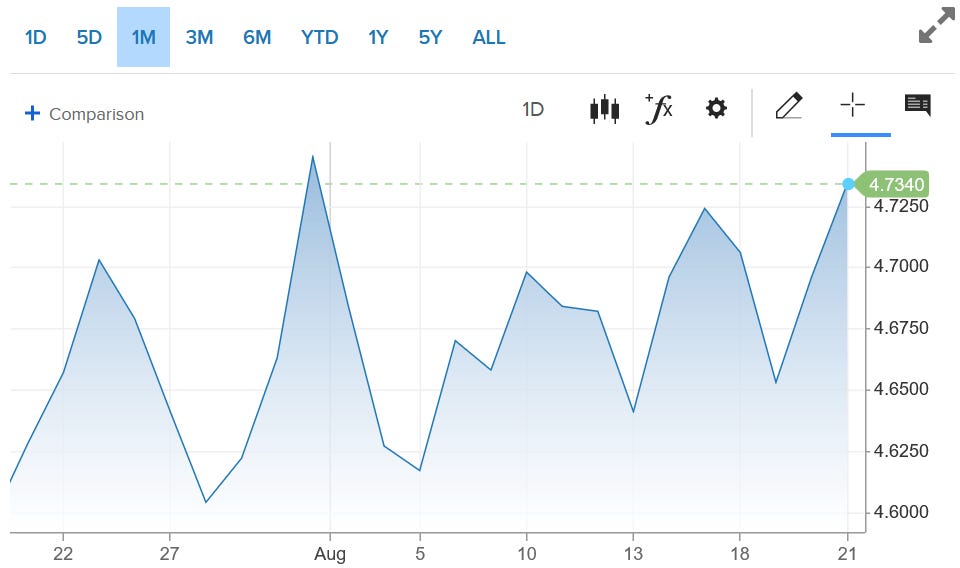
The bond market set the tone this week. The 30-year Treasury yield climbed to 5.31% on Monday, its highest level since June 2007, then touched 5.34% intraday on Tuesday for a 19-year peak, while the 10-year note topped 4.75%, a 20-month high.
Traders pointed to a deficit that the Congressional Budget Office now projects will exceed $2 trillion this year, heavy corporate issuance by artificial intelligence firms, and oil-driven inflation risk.
The Treasury Department intervened on Wednesday. It said it would at least double the size of liquidity support buybacks for securities maturing in 10 to 30 years, lifting each operation to at least $4 billion from $2 billion, effective September 9 through November 4. Yields fell sharply.
The 30-year closed down 9 basis points at 5.196%, and the 10-year settled 5.7 basis points lower at 4.647%.
The department also disclosed that outstanding public debt had reached $40 trillion for the first time. Relief lasted one session. Treasury Secretary Scott Bessent said on Thursday that repurchases could exceed $4 billion per issue, and long-end yields erased the entire decline.
The 30-year finished Friday more than 3 basis points higher at 5.273%, above the 5.21% it yielded a week earlier, and the 10-year hovered near 4.70%. Breakeven inflation rates reached their highest level in more than two months.
Minutes from the July 29 meeting, released Wednesday, showed some policymakers favored raising rates this year.
The Federal Reserve held its target range at 3.50% to 3.75% at that meeting on a 9-3 vote, with all three dissenters calling for a 25-basis-point hike.
Futures ended the week pricing a 39% chance of a September increase.
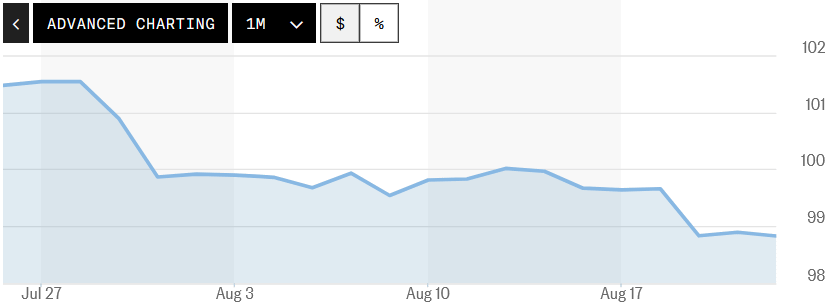
The U.S. Dollar Index closed near 98.79 and posted a weekly loss as the euro touched $1.1711, its strongest since May 14.
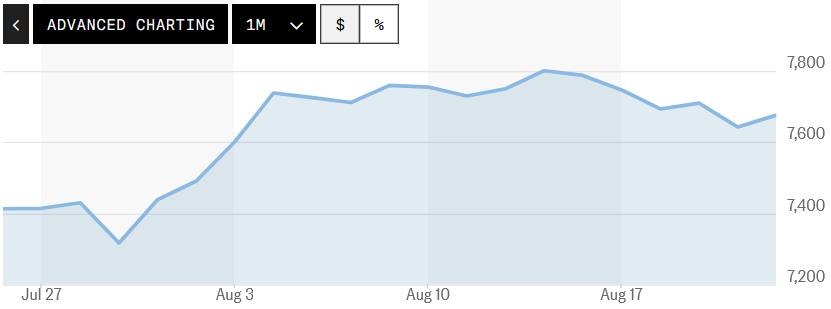
Equities absorbed the damage. The S&P 500 fell 1.4% on the week to 7,674.31, roughly 1.6% below the record close of 7,798.99 set on August 13.
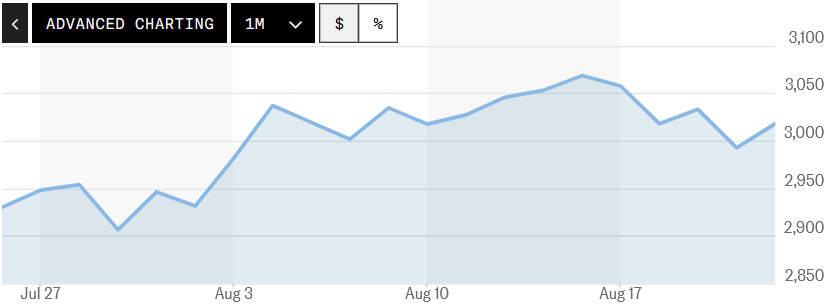
The Nasdaq Composite dropped 2.1% to 26,180.46, the Russell 2000 lost 1.6% to 3,018.81, and the Dow Jones Industrial Average slipped 0.8% to 53,276.81 for a second consecutive weekly decline.
Thursday delivered the worst session in three weeks, with the Dow shedding 703.84 points, or 1.32%.
Walmart led the rout and fell roughly 9%, its steepest one-day loss in four years, after reporting the slowest quarterly sales growth in more than six years.
The stock ended the week down about 10%.
The Philadelphia semiconductor index gave up about 5% over the five sessions as higher long-term borrowing costs pressured capital-intensive technology names.
Friday brought a partial rebound. The Dow added 517.60 points after S&P Global’s flash composite index rose to 56.0 in August from 54.5, the fastest pace of U.S. business activity since April 2022.
Energy stayed firm. Brent crude gained more than 5% on the week and traded above $93 per barrel, while West Texas Intermediate rose about 5% and settled near $86.70 per barrel.
Bessent said Washington would impose the toughest sanctions in history against Iran, and President Donald Trump described the coming package as an economic D-Day.
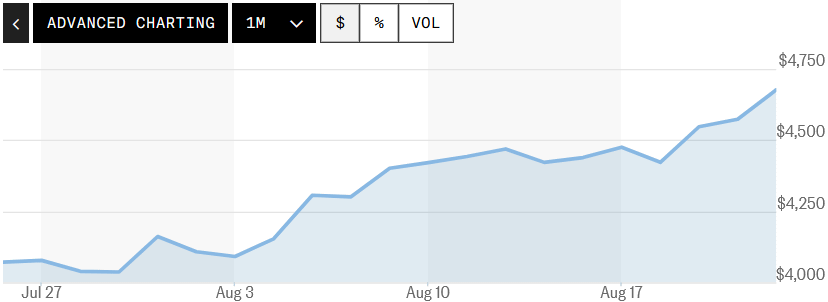
Precious metals rallied on the same fiscal anxiety. Spot gold ended near $4,590 per troy oz, its highest since May, and gained more than 3% on the week for a third straight advance, while December futures traded above $4,660.
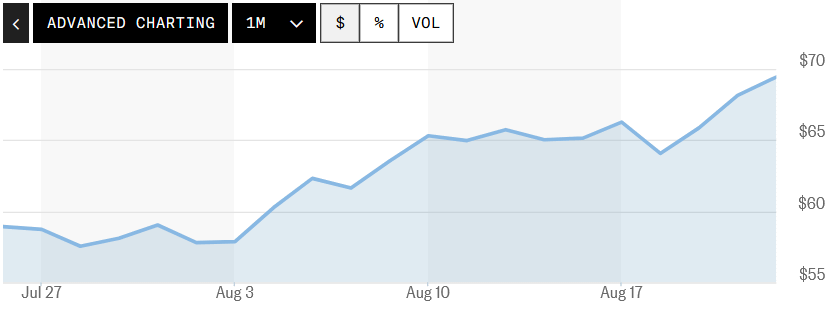
Silver climbed about 2% on Friday and touched $70 per troy oz intraday, a level last seen in mid-June.
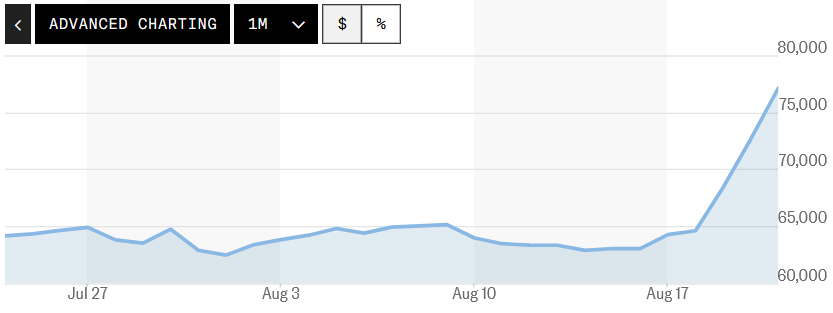
Bitcoin was the week’s outlier and surged about 22% to near $77,000 after reaching $79,400 on Friday, its best weekly gain since March 2023.
Roughly $2.7 billion in crypto short positions were liquidated, and spot bitcoin ETFs drew $606 million of net inflows on Thursday.
Investors now await Bessent’s Monday briefing on Iran, Nvidia’s results on Wednesday, and Warsh’s Jackson Hole keynote on Friday.
Market Movements
The following assets experienced dramatic swings in price this past week. Data are up-to-date as of Aug 14 at approximately 4pm EST.
(Data from StockAnalysis.com)
UP
Agnico - up 16.40%
Southern Copper - up 14.97%
Merck - up 12.68%
DOWN
Intel - down 12.19%
Cloudfare - down 11.56%
Walmart - down 10.03%
DXY - down .86%
Bitcoin - up 23.17%
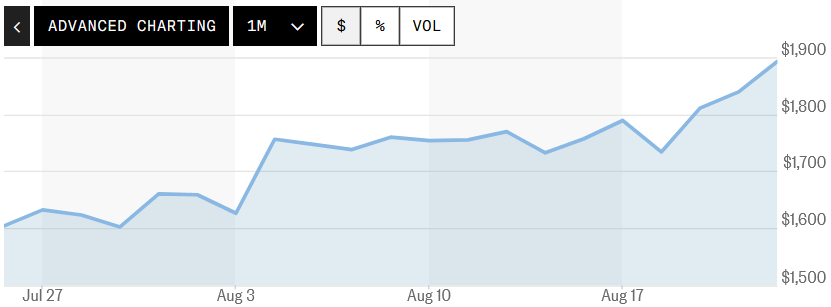
Gold - up 6.04%
Silver - up 7.94%
Platinum - up 8.12%
10-year Treasury Yield - up by 4.8 basis points
(10-year data from https://www.cnbc.com)
S&P 500 - down 1.43%
Russell 2000 - down 1.65%
Chris Vermeulen, Chief Market Strategist at The Technical Traders, analyzed which of the targets and reversal triggers from that appearance had played out. His S&P 500 call held up best: the weekly bull-flag pattern still pointed toward roughly 8,500, close to his prior 8,555 target, while a shorter-term daily chart pointed to 8,100 to 8,200 first. He remained long the S&P 500 and Nasdaq, having re-entered a couple of weeks earlier and already trimmed at a first target rather than adding.
The Nasdaq’s bull flag still pointed to an 18% to 20% advance, but only if semiconductors resumed leadership. Statistical price targets, not momentum and not round numbers, will guide further trims, since his firm scales out at levels where an asset has historically tended to stall.
His yield call also stood. The 30-year’s monthly chart still pointed toward 8%, a level he said would blow up the system, with the current pattern echoing the run-up to 2007. The Treasury’s move to double bond buybacks to $4 billion per operation briefly reversed that pressure, but the relief lasted barely a day before the 30-year climbed back above 5.23%.
The metals reversal trigger he had described- gold and silver breaking their prior swing highs with the 20-day and 50-day moving averages climbing back above the 150-day- had not fired. Gold pushed to about $4,580/oz after a 3% jump on the buyback news, yet he stayed on the sidelines, having exited gold and silver near their prior peak.
He called the public rush into gold and silver miners a contrarian warning sign, arguing the bounce still looked like relief within a longer downtrend rather than a new bull phase. He wanted the rally to hold for more than two or three weeks before trusting it.
Bitcoin offered a parallel case. After lagging gold and the Nasdaq for most of the year, it jumped 15% to 17% in 48 hours to above $72,000, a move he read as another news-driven bounce inside a longer downtrend, and he cautioned against chasing it.
Vermeulen accepted that his caution means missing further upside if the metals rally continues, but he prefers confirmed trend shifts to prediction, the core of what he calls asset revesting. His new book, After the Rally, takes up a different subject, the risks that traditional strategies pose to older investors heading into a financial reset.
The single chart that decides the next month, in his view, is gold’s moving-average structure: the 20-day and 50-day averages need to cross back above the 150-day before he will call the bear market over.
Gold has long been viewed as a store of value. The catch is that it typically does not generate income. Monetary Metals takes a different approach, allowing investors to earn a yield on their gold, paid in physical gold.
Check out David’s interview with CEO Keith Weiner in the video above.
Through its leasing platform, investors can earn up to around 4% annually, with yield paid monthly in ounces rather than dollars.Returns are measured in gold itself, which may appeal to investors focused on growing their holdings in physical metal.
The gold remains your asset throughout the process and can be redeemed at any time.
Thousands of investors are already earning monthly yield in gold through Monetary Metals.
Learn more at Monetary-Metals.com/Lin
Mark Skousen, Editor of The Skousen Report and Macroeconomist Strategist at the Oxford Club, discussed what he called a permanent inflation era, a trend he dates to the end of World War II. Three numbers anchored his case.
The first was gross output, an official measure of spending at every stage of production that runs more than twice the size of GDP. It grew slower than GDP for over a year, turning negative in real terms, before reversing in the first quarter to outpace GDP, a reversal Skousen read as an optimistic sign for the supply chain.
The second was the gap between headline inflation and the real cost of living. Annual CPI growth eased to 3.4% from a May peak near 4.2%, while The Economist priced a July 4 barbecue for four at $81, up 12% from a year earlier. CPI understates the burden, Skousen argued, since it excludes income, capital gains, and estate taxes, and he predicted the affordability crisis could cost Republicans the House in November.
Most alarming to him was the federal debt load. He put the national debt near $40 trillion, said the Treasury must refinance $7 trillion annually, and noted interest payments now exceed defense spending. If buyers balked at Treasuries, rates would have to rise sharply, the kind of shock that, in his long-standing maxim, can murder a bull market that would never commit suicide on its own.
Skousen tied the outlook to Kevin Warsh, the new Fed chairman he called more monetarist and anti-inflation than his predecessor. However, Warsh had still accepted the Fed’s 2% target rather than full price stability.
Those numbers left him broadly bullish all the same. He likened the decade to the 1920s and 1990s, arguing technology shares were only halfway through a cycle that could run to 2029 or 2030, and cited corporate earnings up 40% this year, aided by the 2017 cut in the corporate tax rate to 21%, as evidence the rally still rests on fundamentals.
For positioning, Skousen favored income stocks such as Main Street Capital, Enterprise Products, and Williams Companies, plus the technology fund XLK and small defense and space suppliers that feed that sector’s supply chain. He favors gold and silver as inflation hedges, crediting gold’s climb from the $1,500 to $1,700/oz range a few years ago to a peak near $5,600/oz, yet he dismissed talk of $6,000/oz or $17,000/oz, since the latter would only make sense amid an actual Treasury crisis.
His message was measured: inflation will likely stay stubborn rather than spiral, at least until the debt math forces a reckoning.
Steve Hanke, Professor of Applied Economics at Johns Hopkins University, weighed in on whether Asia faces a repeat of 1997 and 1998. He discussed the yen, Treasury yields, money supply, and gold in turn.
The yen traded at 159.58, having given back roughly half of its move toward the pre-intervention level of 164 after the July 31 US-Japan intervention pushed it down to about 156. Hanke had called that rebound a dead-cat bounce at the time, and the slide back confirmed it, with short sellers who had exited now piling back in. The yen sits in an unstable equilibrium, he said, and another joint intervention will be needed to hold it, since the fundamentals have not changed.
Japan’s M2 money supply grew just above 2% annualized, far below the roughly 6% pace he calculates is needed to meet the Bank of Japan’s 2% target, while inflation stayed below that mark. He blamed monetary tightness rather than loose policy, adding that widening deficits, driven by the new prime minister’s defense spending on top of the highest debt-to-GDP ratio among advanced economies, compounded the yen’s weakness.
Hanke forecast that the 30-year Treasury yield could climb by at least another 50 basis points, citing Middle East supply disruptions from the war in Iran and Houthi attacks on the Red Sea, persistent US inflation, and rising Treasury issuance. He allowed that the July 31 intervention may have doubled as indirect yield-curve control, a rationale offered to head off a yen carry-trade unwind that would force investors to dump Treasuries. A move of that size in the 30-year would pressure stocks and precious metals alike.
Gold had finished its consolidation and resumed climbing, keeping intact the $6,000/oz secular target he set on a prior visit. With the last peak near $5,500/oz, the call remained within reach.
Asked whether Asia faced a rerun of 1997 and 1998, Hanke said he saw no specific crisis on the horizon despite the historic intervention, though such episodes are hard to forecast. He cited his correct 1998 ruble call and the largely unpredicted Thai baht break as evidence, and declined to name which currency he would short today, promising an answer next time.
Hanke placed the episode inside a longer arc running back to Japan’s 1991 bubble collapse: decades of slow money growth have kept its economy and currency weak, a pattern he expects to persist until Tokyo either floats the yen under a strict monetary rule or fixes it permanently through a currency board.
Danielle DiMartino Booth, CEO of QI Research, discussed Treasury’s move to double its long-end bond buybacks. The program rose to at least $4 billion per operation from $2 billion, the 30-year yield fell from a 19-year high, gold rose 3%, and the dollar index dropped by 80 basis points.
Booth classified the program as closest to Operation Twist but run by the Treasury rather than the Fed, and said it was not QE since the Treasury cannot create reserves. She would rather see the Treasury do this than have the Fed eventually launch QE. When the host suggested that the timing alongside the same-day Fed minutes looked coordinated, she called the term too strong, noting that Warsh and Bessent meet weekly, as Fed and Treasury chiefs always have.
On the price-stability mandate, minutes from the Fed’s late July meeting showed only four or five of 17 members favored a hike, fewer than markets assumed; three regional presidents dissented for higher rates, but no governors joined them. Data since then turned more dovish, she said, with downside misses on core CPI, producer prices, and import prices.
She pointed to Truflation’s core reading, tracking 15 million prices daily, at 1.62%, and to retailers including Target, Home Depot, and Lowe’s reporting that consumers had money only for essentials. She cited record rent concessions, homebuilder discounts, housing starts at their lowest since 2022, small-business bankruptcies up 24% year-over-year, and personal bankruptcies up 50% from pre-pandemic levels.
On the employment mandate, Booth noted that July payrolls fell unexpectedly by 23,000, and the economy has shed 1.6 million full-time jobs since year-end. Participation continued to decline as population growth outpaced job creation, and she argued that Warsh focuses almost exclusively on inflation, assuming labor will heal once prices stabilize.
Consumer sentiment remained near record lows despite a slight improvement since May, and the share of Americans expecting higher borrowing costs rose from 44% in July to 53% in August. She linked the strain to gasoline prices about a dollar higher than a year earlier and to part-time work to replace lost full-time income.
With both mandates leaning dovish, the case for tightening had eroded, and the debate could flip toward rate cuts if weak data persists. She expected markets to keep testing Bessent, potentially forcing the buybacks to double again toward $8 billion, but no further major interventions before the midterms.
For investors, Booth said she had resumed buying gold as a hedge against widening credit stress even as she stayed cautious on broader risk assets tied to the AI buildout.
Adrian Day, President of Adrian Day Asset Management, spoke with David Lin the day the Treasury announced it would double long-term debt buybacks, sending gold up 3% to roughly $4,500/oz, Bitcoin up 5.5% toward $70,000, and stocks higher in a broad risk-on session.
Day was returning for the first time since mid-July, when he called rock-bottom sentiment and lowest-quintile miner valuations a setup for a strong move. He is now far more bullish than three or four months earlier, since gold climbed for weeks even as the dollar, oil, and yields all rose, a divergence he read as strength in the metal rather than coincidence.
Silver had kept pace with gold and junior miners had matched the larger GDX, both signs of a healthy, broadening rally. Still, miner valuations remained near long-term lows across most metrics despite nine straight quarters of rising industry free cash flow.
Asked if he was still buying, Day said he had bought so heavily he had little capital left, though he stopped short of calling it a mania, seeing none of the ETF premiums that marked 2011’s false rallies. He would not sell conservative clients’ other holdings to add gold where allocations had already drifted to 35% to 40%, though investors underweight should raise cash to buy. The AI bubble and private credit, his July worries, did not come up.
Central banks and Tether had kept buying gold in increasing amounts through the year, aside from some selling in March tied to the Iran conflict. On the buyback move, he drew a parallel to Operation Twist, aimed at suppressing long-term yields as pension funds and insurers grew reluctant to hold 20- and 30-year debt.
The buybacks will prove inflationary, in his view, since the government is not curtailing short-term issuance to offset them, thereby keeping the money supply expanding. He would now plug $3,000/oz into project economics as a conservative planning price, where many miners a year ago still assumed less than $2,000/oz, and only a halt in central bank buying, a liquidity crisis forcing gold sales, or real fiscal consolidation would push bullion back below that level.
He cited BHP’s report that copper profit rose 48% to $18 billion, overtaking iron ore as its top earner for the first time. He said the middle of a commodity cycle favors leadership by copper and oil, given a multi-year supply shortfall. Investors have been overweight gold since buying two or three years ago and could reasonably trim into those two.
The strong move Day predicted in July appeared to be underway, though the institutional wave he was waiting for may be mostly ahead, since GDX and GDXJ inflows had only turned up in the past week.
Peter Boockvar, CIO of One Point BFG Wealth Partners, discussed the Treasury’s move to double its long-end bond buyback program. The August 19 announcement, expanding purchases to $4 billion per issue in the 10-to-20-year and 20-to-30-year sectors, briefly pulled yields lower before a sharp reversal. Boockvar called it a form of Operation Twist unlikely to cap rates without a shift in fiscal policy.
He likened the move to foreign exchange intervention, fleeting without a coincident policy change. Treasury Secretary Scott Bessent had floated the idea of fiscal consolidation. Still, Boockvar doubted Congress could deliver it, noting the DOGE cost-cutting push had not gotten far, and that real consolidation means touching entitlements, which lawmakers will not do. He guessed 4.75% was Bessent’s unofficial line in the sand on the 10-year, roughly where it sat when the interventions began.
Boockvar attributed the rise in yields since late February mainly to real rates rather than to inflation expectations, which had remained benign. That could change if oil and commodity prices keep climbing and force the Fed to hike into an already strained fiscal position, and he added that the Fed and Treasury were not aligned on rate policy.
Against that backdrop, Boockvar held roughly a third of his portfolio in commodities and commodity-related stocks. He pointed to the Bloomberg Agriculture Index near its highest level since May 2024, with wheat near $7 a bushel, corn near $5, and soybeans approaching $13, a rally tied to farmers cutting fertilizer use, which he expects to curb future crop yields. Oil near $90/barrel added to the inflation pressure.
He kept fixed income in short duration and was not bullish on the dollar, a stance that predated the intervention and was rooted in a broader shift in global trade and capital flows. He also flagged corporate credit risk, noting triple-C-rated high-yield spreads had widened past last year’s Liberation Day levels, and said he was watching private credit refinancing closely.
To complement the dollar view, Boockvar held international stocks and bonds, particularly emerging markets, positioned to benefit from dollar weakness. He expects long-term yields to keep climbing regardless of Bessent’s efforts, arguing Treasury lacks the firepower to change course, and said the Fed might eventually resort to quantitative easing or yield curve control, tools he called dangerous to unwind.
Heading into Jackson Hole, Boockvar did not expect much from Kevin Warsh’s first appearance there as Fed chair, with Warsh’s hands tied between deficit pressures he cannot control and inflation risk from rising energy prices.
He closed by conceding a limit of his own: Bessent’s buyback maneuver was not something he had expected, a reminder that policy surprises remain a wildcard his positioning cannot fully hedge.
Arthur Hayes, Chief Investment Officer and co-founder of Maelstrom and CEO of the Flop Network, talked about money printing, the credit dynamics behind the AI buildout, and his outlook for gold and Bitcoin. Any unwind of an AI bubble, he argued, will resemble the 2008 credit crisis rather than the 2000 dot-com bust, since the buildout is financed with borrowed money rather than driven by earnings.
In his reading, the Federal Reserve is already printing money in practice. Reserve management purchases continue, and the balance sheet keeps expanding, while, by his account, the gap between the 2-year Treasury yield and the effective fed funds rate signals that markets expect cuts. He also noted reports that the Treasury Secretary has discussed yield-curve control through the Fed’s repo facility.
From there, credit moves through banks, private credit funds, and captive insurers into the hyperscalers, whose free cash flow has turned sharply negative as they fund data center buildouts. He pointed to the SEC’s recent loosening of rules on collateralized debt obligations backed by AI data center assets as evidence regulators are smoothing the path for more securitized financing. Pairing financial engineering with a government mandate, he said, reliably produces overbuilding.
The marginal dollar of credit has gone almost entirely into the AI trade. He cited chipmakers and memory suppliers such as SK Hynix and Samsung, up roughly 30-fold over the past year by his count, and SanDisk, up roughly 50-fold. That concentration, he argued, is why the Nasdaq kept hitting record highs even as Bitcoin and the broader crypto market stagnated despite a rising M2 money supply.
The buildout is now entering what he calls its capital-wastage phase, in which credit continues to flow to keep overleveraged participants solvent even as returns deteriorate. As that phase progresses, gold and Bitcoin will begin performing, since more money gets funneled into the system to keep AI participants afloat.
Hayes has remained structurally long Bitcoin and recently added to Ethereum, along with new positions in Ethena and Ether.fi, calling current sentiment despondent, which is when he prefers to invest. He also cited Hyperliquid as an altcoin that has outperformed in recent years.
Ethereum reaching $5,000 would likely spark a broader altcoin rally, he said. He dated the break in the AI credit chain to the moment a major hyperscaler first slows capex growth, flipping market psychology from rewarding spending to rewarding restraint, a moment he places in mid to late 2027 and expects to be obvious by 2028, when the cycle ends for everyone.
Lobo Tiggre, Founder of The Independent Speculator, said he had not bought the gold move and had no plans to chase it. Gold’s roughly 10% bounce since July 31, he noted, echoed three post-2011 rallies that each proved to be head fakes.
Mining stocks, measured by the GDX, had jumped about 30% since early August, and mainstream coverage had turned bullish on gold again. Sentiment could reverse quickly, he warned, particularly if the war in the Middle East flared back up, and a 10% rebound still did not prove the bottom was in.
Gold and silver mining shares stayed off his buy list. Chasing the rally, in his description, was a greater-fool trade, buying high in hopes of selling higher, and he would rather wait for an objective buy-low setup. He kept adding to physical bullion regardless of price, treating it as savings rather than speculation, and had not sold an ounce of gold or silver this cycle.
Copper, his top pick for two straight years, drew cautious interest rather than conviction buying. Tiggre called BHP’s long-term demand forecasts reasonable given data center and electrification growth, but flagged a near-term copper squeeze tied to anticipated Trump administration tariff decisions, a headline that had previously whipsawed the metal. He had added only a little to his own copper position and called it a high-risk bet near term.
Uranium remained his highest-conviction idea. Spot uranium, trading near $85/lb to $90/lb, has lagged a steadily rising long-term contract price since a January spike faded, and Tiggre expects spot to eventually catch up and overshoot it. He would be buying now if he were not already loaded up on uranium stocks from years earlier.
Rising bond yields posed the nearer-term threat to gold, with the 30-year Treasury near its highest level since 2007, even as stagflation from weak labor markets and sticky inflation kept him structurally bullish. He also dismissed as wildly optimistic a senior administration official’s on-air claim that the Strait of Hormuz would become irrelevant within two years.
Asked whether all this made him a permabull, Tiggre agreed, so long as governments keep printing money. The rally, for now, will have to get along without him.
Jay Singh, Founder of Special Situations Research and former Portfolio Manager at Goldman Sachs, discussed the August market rally, hyperscaler capex risk, and the widening gap between corporate profits and consumer sentiment.
Asked whether he was buying the summer rally or watching a dead-cat bounce, Singh said he was buying. The NASDAQ suffered an 11% drawdown last month amid a sell-off in semiconductors and Korean momentum names, with a crackdown on leveraged ETFs driving a 45% decline in those stocks and a 50% drop in momentum names broadly. Fears of a Federal Reserve rate hike looked overblown to him, and benign CPI and PPI readings suggested the 10-year Treasury yield had temporarily peaked.
Singh expected the rally to extend into November’s midterms, a stretch he called a Goldilocks environment given limited room for President Trump to escalate tariffs or the Iran conflict beforehand. His firm had bought gold miners, including Alamos Gold, Barrick, Kinross, and Agnico Eagle, partly on the view that real rates had temporarily peaked, leaving gold bid.
Asked about hyperscaler spending, including Alphabet’s $85 billion equity raise, the largest in US corporate history, Singh noted the same quarter’s capex pushed Alphabet’s non-GAAP cash flow to negative $5.85 billion. Presented with a Goldman Sachs review finding $1.5 trillion in hyperscaler purchase and lease commitments, of which $1 trillion had not yet started, he added a Morgan Stanley forecast of $1.2 trillion in AI capex next year. Nvidia’s $500 billion financing effort to fund purchases of its own GPUs made the spending links among Nvidia, OpenAI, and Anthropic increasingly circular in his view.
Asked why record profits, including Goldman Sachs earnings up 78% year-over-year, coexisted with University of Michigan consumer sentiment near historic lows, Singh described a K-shaped economy. The wealthiest 10% of consumers now account for about 60% of spending, up from 30% two decades ago, while everyday costs for groceries, rent, and healthcare sit 20% to 25% above pre-pandemic levels. Wages had not kept pace outside tech and finance, sectors themselves exposed to AI-driven cuts.
Pressed on what could end the rally, Singh pointed to a renewed spike in the 10-year yield, a surprise September rate hike, or renewed escalation in Iran after the midterms. He was less sure about the circular financing propping up AI infrastructure spending, which will likely continue to beat earnings estimates for a few more quarters.
He admitted he could not say precisely when, beyond some point next year, investors will start questioning whether that arrangement is sustainable.
Monday, Aug 24 -
No economic data
Tuesday, Aug 25 -
S&P Cotality Case-Shiller Home Px Index (June)
New Home Sales (July)
Conference Bd - Consumer Confidence (August)
Wednesday, Aug 26 -
NVidia earnings
CrowdStrike earnings
Durable Goods (July)
2nd estimate GDP (2Q)
Personal Income, M/M% (July)
Consumer Spending, M/M% (July)
PCE Price Idx, M/M% (July)
PCE Price Idx, Y/Y% (July)
PCE Core Price Idx, M/M% (July)
PCE Core Price Idx, Y/Y% (July)
Thursday, Aug 27 -
Weekly Jobless Claims (Aug 22)
Advance U.S. Trade Balance in Goods (July)
Wholesale Inventories (July)
Retail Inventories (July)
Kansas City Fed Survey (Aug)
Friday, Aug 28 -
Chicago Business Barometer - ISM-Chicago Business Survey - Chicago PMI (Aug)
U. Michigan Final Consumer Survey (Aug)
No posts
Comments
Nothing yet. Say the first thing.
Sign in to join the conversation.