
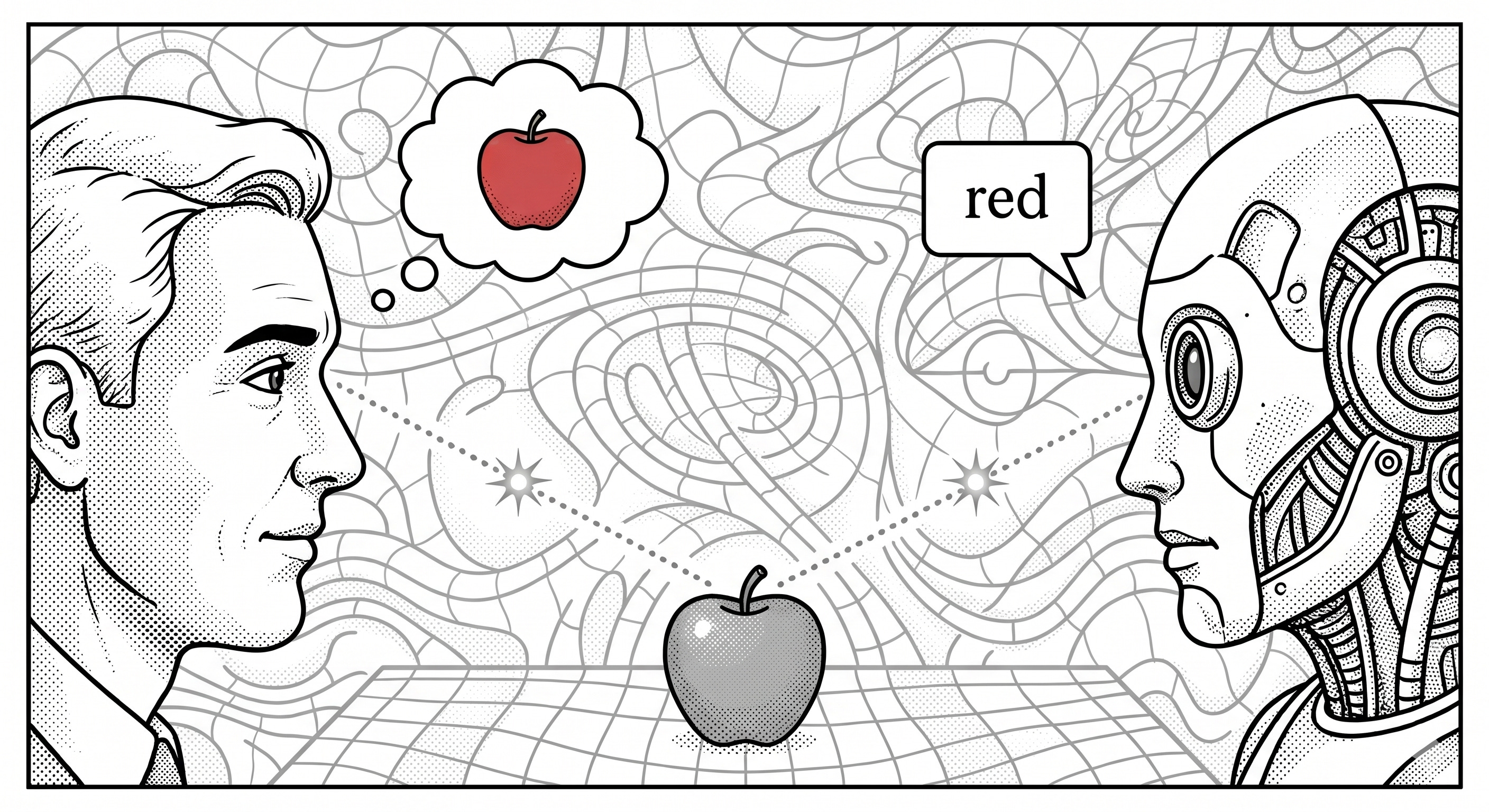
In my previous post, I argued that the only way to make meaningful progress on the Science of Consciousness is to apply a “startup mentality” to the existing 350+ theories. We cannot afford to fund all of them equally; we must pick the most promising candidate, pressure-test it with rigorous funding and technology, and either validate it or “fail fast” and move to the next.
But that immediately begs the million-dollar question: How do we pick the first one?
If we are going to commit our time and resources, we cannot rely on academic trends or intuition alone. We must start with First Principles. Before we can build a testable hypothesis, we must establish a foundation of bedrock assumptions that any viable theory must respect.
Based on my last decade studying part-time the state of philosophy and physics, here are the three assumptions that guide my search.
It sounds ridiculous to have to state this, but in modern philosophy of mind, this is a radical act. Some theories, like “Illusionism,” actually argue that subjective experience is merely a trick our brains play on us, a cognitive mirage.
I reject that. A mirage still requires conscious experience. The foundational pillar of my worldview is that consciousness, specifically Qualia, the raw, felt subjective experience of reality,is an undeniable, irreducible feature of existence.
To illustrate, consider this simple symbol: 🔴.
When we discuss 🔴, we are not talking about data processing. We aren’t talking about the frequency of light (approx. 700nm), nor are we talking about the linguistic label “redness” or references like “the apple is red.” We are talking about the distinct, undeniable, raw feeling that accompanies looking at it. All of the above are mere pointers to the experience of 🔴.
It is the “internal light” that illuminates biological processing. A physical science that ignores the felt-ness of 🔴 is an incomplete science.
My second principle is that the raw feeling of 🔴 is fundamentally non-computable. No symbolic manipulation, no arrangement of digital software, no matter how complex, will ever logically result in an “inner feeling.”
This is supported by two main observations:
In computer science, the Church-Turing thesis roughly suggests that any algorithm can be executed on any Turing-complete system. The hardware doesn’t matter; the logic does.
If 🔴 were merely an algorithmic output, it shouldn’t matter what physical system runs the program. Imagine a human being manually moving pebbles on a beach to simulate the logic gates and data flow of the brain. According to computationalism, if that person arranged the pebbles in the correct logical sequence, at some point, the physical act of moving pebbles should generate the subjective experience of seeing red.
Read that again: the physical act of moving the new N-th pebble on the beach would generate 🔴 out of thin air.
Our deepest intuition, and logical deduction, tells us this is improbable. “Feeling” is not a product of abstract logic; it seems to be linked to the specific, physical reality of the substrate itself.
This also means our current attempts at AGI, running on digital architecture (computation), are not, and will never be, conscious. The ChatGPT algorithm of today and tomorrow can be computed on any logically equivalent system, whether that is a computer, a sheet of paper with pen strokes, or a person moving pebbles on a beach. 🔴 cannot emerge from this process.
Computers are entirely comprised of shared, formal descriptions or symbols: strings of bits (0s and 1s) and the logical rules that manipulate them.
But 🔴 is inherently, perfectly private. No amount of descriptive data can convey the essential quality of 🔴 to a person who has been blind since birth. I can tell them the physics of the wave, the physiology of the eye, and the chemistry of the brain, but the feeling of 🔴 remains a secret to everyone but me. We can’t even agree, using words (symbols), if my feeling of 🔴 is the same as yours.
You cannot map descriptions (computation) to ineffable experiences (Qualia). The gap cannot be bridged by a computer, any description, or any symbolic manipulation.
If consciousness cannot be programmed, why is it here?
My third principle is that consciousness is not a useless passenger. If the felt experience of reality (pain, pleasure, joy) were just a functionless byproduct, what philosophers call an “epiphenomenon”, then evolution would have had no reason to preserve it.
Feelings drive our survival behavior. We avoid the physical flame because of the feeling of pain. We seek reproduction because of the feeling of pleasure. Therefore, the non-computable feeling must influence the physical, computational world.
(Think of Sir Roger Penrose’s mathematical argument: he suggests that mathematical “understanding” is non-computable because humans can “see” the truth of certain Gödelian statements that no step-by-step algorithm can ever prove.)
Furthermore, if feelings were “useless baggage,” their specific quality would be arbitrary. Evolution could have easily mapped the functional utility of “damage avoidance” to the qualitative feeling of “pleasure,” and the biological reflex would have still worked.
The fact that our feelings align perfectly with our survival needs, that being torn apart feels bad and thriving feels good, proves that Qualia is not a shadow. It is not a spectator.
Consciousness is the Pilot, not the Passenger. The tangible survival advantage it provides proves it is a causal force that cannot be reduced to simple, unconscious “zombie” logic.
If we accept these three first assumptions, we are forced to conclude that:
Consciousness is real (🔴).
Consciousness cannot be coded by software.
Consciousness causally influences the physical world.
The tension established by these first three principles forces us to break radically from the dominant materialistic worldview. We must stop viewing consciousness as a complex arrangement of data. We must recognize that the “internal light” of feeling is not the output of a program.
If 🔴 is real and irreducible (Assumption 1), yet fundamentally non-computable (Assumption 2), we are driven to a revolutionary ontological conclusion: consciousness cannot be an emergent byproduct of logical complexity. Instead, consciousness must be a fundamental property of reality, an intrinsic, latent feature present in the very fabric of nature (aligning with philosophical traditions like Panpsychism or Idealism).
To put this in tech terms: we must stop thinking of the “mind” as a program running on the brain. The felt-ness of experience is not algorithmic; it is an intrinsic, physical quality of matter itself.
This means the biological brain, with its extraordinary complexity, does not generate consciousness. Instead, the brain behaves like an advanced antenna or an amplifier. Its unique architecture captures the fundamental, “pure awareness” latent in the universe and modulates it. The brain shapes that raw property into the structured, detailed subjective experience we identify as “me”.
My fellow entrepreneur-researchers Suzanne Gildert, Aneil Mallavarapu and Federico Faggin all independently argue for a similar perspective in their critique of Strong AI, contending that classical computational models cannot explain unified subjectivity. Like me, Mallavarapu suggests that the brain might contain two systems: a classical system and an underlying quantum substrate that “holds” our subjective experiences.
In this model, evolution has selected for a physical architecture where the mechanical processes of the brain consult this non-computable substrate to solve hard problems, acting as a crucial survival advantage.
As Mallavarapu writes regarding this dual-brain architecture:
“In computer science, external facilities consulted by a computer (like a database) are called ‘oracles’. So the quantum brain may be an oracle for the classical brain.”
This perfectly mirrors the concept of the “hardware pilot”: a fundamental property of reality consulted by biological processes to provide direction.
This leads to the final, necessary hurdle: if consciousness is a fundamental, non-computable “hardware” driver (Assumption 3), how does it actually exert its causal influence over the computational structure of the biological brain?
Most established physics, from Newtonian mechanics to the standard, “unitary evolution” of a quantum system, is rigidly computable. There is only one known “gap” in this determinism: the measurement problem, or the collapse of the wave function.
Standard quantum mechanics details precisely which probabilistic outcomes might happen, but it remains profoundly silent on why one specific outcome actually occurs. This moment of collapse is indeterminate. It is a fundamental, irreducible break from computability.
It is therefore entirely rational to hypothesize that this gap is not a mystery, but a mechanism:
🔴 is a Selector, not a Computer: Consciousness interfaces with physical reality precisely at the moment of quantum collapse. The brain does the computation; consciousness performs the selection.
The Mechanism of Will: By subtly “biasing” or “steering” the probabilities of these indeterminate collapses within the physical architecture of the brain, consciousness exerts its influence. This is the true origin of Free Will. It is the non-computable pilot directing the physical hardware, providing the tangible, qualitative edge selected by evolution for survival.
While I believe the primary “interface” for causal will resides in the indeterminacy of wave-function collapse, this is not the only compelling reason to investigate this connection.
Indeed, the founders of quantum mechanics themselves, including figures like Max Planck and Erwin Schrödinger, speculated that consciousness could be the fundamental substrate supporting reality and might not be reducible to standard physical laws. These aren’t just historical footnotes; they are roadmaps pointing toward deep, symmetrical parallels between the anomalies found in physics and the anomalies found in internal experience.
These clues, identified by subsequent research and the founders themselves, collectively prove that the quantum-consciousness connection isn’t speculative “new age” filler, it is a critical, rigorous domain of study, and it is “worth going to the bottom of it!”. Here are a few other compelling parallels that demand investigation:
Superposition and Singularity: Quantum systems exist in “Superposition,” a blur of simultaneous probabilities until observed. Yet, our subjective reality is never a blur. In every moment, we experience a “Single, Definite Experience”, suggesting consciousness may be the very mechanism that forces a single choice from quantum possibilities.
Boundary and Unity: Computation alone cannot account for the “boundary problem”, how billions of separate events unify into a single field of consciousness. Because computation is substrate-neutral and pace-invariant, it lacks a native connection to specific moments in space and time. Researchers Andres Gomez Emilsson and Chris Percy argue that “...computation-first accounts lack a non-arbitrary definition of boundaries...” and that a viable theory requires physical structure, where the unity of experience “corresponds to the physical unity of a concrete, spatially and temporally extended physical process.”.
No-Cloning and Privacy: Standard computer science is built on copying information (copy/paste). Quantum information, however, strictly cannot be duplicated, a principle known as “The No-Cloning Theorem”. This perfectly mirrors “The Privacy of Subjectivity”: your felt 🔴 is unique, private, and cannot be perfectly shared or duplicated as external data.
Bigness vs. Oneness: External physics describes vast scales, up to “The Universal Wave Function”. Internal experiences often report a profound “Connection to Oneness”, raising the possibility that these are subjective and objective views of the same principle.
Breathing Fire: Mathematical equations describe the how of the universe, but even figures like Stephen Hawking asked, “What is it that breathes fire into the equations and makes a universe for them to describe?”. Perhaps the answer lies in “The Intrinsic Reality of Experience” as the primary engine.
Quantum Biology: We must also investigate if this connection is the “Missing link for life/evolution?”. The nascent field of Quantum Biology suggests biological systems might natively utilize quantum effects.
At CUSAC, these first principles are not abstract philosophical toys; they constitute our foundational investment thesis. They filter out the dead ends and point us directly toward the necessary breakthrough.
If consciousness cannot be programmed, it cannot exist as “software.” It must be a fundamental “hardware pilot,” utilizing the inherent windows of quantum indeterminacy to guide our biological vehicle towards survival.
With these bedrock assumptions in place, we are no longer just theorizing. We are actively refining and developing a formal framework that honors these principles. We call this avenue of research Quantum Idealism.
(I will be dedicating an entire upcoming post to outlining exactly what Quantum Idealism is, how it differs from standard quantum interpretations, and how it mathematically merges physics with phenomenal reality).
The time for endless, circular debate is over. Our singular goal now is to apply the “startup mentality” to Quantum Idealism: move fast, design rigorous, testable experiments, and put this hypothesis to the ultimate proof in the laboratory. We intend to find the undeniable imprint of the “Pilot” on the physical machine, or falsify this theory as fast as possible!
If this mission resonates with you, I invite you to follow our progress, get involved, or donate at CUSAC.org.
A Note on the Writing
This post was drafted by me to ensure the vision and stories were authentic. I then used AI (Gemini) to help refine the grammar, spelling, and flow. As a French Canadian writing in English, I’ve often felt like a “second-class” writer, but I believe AI gives us all the ability to express our deepest ideas better and faster.
No posts
Comments
Nothing yet. Say the first thing.
Sign in to join the conversation.