
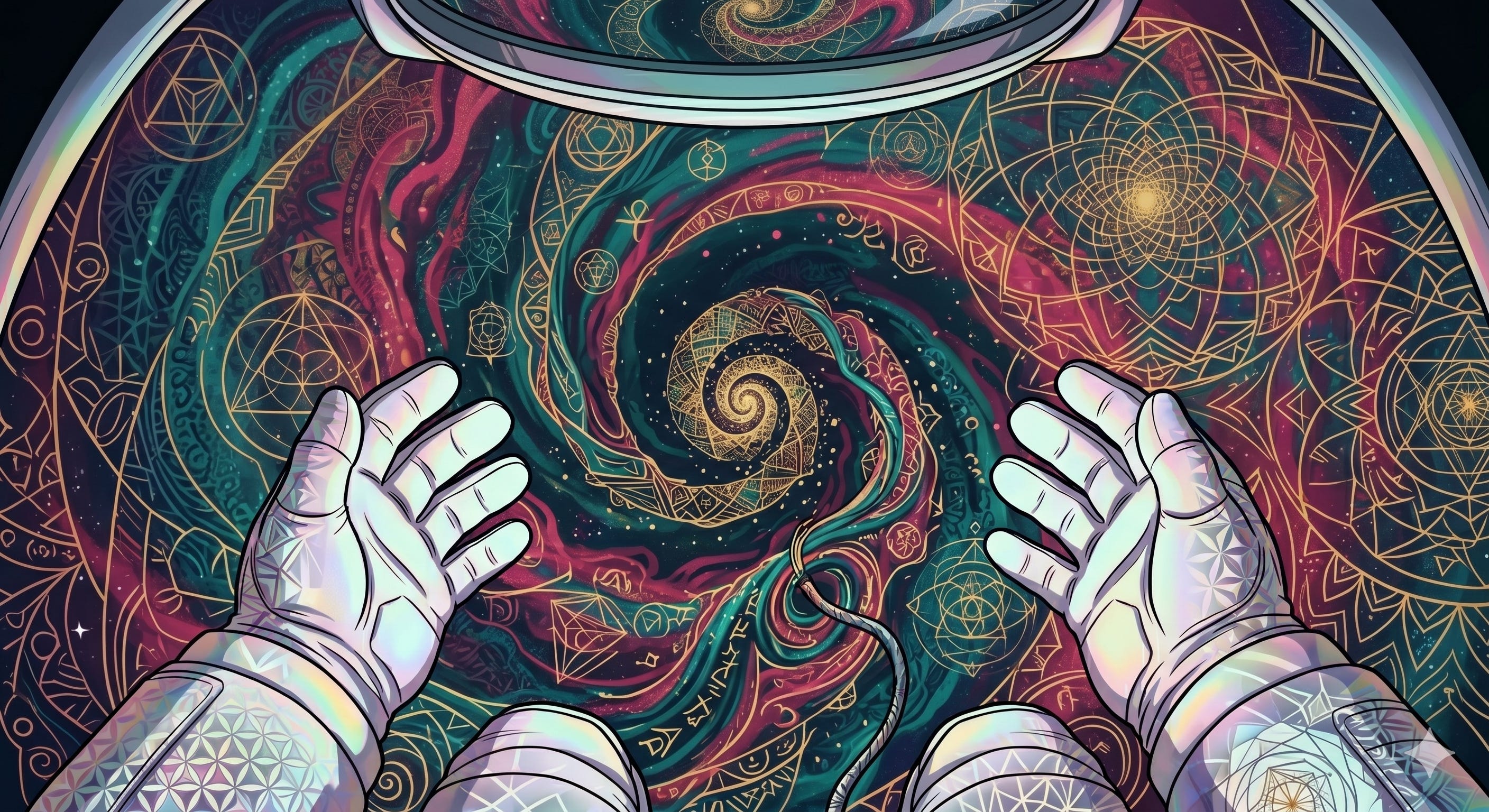
Consciousness is the ultimate mystery. Yet, most of the time, we don’t even notice it. Like a fish that never thinks about the water it swims in, consciousness is the medium through which we experience... well, everything.
When I talk about consciousness, I am specifically referring to subjective experience: that private space in our minds where we feel, think, and operate our daily lives. Every memory, every emotion, and every bit of knowledge we possess is only accessible through this “internal screen.”
To lose consciousness is to cease being present in the world. We can’t feel it; we can’t act on it. We simply aren’t there. (Though, interestingly, when we sleep, we remain conscious of our dreams, provided we can remember them.)
Despite its importance, we are essentially “in the dark.” We have no unified explanation for what consciousness is or what it actually does. Not from philosophy, neuroscience, psychology, nor physics. There is no scientific consensus, not even the beginning of a “proto-theory.” We are building the future on a foundation we don’t understand.
While we remain confused about our own minds, we are building machines that will soon surpass our intelligence. As these AI integrate into society as digital agents and robotic forms, we are seeing the rise of AI Psychosis: a state of confusion where millions of people believe these machines are already conscious beings with moral status, and develop deep emotional relationship with them.
Simultaneously, technologies like Neuralink suggest a future where we merge our brains with hardware to keep pace. We are looking at a world of extended cognitive capabilities, increased input-output speeds, and perhaps even the ability to inhabit virtual worlds directly within our consciousness. The future is looking more and more like The Matrix.
We know almost nothing about the “how” of consciousness, and until recently, few people cared. But a revolution is underway.
I predict that consciousness will become a mainstream topic within the next five years. It will drive research, product development, and ethical debates at an unprecedented scale. This isn’t just a philosophical curiosity anymore, it is the next great frontier of human evolution. And for me, this is exactly what gives me hope for the future.
When I was 18, I was a student of Math, Physics, and Computer Science at the Université de Montréal in Canada. I was obsessed with the true nature of reality, but only through the lens of “hard” science. I wanted to solve the mysteries of the Big Bang, black holes, and the “interpretation-resistant” puzzles of quantum mechanics, superposition, entanglement, and the measurement problem.
To me, consciousness wasn’t even on the radar. I viewed it as a mere byproduct of the brain, a side effect of biology that science would eventually “solve” and move past. The real mysteries, I thought, were out there in the stars and the subatomic void.
At the time, I was living with my father in Montreal, recently divorced from my mother. He was a programmer by trade, but his own search for the nature of reality had led him down a very different path. While I was looking at equations, he was exploring the internal frontier.
His journey started with philosophy and science, but eventually branched into Indian, Chinese, and Christian mysticism. He dove into meditation and prayer, eventually reporting a “Kundalini experience”, a powerful awakening of energy through is spine that changed his life. He began meditating daily to reach what he called “Pure Consciousness,” a source of everything that he believed was accessible within each of us.
We spent countless hours arguing. He would insist on the primary importance of consciousness, while I would dismiss it as an unimportant biological flicker.
Between these debates, we watched The Matrix together at least a dozen times. We were fascinated by its vision of the future of humanity and the philosophy behind the “simulation.” But even as we analyzed the movie’s deeper meanings, I remained stubbornly intellectual. I could talk about the idea of consciousness for hours, but I didn’t actually care about it.
It was a theoretical problem, not a personal one. At least, not yet.
Like many teenagers, my first encounters with altered states of consciousness were unremarkable. Since the age of 16, I had experimented with alcohol and cannabis, but it was mostly about “goofing around” with friends, laughing, partying, and being a kid.
But everything changed one night in my father’s basement.
While he was out, a group of us decided to try psychedelic mushrooms. We took about two grams of dried mushrooms with the simple intent of eating pizza and watching movies. It was, in retrospect, a terrible “set and setting.”
As the mushrooms kicked in, our perception began to warp. We lost our appetite for the giant pizza we’d ordered. Suddenly, one of my friends began choking while drinking some juice. It triggered a collective spiral into a “bad trip.” We felt like we were dying, or perhaps already dead. We were too terrified to go outside, trapped in the dark basement with our own minds.
During the height of the fear, I had a vision that changed my life. I felt like an astronaut who had become unattached from his ship, drifting slowly into the infinite void of space. I watched my “ship”, which represented my access to reality, get smaller and smaller as the blackness of the void surrounded me.
It was terrifying. But in that terror, I made a profound discovery.
I realized that while my reality was dissolving and the “David” who was scared was spiraling, there was a part of me that remained absolutely stable, immobile, and present. My consciousness was separate from the content of the experience. For the first time, I felt that the person who was afraid wasn’t the “true” me, I was the pure awareness behind it all.
A few years later, we tried again, but this time we did it right: a beautiful summer day in a park with fresh fruit and good intentions.
This experience was a total breakthrough. Reality felt “more real” than reality. The sky, the plants, and even the rocks felt vibrant, alive, and deeply connected. I had never experienced anything so powerful.
It left me with a burning question: if there is “normal” consciousness and then this “surreal” state, how vast is the staircase of consciousness? How many steps are there, and how much of the world of subjective experience are we currently missing?
Since then, I’ve explored various states through meditation, breathwork, LSD and Ayahuasca. Some were blissful, others were terrifying, but each served as a reminder that consciousness is the ultimate interface between ourselves and reality. It finally opened my eyes to what my father had been trying to tell me. I stopped arguing, and I started listening.
While I was fascinated by the nature of reality, I eventually realized I was more of an innovator than a traditional researcher. My true skill lay in forming a vision, securing capital, and aligning a team to make things happen.
I leaned into this “builder” DNA, leaving my bachelor’s degree after two years to launch my first startup in EdTech, ChallengeU. This was followed by a digital transformation agency, Novatic, and finally Squido Studio, the VR game company I lead today. At Squido, we focus on VR/XR experiences and AI, always keeping an eye on the horizon for the day we can create “Matrix-style” links through neural interfaces.
Yet, throughout twenty years of building companies, the question of consciousness remained my “north star.” I became convinced that solving the “Hard Problem” of consciousness is the most pressing mission of our time.
In 2018, I came across the work of physicist Tom Campbell. He was proposing a “Theory of Everything” (My Big TOE) that suggested a fundamental link between consciousness and physics. He launched a Kickstarter to test these ideas in a quantum optics lab through variations of the double-slit experiment.
The highest pledge was $10,000, which promised direct access to the research team. I saw this as my “way in”, a chance to pivot from a passive observer to an active participant in consciousness research. I pledged the money, and soon after, I received an email from Tom.
I quickly learned that while the funding was there, the academic world was not. Consciousness was a “taboo” subject in most physics departments, and Tom was often dismissed as a spiritual guru rather than a researcher.
This is where my entrepreneurial background kicked in. I volunteered to lead the outreach to universities. To get our foot in the door, I changed the narrative: we weren’t looking for “ghosts in the machine”; we were proposing seven pedagogical experiments to teach the fundamentals of quantum physics.
It worked. I secured partnerships with CalPoly in Los Angeles and Polytechnique de Montréal.
In parallel, I hired a private tutor to master the math behind the experiments: Charles Alexandre Bédard, a brilliant physicist whose supervisor, Gilles Brassard, is a Turing Award winner.
Charles was honest with me from Day 1: “David, you won’t find a link between quantum mechanics and consciousness here. These experiments will likely just reconfirm the QM we already know.”
He was right. I spent the next five years embedded in quantum optics labs, debating math, calibration, and data analysis with experimentalists. In the end, the data disproved Tom’s specific hypothesis, but the journey was a massive success. We created some of the best online resource for learning quantum physics through the lens of the measurement problem, and I gained a deep, mathematical understanding of the mysteries involved.
This journey led to a seat on the board of CUSAC (The Center for the Unification of Science and Consciousness), the non-profit Tom founded to realize these experiments. I was eventually named Executive Director.
Today, always as a volunteer, my mission is to apply the “startup mentality” to consciousness: move fast, be efficient, and develop a rigorous theory of consciousness that can finally be tested in the lab.
The primary challenge in consciousness research today is a massive “signal-to-noise” problem. There are currently over 350 theories of consciousness, each with its own literature and worldview. Most of them, however, are not developed enough to offer definitive, falsifiable predictions.
On top of that, the subject remains a social and academic taboo. While we see more “flippers”, high-profile scientists like Federico Faggin and Christof Koch who changed their views after profound subjective experiences, the funding remains abysmal.
The world spends less than $50M a year on consciousness research. To put that in perspective, that is 10,000 times less than what is currently invested in AI every year. We are pouring billions into building “minds” while spending pennies to understand what a mind actually is.
With my entrepreneurial background, I don’t want to just talk about the problem, I want to implement modern, efficient work practices to solve it. I advocate for a “startup mentality” in the lab:
Identify a Theory: Pick one “family” of theory among the 350.
Build the Infrastructure: Raise the funds and awareness needed to develop technological tools that facilitate research.
Pressure Test: Develop testable predictions and run experiments as fast as possible to try and falsify the theory.
If a theory is falsified, we don’t view it as a failure. We cross it off the list and move to the next one. This is the only way to cut through the noise.
At CUSAC, we believe a quantum approach to consciousness is the most promising path forward (I’ll dive deeper into the “why” of that in a future post). We are currently focused on making tangible progress through theory development and large-scale experiments.
We are also bringing the brightest minds in the field together. In August 2026, we are organizing the Quanta 2 Qualia conference in Quebec, in collaboration with ETS (École de Technologie Supérieure) and FQxI (The Foundational Questions Institute).
As with any non-profit, our mission is fueled by donors who believe that understanding the nature of our existence is a goal worth hitting. We are constantly fundraising to ensure this research doesn’t just stay in the realm of “maybe,” but moves into the realm of “proven.”
By now, you understand why I believe consciousness is the ultimate frontier and how I intend to contribute. But what does it actually mean to make progress in this field? What impact could it have on our daily lives?
To start, we need a Mathematical Theory of Consciousness.
As explored in works like Principia Qualia, a true theory would explain exactly what consciousness is made of and how it interacts with physical matter. If we had such a theory, we could predict subjective experience with the same precision we use to predict the orbit of a planet. We could say: “If I arrange energy and matter in this specific pattern, it will result in the subjective feeling of ‘blueness,’ or the ‘taste of coffee,’ or the sensation of ‘joy.’”
This isn’t just a philosophical exercise; it would lead to a new era of physics and technology.
The Consciousness Detector: We would finally have a way to know, with certainty, if an AI, a patient in a coma, an animal, or even a plant is “conscious.”
The Missing Link to AGI: Consciousness might be the key to achieving Artificial General Intelligence that is truly efficient, capable of rapid learning, and fundamentally aligned with human values.
Next-Gen Interfaces: This would lead to the evolution of Brain-Computer Interfaces (BCI). We could move beyond the limitations of Neuralink to create devices that allow us to experience entirely new colors, explore “psychedelic” realms safely, or even interact with matter at a distance using only our intent, no surgery needed.
Digital Immortality: We might eventually consider the possibility of “uploading”, transferring consciousness into digital worlds or robotic forms for a form of immortality. This is the kind of long-term vision that informs my work at Squido Studio.
While the technology is exciting, the most important aspect for me isn’t a product, it’s the meaning.
Understanding consciousness would allow us to understand what happens at birth and at death. It would reveal whether consciousness is just a “glitch” in the brain or something fundamental to the universe itself.
Humanity is currently at a crossroads. We are struggling with greed, war, and the looming shadows of climate change and uncontrolled AI. I think many of us feel that something is misaligned, that as a species, we are “sick.”
I have high hope that consciousness is the missing link. By understanding it, we can reconnect with our true nature and gain the wisdom needed to build a future where life and awareness don’t just survive, but thrive.
If this mission resonates with you, I invite you to follow our progress, get involved or donate at CUSAC.org.
A Note on the Writing
This post was drafted by me to ensure the vision and stories were authentic. I then used AI (Gemini) to help refine the grammar, spelling, and flow. As a French Canadian writing in English, I’ve often felt like a “second-class” writer, but I believe AI gives us all the ability to express our deepest ideas better and faster.
No posts
Comments
Nothing yet. Say the first thing.
Sign in to join the conversation.