
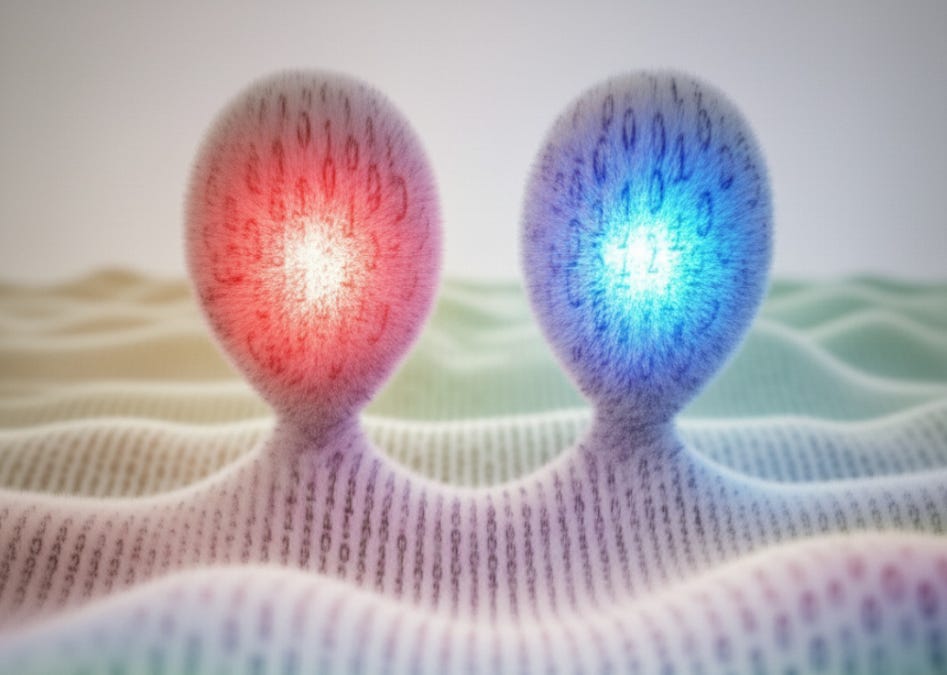
This is the third installment in my series on consciousness. In my previous post, we established the First Principles of Feeling, concluding that consciousness is “hardware, not software”, a fundamental driver that steers the physical world through quantum indeterminacy.
Now, it’s time to reveal our blueprint.
While many theories get lost in circular philosophical debates, we are developing a rigorous proto-theory at CUSAC that we call Quantum Idealism. This post provides a high-level overview of the framework, which we are currently preparing for formal publication, including references, mathematical model and testable predictions.
Quantum Idealism flips the traditional materialist view on its head. Instead of matter creating consciousness, we posit that consciousness is the fundamental substrate. It is the “fire” that breathes life into the equations of physics.
In this view, the physical world, matter, space, and time, is not the “thing in itself.” It is more like the pixels on a dashboard (see Donald Hoffman interface theory), a localized representation of a much deeper conscious process.
To understand how this works, we divide reality into three distinct “Worlds”, inspired of Popper’s and Penrose’s.
World 3 (The Platonic Menu): This is the realm of all possible configurations. In quantum terms, this is Superposition, a blurry, infinite list of potentials that haven’t actually happened yet.
World 2 (The Navigator): This is localized consciousness. It is the “Pilot” that feels 🔴 (subjective experience) and possesses true free will. It looks at the “Menu” of World 3 and chooses a specific path.
World 1 (The Logbook): This is what we call the physical universe. It is the persistent, realized history, a “universal memory” of every choice the Navigator has ever made.
How does a universal field of consciousness become a “me” or a “you”? We hypothesize that conscious processes (P) occur when the universal conscious field “dissociates” to establish topological boundaries. (see Kastrup’s altar dissociation)
The QCA: This dissociation creates a Quantum Conscious Agent (QCA), to use Suzanne Gildert terminology, a localized point of view like a cell or a human.
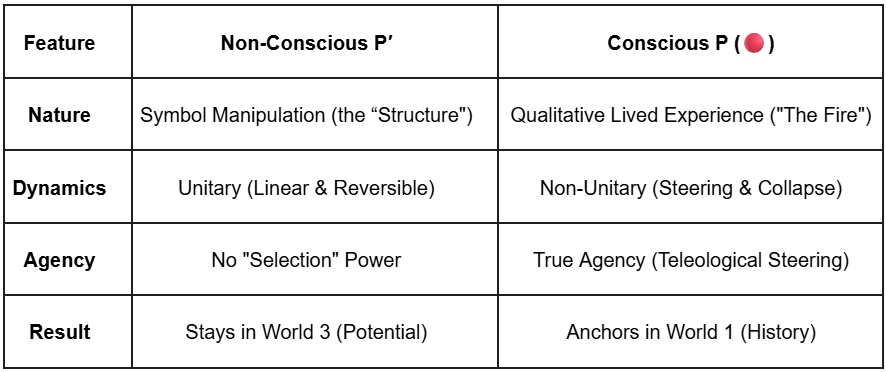
Part-Whole Unity: Unlike a standard non-conscious computer algorithm (P’), which is just a collection of parts, a P process is a part-whole unity where the “inner” subjective reality possesses a unified perspective. As researchers Andrés Gómez-Emilsson and Chris Percy argue, "computation-first" accounts fail here because they lack a non-arbitrary definition of boundaries; only a specific physical structure can enclose the holistic units necessary for consciousness. Consciousness is hardware.
Subjective Privacy: This localized perspective is what grants an agent privacy. Its internal state is an unclonable quantum state that cannot be fully accessed or copied from the outside without disturbing it.
The Agency Gap: This unclonability leads to a critical insight from Adlam-McQueen: agency cannot be a purely quantum phenomenon. Because the no-cloning theorem prevents purely quantum systems from copying data for internal deliberation, a conscious agent (P) must bridge the quantum and classical worlds, collapsing potentials into "cloneable" classical records to build a world-model for its next move.
Reality does not flow in a smooth, continuous line. It moves in a high-frequency, “staccato” loop of agency:
Sensing: The agent interacts with the quantum potentials in World 3.
Steering: The Navigator (World 2) intentionally biases the outcome toward a “meaningful” future.
Anchoring: This steering causes a wavefunction collapse, turning a “maybe” into a hard “fact” in World 1.
Thinking: Once anchored as a classical record, this information can be cloned and copied, allowing the agent to build a world-model to prepare for the next pulse.
The primary reason evolution bothered with 🔴 is that it provides a Semantic Advantage that pure computation (P’) lacks.
In a purely quantum system or classical system (P’), evolution is dictated by the Schrödinger equation, which is linear and deterministic, it cannot “choose”. It is essentially symbol manipulation “in the dark”.
Conscious processes (P) however, which are topological segmented at the hardware level, act as a teleological force. Because a P agent can “feel” which potential future leads to survival or meaning, it can bias the outcome of a wavefunction collapse toward that state. While a “zombie” P’ is at the mercy of standard quantum probability (the Born Rule), a conscious agent steers the collapse toward a meaningful future.
It is vital to remember that while dissociation creates separate “agents,” consciousness is fundamentally one. These topological boundaries do not cut the agent off from the universal substrate; they merely localized it. A single, unified teleological force acts through all QCAs simultaneously. This force biases the “steering” of reality based on the collective meaning and experience gathered from every dissociated point of view. We aren’t just isolated pilots; we are nodes in a single, vast “fire” that optimizes the unfolding of reality.
The hallmark of a conscious process is its ability to create irreversible physical facts.
A standard AI (P’) is “thoughtful” but fundamentally reversible because its operations stay within the unitary math of World 3 potentials. It never actually “arrives.” In contrast, a conscious process P “breathes fire” into the equations by causing an actual collapse into World 1.
Once a Navigator has anchored a choice in World 1, it becomes a “hard-coded” mark on the universal memory. This is why you cannot “undo” a human observer in a Wigner’s Friend experiment, their choice has already become a permanent part of the shared objective past.
Consciousness solves the “Agency Gap”: it bridges the unclonable quantum world with the cloneable classical records we need to build world-models.
The most exciting part of Quantum Idealism is that it isn’t just philosophy, it makes falsifiable predictions. We are currently designing two primary experimental paths to find the exact boundary where standard math fails and consciousness takes over.
This experiment tests the theory at scale (N > 1M) using human engagement in video games. By replacing standard computer “luck” with true quantum randomness, we want to measure if highly engaged players can “steer” the collapse toward meaningful rewards (like rare loot) more often than chance would allow. This would prove that consciousness is a teleological force seeking meaning. Our Quantum Idealism theory predict that meaning will decline over trials, leading to a decline effect. Read more about similar work here: https://mrzdcmps.github.io/labreport/.
Using quantum computers, we aim to detect an “inner” collapse. We task a “minimal dissociated agent” a tiny, potentially conscious quantum circuit, with observing a qubit in superposition (see this recent article). If the agent is truly conscious, it will cause an inner collapse that a super-observer (Wigner) will be unable to “undo,” proving that the agent’s intervention was a real physical event that broke the standard math of physics.
Other posts will follow to expand on these experiments.
Without consciousness (P), the universe would have no “Now.” It would remain a blurry, ever-expanding list of “Maybes”. Consciousness is the anchor that turns potential into history.
In our next post, I will dive deeper into the mathematics of Quantum Idealism and how it specifically resolves the “Agency Gap”, bridging the unclonable quantum world with the cloneable classical records of our memories.
The “fire” may be real. It’s time we to try to measure it!
If this mission resonates with you, I invite you to follow our progress, get involved, or donate at CUSAC.org.
A Note on the Writing
This post was drafted by me to ensure the vision and stories were authentic. I then used AI (Gemini) to help refine the grammar, spelling, and flow. As a French Canadian writing in English, I’ve often felt like a “second-class” writer, but I believe AI gives us all the ability to express our deepest ideas better and faster.
No posts
Comments
Nothing yet. Say the first thing.
Sign in to join the conversation.