
In my last post, I introduced Quantum Idealism, our blueprint for understanding how consciousness, the Navigator, steers the physical world through the “staccato pulse” of wavefunction collapse. But as any entrepreneur knows, a blueprint is just a beautiful dream until you pressure-test it against the cold, hard reality of data.
Through my game company, Squido Studio, I began developing and studying a platform that could turn gameplay into data. Today, I'm pulling back the curtain on Project PlayerMind, the formal initiative to move this work into a rigorous research setting under the CUSAC umbrella.
PlayerMind is more than an experiment; it is a vision for a new kind of research infrastructure. By integrating rigorous scientific protocols directly into popular video games, we are building a platform where scientists can pre-register and configure consciousness, psychology, and cognitive studies reaching millions of human beings. It provides a controlled subjective environment that is finally scalable, transparent, and replicable.
In this article, I’ll share an overview of our early prototype that has been running for the past few weeks. By integrating true quantum randomness into a popular Roblox game, we are attempting to replicate a century’s worth of parapsychological data in just a fraction of the time and cost.
For over 100 years, researchers like Dean Radin, Markus & Deschamps and the PEAR labs have investigated whether human intention can influence physical reality (Micro-PK) or sense future events (Precognition). While their results were often statistically significant, they suffered from two fatal flaws:
Low Engagement: Forcing a participant to look at a screen of 1s and 0s is boring. There is no “semantic meaning” (Qualia) or survival pressure.
Small Sample Sizes: Most studies involve fewer than 1,000 participants (N < 1000). This makes it nearly impossible to distinguish a real signal from a “decline effect”, the well-documented phenomenon where an initial “hit” fades into noise as additional trials are performed.
Hard to Replicate: Traditional lab experiments are expensive, slow, and difficult to scale. If a result is found, it can take years for another team to gather a similar participant pool to verify it, and methodology is often questioned when they publish extraordinary claims.
As the CEO of Squido Studio, I realized we already had the infrastructure for a massive solution. Over the past few weeks, we contacted the developer of the game Fling to Climb on Roblox, which has over 1.5 million monthly players, to conduct preliminary data sampling. This 'incubation phase' at Squido allowed us to test parameters like distance and meaningfulness before transitioning the project to a formal scientific environment, under CUSAC.
Inspired by the work of researchers like Maier and Deschamps who have been studying these phenomena since 2016, we have developed two primary types of data sampling within Project PlayerMind.
This experiment tests if a player’s engagement can “steer” an external quantum event. In Fling to Climb, we replace the reward pseudo random logic with a quantum random number generator (like ID Quantis, ANU QRNG, Entangled etc.). We want to see if players can bias the collapse toward a “meaningful” reward (like rare loot).
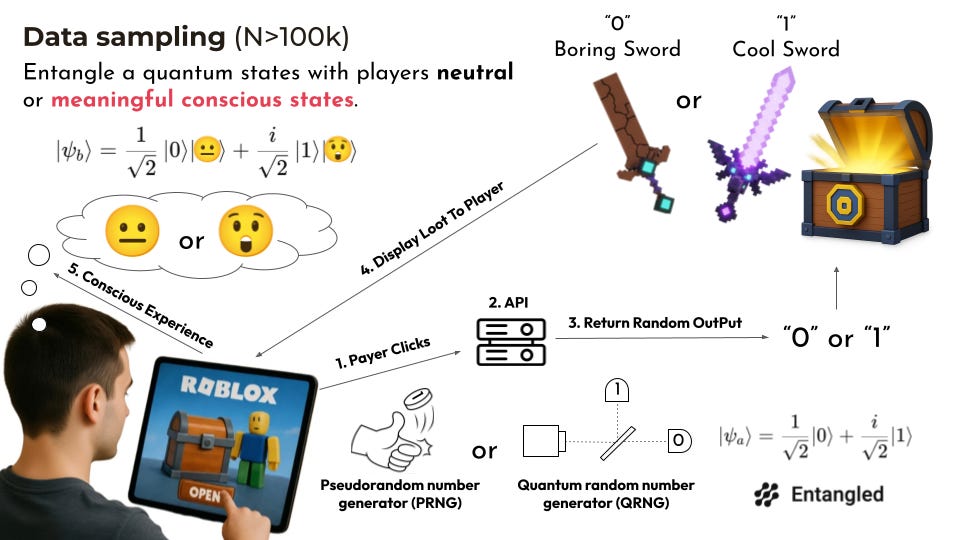
The “Environment” Problem: This experiment presupposes that the wavefunction does not collapse until the player observes the result. However, for the data to reach the player, the API call generating the quantum number must traverse half the Earth. We suspect the interaction with the environment along that path might “leak” information, causing the collapse long before the player ever sees it.
This is where Quantum Idealism gets interesting. This experiment presupposes that humans have internal quantum processes associated with their own consciousness. The game pre-selects a reward behind “Door A” or “Door B” using a quantum process. The player has one chance to guess. Here, the “steering” happens within the player’s own internal hardware pilot. It’s really similar to the micro-pk data sampling, except the reward location chosen in advance, and the player needs to guess where it is hidden.
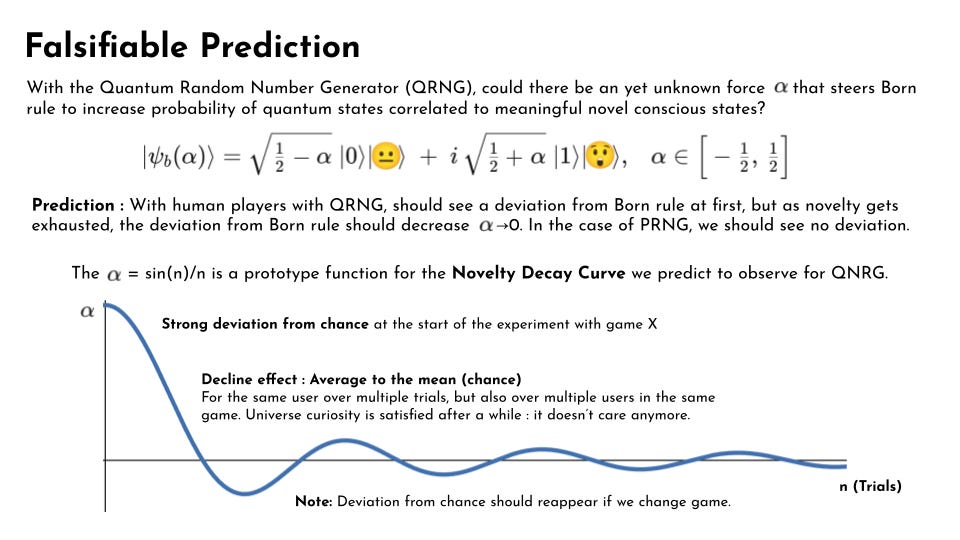
To move from philosophy to physics, we are proposing a testable modification to how we calculate the probability of events. Our theory suggests that the Effective Probability of an outcome is the sum of the standard physical probability, the Born Rule, and a secondary Conscious Steering force.
This steering force is determined by two specific variables: the Meaning of the outcome for the player (the reward’s value or Qualia) and the Agency of that player, representing their level of focus, intention, and engagement. By isolating these variables, we create a clear falsification point: if our data follows standard chance regardless of a player’s engagement or the reward’s value, the theory is wrong. But if we find a deviation that tracks with “meaning,” we have the first mathematical evidence of the Navigator in action.
The data I’m sharing below was collected through Squido Studio’s initial exploration. So far, we have tracked two distinct types of engagement: External Steering (Micro-PK) and Internal Sensing (Precognition), gathering over 110,000 unique players to pressure-test our methodology.
We’ve spent the last two weeks doing “data sampling” to explore parameters like distance, meaningfulness, and the decline effect. To ensure absolute scientific rigor, we utilize a SHAM value protocol as suggested in the Advanced Meta-Experimental Protocol (AMP).
Every time a player triggers a reward, the system retrieves two separate values: one to determine the player’s reward, and an unused SHAM value. Because the SHAM value is never presented to the player, it carries no “meaning.” Comparing the two allows us to validate that any steering effects are truly linked to conscious interaction and not the result of hardware drift or environmental noise.
So far, with 70,000 unique players doing 1 trial each, the data shows no deviation from chance globally, and no particular decline effect shape. This supports our suspicion that the distance between the quantum source and the player, and the environmental noise in between, might be “killing” the signal, or of course, that there is simply no micro-pk effect. See full analysis here.
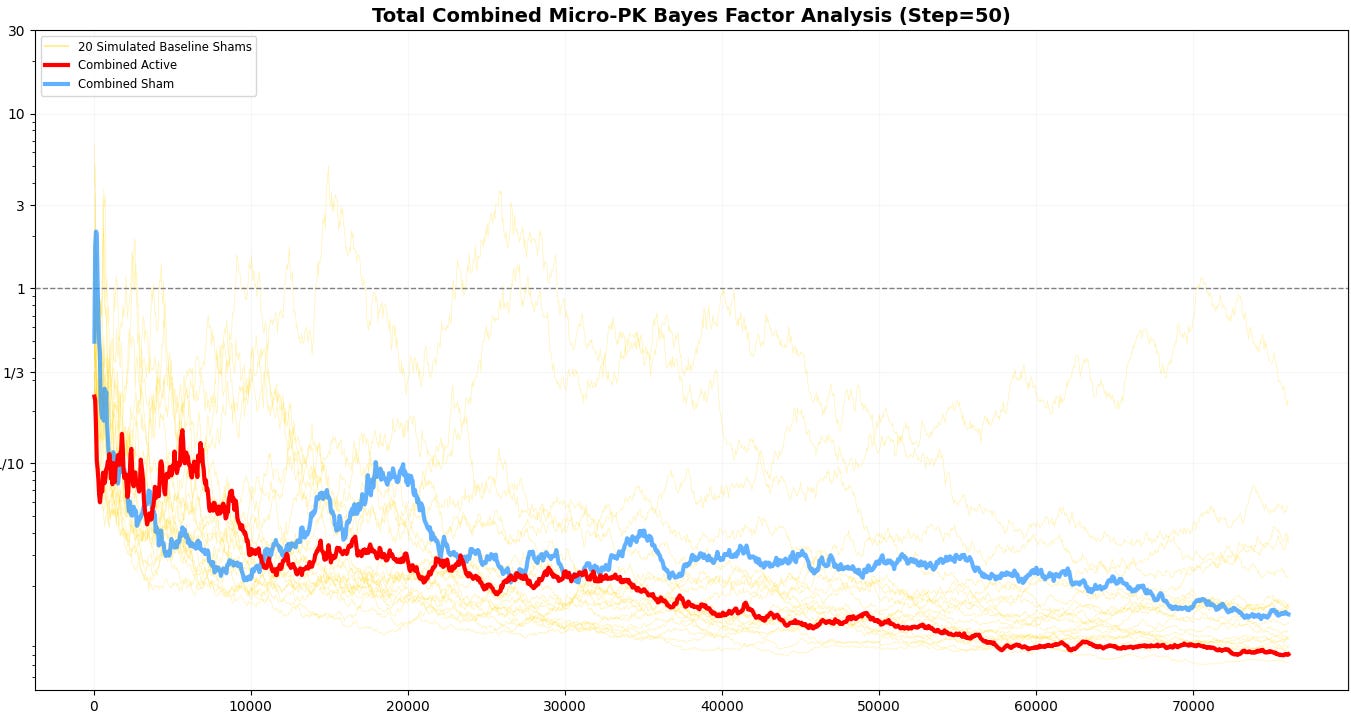
This graph tracks the cumulative evidence for the Navigator through a Sequential Bayes Factor. The X-axis represents 70,000 unique players in chronological order, while the Y-axis measures the likelihood of the psi hypothesis (H_1) versus the null hypothesis (H_0). A value above 1 indicates the evidence favors micro-pk effect, while a value below 1 supports pure chance. As we accumulate more data, the value moves further away from 1 to clearly confirm which hypothesis “wins”.
This is the early “hit.” In our preliminary run of 40,000 trials, we also see no deviation effect globally, but we observed a rare oscillating decline effect, similar to what was observed in this 2018 micro-pk experiment. The signal starts strong, then oscillates and declines toward chance (H_0). Statistically, there was only a 5% chance of seeing this specific pattern (compare to the 20 simulated baseline shams, in pale yellow). See full analysis here.
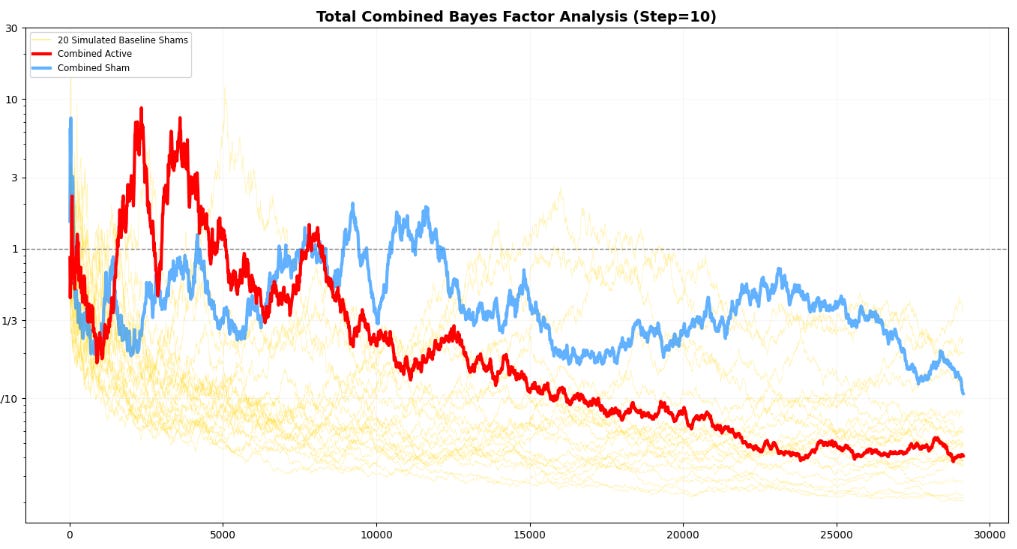
This graph tracks the cumulative evidence for the Navigator through a Sequential Bayes Factor. The X-axis represents 40,000 unique players in chronological order, while the Y-axis measures the likelihood of the psi hypothesis (H_1) versus the null hypothesis (H_0). A value above 1 indicates the evidence favors a pre-cognition effect, while a value below 1 supports pure chance. As we accumulate more data, the value moves further away from 1 to clearly confirm which hypothesis “wins”.
Because of the popularity of Fling to Climb game, we were able to collected these 110,000 human players trials over the course of only 2 weeks. That’s the power of project PlayerMind!
Our theory predicts that if we introduce a long enough pause or change the reward to reset its “meaning,” the effect should reappear (oscillating decline effect).
We are now launching additional data sampling, about 20 studies of 30,000 trials each (N=600,000 unique players) over the next few weeks.
If we see this “early hit and oscillating decline” pattern 2+ out of 20 studies (which is 10%+ , twice as much as baseline chance), we have something interesting, worth replicating even more.
This is just the beginning. The next step is moving this work out of the game studio and into a formal research setting under the CUSAC’s PlayerMind umbrella. Our vision is to evolve these tools into a transparent, scalable research platform where the global scientific community can pre-register studies and access immutable data on the blockchain.
Pre-registered & Transparent: No “file-drawer” effect where failed studies are hidden.
On the Blockchain: All data will be anonymized, immutable and available to the global scientific community.
The Multiverse of Research: We aim to connect PlayerMind to 100+ different games, reaching 10 million+ players.
We are moving past the era of “maybe” and into the era of “proven”. We’ll have more data from our first formal 600k-player run in the upcoming weeks.
If this mission resonates with you, I invite you to follow our progress, get involved, or donate at CUSAC.org.
Note on the Writing:
This post was drafted by me to ensure the vision and stories were authentic. I then used AI (Gemini) to help refine the grammar, spelling, and flow. As a French Canadian writing in English, I’ve often felt like a “second-class” writer, but I believe AI gives us all the ability to express our deepest ideas better and faster.
No posts
Comments
Nothing yet. Say the first thing.
Sign in to join the conversation.