
Please see relevant disclosures here.
The compute market has many different forward curves, none of them public. These curves live inside confidential, multiyear contracts between infrastructure providers and their largest customers. When a customer agrees today to purchase a specified amount of compute capacity over the next several years, the parties are establishing a price for future compute, even if they never call the transaction a forward contract.
Strictly speaking, these agreements do not produce a single forward curve. They produce a patchwork of private forward prices, each negotiated for a different configuration, location, delivery schedule, service level, and counterparty.
The prices are confidential. The contracts are difficult to compare. And each agreement performs functions that, in a more mature commodity market, would be distributed across several different instruments. All of this makes compute offtake agreements more than mere procurement contracts. They are the compute market’s privately negotiated substitute for a forward market.
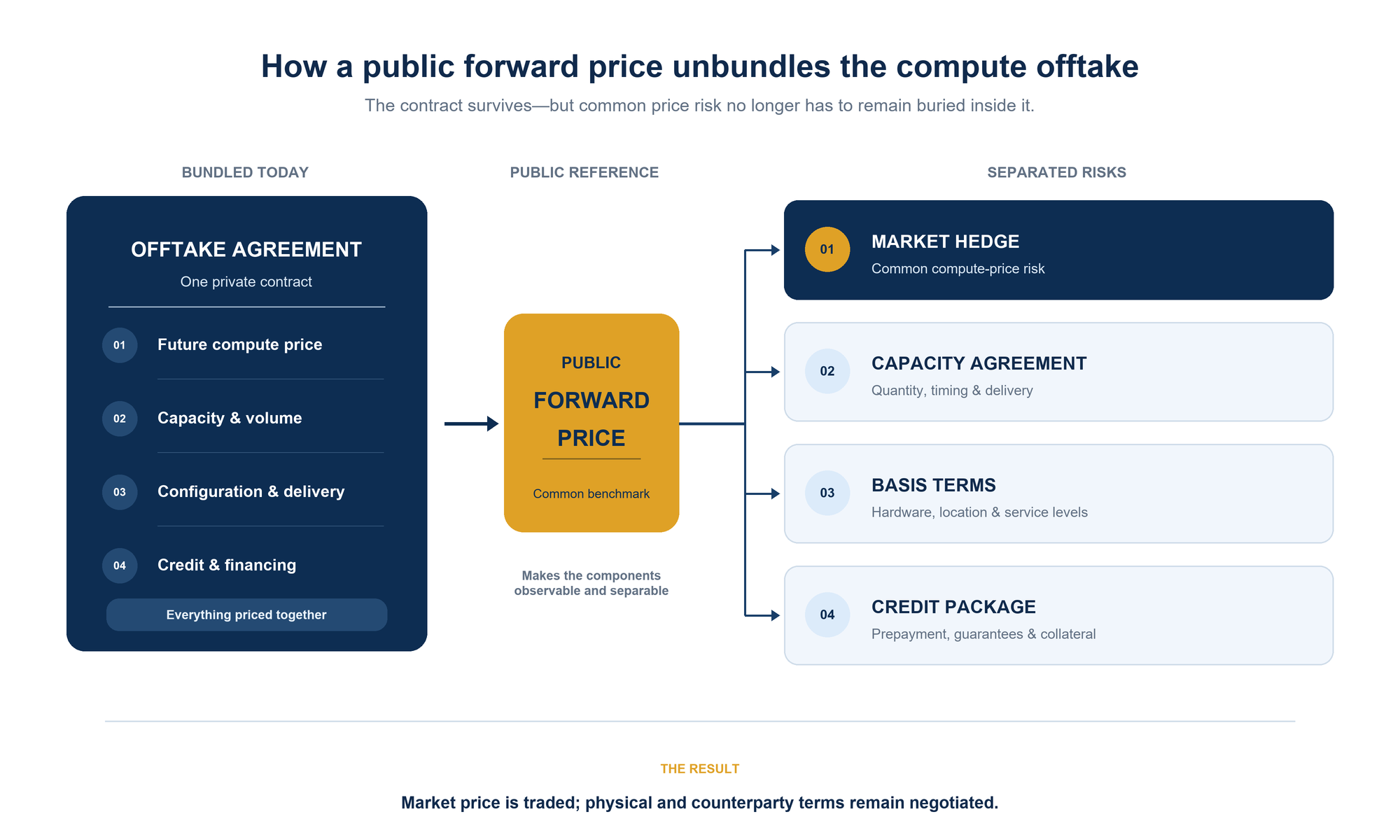
An offtake agreement typically performs at least four economic jobs.
First, it establishes a price, or a pricing formula, for future compute. The buyer gains some protection against scarcity and rising prices. The provider gains some protection against falling prices and unused capacity.
Second, it reserves physical capacity. The customer is not merely expressing a view on the price of compute. The customer wants access to particular infrastructure during a particular period.
Third, it allocates performance risk. The agreement may specify hardware, location, availability, networking, delivery dates, service levels, and remedies for nonperformance.
Finally, it supports the financing of the infrastructure itself. A long-term customer commitment gives lenders evidence that an expensive collection of GPUs, networking equipment, power contracts, and data center capacity will generate revenue after it has been built.
In March 2026, for example, CoreWeave disclosed an $8.5 billion delayed-draw term loan (DDTL) facility intended primarily to finance infrastructure required for a customer contract. (I’ve previously written about this deal, here.) The facility’s covenants included a minimum debt-service coverage ratio, while certain adverse events involving material contracts could constitute events of default.
In other words, the customer contract, the physical infrastructure, and the financing were all part of the same economic package.
Suppose a neocloud wants to build a large compute cluster that will begin operating eighteen months from now. It needs to make decisions today about equipment, power, data center space, networking, and financing. But it does not have a broadly observable market price for the compute capacity the cluster will produce eighteen months from now. A lender therefore cannot look at a public forward curve and value the project’s expected future output. It has to look at a customer contract instead.
The contract provides the missing information: who is expected to pay, how much they have promised to purchase, when the payments begin, and what happens if they fail to perform. Public disclosures make the connection unusually explicit. CoreWeave has said that some of its delayed-draw loans are collateralized by infrastructure assets and contractual cash flows, and that customer credit quality and visibility into future payments can reduce its cost of capital. Indeed, its March 2026 facility, referenced above, had a single counterparty, Meta, take the entire capacity. Meta is itself an investment-grade customer, so the financing itself received an investment-grade rating.
What this means in practice is that the lender is not simply financing GPUs. It is financing GPUs secured by a stream of promised customer payments. And if the downstream customer is investment grade, as Meta is, the loan will be much less expensive, than if the portfolio of customers is thinly capitalized startups.
And this shows why the customers’ identity matters so much. Two contracts with identical nominal prices can have very different financing value if one buyer is more creditworthy, has provided a larger prepayment, or has offered stronger guarantees.
The resulting “forward price” is therefore not a pure price for compute. It also contains compensation for credit risk, delivery obligations, technical specifications, contractual flexibility, and the value of reserving scarce capacity.
All of that is embedded in one confidential number.
CoreWeave’s $8.5 billion DDTL 4.0 facility makes this asymmetry unusually visible. The company described the facility as a non-recourse investment-grade financing for GPU infrastructure associated with a long-term customer contract. Its transaction case study shows that the collateral includes the infrastructure, the customer contract, and the corresponding data center leases.
The associated 10-Q says the facility requires interest rate hedges covering at least 95% of anticipated floating rate borrowings and also imposes certain power cost hedging requirements. In other words, the project can hedge two major inputs (interest rates and power) but it cannot hedge the market price of its future compute output independently of signing a customer contract.
For the buyer, a long-term commitment can become expensive if compute prices fall, workload requirements change, or a new generation of hardware makes the contracted capacity less attractive. Capacity that looked scarce at signing may no longer be scarce when delivered.
For the provider, the agreement can surrender much of the upside if demand remains strong and prices rise. It can also leave the provider dependent on a small number of customers whose failure to perform would create both unused capacity and financing pressure.
For lenders, the contract creates visibility but also concentration. A project financed against one or two anchor customers is partly a bet on those customers’ future solvency and willingness to honor their commitments.
And for the market as a whole, private contracts provide very little price discovery. Each transaction may contain useful information about the value of future compute, but that information remains locked inside the agreement.
The market therefore produces forward prices without producing a forward curve.
Now imagine that the market develops an observable forward price for a reasonably standardized unit of compute. The contract would not need to reproduce every characteristic of every physical transaction. It would need to represent a common reference exposure closely enough that buyers and providers could hedge the general movement of compute prices.
A provider expecting to bring capacity online could sell the reference contract. A customer expecting to consume compute could buy it. Their physical agreement could then focus on the features that actually require bilateral negotiation.
The economics of an offtake price might be expressed as:
Physical compute price = reference forward price ± configuration basis ± location basis ± delivery and service-level basis ± credit and contractual-optionality basis
The reference contract would handle common market price risk. The offtake would handle the difference between the reference product and the compute actually being delivered.
This would make the offtake resemble a basis contract. The agreement would still matter. Customers still need capacity, not merely financial settlement. Providers still need to know when and where that capacity must be available. Hardware type, networking, reliability, scheduling, and remedies for nonperformance cannot be replaced by a futures position.
But the parties would no longer have to use a single bilateral contract to manage every risk at once.
A public forward curve would also change how infrastructure is financed. Today, committed customer revenue is inseparable from the financing package. In May 2026, CoreWeave announced a new financing capacity, dubbed DDTL 5.0 (i.e., a distinct financing package from the March 2026 financing discussed above). DDTL 5.0 was structured to support assets dedicated to two customer contracts, with its roughly five-and-a-half-year maturity aligned to the deployment schedule and useful life of the underlying equipment. (Confusingly, there is yet another financing structure for CoreWeave, dubbed DDTL 5.5, which was recently announced, and for which Fitch provided a credit rating.)
In a more developed market, a lender might evaluate a combination of customer contracts and financial hedges. An offtake could establish the physical basis and minimum utilization, while exchange-traded or cleared contracts could hedge some portion of the general price exposure. That would not make the customer irrelevant. Nor would it necessarily allow speculative projects to obtain financing without committed demand. A futures position does not operate a cluster, pay an invoice, or guarantee that someone will consume the capacity.
But it could make the sources of risk easier to identify. Instead of treating “the customer contract’ as a single indivisible source of bankability, lenders could separately evaluate market price risk, utilization risk, basis risk, operating risk, and counterparty risk. Transparency doesn’t eliminate these risks, but it makes them more legible.
None of this means that introducing a forward contract automatically solved compute finance. A hedge is useful only if the reference price tracks the provider’s actual revenue closely enough. Differences in hardware, geography, utilization, networking, contract duration, or service quality could create substantial basis risk.
Tenor matters as well. A project backed by a five-year customer agreement cannot fully hedge itself using a thin contract that trades only a few months forward.
Futures also require collateral. A provider whose hedge gains value at the same time that its physical business deteriorates may be protected economically. A provider whose hedge loses value while the physical asset gains value may face margin calls long before the physical revenue arrives. That timing mismatch can create a liquidity problem even when the hedge ultimately works.
And a financial contract does not solve delivery risk. It cannot make a delayed data center open on time, secure additional power, repair a network failure, or turn one generation of GPU into another.
The public curve would solve a narrower problem: it would allow the market price of future compute to be observed and traded separately from the rest of the transaction. That narrow problem is still important.
Compute offtake agreements exist for good reasons. Infrastructure is expensive, delivery takes time, customers need confidence that capacity will be available, and lenders want evidence of future cash flow. A public forward market would not eliminate those needs. But what it could do is reveal which part of an offtake price reflects the expected market price of compute and which parts reflect configuration, location, service, credit, scarcity, and contractual flexibility.
The offtake agreement would survive, but it would no longer be the only practical place where all of those risks can be priced. The compute market already negotiates prices for future capacity. The next step is to take the private forward market that already exists, and make part of it public.
If you enjoy this newsletter, consider sharing it with a colleague.
Share Buy the Rumor; Sell the News
I’m always happy to receive comments, questions, and pushback. If you want to connect with me directly, you can:
Comments
Nothing yet. Say the first thing.
Sign in to join the conversation.