
Please see relevant disclosures here.
Compute futures have a standardization problem. An H100-hour in Virginia, delivered as part of a large InfiniBand cluster under a twelve-month commitment, is not the same economic good as an interruptible H100-hour available from a single server in Northern Europe. The chips may have the same name, but the buyer is purchasing a different configuration, in a different location, under a different contract, with different performance and delivery risks.
This is often presented as an objection to compute derivatives. If the underlying product isn’t fungible, how can an exchange create standardized futures contracts around it?
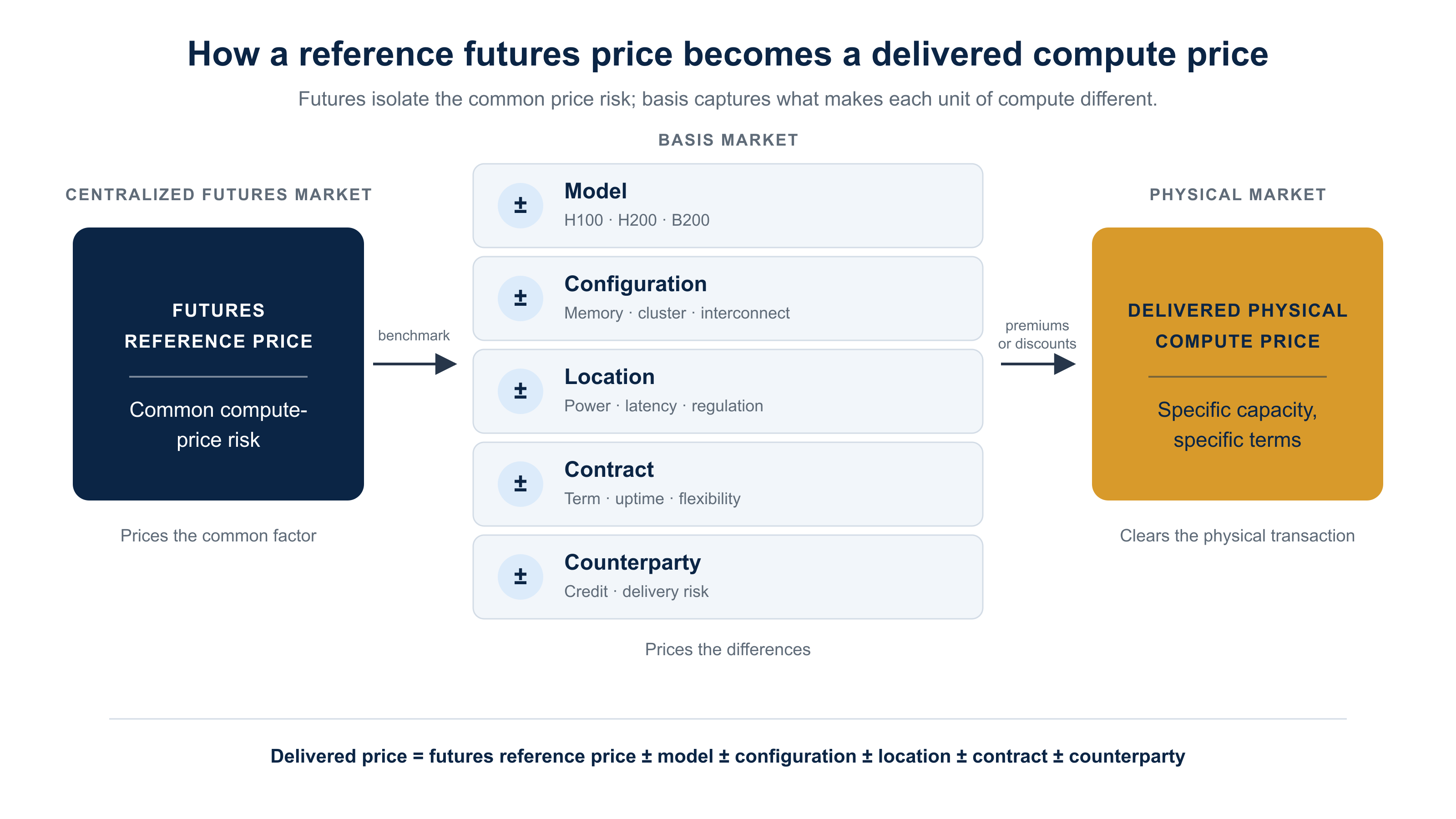
But this objection has the structure backward. Futures markets don’t require every unit in the physical market to be identical. They require a sufficiently clear reference exposure and a market capable of pricing deviations from that reference. In other words, the futures contract standardizes the benchmark. The basis market prices everything the contract leaves out.
So, compute futures won’t make compute fungible. If they succeed, they’ll do something more useful. They will make its non-fungibility legible.
Physical commodity markets already operate this way. WTI is a reference price for crude oil, not the price of every barrel produced everywhere in the world. Natural gas delivered outside Henry Hub trades at a regional basis. Power prices differ by location and hour because congestion and transmission constraints make a megawatt at one node economically different from a megawatt somewhere else. Freight contracts use standardized routes and vessel classes, even though no two voyages are perfectly identical.
The benchmark doesn’t eliminate differences within the physical market. It gives those differences something to be priced against. A compute futures contract would perform the same function. It might establish the forward price of a defined H100 or H200 rental unit, under a specified methodology, for a particular settlement period. Most commercial users won’t own or consume something perfectly identical to that definition. Their physical exposure will trade at a premium or discount to it.
That difference is basis. And it’s important to understand that a compute contract can’t eliminate basis. Rather, a well-designed compute futures contract explains enough of the physical price that the remaining basis can be identified, modeled, and eventually traded.
“GPU-hour” sounds like a standardized unit. Economically, it’s closer to the beginning of a description. The first basis visible is the processor itself. An H100, H200, and B200 aren’t interchangeable merely because they all perform AI workloads. Their relative value depends on memory, power consumption, software support, and performance on the particular workload being run.
Even within a model, form factor and memory configuration matter. So does cluster architecture. A buyer training a large model may value a thousand tightly connected GPUs much more highly than the same number scattered across small clusters. Interconnect quality can determine whether nominally available compute is actually useful compute.
Location introduces another set of differentials. Power costs, latency, data-residency rules, export controls, and access to supporting infrastructure all affect the value of capacity. A GPU in a region with cheap power may be attractive for a flexible workload and unusable for one with strict latency or regulatory requirements.
Contractual terms create basis, too. Spot, interruptible, reserved, and multi-year capacity are different products. Uptime guarantees, support obligations, replacement rights, scheduling restrictions, and the creditworthiness of the provider all change what the buyer is receiving.
The physical price can therefore be expressed conceptually as being comprised of the following sub-prices:
model basis
configuration basis
location basis
contractual basis
counterparty basis
That looks complicated because the physical market is complicated. A standardized future doesn’t make the complexity disappear. It separates the common risk from the idiosyncratic price risk.
This is where exchange-for-physical transactions, or EFPs, could become important. An EFP allows two parties to exchange a futures position for a related physical transaction1. The futures leg provides the standardized market price. The physical leg specifies what will actually be delivered. The difference between them is negotiated as basis.
Imagine a model company that has bought H200 futures to hedge a compute requirement six months from now. As that date approaches, it finds a provider offering the cluster size, location, interconnect, and service time it needs.
The buyer and provider can negotiate the physical capacity relative to the futures benchmark. If the particular capacity is more valuable than the inference exposure, it trades at a premium. If it is less flexible, less reliable, or in a less desirable location, it trades at a discount. The futures position and physical agreement are exchanged as part of the transaction.
The future doesn’t magically become a specific cluster. It supplies a common financial reference for negotiating that cluster. This is also why cash settlement and physical delivery aren’t necessarily competing designs. Cash settlement can concentrate liquidity in a standardized contract. An EFP market can then connect that contract to a heterogeneous physical market without forcing every configuration through a single delivery specification.
Basis risk is frequently seen as invalidating the hedge. But that sets an impossible standard. Most commodity hedges contain basis risk. A hedge does not need to eliminate all risk in order to be useful. For example, a neocloud might own capacity whose price doesn’t move perfectly with the settlement index. But if the futures contract captures the dominant movement in GPU rental prices, selling futures can still remove a large portion of its revenue risk. What remains is the provider’s exposure to its location, configuration, operating performance, and customer mix.
That separation may be especially useful for lenders. A lender financing GPUs currently has to underwrite both the general market price of the hardware’s productive capacity and the borrower’s ability to monetize a particular deployment. A futures curve could provide a reference mark for the first risk. Basis adjustments and haircuts would address the second.
The result wouldn’t be perfect collateral valuation. It would be a more explicit decomposition of the risks already present.
None of this guarantees that compute futures will work. A benchmark can fail if it represents too little of the physical market, if its methodology is opaque, or if the underlying transactions are too sparse to produce a credible settlement price. A hedge can fail if physical prices and the index stop moving together. An EFP network can remain theoretical if too few capacity providers are willing to quote physical differentials.
Technological turnover makes the problem harder. A benchmark tied to one GPU model may lose relevance quickly as workloads migrate to newer hardware. The market may have to maintain overlapping model contracts and a set of spreads connecting them. Liquidity could fragment precisely where hedgers most need specificity.
Basis could also be unstable. A location premium might widen suddenly because of a power constraint. A configuration premium might collapse after a software improvement makes distributed clusters more useful. A provider discount might become a credit discount when the market questions whether promised capacity will actually be delivered.
The market’s success will therefore depend on more than futures volume. It will depend on whether participants can observe and agree on the reasons physical compute trades away from the reference market.
When compute futures begin trading, the headline numbers will be price, volume, and open interest. Those will matter. But the more consequential dataset may emerge away from the central order book.
Can multiple providers quote consistent premiums for large clusters? Does geography produce stable differentials? How much more is reserved capacity worth than interruptible capacity? Does the spread between hardware generations behave predictably? How large are the residual hedging errors for actual buyers and sellers?
Those prices will reveal whether compute becomes one commodity or a family of related commodities connected by tradable differentials. Futures will create the reference price. The basis market will determine whether that price can travel into the real compute economy.
If you enjoy this newsletter, consider sharing it with a colleague.
Share Buy the Rumor; Sell the News
I’m always happy to receive comments, questions, and pushback. If you want to connect with me directly, you can:
follow me on Twitter,
connect with me on LinkedIn, or
send an email to dave [at] davefriedman dot co. (Not .com!)
It’s important to note here that “exchange for physicals” does not mean that actual GPUs are delivered to the end customer. The thing being delivered isn’t physical at all; rather, it’s compute capacity that is delivered. “Exchange for physicals” is an artifact of a time when commodities markets were purely physical. Many non-physical things (power, especially) have since been commoditized, but “exchange for physicals” persists.
Comments
Nothing yet. Say the first thing.
Sign in to join the conversation.