
Welcome Friends
I’m experiencing a strange, dissociative feeling after returning to a scorching London from two weeks on holiday in France. Maybe it’s just the usual post-holiday let-down. Or perhaps it was my decision to plunge immediately into a double bill of Andrei Tarkovsky: the 4K reissue of Nostalghia on Saturday, followed by The Sacrifice on Sunday. Nothing eases you gently back into ordinary life quite like several hours contemplating spiritual crisis, exile and the possible end of the world.
This post isn’t going to become a deep-dive comparative review, you’ll be pleased (or maybe even disappointed) to know. What I will say is that, watching them as Tarkovsky’s final two films, I got a powerful sense of both the artist and the human being wrestling with mortality, memory and faith, along with more than a little artistic self-examination about the purpose of art itself. Both films seem haunted by the question of whether art can offer any meaningful response to personal despair or collective catastrophe—or whether the artist is simply condemned to keep staging the question.
Nostalghia resonated more strongly of the two. I’m using the word “resonated” because “enjoyed” (or, indeed, “disliked”) seem like rather trite verbs to apply to Tarkovsky’s cinema. The film is extraordinary to look at, but what fascinates me most is the way its compositions and organisation of the frame create a kind of hypnotic flatness. Tarkovsky’s slow tracking shots often move laterally across rooms, ruins and landscapes, rather than driving us more conventionally into the depth of the image. The camera glides past figures, walls, doorways, pools and fragments of architecture as though surveying not simply a physical space but a field of memory.
That movement has a curious effect. It makes the world feel at once materially present and strangely inaccessible. The spaces are richly textured: water, stone, mist, mud, crumbling plaster. It’s simultaneously beautiful yet corporeally disgusting. And the characters often appear sealed within, emotionally stranded inside the frame. The long takes deny us rhythms of narrative emphasis or momentum. He is of course famous for inhabiting duration, waiting for meaning to gather around gestures, objects and movements that initially seem obscure. The result is less like watching a story unfold than gradually entering a state of consciousness.
This feels particularly appropriate for a film about exile and homesickness. The Russian landscape is repeatedly imagined from within Italy, so that memory begins to contaminate the present. Places overlap; identities blur; the material world becomes porous. The film’s “flatness”, then, is not an absence of depth but a different kind of depth (psychological, spiritual and temporal) compressed into the surface of the image. Tarkovsky’s camera seems to be searching for a passage between the visible world and whatever might lie behind it, while remaining painfully aware that such a passage may not exist.
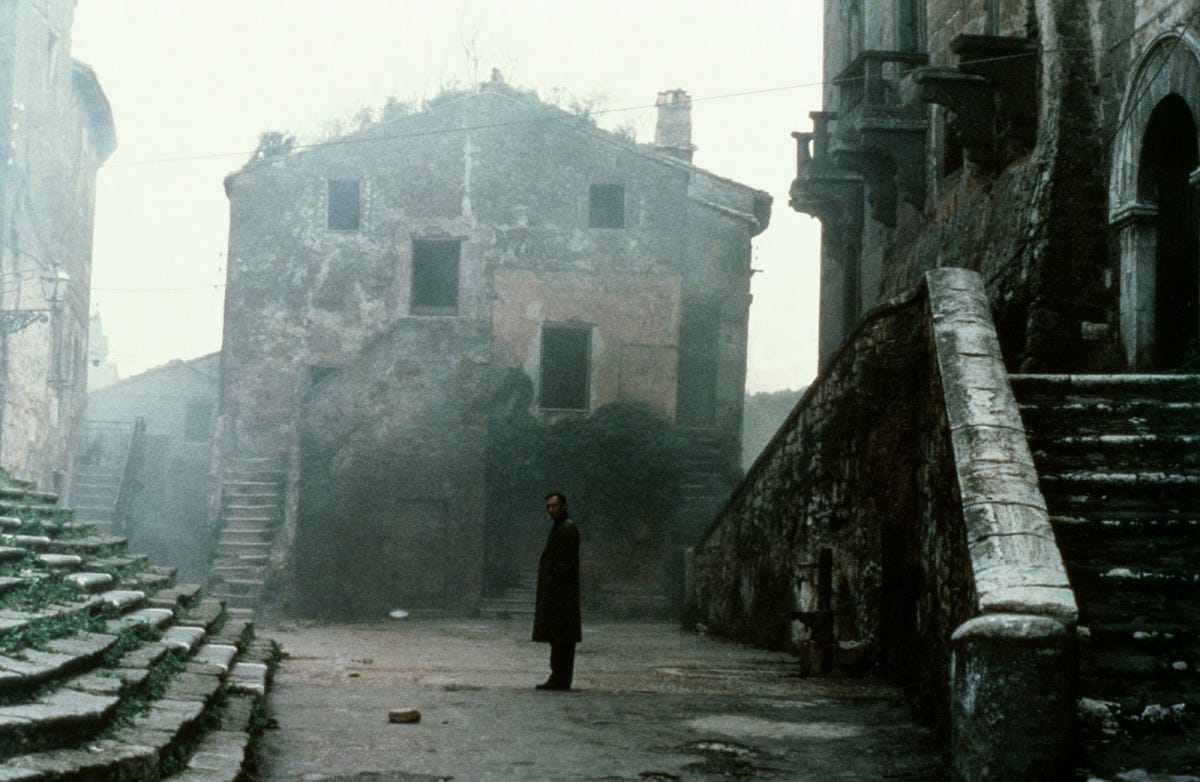
Tarkovsky’s use of time and space seems to traverse the inner psychology of his central character, a poet named Andrei (in case we might miss the assertion) played by Oleg Yankovsky. He is in Italy researching the eighteenth-century Russian composer Pavel Sosnovsky, who lived there and later died by suicide after returning to Russia. The film’s more elusive sequences might be dreams, unreliable memories of childhood, or possible visions of the afterlife.
Andrei is travelling with a female interpreter, Eugenia (Domiziana Giordano), and as they wander through the ethereal landscape, they encounter Domenico (Erland Josephson), who may be mad or may possess some kind of fundamental truth. Andrei seems to recognise something of himself in Domenico. In one sequence, he sees himself as Domenico and has visions in which his wife, Eugenia and Mary, the mother of Jesus, seem to blur into one another.
Above all else, the viewing experience felt like a reset: a reminder of the interpretive relationship between mise-en-scène and meaning, operating through a kind of associative realism. Tarkovsky’s images do not simply illustrate ideas; they create a space in which philosophical meaning emerges through duration, juxtaposition and atmosphere.
Coming out of the film, I wondered whether this kind of high-modernist, opaquely philosophical art cinema, work that may no longer have the economic or cultural conditions necessary to be made today, sits beyond the critical criteria of the model I wrote about in my last post. Perhaps Perkins’s approach is well suited to films organised around the expressive integration of narrative, performance, framing, gesture and mise-en-scène and the interpretation of a film as a coherent whole.
Tarkovsky’s cinema certainly rewards attention to framing, sound, movement and duration. And certainly the notion of meaning as attitude (as distinct from meaning as message), could focus on films that address themes such sympathy, judgement, irony or emotional orientation without stating a proposition. But the relation between detail and meaning is often less securely governed by narrative context, character psychology or proportional dramatic emphasis. Something I need more time to think through.
Unusually, August is looking incredibly busy for me, which I’m actually quite grateful for. Reflecting on two years of being, in the broadest sense, “freelance”, I’ve discovered that I function much better when I have a structured system of practice in place. For example, I find it very difficult to go straight from getting up to the desk that sits longingly in my flat.
There’s a barrier there that I first identified years ago.
I was an extremely lazy kid. At school, I was a C-grade student, putting in the bare minimum effort required to stay out of trouble and concentrate on sport. When I got to university, aged 25, sitting down to research and write essays did not come naturally. I employed every psychological trick available—the Pomodoro Technique, productive alternation, time-boxing etc—before they became common parlance in today’s productivity economy.
Over time, I managed to purge the laziness from my character. One system that worked, and has stuck with me, was changing location every 90 minutes: go for a walk, then find a new space. This is easier when you have access to a university campus, to be sure. However, café-hopping in North London is an expensive business, particularly if your productivity depends upon artisanal coffee.
So now, in the mornings, to force myself into the flow of work, I go to a coffee shop first thing for at least a couple of hours, then come back home and continue in the afternoon. Fifteen minutes north along Upper Street in Islington, there’s an air-conditioned Pret A Manger. I go there, buy a £1 filter coffee which I then nurse as long as possible.
Without wanting to seem like a shill for the chain, I like the unpretentious, bustling straightforwardness of the place. It offers a sense of “being in the world” that seems to give a writing day some impetus.
It’s a hack I’ve shared with my students, a whole raft of whom have just handed in drafts of their final 7,000-word portfolios.
Indeed, over the next month, I’m going to have to organise my days ruthlessly so that I can continue developing my Substack work while also making my way through these student texts. The structure of the rest of August will more or less take care of itself: mornings reserved for creative work, afternoons for reading and commenting.
I wonder if at some stage a post on writing hack might be worth attempting?
Alongside this, I’m fortunate enough to be heading up to Edinburgh on Friday for ten days. This means I’ll be able to take in some of the main festival, and I’ve also got press accreditation for the Edinburgh Film Festival, which starts on the 13th.
I’ve never been to the festival before. A bit of rudimentary research revealed that it was established by the seminal documentarian John Grierson in 1947 and was initially focused solely on documentary. Grierson coined the term “documentary”, defining it as “the creative treatment of actuality”. It’s one of those phrases stamped permanently onto my brain at university.
In the 1950s, the festival broadened its scope beyond documentary, aided by its expansion into additional venues across the city. In 1953, the Cameo and several other cinemas were incorporated into the festival, making it possible to screen 170 of the 210 films submitted. That same year, actor and director Orson Welles delivered a lecture at the Cameo; in 1954, John Huston served as Honorary President. By 1958, the Edinburgh Film Guild had moved into a new Film House at 3 Randolph Crescent, fitted with its own 100-seat cinema.
From the late 1960s and throughout the 1970s, particularly under the directorship of Lynda Myles, the festival would “assume an innovative, oppositional face, offering a platform for cultish directors and a window for some of the most exciting developments in international filmmaking.” Myles, who led the festival from 1973 to 1980, was the first woman appointed to direct a film festival anywhere in the world.
Apparently, it was Myles, together with the writer Michael Pye, who coined the term “movie brats”, defining a new generation of American filmmakers nurtured by watching and studying popular cinema rather than emerging through theatre or a traditional industry apprenticeship.
By the 2010s, however, the festival had entered a tumultuous period. The difficulties arguably began with its move to June in 2008, separating it from the energy and cultural density of Edinburgh’s wider August festival season. The decision came to be regarded as a mistake: audiences declined, the festival lost some of its sense of occasion, and it no longer seemed able to attract the star power it once had. The festival has since returned to August, a move intended to reconnect it with the city’s larger cultural ecology.
Then, in 2022, the Centre for the Moving Image (the organisation operating both the Filmhouse and the festival) went into administration. Filmhouse closed and the Edinburgh International Film Festival abruptly ceased trading. The organisation cited a combination of sharply rising energy costs, inflation, reduced trade following the pandemic and the wider cost-of-living crisis. At the time, audience numbers were reportedly 50 per cent below pre-pandemic levels.
The Scottish filmmaker and critic Mark Cousins, wrote in the Guardian at the time about the loss to film culture. For Cousins, Filmhouse and EIFF had not simply provided venues and screenings; they had created a home for cinephilia—international in outlook, intellectually adventurous and rooted in the cultural life of the city.
Covering the London Film Festival 2022 on The Cinematologists Podcast I spoke to director Tricia Tuttle about the situation in Edinburgh. The wider malaise of reduced cinema-going in the wake of the pandemic appeared to pose a serious threat not only to individual venues, but to festival culture more broadly.
The revival was pieced together rather than achieved through a single institutional rescue. Screen Scotland first purchased EIFF’s name, intellectual property and brand assets from the administrators, ensuring that the identity of the festival could be transferred to a future operator. In 2023, a compact, transitional edition was mounted under the auspices of the Edinburgh International Festival, keeping the flame alive while a more permanent structure was developed.
For 2024, producer Andrew Macdonald chaired the formation of a new organisation, with Paul Ridd appointed as festival director. Re-established as a new independent entity, EIFF returned to its August setting with a re-energised programme, world-premiere competitions and substantial audience-voted prizes named after Sean Connery and Thelma Schoonmaker. The emphasis was once again placed on discovery: emerging filmmakers, independent work, repertory cinema and films that might struggle to gain comparable attention elsewhere.
By 2025, the festival had begun to look less like a rescue operation and more like a viable new phase. Last year’s edition hosted 194 screenings, 18 world premieres and more than 16,500 attendees, while the Filmhouse itself reopened in June after a three-year campaign; although the cinema and festival now exist as institutionally separate organisations.
So, I’m fascinated to experience the vibe, if it has rediscovered something of its historic identity. Its renewed focus on first-time directors, mavericks and challenging independent cinema recalls the spirit of discovery associated with Myles’s era. As I’ve talked about with several guests on Cinema Body/Cinema Mind, the celebrity/red-carpet obsession, both the political and programming timidity, and the real impact on wider film culture, are issues all major festivals are navigating.
Schedule and content for the upcoming sessions of Becoming a Better Film Critic
Because of the workload I’ve outlined above, it’s is going to be too difficult for me to record the live sessions every week from the remainder of my Becoming a Better Film Critic Course. Because of this and because I actually want to add a couple of sessions, I’ve decided to extend the session over the coming months and into the beginninng of September
I’m quite a way away from Substack being a full time occupation and because of the teaching commitments I don’t have time for the level of research and preparation required to deliver the detail and depth that are in my 2-hour long sessions.
So, here is a rundown of the provisional dates and titles for the rest of the course:
Can Politics Make Us Bad Critics? How Ideology has supplanted Aesthetics in Film Analysis - Thursday 20th of August - 4:30pm (BST); 8:30am (PDT); 11:30am (EDT) - LIVESTREAM LINK
Where Am I in the Film? Subjectivity, Memory and Writing the Self through Cinema - 2nd September - 4:30pm (BST); 8:30am (PDT); 11:30am (EDT).
Critical Discourse in the Digital Era: Crisis or Revolution - DAY TBC 4:30pm (BST); 8:30am (PDT); 11:30am (EDT).
Film Criticism Roundtable - Time and Day TBC
In between these session I am going to continue to record live interviews for the Cinema Body/Cinema Mind podcast. I have it in mind the Wednesday afternoon/evening will become a regular time where I will livestream cinema conversations.
I also have a piece coming out next Monday/Tuesday, which addresses a particularly strand of the Christopher Nolan discourse. It’s not another Odyssey review, I take very much a Cinema Body/Cinema Mind approach unpacking Nolan’s paradoxical assertions regarding technology.
If you have been thinking about joining the course but have perhaps thought that you have missed the beginning, all the sessions are recorded and available to below to paid subscribers.
Here are some testimonials from those who have followed the first three sessions.
Lloyd Dean: Just to say that I really enjoyed this first episode. I'm still playing catch up with the others but enjoy that your content is percolating in my mind….This course (and supplementary materials) seem like astonishing value for money as well. I've realised I don't need to rush through the materials, I can take my time to read the additional resources, reflect and then move forward. My metacognitive boxes are being ticked.
Ian - into the red: Just to say the first lecture was excellent. It was incredibly comprehensive, I wasn’t expecting a history of taste and aesthetic judgement from Hume up to now, but that is what you delivered - must have been a lot of work! Well worth it, though, and a good overview of the subject to dive into in subsequent classes. Also, a lot of interesting thinkers and books some of which I will follow up - thanks for the resources and slides also. I don’t know if people realise, but a course like this at an Adult Education college or the BFI would cost multiples of your subscription, so amazing value for money here.
C. C. Simmons: Loving this a lot, Dario; thanks for all the work you've put into this!
Tom Violett: Subscribe to this bloke. You'll be glad you did!
If you’re new here, Cinema Body / Cinema Mind is where I write, teach and podcast about cinema, media and art through a mixture of close analysis, film theory, cultural criticism and personal reflection. The aim is to bring the depth of academic film study into a more open, accessible and conversational space.
I’d be very grateful if you considered becoming a subscriber. It helps sustain the time, research and care that goes into the essays, podcasts, resources and live sessions I produce.
You can also support the work in smaller but genuinely meaningful ways: by liking, restacking, commenting, or sharing posts with people who might be interested. In the digital attention economy, human recommendation still matters. Perhaps more than ever.
A paid subscription is £5 per month, or £50 for the year. It gives you access to the full archive of subscriber-only articles, podcasts, teaching resources and recordings, including all sessions and materials from my online course Becoming a Better Film Critic.
Or, if you appreciate my work you can also Buy me a Coffee.

I want to thank and welcome new subscribers to my paid tier: Michael Hallimond, Bigshell, Nettle, David Minnihan and Filmscalpel. It bears saying again that I am so appreciative of those who have deemed what I do worthy of economic support. It undoubtedly allows me to continue to build the site.
So, below, for paid subscribers, the resource list with links for session 4 on ideological criticism that will run next Wednesday.
Comments
Nothing yet. Say the first thing.
Sign in to join the conversation.