
Welcome Friends.
In my third session of Becoming a Better Film Critic, I drew heavily on V.F. Perkins’s essay “Must We Say What They Mean?”, written in 1990 (download in the resources section below).
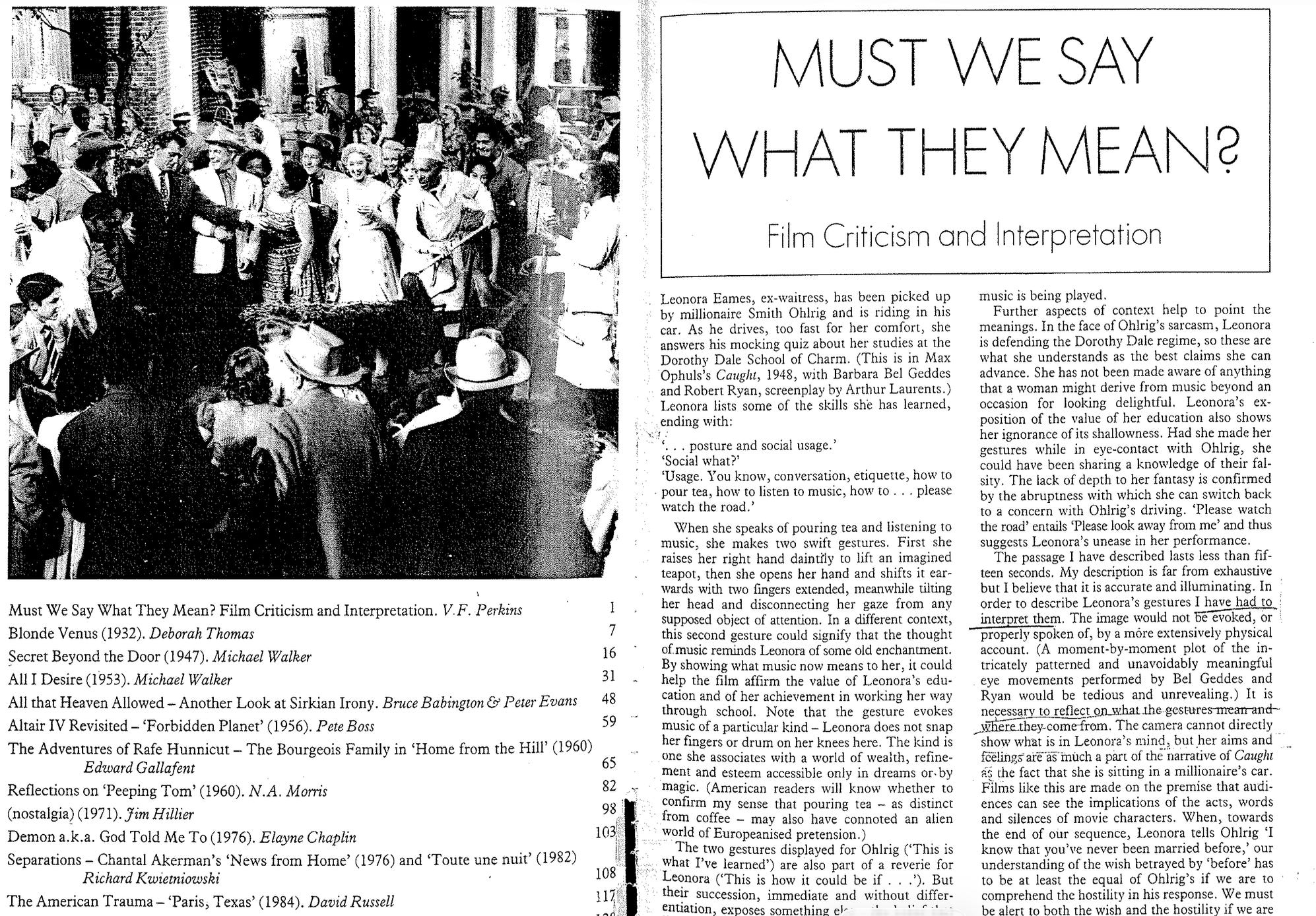
Returning to it for the session, I’m convinced that this is a piece every film critic should read. Much of the article is a rejoinder to David Bordwell’s work on interpretation, which I covered in Session 2. Perkins sees the model set out in Making Meaning as an impoverished account of interpretation, particularly in its suggestion that the critic’s job is to uncover a meaning the film is somehow hiding.
For Perkins, meaning exists in the organisation of the images themselves: in gesture, duration, framing, performance, sound, context, and the relationship between one moment and another. Film criticism is therefore not primarily the recovery of a detachable idea. It is the effort to describe how meaning exists as cinematic experience.
I used Perkins’s essay because it struck me as a fantastically useful reset, particularly in an era of largely generic, faux-critical assertion. Yes, there is great writing on film out there. But erudite and insightful voices are often lost in a tsunami of cultural abundance that seems to sprint, with terrifying speed, towards politically inflected judgement, often based on an implied standard of representational ethics.
There is an urgency to declare “what the film is saying” by fitting it into the terms of a prevailing discourse.
I don’t want to dismiss any of that. Films are, of course, intrinsically shaped by, and themselves shape, the cultural milieu, often speaking directly to the social conditions and concerns of their production and reception. They may also repurpose classic stories and myths to re-engage with age-old questions about the human condition. In that sense, critics must absolutely engage with cinema’s ideological mechanics, exploring how individual films refract our ideas, ideals, and identities.
Moving Away from Extractive Criticism
What underpins Perkins’s argument, and what I want to focus on here, is the depth and precision of his textual analysis. It is a lesson in critical attention: attention to how mise-en-scène shapes the ways in which a film “makes itself available” to be read.
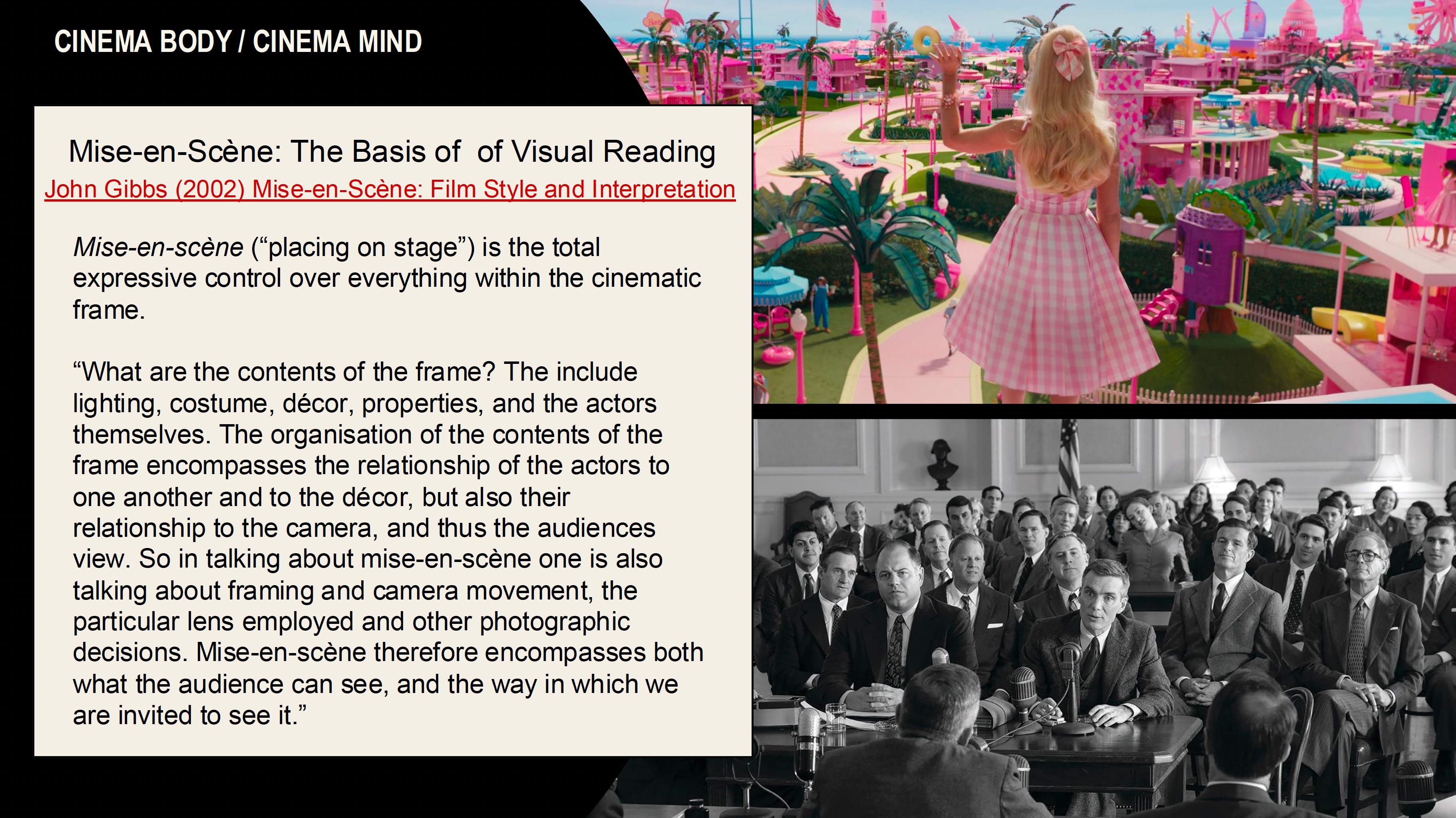
I’ve used that phrase, “makes itself available”, quite frequently in the last two live sessions. To me, it suggests that interpretation is not simply something we mine, as though criticism were a form of extraction: drilling down through layers of sound and image to locate buried nuggets of meaning beneath. For Perkins, meaning emerges from the active relationship between observable filmic detail and the formal orchestration that guides our perception.
To say a film "makes itself available," however, is not to write a blank cheque for the critic's own assumptions. A skeptic might reasonably ask: how do we know when a critic is genuinely observing a film's available meaning versus projecting their own agenda? The boundary lies in the principle of totality. A robust interpretation must account for the whole of the film's formal choices rather than cherry-picking isolated details. It requires an allegiance to the complete cinematic ecosystem.
Perkins reminded me that the critic’s first responsibility is to the particularity of the film itself: to what is actually there, and to how it has been composed, timed, framed, and performed. Central to this is an idea I’m still ruminating on: description is always already interpretation.
I must admit that, in my work with students, I have often found it useful to propose a separation between description and interpretation, treating them as distinct stages to help beginners hone their observational skills before leaping to conclusions.
Yet one of Perkins’s most consequential claims in the piece is that there can be no interpretation-free description of a film. Description requires selection. The critic decides what to mention, which words to use, which relationships matter, and how much significance to assign to a gesture. To describe a camera angle as "looming" rather than "high," or to note an actor's "hesitation" instead of their "pause," is already an act of interpretation. Even apparently neutral description involves judgement. Even apparently neutral description involves judgement.
But this does not mean that all descriptions are equally legitimate. A critical account remains answerable to the film. It must be tested against the timing of a gesture, the actor’s performance, the framing, the surrounding dialogue, the character’s situation, and the film’s larger patterns.
One might describe Perkins’s approach as a form-first model of criticism. In this piece, I draw upon his article Must We Say What They Mean? to think through the parameters of a criticism grounded in close attention: one that begins with what the film makes perceptible through performance, framing, gesture, sound and duration before moving towards broader interpretive claims. This does not mean retreating from questions of ideology, culture or judgement. It means ensuring that such claims remain accountable to the particular form of the film itself.
A Case Study in Attention: Max Ophüls’s Caught
Throughout the article, Perkins turns to several films, including The Wizard of Oz, Psycho, and The Grapes of Wrath. But it is Max Ophüls’s “melo-noir” Caught, however, that receives his most sustained attention. Perkins uses Caught to demonstrate the attentive, evaluative viewing required to truly grasp a film's specific cinematic form.1
Ophüls 1949 picture is bitter little fairytale of upward mobility curdling into entrapment. Barbara Bel Geddes plays Leonora Eames, introduced as Maud, a working-class woman whose dreams of glamour have been shaped by magazines. She attends a Los Angeles charm school and takes on modelling work, projecting a paradoxical mixture of innocence and calculation.
She marries Smith Ohlrig, a millionaire played by Robert Ryan with pathological froideur. His psychological derangement is established in scenes with his psychologist, and Leonora quickly becomes the object of his obsessive, violent control and jealousy. She escapes and finds work as a doctor’s receptionist, where she meets James Mason’s decent, overworked paediatrician, Larry Quinada, who represents an alternative understanding of what life might be.
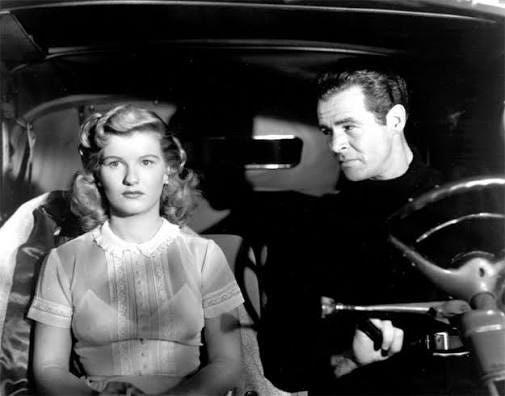
Caught as much as a romantic reality play as a critique of the fantasy structures of material success. In this sense, it’s interesting to read such a film against the hyper-aspirational desire that shapes so much of contemporary culture. Class distinctions, female self-invention, emotional abuse, coercive wealth, the fantasy of romantic rescue, and a fascinatingly complex, problematic (some might say) depiction of aspiration and the American Dream.
The film reflects Ophüls’s stylistic signatures: flowing camera movement, dynamic framing, beautifully rendered compositions and an extraordinary sensitivity in defining the emotional pressures through cinematic space.
If you haven’t seen it, it’s available in full on YouTube.
In Session 3 of Becoming a Better Film Critic, I discussed the “fly-swatting scene” and the way Perkins unpacks this seemingly minor gesture, performed by Barbara Bel Geddes in the film’s opening sequence. Preceding this, however, is a forensic articulation of a later scene, one that is equally instructive in helping us understand his method.
The Anatomy of a Gesture
Leonora sits in Smith Ohlrig’s car and answers his mocking questions about what she has learned at the wonderfully named “Dorothy Dale School of Charm”. She talks about posture, social usage, conversation, etiquette, pouring tea, and listening to music. As she does so, she performs a series of small gestures. These are forensically addressed by Perkins:
“When she speaks of pouring tea and listening to music, she makes two swift gestures. First she raises her right hand daintly to lift an imagined teapot, then she opens her hand and shifts it earwards with two fingers extended, meanwhile tilting her head and disconnecting her gaze from any supposed object of attention. In a different context, this second gesture could signify that the thought of music reminds Leonora of some old enchantment. By showing what music now means to her, it could help the film affirm the value of Leonora’s education and of her achievement in working her way through school. Note that the gesture evokes music of a particular kind - Leonora does not snap her fingers or drum on her knees here. The kind is one she associates with a world of wealth, refinement and esteem accessible only in dreams or-by magic. (American readers will know whether to confirm my sense that pouring tea - as distinct from coffee - may also have connoted an alien world of Europeanised pretension.)”
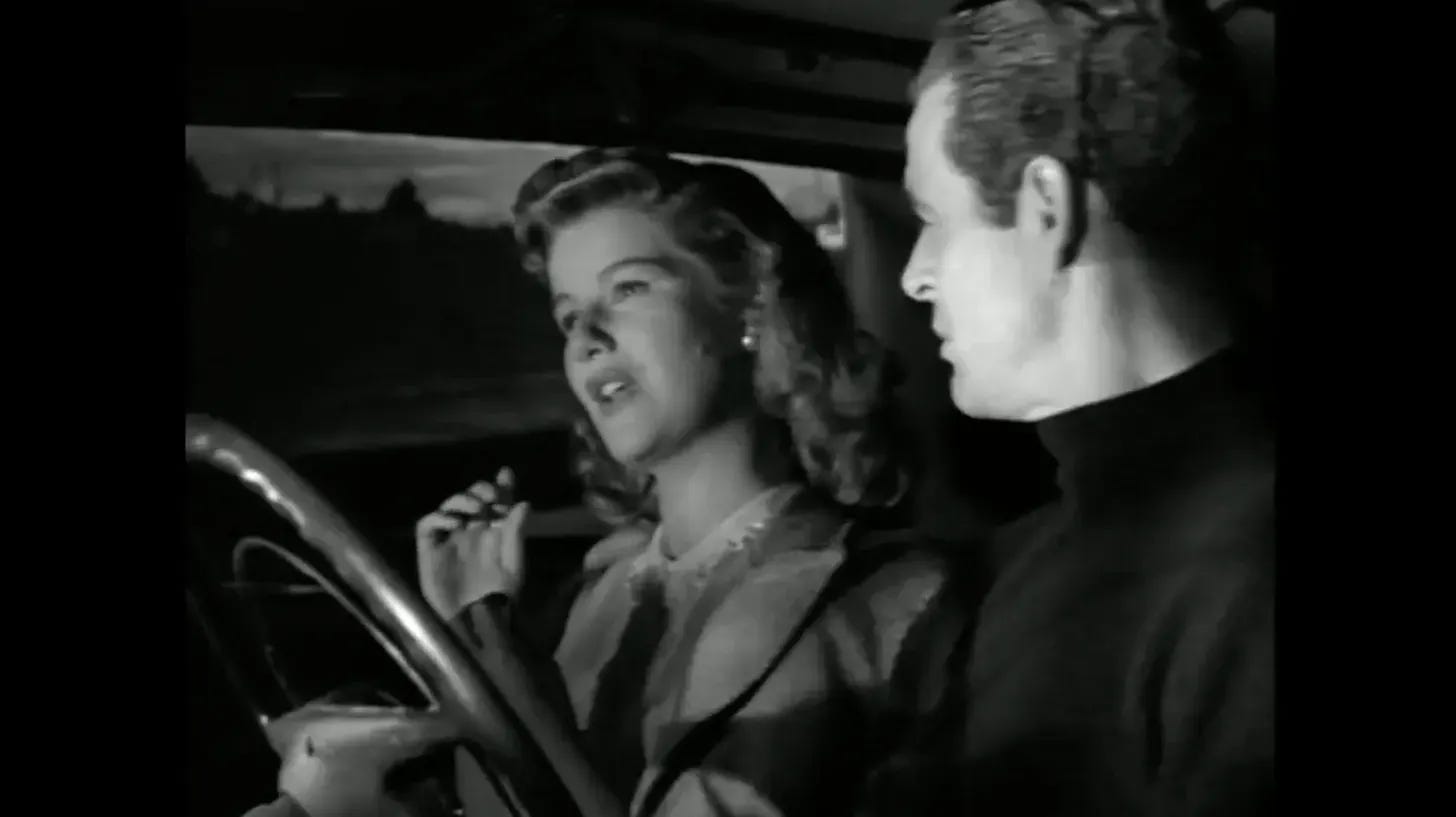
These interrelated gestures, and Perkins’s deep articulation of how they create meaning, tell us something crucial about the social relations and patterns of value that form both the narrative and thematic core of the film. It is as detailed a passage of film criticism as you are likely to encounter. Within the context of the article, however, this is not merely the prelude to a reading of the film in a narrow sense. Perkins leads the reader towards a broader claim:
“Films like this are made on the premise that audiences can see the implications of the acts, words and silences of movie characters.”
Perkins never fully explains what he means by “films like this”. Perhaps the phrase offers a subtle signal of affirmative judgement towards Ophüls’s work: an indication of value. It is as though Caught interpellates (calls upon) an implied audience whose cinematic literacy can be trusted to engage with the subtleties of what is being made available.
What is key here is Perkins’s demand for attentiveness to form. But this does not mean merely attending to the surface-level question of what we see, nor does it involve a set of generalised banalities alluding to the film’s “cinematic quality”. It certainly does not amount to that lazy form of faint-praise damnation: “beautifully shot”.
The brilliance of Perkins’ reading is in the attention to detail. Yet, he does not inflate the detail beyond what the film will bear. He knows that not every object is equally important. He is attentive to proportion and to the various elements of “what the film offers”, without reducing this to an appeal to objectivity over subjectivity. Nor does he fall back on a crude form of symbolism.
For Perkins, Leonora’s gestures reveal how she has absorbed refinement as performance. Listening to music is not yet an aesthetic experience; it is a posture, a social attitude, something one learns in order to appear cultivated. Key to this is that Ophüls does not isolate the gesture in close-up. It remains within a medium shot, with Ohlrig still present, still controlling the emotional temperature of the scene. The gesture is there to be noticed, but not to dominate. It is one element within the film’s complex orchestration of class fantasy, social humiliation, and self-invention.
Here, Perkins shows how Ophüls marshals interlocking cinematic elements to manifest social dreaming, bodily performance, and material limitation directly through form. He is interested in how the film grades the detail: how much emphasis the camera gives it; how it sits within the shot; how performance activates it without overplaying it; and how the surrounding décor, soundscape, and dramatic context determine its force.
He goes on:
“No neat distinction can be drawn between the meanings that Leonora offers to Smith Ohlrig, that Barbara Bel Geddes offers to the camera and that the film offers to its audience. An appreciation of this sequence should encompass all three. The aptness of the writer's invention in having Leonora include 'how to listen to music' in her catalogue of social usage; the skill of Bel Geddes in enacting, via a tiny beat after each 'how to', the split second of recall that betrays Leonora's gestures as unspontaneous and insecurely learned; the precisely graded camera position that gives prominence to the listening gesture while allowing us to see enough of the tea-pouring (partially obscured by the steering wheel in the foreground) to supply the informing context: these are all achievements in the construction of meaning.”
The Layered Transaction of Meaning
What Perkins defines here is a model of film meaning as a layered transaction between character, actor, camera, and spectator. Leonora believes she is presenting herself to Ohlrig as socially accomplished; Bel Geddes communicates the insecurity and effort concealed within that performance; Ophüls’s framing determines what the audience can see and how much weight the gesture should carry. At the same time, the gesture reveals something larger about class aspiration, social education, and Leonora’s uncertain self-invention. The film regards her with humour, sympathy, and critical distance all at once.
Leonora is performing refinement for Ohlrig; Bel Geddes is performing Leonora’s insecure performance for the camera; and Ophüls organises these layers through writing, gesture, framing, timing, and scale. Meaning does not belong to any one of these elements in isolation. Perkins’s final phrase, “the construction of meaning”, describes their precise coordination: not the delivery of a message, but the organisation of relationships through which an attitude towards Leonora and her world becomes perceptible.
The critic’s task, then, is to describe how the film allocates significance: what it foregrounds, what it embeds within the shot, and what it allows to hover at the edge of attention. Perkins is not arguing that critics should abandon questions of meaning, nor that films should be protected from interpretation as though interpretation were an external violence done to them. He is pushing back against a model in which meaning is treated either as hidden content to be extracted or as a paraphrasable proposition that the critic simply translates from image into language.
For Perkins, the meanings that matter in cinema are often neither concealed nor explicitly stated. They are produced through the film’s expressive organisation. This is why he repeatedly returns to questions of proportion, placement, and emphasis. A gesture may be noticeable without becoming central; an object may carry implication without hardening into a symbol; a close-up may increase the weight of a reaction, while a medium shot may allow several competing meanings to coexist.
Interpretation, therefore, requires us to trace how a film distributes significance across its entire canvas: through dialogue, performance, framing, movement, décor, sound, editing, and the spectator’s own active noticing. Perkins’s criticism is exacting because it remains answerable to those relations. It does not impose meaning upon the film from outside, but tries to articulate what the film has already made available through the particular form of its construction.
If you’re new here, Cinema Body / Cinema Mind is where I write and speak about cinema, media and art through a mixture of theoretical analysis, cultural criticism and personal reflection. The aim is to bring the depth of academic film study into a more open, accessible and conversational space.
If you’ve enjoyed this piece, or if the work here feels useful to the way you think about cinema, I’d be very grateful if you considered becoming a subscriber. It helps sustain the time, research and care that goes into the essays, podcasts, resources and live sessions I produce.
You can also support the work in genuinely meaningful ways: by liking, restacking, commenting, or sharing posts with people who might be interested. In the digital attention economy, human recommendation still matters. Perhaps more than ever.
A paid subscription is £5 per month, or £50 for the year. It gives you access to the full archive of subscriber-only articles, podcasts, teaching resources and recordings, including all sessions and materials from my online course Becoming a Better Film Critic.
For anyone who is thinking of signing up I have completed 3 sessions and there are another 5 to come.
Or, if you appreciate my work you can also Buy me a Coffee.

It is one thing to appreciate this exacting attention to detail in a classic of the Golden Age, but applying it to the modern landscape of cinema reveals just how urgently we still need Perkins's method. Below, for paid subscribers, I put this into practice by breaking down a scene from The Invite directed by Olivia Wilde, showing exactly how modern mise-en-scène continues to orchestrate our perception.
The Invite: A Cinematic Architecture of Manners
It’s strange how, when you see two films in close succession, aspects of them begin to connect, even though, on the surface, you could hardly imagine two more different filmmakers—or two more different cultural and historical contexts.
The evening after I watched Caught, I went to Picturehouse Central in Soho to see Olivia Wilde’s new comedy, The Invite. Shot on film, it has a gauziness in which one can luxuriate. I found it an incredibly funny, astute, grown-up comedy of manners, set in a single location and featuring a cast who seem to have been afforded the space and freedom to develop real psychological depth within a brilliantly orchestrated rhythmic interplay.
Comments
Nothing yet. Say the first thing.
Sign in to join the conversation.