
Welcome, friends.
This is not another Odyssey review. Promise.
There are many more writers and critics thoroughly invested in the film’s relation to Homer, where it fits within Christopher Nolan’s oeuvre, the tensions involved in adapting such an expansive literary text into a single film (even one as short as 3 three hours), and the many cultural sensitivities the first production has alighted.
I think it’s fair to say that The Odyssey’s release has been a juggernaut of discourse production. And now, I admit, I’m going to “piggyback” onto it, hopefully to interesting ends.
The one particular strand that piqued my interest relates directly to cinema-going today and, by implication, to how we conceive of cinema as an experience. It also brings together questions of economics and marketing of the film industry, social politics and cultural capital, all of which shape the increasingly fraught question of how films should, “ideally” be watched.
It has also provoked a fascinating range of reactions online, both serious and satirical. These are further evidence of one of the enduring paradoxes of contemporary film culture: criticism can be endlessly diverse, innovative and insightful, while also being petty, tribal and remarkably adept at turning personal preference into doctrine.
What I am referring to, of course, is the debate surrounding the myriad formats in which The Odyssey is currently screening: IMAX 70mm, digital IMAX, standard 70mm, and standard digital projection. It leaves the contemporary cinema-goer to navigate a dizzying permutation of aspect ratios, screen dimensions, and projection systems, and implications of one’s choices not only for the experience of the film itself, but indeed where sad “choice” places you on the unofficial ziggurat of cinephile (self) importance.
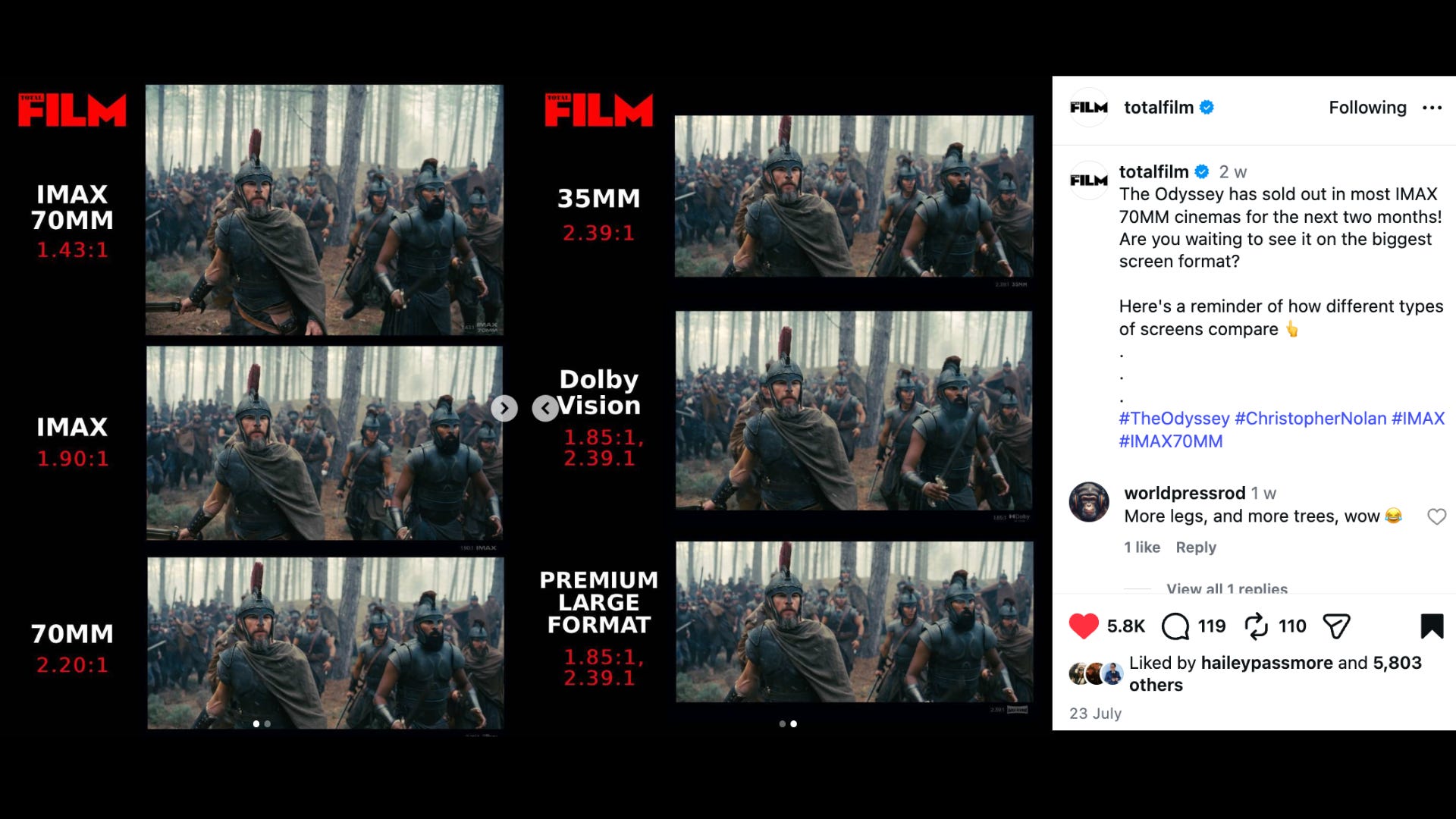
This piece was prompted by the seamless translation of Christopher Nolan’s personal filmmaking philosophy into a corporate marketing narrative. The positioning of IMAX 70mm as the undeniable “gold standard” for viewing The Odyssey emerges directly from his public commitment to specific technologies and what could be bordering on a dogmatic view of what constitutes a genuine cinematic experience.
What I want to explore here is the increasingly cultish technological fetishism surrounding Nolan. The issue isn't simply that he embraces some tools while rejecting others, but that he constructs a rigid moral and aesthetic hierarchy between them. He aligns specific technologies with craft, materiality, and authenticity, while dismissing others as corrosive and antithetical to genuine creativity. Generative AI is the most glaring recent target, but his well-documented refusal to use smartphones or email feeds into this same carefully curated self-image.
The result is a vision of filmmaking and spectatorship built around an idealised relationship with technology—one that concretises Nolan himself in an almost singular category.
The way one sees The Odyssey has become weaponised within a much older battleground over cinematic authenticity: the recurring attempt to define cinema according to the technological conditions supposedly required for its fullest or most legitimate experience. IMAX is only the latest intervention in a historical lineage of such battles.
I then want to consider how critics, commentators and fans have helped buttress this discourse, creating a form of cultural capital around the perceived hierarchy of how one “chooses” to experience the film. The phrase “As Nolan Intended” has become the rhetorical symbol of this tendency.
From there, I’ll turn to the backlash against such claims: arguments about scarcity, cultural access and the wider economics of exhibition, including the possibility that the aggressive premiumisation of cinema around a production such as The Odyssey may strengthen one particular form of cinema-going in the short term while potentially weakening others in the longer term.
What makes this backlash so fascinating is how it weaponises the cult of technological fetishism, and its associated cinephile cultural capital, through satirical deconstruction. Across memes, videos, and articles, “As Nolan Intended” has been relentlessly reversed, exaggerated, and ironically reimagined.
Finally, though, I must turn the critique inward. Technological fetishism is notoriously easy to spot in others, yet much harder to recognise in ourselves. We must acknowledge the extent to which we are all deeply implicated in a modern culture of selecting, ranking, and optimising our viewing habits—and how those choices ultimately construct our own, deeply personal sense of what cinema ought to be.
If you’re new here, Cinema Body / Cinema Mind is where I write, teach and podcast about cinema, media and art through a mixture of close analysis, film theory, cultural criticism and personal reflection. The aim is to bring the depth of academic film study into a more open, accessible and conversational space.
I’d be very grateful if you considered becoming a subscriber. It helps sustain the time, research and care that goes into the essays, podcasts, resources and live sessions I produce.
You can also support the work in smaller but genuinely meaningful ways: by liking, restacking, commenting, or sharing posts with people who might be interested. In the digital attention economy, human recommendation still matters. Perhaps more than ever.
A paid subscription is £5 per month, or £50 for the year. It gives you access to the full archive of subscriber-only articles, podcasts, teaching resources and recordings, including all sessions and materials from my online course Becoming a Better Film Critic.
Or, if you appreciate my work you can also Buy me a Coffee.

For paid subscribers below: I explore Nolan’s philosophy of technology, the definition of technological fetishism, the discourse of IMAX as a case study, and the many stands of the discourse that have emerged on online around idealised viewing experiences:
Christopher Nolan might be considered the original doyen of IMAX absolutism. Over successive projects, as he has been afforded ever greater scope, budget and industrial clout, he has shot increasing proportions of his films using IMAX cameras, culminating in The Odyssey, the first dramatic feature to be shot entirely in the format. This required not merely access to an existing technology but the capacity to have the technology effectively modified around the requirements of his filmmaking: after Oppenheimer, IMAX engineers developed a sound-blimp system that made its notoriously noisy cameras viable for dialogue scenes. The resulting apparatus could weigh around 300 pounds and required film magazines to be changed every few minutes.
The pushing of technological possibility has been central particularly to Hollywood’s evolution, one can potentially read Nolan’s utterances on filmmaking and film watching as something of a personal philosophy of technology.
Nolan values technologies not for their novelty, nor for experimental possibility for its own sake. It’s their capacity to intensify attention, materiality, and authorial intent that he has articulated as the driver. This nuance makes it reductive to label him a simple Luddite; rather, he treats tools that disperse focus or render processes frictionless with deep suspicion. Thus, photochemical film, IMAX, and digital editing fit comfortably within his worldview, while smartphones, email, and generative AI decidedly do not.
Consequently, his advocacy for IMAX goes far beyond mere aesthetic preference. Since at least 2012, he has championed it as the “gold standard,” arguing that filmmakers operating at an industrial scale have a responsibility to use the highest-quality technology available. Crucially, however, he conceded that maintaining this choice requires filmmakers to possess the “resources and power” to demand it.
That little qualification seems rather important.
His insistence that IMAX being the preferred way to see his films has only intensified. In relation to Oppenheimer, Nolan described the massive, luminous image as a space into which the spectator could lose themselves in, explicitly aligning this choice with a sense of duty:
In interviews for The Odyssey, the rhetoric becomes almost metaphysical. Nolan describes 70mm IMAX as so enveloping that, “you’re really letting the screen disappear. You’re getting a feeling of 3D without the glasses. You’ve got a huge screen and you’re filling the peripheral vision of the audience. You’re immersing them in the world of the film.”
It’s not just IMAX however.
In his Sight and Sound interview with Christopher Frayling, Nolan draws on Tacita Dean’s idea of the “resistance of the medium”: that creative possibilities arise partly because materials resist us. Clay pushes back against the sculptor; photochemical film imposes particular constraints upon the filmmaker. Nolan therefore insists that film should properly be understood not as an old technology awaiting replacement but as a medium. Technologies become obsolete; media remain available for artistic exploration. Digital and photochemical cinema can therefore coexist.
Nolan’s campaigning for the continued availability of celluloid has helped resist precisely the kind of technological determinism that assumes every new technology must inevitably erase the previous one. There is something progressive about insisting that filmmakers should retain a plurality of aesthetic tools rather than accepting whatever workflow happens to be most profitable for technology companies or studios.
The contradiction arises because the principle of plurality sits rather awkwardly alongside the rhetoric of supremacy.
The problem isn’t that Nolan shoots IMAX 65mm (The shooting is 65, the exhibition is 70mm). The problem emerges when one extraordinarily expensive and infrastructurally demanding aesthetic begins to stand rhetorically for cinema at its most fully realised.
That matters because Nolan occupies an almost unimaginably privileged position from which to formulate this philosophy. The Odyssey did not merely use an expensive camera: IMAX effectively engineered new technological solutions so that Nolan could realise his preferred method of production. Its most exacting exhibition format requires an extraordinarily scarce network of 70mm IMAX venues (41 worldwide). Even Nolan himself has repeatedly acknowledged that preserving such choices depends upon possessing the industrial power to demand them.
So what happens when this exceptional position is allowed to masquerade as a general philosophy of filmmaking?
Because cinema has also been transformed, aesthetically and politically, by technologies that have made filmmaking cheaper, lighter, messier and more accessible. The capacity to pick up a small digital camera, a phone, a cheap recorder or a laptop and make something without first acquiring the blessing of a studio is surely part of any genuinely diverse and experimental conception of cinema. Technological limitations can be aesthetically productive, certainly. But those limitations don’t have to involve a 300-pound IMAX camera and millions of dollars of industrial infrastructure.
There is therefore something somewhat paradoxical about a defence of medium diversity that can nevertheless end up establishing technological extravagance as the pinnacle of cinematic seriousness.
This hierarchical worldview is nowhere more apparent than in Nolan’s strident rejection of generative AI—or, more accurately, the cultural and economic programme being built around it. During the press tour for The Odyssey, he made this position abundantly clear to AFP in Paris:
“The interesting thing with AI is I’ve never seen a technology that’s been so successfully adopted by Wall Street and by investors and by tech companies that the public has so thoroughly rejected.”
And in this interview below, with a particularly star-struck interviewer Hugo Travers, Nolan deploys an interesting metaphor for the film he was promoting: “I think AI is a Trojan horse that everybody knows the Greeks are inside.” It is, as he went on to joke, a transparent Trojan horse—one where we can all see exactly what is happening.:
He pushes the metaphor further, describing it as a 'transparent' or glass Trojan horse. The joke lands because it perfectly captures the audacity of the current AI enterprise. A Trojan horse is supposed to conceal its danger within a gift, but here, the danger is in plain sight. The true deception of generative AI isn't that it is hiding its mechanisms of exploitation; the deception lies in convincing us that this glass horse is an inevitable gift of progress that we have no choice but to accept.
Yet Nolan’s objection goes deeper than straightforward technological conservatism. As he argued during the Oppenheimer press cycle, his primary concern is the abdication of responsibility: by attributing agency to artificial intelligence, corporations and institutions can build a system and then conveniently claim that the machine decided.
In rather grandiose terms, he warns against assigning “godlike characteristics” to technologies and treating them as false idols. Ultimately, what Nolan distrusts is that crucial tipping point: the moment a technology ceases to be an instrument and is instead elevated as an autonomous substitute for human perception, judgment, and creativity.
This raises a more pointed question: who actually possesses the luxury to maintain such rigid boundaries between the technologies they embrace and those they refuse?
Indeed, one might suggest has the propensity for certain level self-mythologising around the use of technology: his well-documented refusal to use email, own a smartphone, or maintain a social media presence.
In a 2026 60 Minutes interview Nolan confirmed that he still doesn’t use email. He gets printed emails. In this snippet is someone derisively suggests he has “no interest”, but also admitting its harder not to have a smart phone.
Rather comically goes on to say he gets a lot of printed emails. So, in effect he does use email; he just creates a kind of phenomenological barrier between himself and direct use of the technology. The labour hasn’t vanished; it has been redistributed to someone else.
Interesting that the conversation goes onto envy. What’s unsaid is the level of privilaage that comes with “living like we all used to”.
Yet, as he told Terry Gross on NPR’s Fresh Air this is framed largely as a defence of attention, Nolan argues that smartphones clutter the interstitial moments where ideas incubate. Abstaining from them grants him the freedom to think, observe, and daydream, a detachment he likens to a kind of superpower.
While this romanticism is undeniably attractive it completely elides the socio-economic reality required to sustain it.
Matt Damon recently provided an even more revealing glimpse of how this works. If Christopher Nolan wants to call you, Damon explained, Emma Thomas will generally text first to warn you that the call is coming. Nolan then rings from some anonymous Universal Studios landline.
This pitched as funny and charming when incorporated into the mythology of the eccentric auteur. But viewed from another perspective, its an example of structural power with regards to how the director engages with people and technology
This acerbic, insightful and succinct critique came from a recent Substack Note I saw from Alexandra
This point is so spectacularly and precisely on the money that it kinda needs no further explanation. But just to give it some context, it echoes a much longer cultural history in which the apparently mundane organisational labour that sustains male creative autonomy is rendered invisible because it is not coded as properly creative labour.
Of course, reducing Emma Thomas to the woman who manages Christopher Nolan’s communications would itself be absurdly reductive. She is his producing partner, an extraordinarily powerful producer in her own right, and absolutely central to the industrial existence of these films. But that actually makes the example more revealing rather than less.
And alongside all this one has to consider the extraordinary privilege required to operate at Nolan’s level in contemporary culture without email, a smartphone or social media. For most aspiring filmmakers, artists, writers and creators, the technological environment is not an optional layer of distraction from the real creative work; it is the infrastructure through which the possibility of doing that work is negotiated in the first place. This is why I find Nolan’s philosophy of technology simultaneously compelling and deeply limited.
At its best, it refuses the banal equation of technological development with progress. It asks what particular tools do to perception, attention and artistic practice; it values material resistance; and it resists the idea that obsolescence should simply be accepted because an industry has declared it inevitable. His insistence that human beings remain responsible for technologies, rather than mystifying them as autonomous forces, feels increasingly important.
But Nolan articulates this philosophy from a position of such extraordinary industrial privilege that the word choice begins to acquire a rather different meaning. He can choose film because studios will finance film; he can insist upon IMAX because IMAX will redesign machinery around his requirements; he can refuse email and smartphones because an elaborate professional infrastructure ensures that communication, logistics and administration continue regardless. None of this makes those preferences illegitimate, but it does mean that his model of technological autonomy is not easily transferable. For most creative workers, technology does not present itself as an elegant menu from which one selects only those tools conducive to concentration, authenticity and artistic integrity. It arrives as submission portals, editing software, messaging platforms, invoices, crowdfunding pages and the ceaseless administrative machinery through which one remains employable. Nolan’s unusual freedom is therefore not really freedom from technological systems so much as the power to have their inconveniences absorbed elsewhere.
Perhaps the more interesting contradiction, then, is that Nolan presents his position as a defence of artistic autonomy while occupying a degree of autonomy available to almost nobody else. That does not invalidate his arguments, but it should make us wary of allowing the working practices of one of the world’s most powerful filmmakers to harden into a morality of cinema. A philosophy designed to preserve artistic choice can quickly become an aesthetic hierarchy in which those without the resources to make equivalent choices appear to be practising some technologically diminished form of the art. That seems particularly problematic if the cinema we are supposedly defending is also meant to remain diverse, experimental and genuinely open to whatever strange new forms filmmakers might make with the tools actually available to them.
There is, however, an important qualification here. Nolan’s philosophy of cinema cannot simply be reduced to technological purism. Writing in The Washington Post at the beginning of the Covid shutdowns in March 2020, he offered a strikingly social conception of what cinemas are, drawing attention not to projectors, film gauges or image resolution but to the workers who sustain them, and describing movie theatres as among the most “affordable and democratic” gathering places in community life. His deeper point was that, for all the surround sound, stars and spectacle, the fundamental reason we go to cinemas is to experience something together. I think this matters because it complicates the caricature of Nolan as simply an analogue fundamentalist. There is a genuinely humanist idea beneath his defence of theatrical cinema: cinema as a collective social practice rather than merely a delivery system for images. But it also sharpens the questions I’m interesting in thinking through. At what point does a legitimate concern for the material conditions of cinema become something more doctrinal? When does a technology stop being one element within a complex social and aesthetic encounter and begin to stand in for the authenticity of that encounter itself? It is at precisely this point that the idea of technological fetishism becomes useful but also requires a little more careful definition.
Comments
Nothing yet. Say the first thing.
Sign in to join the conversation.