
Hey! It’s me, Darcy! Welcome to the third issue of The Vanishing Word where I chat with newsletter editor, Tania Reitsma, about my process of making comics while keeping you up to date on anything new and exciting.
In this issue:
What’s New? – Conventions & Pre-orders
How I Make Comics Q&A #3 (of 12) – Outlining
Comic Shop Spotlight – OK Comics
Mailbag – Ask Me Anything!
Pre-order The Cutting Garden - TODAY!
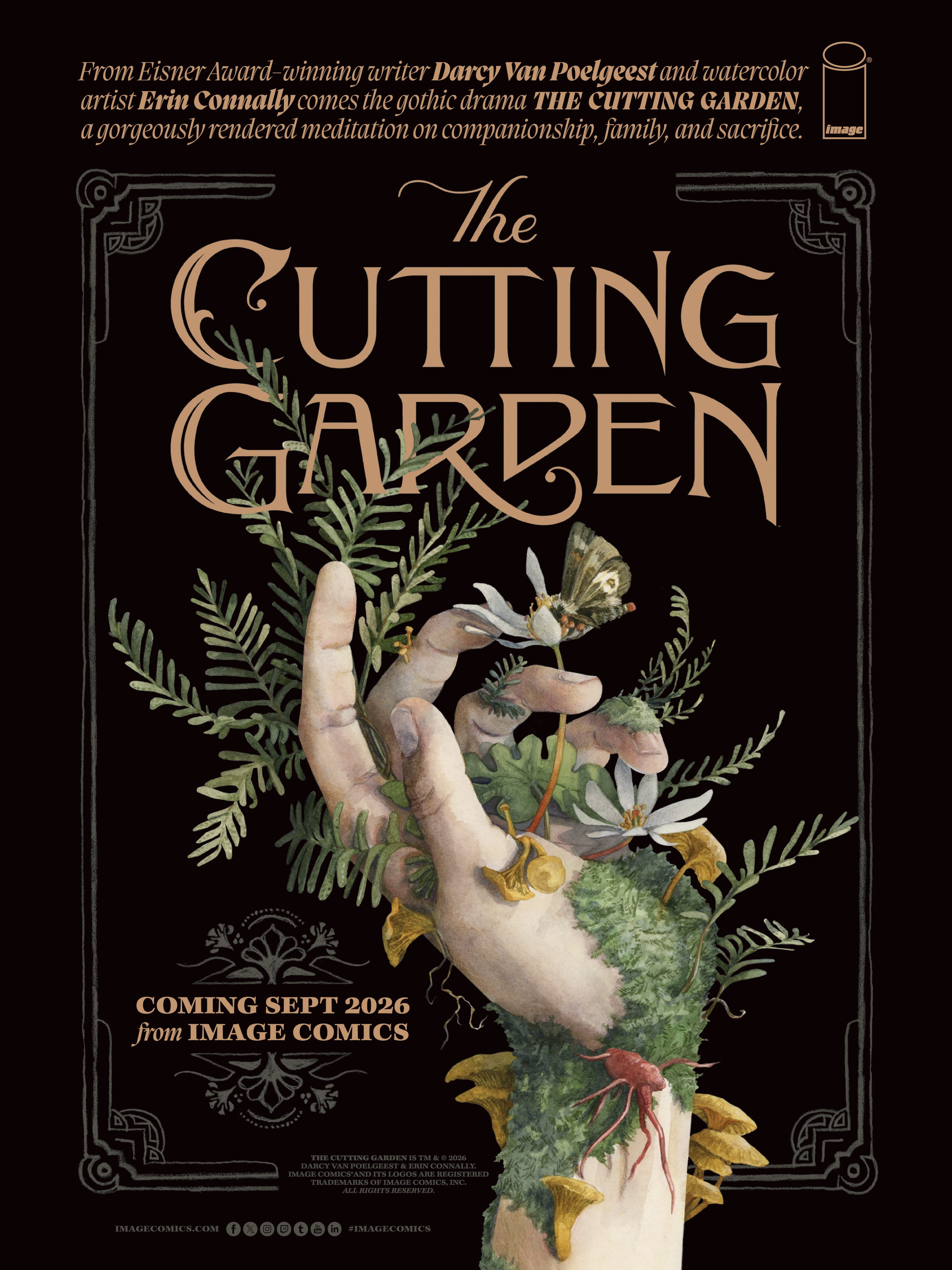
We’re starting with the BIG NEWS! My upcoming graphic novel, The Cutting Garden with artist Erin Connally, letterer Aditya Bidikar, and designer Ben Didier, is now available for pre-order!
We could not be more proud of this book and it’s going to be delivered in a gorgeous hardcover edition. The Cutting Garden comes out this fall, but if you pre-order in advance, it helps the publisher to know how many copies we need to print, and more importantly—guarantees you get a copy! If the initial orders are low and then demand spikes upon its release, it might be difficult or even impossible to get one. So please consider pre-ordering today from your local retailer or Amazon, Barnes & Noble, or Bookshop.org.
Below is a poster that Image Comics is sending out to a bunch of retailers to help promote the book. If you’re one of the shops or you see this in the wild, snap a pic—we’d love to see it on display!
Fan Expo Vancouver – Recap
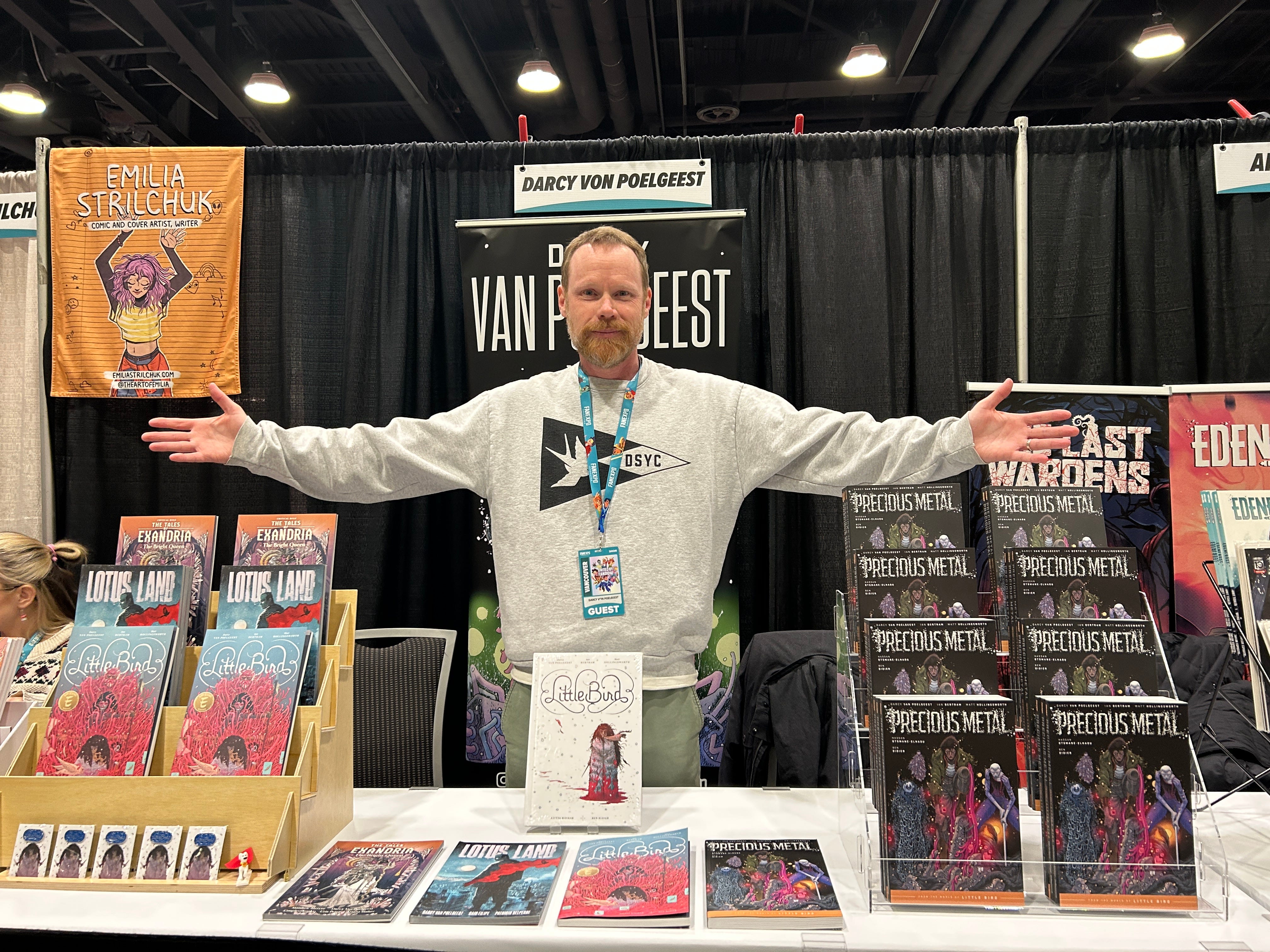
Another fantastic year at Fan Expo Vancouver. I brought as many books as I had on hand and sold out of nearly everything. The big seller this year was Precious Metal, and it was incredibly rewarding to talk about the book and sign copies for readers who had been patiently waiting to return to the world of Little Bird ever since Precious Metal was announced. The only thing I didn’t like about the show was the flu I came home with which laid me OUT for about four days. Here I am pre-sickness—ready to go!
Next up, Calgary Expo
My next appearance will be in Alberta at the Calgary Expo from April 23–26 at Stampede Park. See details here.
In this ongoing series called How I Make Comics, I reflect on my process and experience of making comic books in conversation with The Vanishing Word newsletter editor, Tania Reitsma. We invite you to subscribe, and share this with anyone who’s interested in following along!
Last month we talked about ideas—where my ideas come from, what it feels like to receive them, and how I decide on which ones to pursue. If you’d like to revisit that conversation, here’s the link: Q&A #2.
This time, our topic is outlining:
An example of my typical outline
Why I appreciate outlines
My definition of the “perfect outline”
Okay, let’s get started!
The Blueprint
TR: First off, what do your outlines look like? Can you show us an example?
DVP: Here’s a single issue outline I did for a series called Lotus Land, which came out from BOOM! Studios back in 2023.
This is pretty typical of what all my single issue outlines end up looking like, but it should be noted that I will write and rewrite them many times before they get to this stage. It’s chaos turned over and over until it becomes order.
The process is essentially making note of each major beat/scene, and then estimating how many pages each scene will need. This ensures that I don’t go into the script with too many ideas and can make it work within the agreed-upon page count for each issue.
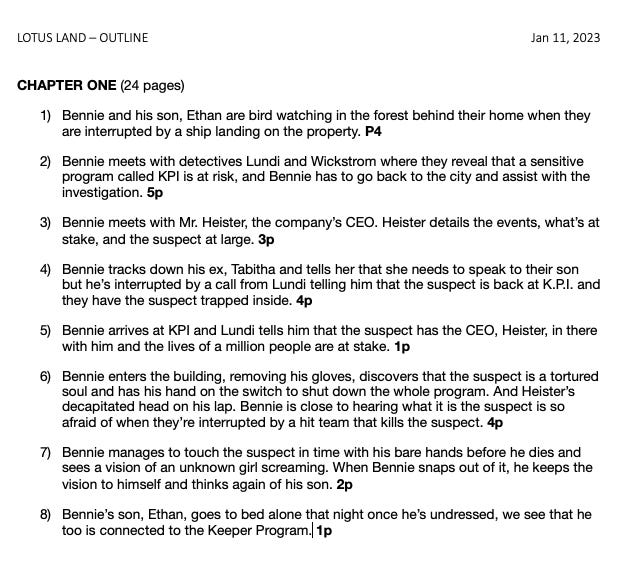
In the case of Lotus Land, I stuck very close to the outline in the final script, but more often than not, it changes more significantly between the outline and finished script.
TR: How does your outline help you write your story?
DVP: I can read the outline almost like a short poem without getting lost in all the details of a full script. Outlining gets the whole story in front of me in a way that’s simple to look at—a blueprint for the script.
As the ideas are still coming, I can adjust the story more easily. For example, if I want to shift a scene or pull out a moment that no longer seems interesting or relevant in the greater context of the story, I’m removing a sentence, not a five-page scene. And because I try to have each scene connect to at least two others, that keeps the whole house of cards from collapsing around me in the script stage. In my experience, most problems that come up in the scripting process could have been solved in the outline.
The Appreciation
TR: What are your feelings around outlining?
DVP: Getting my ideas into an outline is where I give my imagination a bit of a rest and tune into something that feels more like putting a puzzle together. It’s also where the story begins to take shape in a very rudimentary way.
In my development as a writer, I probably put off this stage the longest because it didn’t feel creative. But I realize now how wrong I was about that. It’s actually just a different kind of creativity.
It’s now one of my favourite stages in the process of writing as I’ve come to see it as working out a puzzle or a song. I have all these pieces in front of me—elements of plot, characters, shadows of tone, sketches of places and things, a certain kind of light in a certain kind of place—and they’re all beginning to find connection points in my head. At some point it becomes too big to hold all in my head. That’s when I know it’s time to start putting it all down in the language of scenes, starting with an outline.
The “Perfect” Outline
TR: What’s your definition of the“perfect outline” before moving onto the next stage? How do you know when you’re done?
DVP: This is such a great question, and I think it perfectly points out the problem I used to have with my approach to outlining.
I’m a perfectionist (by that I mean certifiably diagnosed) so my whole life has been a work in progress in terms of letting things go. This used to really bog me down at the outlining stage—trying to get it perfect. With self-awareness and effort over the years, my definition of the perfect outline has definitely evolved.
At first, I put too much emphasis on it. Spending too much time on the outline stifled the advancement of the whole writing process. I used to outline for months, but now I won’t spend more than a couple of weeks to get all the ideas down and move things around. I do it until things just feel right, then I cut myself off—no more second-guessing! This feeling is very difficult to explain. There’s no mathematical equation to arrive at. But I will keep working and reworking the outline until I hit that feeling, and as soon as I do, I’m moving on.
The easiest way to describe this visually is to think of a clay sculpture. The idea stage is like creating the clay, harvesting the physical material from the raw earth of your own experiences, feelings, and curiosities. Then the outline stage is playing with that clay until you see the rough shape of a face looking back at you. That moment when you see the face—that’s when I move on.
TR: How does it feel to play in the space of possibilities—knowing that your story will continue to change and evolve in the next stages?
DVP: It’s pure joy and excitement because I’ve worked it out. Nothing beats the feeling of looking at a “finished” outline and seeing that the story is there. I’m now free to go flesh out all the details in a script while continuing to be open to the unexpected ideas that excite me along the way.
TR: Thanks, Darcy, for showing us the magic of outlining. What topic will you tell us about in the next Q&A?
DVP: From outline, we move into the first draft of a script. This is kind of a big one, so we’ll break it into two parts. For me, the first draft is both the easiest and hardest stage of writing. But because I have an outline, I will not be forced to stare into the soul-crushing void of an empty page!
TR: From looking inward at the comic-creation process, let’s now turn our attention outward—to shine a light on our global community of comic shops!
In this section, our favourite comic shops get to give a little show-and-tell. This month, we’re visiting OK Comics in the UK with a message from Assistant Manager, Danielle!
Danielle: Founded by Jared Myland over twenty years ago, OK Comics is a small but perfectly formed bookshop in the beating heart of Leeds City Centre, UK. Located in one of the few historic arcades, OK has an undeniable charm. Specialising in comics, graphic novels, and manga, there’s something to be found for every reader—curated by comic readers, for comic readers.
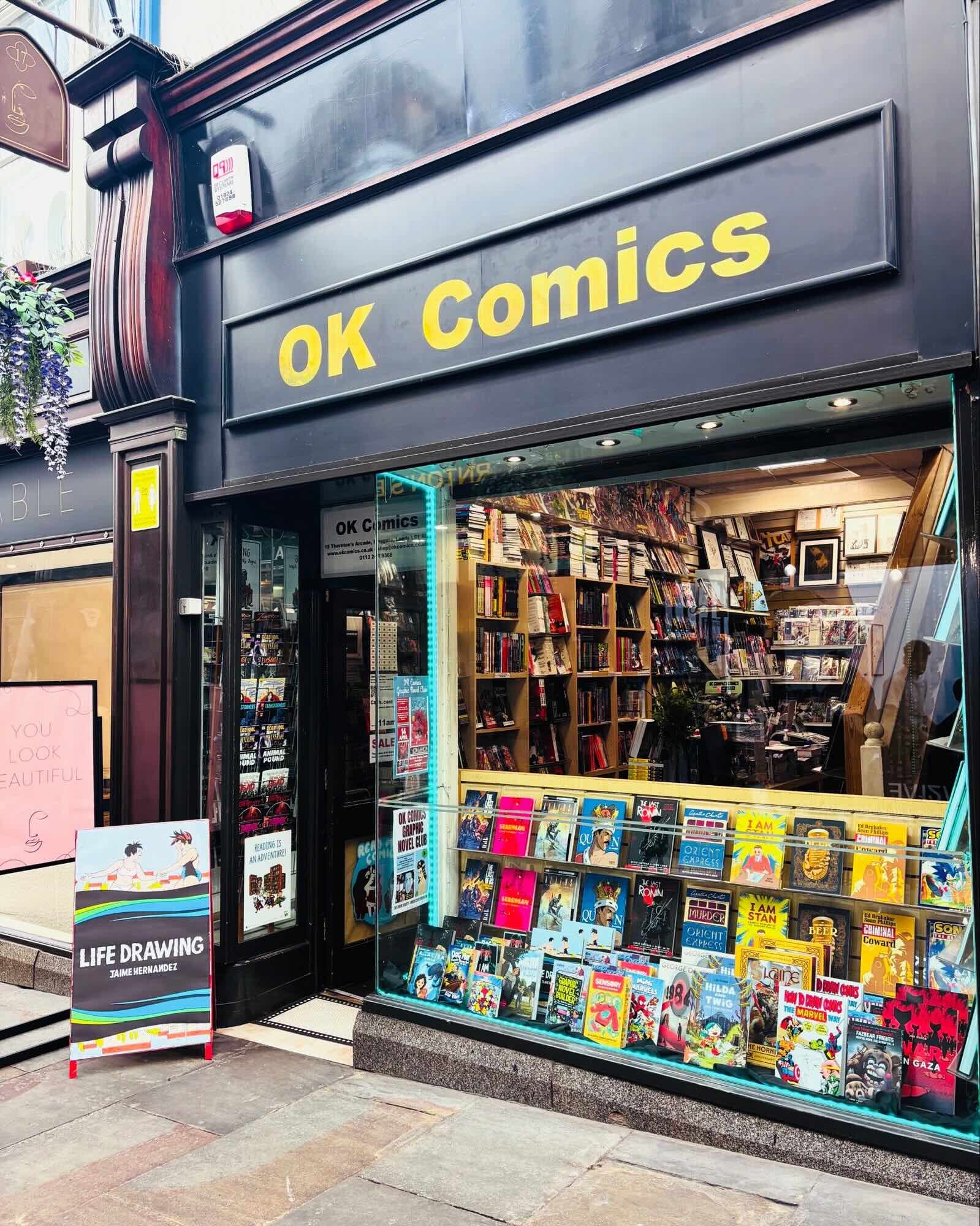
DVP: OK Comics was a very early supporter of my work and continues to be one of the biggest champions. I believe they were the first shop to ask for a bookplate prior to Little Bird’s release and have continued to do so for more recent work. And it’s not just their unwavering support that puts OK Comics at the top of my list for favourite comic shops—it’s their impeccable taste. It’s a relatively small shop so they put a lot of effort into curating their stock which means you really can’t go wrong. You could buy blindfolded and get a great book regardless. Just check out their window display!
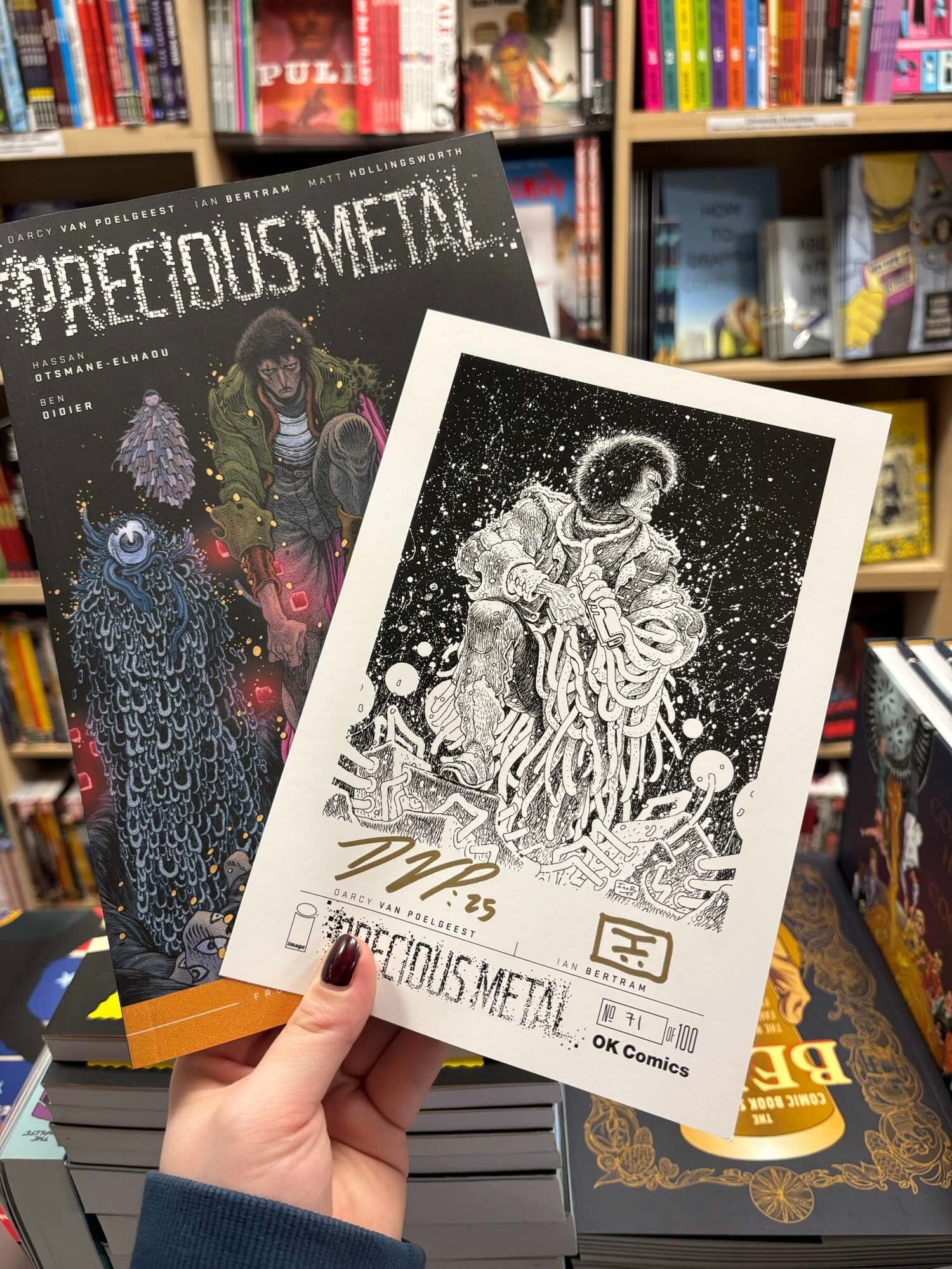
Below is our latest bookplate for Precious Metal, signed by me and Ian Bertram. They may even have a few left if you’re interested!
Remember to support your local comic shop whenever possible as they remain the lifeblood of this whole industry.
You can shop and learn more about OK Comics here!
Got a question or a thought to share about our discussions on The Vanishing Word? Send a reply! From time to time, we’ll share a message and answer it here!
TR: Alright, this time we got a question from our friend Randy, and it’s a good one!
Randy: Hey Darcy,
You mentioned that your ideas are influenced by experiences in your life. With something like Lotus Land, how important was it to ground the story in an environment that is authentic or familiar to you?
DVP: Hey Randy! Even though Lotus Land takes place in Vancouver, a city I know well, it’s so far in the future that there’s nothing much left that really resembles it today. So in terms of the location, it came down to capturing the mood and feeling of Vancouver. As well as having it rain in nearly every scene.
But when I talk about being influenced by experiences, I’m mostly thinking of emotional experiences. Even if I haven’t gone through what the characters are going though, there’s always something in my life that overlaps enough to get me inside of the experience emotionally. There’s a connection point I can draw from, giving me something unique to say and feel. With this in mind, I could set a story on the moon if I felt like I can empathize with the characters —and for me, that’s the authenticity I’m after. Thanks for the question!
Thank you for reading. Don’t forget to subscribe and share. Be kind to yourself – DVP
No posts
Comments
Nothing yet. Say the first thing.
Sign in to join the conversation.