
Hey! It’s me, Darcy! Welcome to the second issue of The Vanishing Word where I chat with newsletter editor, Tania Reitsma, about my process of making comics while keeping you up to date on anything new and exciting.
In this issue:
What’s New? – Calgary Expo (April 23–26, 2026) & A Sneaky Award
How I Make Comics Q&A #2 (of 12) – Ideas
Comic Shop Spotlight – Challengers Comics + Conversation
Mailbag – Ask Me Anything!
Conventions in 2026
Calgary Expo just announced its guests and you’ll never guess who they’ve invited for the first time! Okay fine, it’s me.
I’m very much looking forward to it as I’ve heard nothing but great things about this show. After years of hearing from readers all over Alberta, I’m hoping to finally meet some of them in person at the event from April 23–26 at Stampede Park. See details here.
By the way, if you missed my announcements from the previous issue, just a reminder that I will also soon be appearing at Vancouver Fan Expo from February 14–16.
Nowa Fantastyka Award (2022…?)
In other news, we just learnt that Little Bird won the Nowa Fantastyka Award for Best Foreign Comic...in 2022. It’s a comic/literary award handed out in Poland for works in sci-fi and fantasy (I think?). So that’s cool. If I had a time machine, I’d go back and give an eloquent acceptance speech.
But since it’s been four years, I’ll keep it simple: “Dziękuję, Poland!”
In this ongoing series called How I Make Comics, I reflect on my process and experience of making comic books in conversation with The Vanishing Word newsletter editor, Tania Reitsma. We invite you to subscribe, and share this with anyone who’s interested in following along!
Last month, I introduced the purpose of breaking down my steps and sharing my thoughts about my creative process. If you need to catch up, here’s the link: Q&A #1 .
In this issue, we jump into the first official and most amorphous topic that we’ll be covering in this series—ideas.
Where do my ideas come from?
My experiences of “receiving” ideas and choosing to pursue them
How I create time and space for ideas to come into the light
The Source
TR: Okay, Darcy, to begin this exploration—where do your ideas come from?
DVP: This is an interesting question, and one that I intentionally don’t think about too much. That being said, here’s my best guess:
I believe all my ideas come from within me. They’re built from experiences in my own life and wait patiently to be plucked from my subconscious mind. So when I “receive an idea”, it’s actually an existing idea, finding a connection point with the outside world. Sort of like lightning finding the path of least resistance before striking earth. Things have to align, internally and externally. This is true of story ideas, but it’s true of smaller ideas too—images, sounds, a line of dialogue. They’re all little strike points between the subconscious mind and the world around me.
I think this is why the feeling of “getting a good idea” is so potent and overwhelming, because you’re releasing something or providing an escape route—perhaps for something that’s been building in the subconscious mind for a very long time.
I’m open to receiving ideas, but not actively searching for them. The key is to “just be”—and the idea will find me. Like in birdwatching, you need to relax, be in the right place, and be ready without expectation. In some cases, the more you look, the harder it is. But if you’re simply observing the natural world around you, just admiring it for what it is, before you know it, you look up and there’s the yellow-throated warbler, obscured by the bramble but it’s there—and you can’t believe that such a beautiful thing has been inside you this whole time.
TR: It sounds like certain elements responsible for bringing out ideas are not always within our control—time, location, life events. If an artist feels frustrated or experiences self-doubt due to a “creative block”, do you think it would help them find peace by viewing ideas through the perspective you’ve just explained?
DVP: Maybe, yes. I think if ideas aren’t coming to you, or at least not the kinds of ideas you’re hoping for, then perhaps you’re not being honest with yourself in some way. I’d suggest turning everything off, including your influences, and just sitting somewhere in nature where you’re forced to face yourself instead of a device. Don’t be afraid to be alone.
The Materialization
TR: I can’t agree more regarding the value in being alone, and how often we forget to look inward first, or avoid doing so because it can be extremely uncomfortable. So starting from looking inward, can you take us through how some of your ideas have materialized into published works?
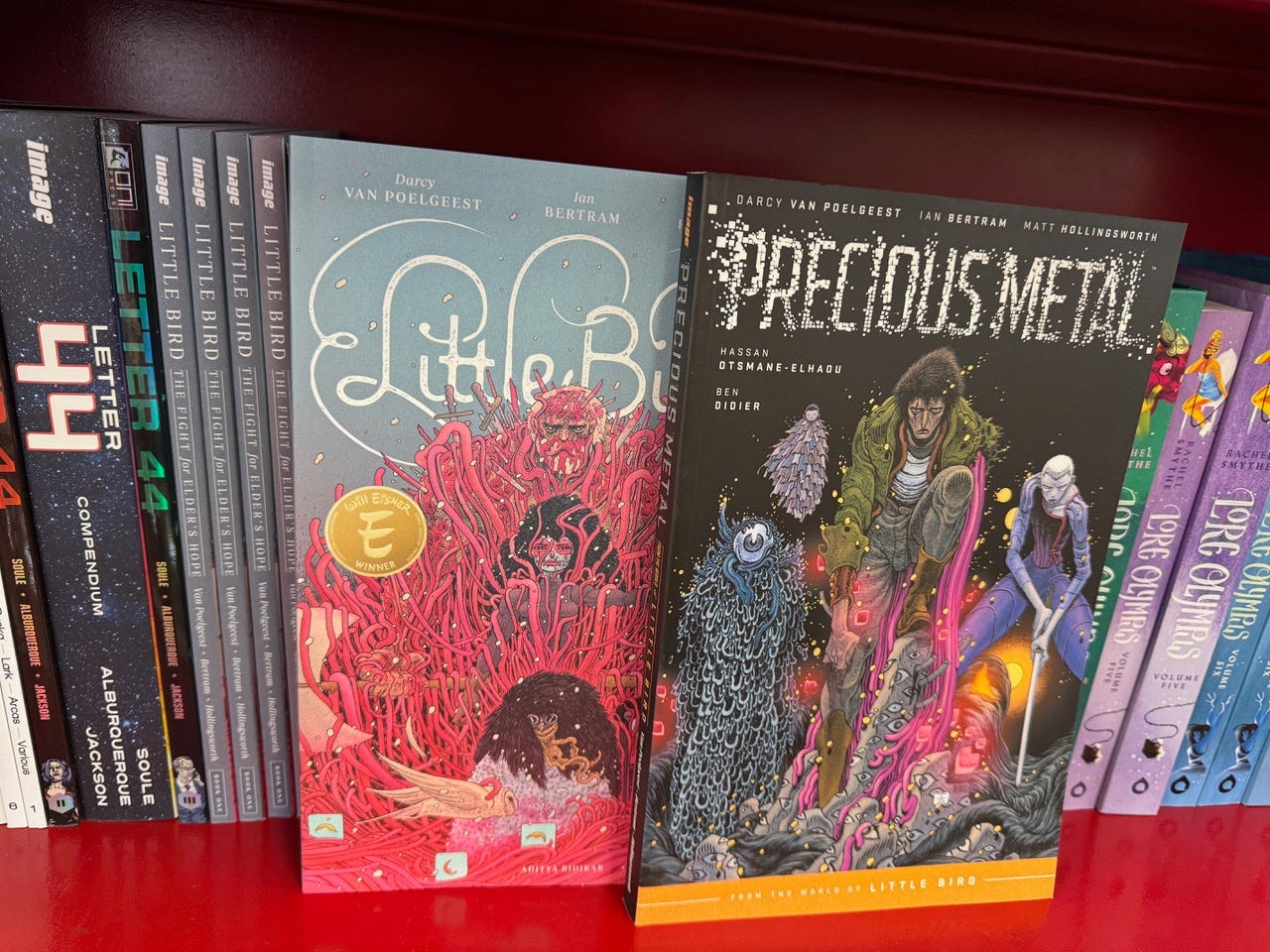
DVP: It’s really difficult to give an example of an idea because it’s so amorphous in a way, but if we take Precious Metal, there were a few things that really came from inside me—purely.
The first thing I recall was this idea of memories causing pain in a way that we most often attribute to physical objects, so I began to think of them like that—memories as objects that we are more or less constructed from. That basic idea was creeping up from my subconscious, and when I was thinking about that character Sarge (Max Weaver) from Little Bird, it found its striking point—the idea of a broken father, held back by his own failures, and how his lack of memories played into that. So I took that as the initial concept and started exploring the past of the character Sarge (Max Weaver) from the same universe as Little Bird, and good ideas, ideas from within, attract more ideas so it just snowballed from there.
TR: Clearly, pursuing those ideas for Precious Metal worked out for you and proved to be worthwhile. In general, how do you discern a good idea from a bad idea?
DVP: The question of a good idea versus a bad idea is difficult because in a way there’s really no such thing as a bad idea. It’s more a matter of how sticky that idea is. A “good” idea, for me, is simply one that just won’t go away. I’m of the mind that I can make any idea work if I feel connected to it.
I used to write down all my ideas, but now I write them down less and less—embracing and trusting my forgetfulness. If I forget it, it doesn’t really matter how “good” of an idea it was. It wasn’t the right one for me.
Once the ideas begin to coalesce and grow to a size and weight that makes it feel as though my head is going to explode, I know it’s time to start writing things down.
The Fear
TR: Are you ever hesitant or afraid to pursue an idea? What holds you back?
DVP: Fear is a terrible and debilitating thing in any art form. It’s really the death of ideas—the anti-idea machine. Occasionally I’ll have the very rational fear of something being taken out of context, or me being personally judged by others, but it’s important to push through that.
I’d rather commit to an idea that I’m afraid of and have it fail, or be misjudged in my intent, than give into that fear. Fear produces mediocrity in all art forms, so accepting the fear and the failures is something I’ve had to come to terms with.
The Preservation
TR: Remember those good ol’ days before social media, streaming services, or the internet itself? With more “content” being thrust in our faces than ever before, how do you preserve your creative mind from being corrupted by useless external stimulus?
DVP: I get as distracted as the next person but in the distracted state, there are usually no ideas there, or if there are, they’re someone else’s. Imagine dedicating three or four years to an idea that isn’t even really yours. Sounds like hell to me! So I like to sit with myself to allow my own ideas to come forward. I take a lot of walks, and try to get up before the rest of my family does so I can just have coffee by myself and stare out the window for a while. Any time I spend daydreaming, whether it’s looking at the leaves on a tree, or the pattern of waves, or just sitting—I begin to look inward. The images become a reflection of my own ideas.
I’m also generally not drawn to current trends, or pop culture, so I’m sort of free to spend more time reflecting and sorting through my own observations and obsessions as opposed to being dragged along by whatever happens to be trending. I do love to read and watch movies, and I’m inspired all the time, but for me, it can be dangerous to spend too much time with new things. And when it comes to reading, specifically, it takes quite a bit of effort due to being dyslexic, so I pick and choose carefully. Whatever void this creates, in terms of external entertainment, I make up for by mining my own thoughts, diving deeper within myself.
The Posture of Openness
TR: Does your openness to receiving ideas apply throughout your entire comic creation process? Are there steps along the way that are more ideas-driven versus other steps that are more technical or routine?
DVP: There’s no controlling ideas—again, they find us, not the other way around—so even as I get into the technical or more routine-driven parts of writing I’m still continually receiving ideas. That’s another challenge altogether, because I want to remain open to new ideas without deviating from the story that’s developing in front of me. I’ve learnt over the years how to stay open to the constant stream of ideas without being swept away in the current, but it takes practice.
TR: Man, for a topic that you say you don’t think about too much, you’ve done a decent job at illustrating your personal definition of ideas. I’m curious how this resonates with our readers. Note to readers: Feel free to reply with your comments!
Looking ahead, what topic will we get to swim around in next time, Darcy?
DVP: Next month we’re going to talk about outlining—the process of transferring all those ideas into scenes, and then organizing them in such a way that a story begins to emerge!
TR: Okay, enough about making comics, now let’s turn our attention to comic shops—the amazing in-person experience-makers and community-builders for comic book lovers and new discoverers of the medium.
In this section, our favourite comic shops get to give a little show-and-tell. This month, we’re visiting Challengers Comics + Conversation in Chicago, with a message from Co-owner, Patrick Brower!
Patrick: Challengers Comics + Conversation strives to prove that the best thing about being in a comic book store—is being in a comic book store! With a combined 65+ years of comic retail experience, Co-owner W. Dal Bush and I endeavor to bring Chicago a full-service, technologically interactive comic store that has the same level of wonder and enjoyment as the comics we sell. And read. And talk about. And champion. For the younger readers (and soon-to-be-readers), we also have Sidekicks, a place for young Challengers. Sidekicks is a dedicated space connected to Challengers with books and fun for all ages. If you’re ever in the area, pop into our award-winning store or explore online!
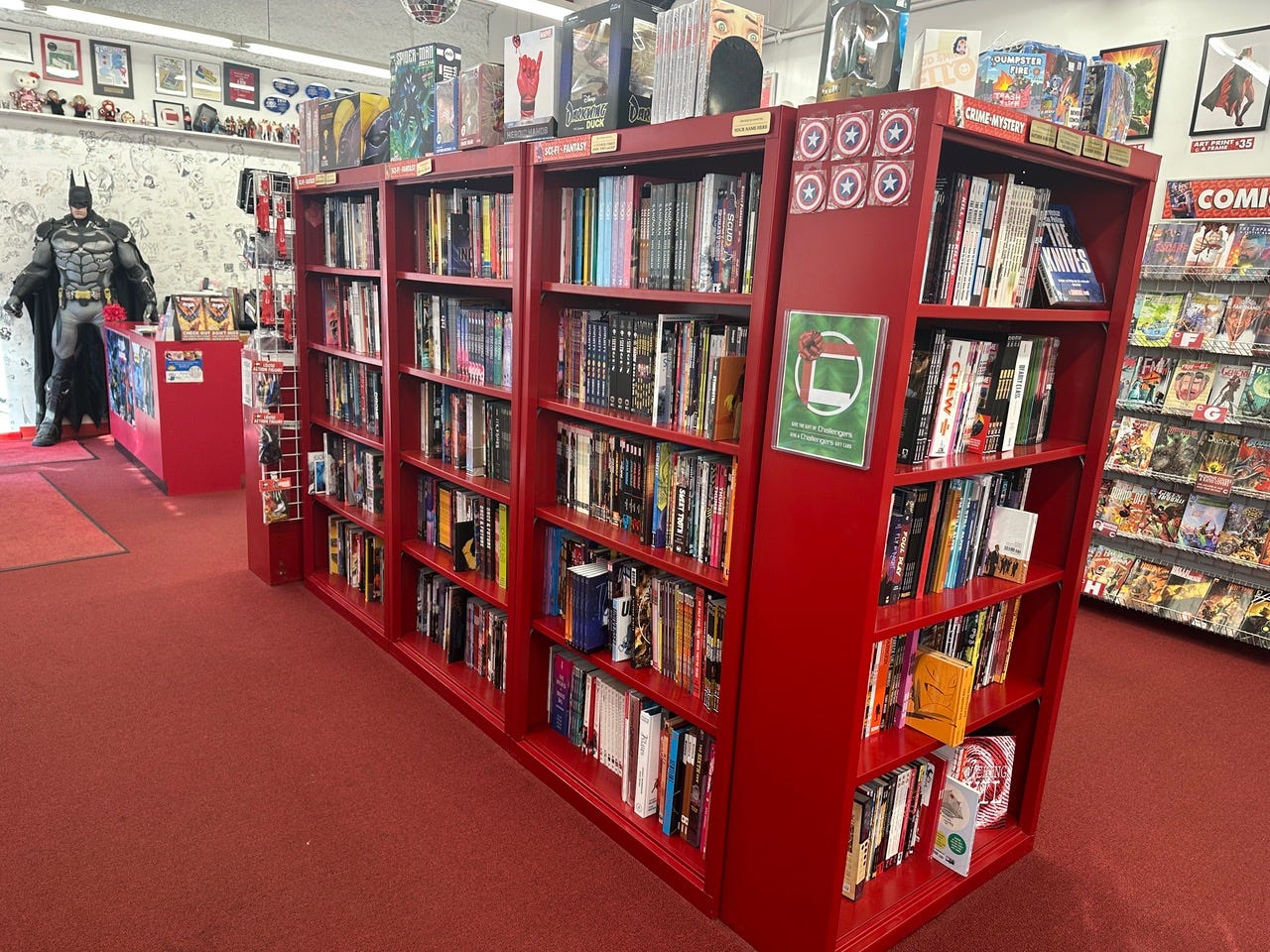
DVP: I’ll never forget my introduction to Challengers Comics + Conversation in Chicago because it’s forever linked to my first published work. When Little Bird was first set to launch from Image in 2019, Challengers reached out with a really unique and fun idea of how they could help get readers on board with this strange new series from a couple of relatively unknown creators. They wrangled another great shop (whom, we hope to feature in the future), All Star Comics in Melbourne, Australia and together they decided to have a Little Bird sales battle!
It was a ton of fun to watch this play out at a distance, and it gave the book a big, early boost while playing an important part in helping launch my career in comics. For this I’ll always be thankful. Thanks, fellas!
Just a reminder to support your local comic shop whenever possible as they remain the lifeblood of this whole industry. And many of them offer something that you simply cannot get online—a community of people passionate about comics!
You can shop and learn more about Challengers Comics + Conversation here!
AMA!
Got a question or a thought to share about our discussions on The Vanishing Word? Feel free to send a reply! From time to time, we’ll pull from the virtual mailbag, share a message, and answer it here!
Thank you for reading. Don’t forget to subscribe and share. Be kind to yourself – DVP
No posts
Comments
Nothing yet. Say the first thing.
Sign in to join the conversation.